LTOE SERIES · OCTOBER 7, 2026 · COMPANION — INTERPRETIVE / NON-EMPIRICAL
The Spiral Staircase: A Companion to Order Under Coherence
Colson Alexander Lake · Halifax, Nova Scotia · Draft companion · version 7 · not sealed · no DOI
Abstract
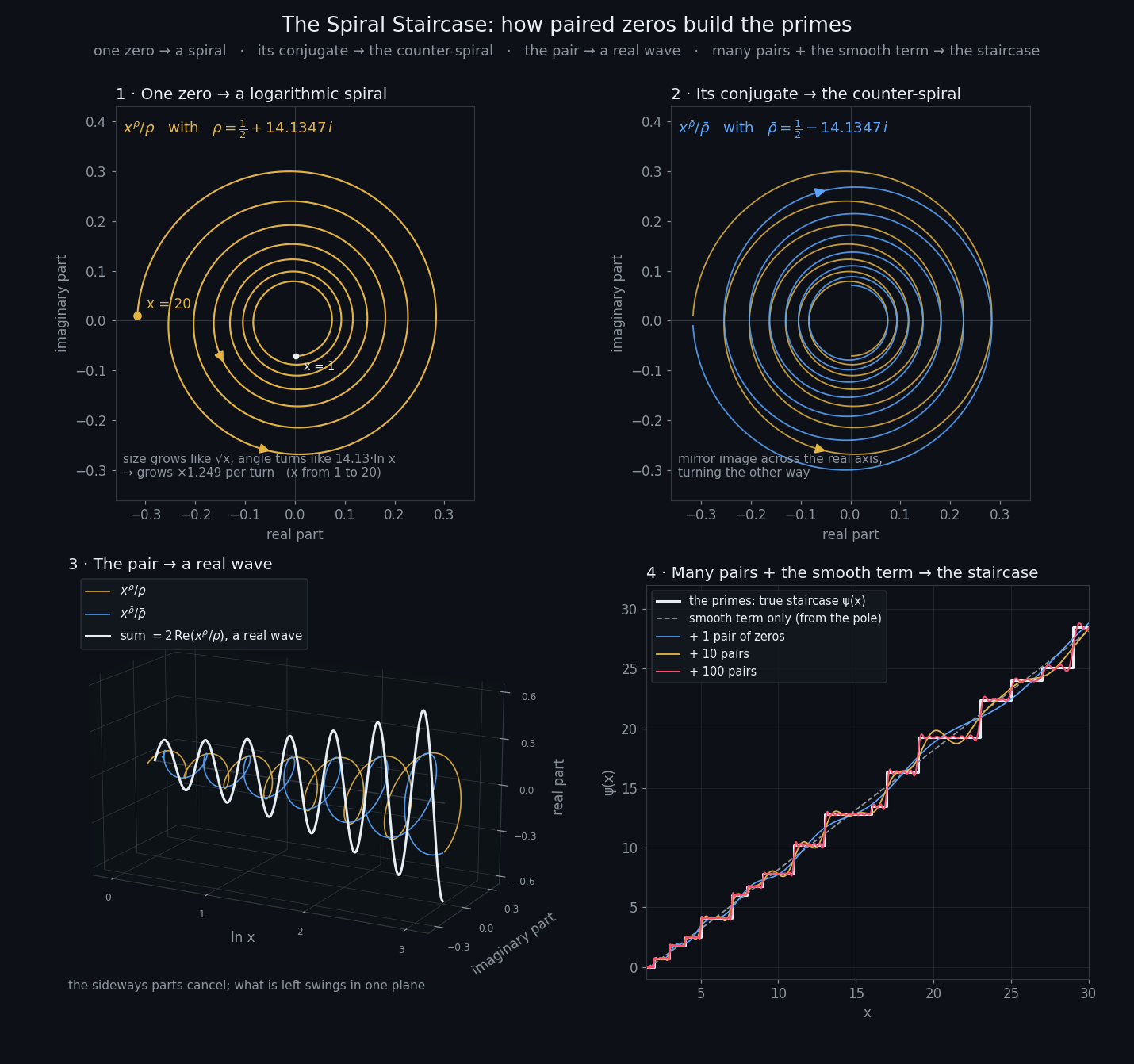
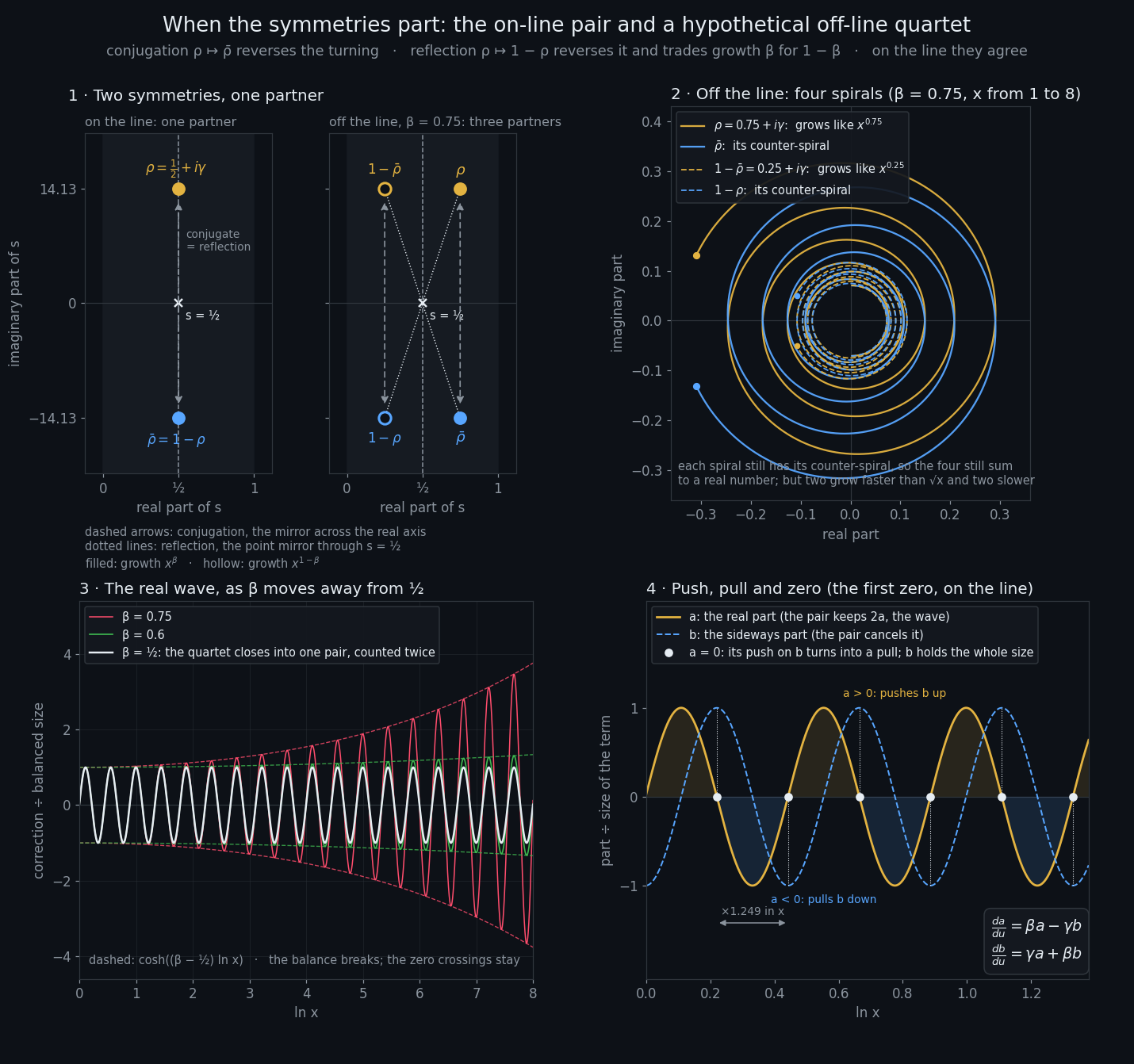
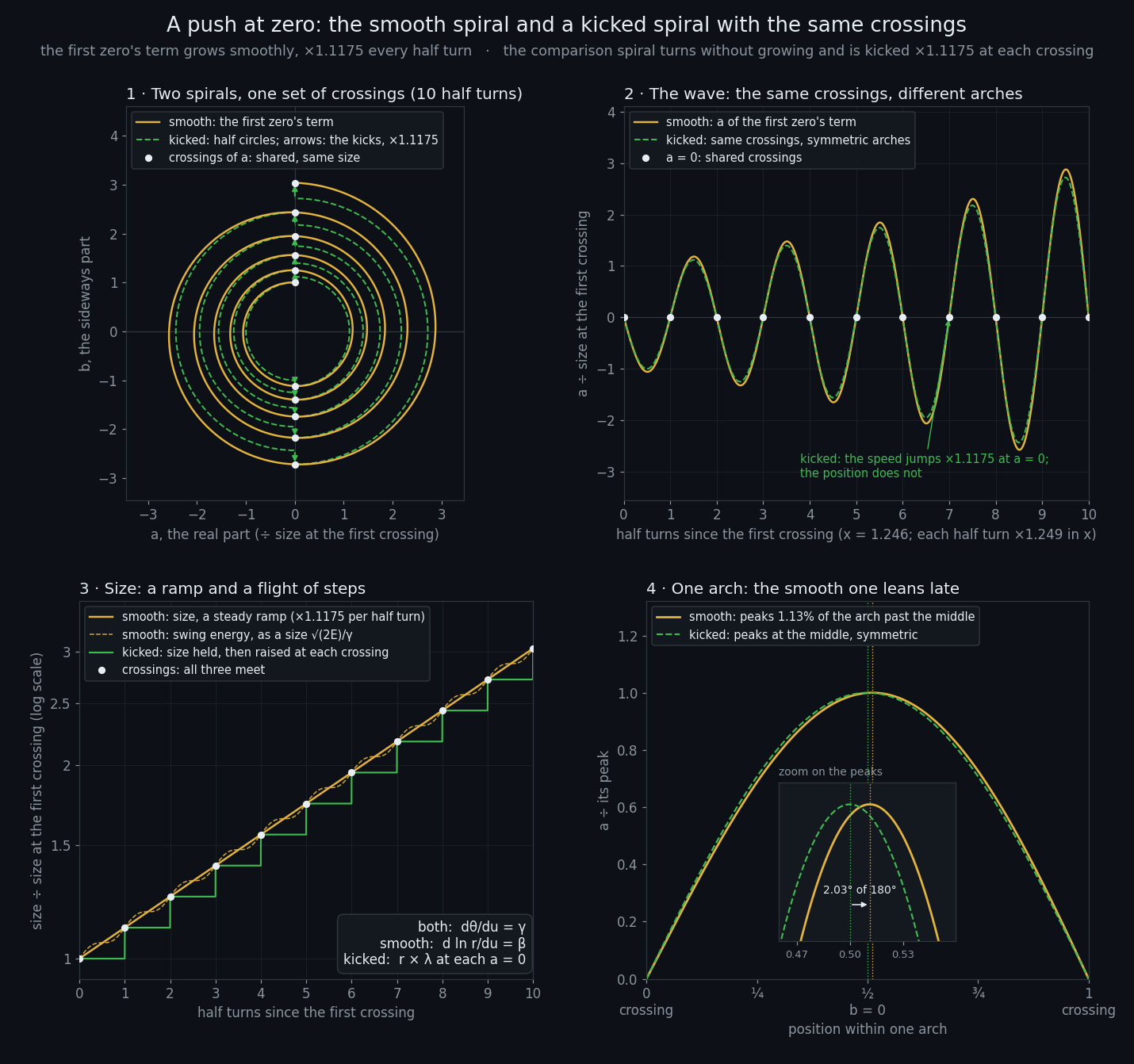
Figure 1 of Order Under Coherence rebuilt the prime staircase from the zeros of the zeta function. Colson described it as a golden spiral made into a staircase, a metaphor for a measurement and its inverse: opposed, separated, and held together around a central median. This companion opens the construction and shows that structure in the mathematics. Every zero on the critical line adds an exact logarithmic spiral. Its conjugate adds the mirror-image spiral, turning the other way, and the pair sums to one real wave. The waves of many pairs, added to a smooth climb, build the staircase. Two symmetries stand behind each pair, and they agree only on the critical line; a quartet of zeros placed off the line by hand shows what changes when they part: the balance of growth breaks, and the rhythm survives almost exactly. Inside each spiral, its two parts set each other's velocities with opposite polarity, and each zero crossing of the wave is where a push turns into a pull. A spiral built only for comparison, turning without growth and kicked larger at each crossing, matches every crossing and differs in between: the crossings keep the rhythm and the growth per half turn, and lose where within each half turn the growth happens. A technical section traces two of these features, how far each arch leans and when the push peaks, to one angle, the spiral's pitch; how far the quartet's crossings can move follows from the same pitch rule, applied at an effective real part that drifts with x. The construction demonstrates known identities; it is not new evidence. Figure 3 draws it from the first 100 zeros; Figure 4 shows the symmetries parting; Figure 5 sets the smooth spiral beside the kicked one.
I · THE METAPHOR
On October 7, 2026, looking at Figure 1 of the original paper, Colson described the rebuilt staircase as a golden spiral made into a staircase. The phrase was a metaphor, not a reference to the golden ratio. Later that day he described the structure it named:
I was using it as a metaphor label for a measurement and its inverse measurement almost like opposite polarities working against each other, but pulled together through their own separation under coherence, almost like they're magnetized to a central median. Again, that could also be metaphor, but I'm trying to describe their structure. I wasn't specifically devoting the golden spiral staircase to being a scientific derivation.
The mathematics has that structure. Each zero on the critical line, ρ = ½ + iγ, has one counterpart, ρ̄ = ½ − iγ: its conjugate and, on the line, also its partner under the functional equation's symmetry s ↦ 1 − s (Sections III and VI). The two contribute spirals turning in opposite directions, and together they leave one real wave whose rhythm, γ, is half their separation, 2γ. Every such pair is centered on the same point, s = ½, on the line that runs down the middle of the critical strip. Whether the spirals are golden is a separate question, raised afterward and answered in a side note (Section XI).
II · ONE ZERO, ONE SPIRAL
The explicit formula, sketched by Riemann in 1859 and proved by von Mangoldt in 1895 in this form, writes the prime staircase ψ(x), which climbs by ln p at every prime power p^k, as a smooth climb minus one term for each nontrivial zero ρ:
ψ(x) = x − Σ_ρ x^ρ/ρ − ln 2π − ½ ln(1 − x^(−2)) — for x > 1 not a prime power, with the zeros summed in conjugate pairs in order of height; at a prime power the right-hand side gives the midpoint of the step
The sum over ρ is a limit. Add the terms of the zeros whose heights lie between −T and T, which keeps each conjugate pair together, and let T grow without bound: the formula holds exactly in that limit (von Mangoldt, 1895; Davenport, 1980, Chapter 17; Montgomery and Vaughan, 2007, Chapter 12). Stopped at a finite height, the sum leaves a remainder. The staircases drawn here, from 1, 10 and 100 pairs, are such finite sums: numerical approximations to the formula, not the formula itself. This companion states no general bound on that remainder; the agreement reported in Section IV is numerical, at the two points it names.
Take one zero on the critical line, ρ = ½ + iγ. Since x^ρ = √x · e^(iγ ln x), its term is
x^ρ/ρ = (√x / |ρ|) · e^(i(γ ln x − arg ρ))
As x grows, the term's size grows like √x while its angle turns like γ ln x. Measured in ln x, the size grows exponentially while the angle turns at a steady rate, which is the definition of a logarithmic (equiangular) spiral: every full turn multiplies the size by the same factor.
growth per turn = e^(π/γ) — a full turn takes x a factor e^(2π/γ) further, and the size grows as its square root
For the first zero, γ = 14.1347, each turn multiplies the size by 1.249 while x grows by a factor of 1.560. For the 100th zero, γ = 236.524, the factor is 1.0134. Higher zeros wind ever more tightly, and each of them is a spiral.
III · THE COUNTER-SPIRAL AND THE PAIR
Zeros come in conjugate pairs: if ρ = ½ + iγ is a zero, so is ρ̄ = ½ − iγ. The conjugate zero's term is the complex conjugate of the first: the mirror image of the spiral across the real axis, turning the other way. Two complex conjugates always add to a real number, so the pair contributes one real oscillating term, a wave:
Its amplitude grows like √x, and it swings evenly in ln x with period 2π/γ. The two spirals do not erase each other. They constrain each other: their sideways parts cancel, and the real wave survives, the one part of the pair that reaches the staircase.
On the critical line the conjugate is also the zero's partner under the functional equation, because 1 − ρ = ½ − iγ = ρ̄ exactly when Re ρ = ½. Equivalently, reflecting across the line (s ↦ 1 − s̄) leaves an on-line zero where it is: it is its own reflection, standing alone on the axis as Section I of the original describes. Its one partner is its conjugate, and that partner turns the spiral the other way.
IV · THE STAIRCASE
Sum the waves. The smooth part, x − ln 2π − ½ ln(1 − x^(−2)), supplies the climb; its main term, x, comes from the pole of the zeta function at s = 1. Each pair of zeros then adds one wave. A few pairs give a wavy ramp. As pairs accumulate, the waves reinforce at the prime powers and cancel between them, and the ramp sharpens into the staircase.
Figure 3 — The Spiral Staircase — how paired zeros build the primes. Panel 1: the term of the first zero, ρ = ½ + 14.1347i, from x = 1 to 20, a logarithmic spiral growing 1.249 times per turn. Panel 2: the conjugate zero's term, its mirror image, turning the other way. Panel 3: both terms wound around the ln x axis; their sum (white) swings in one plane, a real wave growing like √x. Panel 4: the smooth term alone (dashed) and with 1, 10 and 100 pairs of zeros added, against the true staircase ψ(x) (white). Computed October 7, 2026 (mpmath, zeros to 25 significant digits; method and code in the Appendix).
With 100 pairs, the rebuilt staircase follows the true ψ(x) closely between the steps: 7.835 against 7.832 at x = 10.5, and 19.221 against 19.266 at x = 20.5. A sum of smooth waves cannot jump, so at each step it rises steeply through the middle of the step, and the rise grows steeper as pairs accumulate, though not with every added pair.
V · BALANCED GROWTH
Every wave from a zero on the critical line grows at the same rate, √x. A zero off the line would break that balance. If ρ = β + iγ with β ≠ ½ were a zero, its twin 1 − ρ̄ = (1 − β) + iγ would straddle the line at the same height, and each would bring its conjugate: two waves instead of one, growing like x^β and x^(1−β) (Section VII draws such a quartet). The larger would outgrow every wave on the line. The hypothesis, that no such twins exist, is equivalent to the staircase staying within about √x of its smooth climb:
ψ(x) = x + O(√x · ln² x) — this bound holds if and only if every nontrivial zero lies on the critical line; von Koch (1901) proved that the hypothesis implies it
Under the hypothesis, every nontrivial zero has real part ½, so every term of the explicit formula has the same radial growth exponent: each grows like x^(1/2). In the language of the figure, every spiral pair grows at one balanced rate, and none outruns the rest.
VI · TWO SYMMETRIES, ONE PARTNER
Section III used a coincidence that deserves a closer look. A nontrivial zero has two mirror relations, and they are different operations.
Conjugation, ρ ↦ ρ̄, mirrors a zero across the real axis. It holds for every zero, because the zeta function is real on the real axis, and it gives each spiral its counter-spiral: it reverses the turning and keeps the growth. Reflection, ρ ↦ 1 − ρ, comes from the functional equation. It mirrors a zero through the point s = ½: it reverses the turning too, and it trades the growth x^β of a zero ρ = β + iγ for x^(1−β). The critical line is the median of every reflected pair, halfway between β and 1 − β; the original's table calls it the 'common ground of indifferences'. The two operations agree on that line only:
1 − ρ = ρ̄ exactly when Re ρ = ½ — (1 − β) − iγ equals β − iγ only when β = ½
On the line, the counter-spiral and the mirror partner are the same zero, and each zero has exactly one partner. Off the line they would be different zeros, and each zero would bring three partners: the quartet β ± iγ, (1 − β) ± iγ. With the pairing symmetry named, the whole construction runs:
spiral ↺ → counter-spiral ↻ → the symmetry that pairs them → one real wave → many waves + the smooth climb → the staircase — the pairing symmetry is conjugation; on the critical line it is also the reflection
VII · WHEN THE SYMMETRIES PART
What changes when the two symmetries part? No zero is known off the line, and the first zero lies on it, so the question can only be asked with zeros placed by hand: a quartet at the first zero's height, γ = 14.1347, with real parts β and 1 − β. Figure 4 draws it.
Conjugation still pairs every spiral with its counter-spiral, so the sideways parts still cancel and the quartet still leaves a real correction:
But the correction is now two waves, one growing like x^β and one like x^(1−β). At β = ½ the four terms close up into two, and the quartet is the on-line pair counted twice, with the balanced size 4√x/|ρ|. Away from ½ the balance breaks. Divided by that balanced size, the quartet's swing follows
swing ≈ cosh((β − ½) ln x) — to within 0.1% for the values drawn; exactly 1 when β = ½
It stays at 1 only on the line. Off it, the quartet's own swing grows without limit against the balanced size; Section V gives what that would mean for the whole staircase. By x = e^8, about 3000, it is 1.34 times the balanced size for β = 0.6 and 3.76 times for β = 0.75.
The rhythm survives almost exactly. The amplitude answers to β, through the cosh; the phase answers to γ, which both waves share. β enters the phase only through each wave's fixed offset, arg(β + iγ) or arg(1 − β + iγ), and through how much each wave weighs. So the quartet's wave crosses zero almost exactly where the on-line pair's does: for β = 0.75 the crossings come earlier, by less than 0.6% of the spacing between them (0.03% near x = 1, where the two waves weigh almost equally, and 0.54% by x = e^8, as the faster-growing one takes over). At this height, anywhere in the strip off the line, a crossing above x = 1 comes earlier, by up to 1.12%, a limit approached but never reached. Section X derives these numbers with the weights included.
Figure 4 — When the symmetries part — the on-line pair and a hypothetical off-line quartet. Panel 1: the two symmetries. On the line, the conjugate of ρ = ½ + iγ is also its reflection 1 − ρ, so it has one partner; off the line, at β = 0.75 (placed by hand), conjugation and reflection give three different partners. Panel 2: the quartet's four spirals for x from 1 to 8. Two grow like x^(0.75) and two like x^(0.25), and each keeps its counter-spiral. Panel 3: the quartet's real correction divided by the balanced size 4√x/|ρ|, for β = ½, 0.6 and 0.75, with cosh((β − ½) ln x) dashed. Off the line the swing grows, while the zero crossings stay in step. Panel 4: the first zero's term in its two parts, each divided by the term's size. At every white dot a = 0: a's push on b turns into a pull, and b holds the whole size. Computed October 7, 2026 (mpmath; method and code in the Appendix).
What conjugation guarantees, a real wave, survives the split, and so, almost exactly, does the rhythm: each pair still turns at γ, and the quartet's combined wave turns up to 0.031% faster than γ for β = 0.75, fastest near x = 1, where the two waves weigh almost equally (Section X). What the line adds, equal growth for a zero and its reflection, is lost. When the two symmetries coincide, one partner does both jobs.
VIII · PUSH, PULL AND ZERO
The opposing forces propel the opposing forces' motion. Push and pull, like reciprocated feedback of opposite polarity.
The terms of the explicit formula are not physical forces, but the structure these words describe is exact inside every spiral. Measure along u = ln x. A zero's term w = x^ρ/ρ = e^(ρu)/ρ changes at the rate dw/du = ρw. Written in its real and imaginary parts, w = a + ib, with ρ = β + iγ, that one rule becomes two:
da/du = βa − γb, db/du = γa + βb
Each part feeds itself at the rate β, and each is coupled to the other at the rate γ with opposite polarity: a feeds b's rate of change with its own sign, and b feeds a's with the opposite sign. The coupling sets velocities, the rates of change, not forces. Written by size and angle, w = r e^(iθ), the same rule separates into two independent ones:
d ln r/du = β, dθ/du = γ — the size grows at the rate β and the angle turns at the rate γ, each on its own
The opposed coupling turns the spiral; the self-feed makes it grow. The conjugate zero runs the same loop with γ reversed, and turns the other way.
Feedback and cancellation are different steps. The cancellation happens between the two spirals of a pair: their sideways parts, b and −b, sum to zero, and the staircase receives only the real wave 2a. The feedback happens inside each spiral, and it keeps the cancelled part at work: the wave's rate of change, βa − γb, depends on b. Across the pair, the same loop links what the two spirals share, their sum, with how they differ, the difference that never reaches the staircase.
Maybe 0 is the resetting point of the numerical feedback loop in the spiral.
The word zero names three different things here. The point s = 0 mirrors the pole at s = 1 under the reflection s ↦ 1 − s; there ζ(0) = −½, and in the explicit formula this point contributes only the constant term −ln 2π. The nontrivial zeros ρ lie in the critical strip; the computed zeros drawn in this companion lie on the critical line, which runs through s = ½, the one point the reflection leaves in place, and only the quartet of Figure 4, placed by hand, is drawn off it. The third is the zero crossing of a pair's wave: a value of x where the wave passes through zero.
Read as the third, this idea also has an exact counterpart, drawn in Panel 4 of Figure 4. The wave (2√x/|ρ|) · cos(γ ln x − arg ρ) is zero once every half turn of the spiral, evenly spaced in ln x, a factor 1.249 apart in x for the first zero. At every crossing a = 0, the whole size of the term sits in b, and a's share of b's velocity changes sign: before the crossing a pushed b one way, after it a pulls b the other. The two parts take turns a quarter turn apart: four hand-offs per turn, two where a crosses zero and b holds the whole size, and two where b crosses zero and a holds it. Every crossing finds the loop in the same configuration, up to sign and size: a at zero, b at full size, a little larger each time. Nothing stops at zero; the direction of a's push turns over, and the motion carries on.
Mathematically this is ordinary sign change, read as a hand-off in the loop; it adds no new mathematics. Two facts still make the crossings a useful reference. They depend on the turning rate γ and barely on the growth, so they survive the parting of the symmetries almost unmoved (Section VII). And they never stop: a single pair's wave is a cosine, so it crosses zero forever; for the whole staircase, ψ(x) − x changes sign infinitely often (Schmidt, 1903, and in stronger form Littlewood, 1914).
IX · A PUSH AT ZERO
Section VIII found every crossing in the same configuration: a at zero, b at full size, a little larger each time. That raises a question. Could the growth happen at the crossings themselves, a kick at each one with plain turning in between? And could the crossings alone tell the two apart?
From one crossing to the next, the term turns half a turn, π/γ in ln x, and its size grows by a fixed factor:
λ = e^(βπ/γ) = 1.1175 per crossing, λ² = 1.249 per turn — for the first zero, β = ½ and γ = 14.1347; λ² is the growth per turn of Section II
At each crossing a = 0 and b holds the whole size, with alternating sign, so the crossings follow one map:
b ↦ −λb at each crossing, b ↦ λ²b per turn
Now build a second spiral, only for comparison. Between crossings it turns at the same rate γ without growing; at each crossing its size is multiplied by λ:
da/du = −γb, db/du = γa; at a = 0, b ↦ λb — the kicked spiral: half a circle between crossings, a kick outward at each
Started together on the first zero's first crossing above x = 1, at x = 1.246, the two spirals cross at the same places with the same sizes, crossing after crossing: over the 10 half turns drawn in Figure 5, to x = 11.5, both grow 3.04 times. Between crossings they differ. The smooth spiral grows all the way round, so each arch of its wave leans late, peaking 1.13% of the arch past the middle. That fraction is arctan(β/γ)/π: the spiral's pitch, the fixed angle of 2.03° at which it crosses every circle around the center, measured against a half turn. Section X shows that the same angle also bounds the crossing shifts of Section VII. The kicked spiral's arches are half sines, symmetric about the middle.
Figure 5 — A push at zero — the smooth spiral and a kicked spiral with the same crossings. The first zero's term (yellow) beside a spiral built only for comparison (green), which turns at the same rate without growing and is kicked ×1.1175 at each crossing. Both start on the term's first crossing above x = 1, at x = 1.246, and run for 10 half turns, to x = 11.5. Panel 1: the two spirals in the plane, crossing the b axis (a = 0) at the same points (white); arrows mark the kicks. Panel 2: the real part a of each: the same crossings, different arches; at each crossing the kicked swing's speed jumps while its position does not. Panel 3: size on a log scale, the term's steady ramp against the kicked spiral's steps, meeting at every crossing; dashed, the term's swing energy E = ½(a′² + |ρ|²a²), drawn as the size √(2E)/γ, rising fastest just after each crossing and not at all at the turning points. Panel 4: one arch of each, divided by its peak: the term's arch peaks 1.13% of the arch past the middle, its pitch of 2.03° out of 180°, while the kicked arch is symmetric. Computed October 7, 2026 (mpmath; method and code in the Appendix).
Discussing a swinging pendulum, Colson put it this way:
It's actually velocity. The force doesn't change. It's the velocity and the direction of it.
The swing of a moves like an ideal pendulum. Writing a′ for da/du, the two rules of Section VIII without growth (β = 0) give a′ = −γb and a″ = −γ²a. The law is the same at every point of the swing, a pull back toward the center in proportion to the distance. At the center, a = 0, the pull vanishes, and the swing passes through on its velocity, carried by b, which there holds the whole size; the velocity keeps its direction through the center and reverses only at the turning points. With growth, the same loop gives
a″ = 2βa′ − |ρ|²a — the same kind of pull, now at the rate |ρ|², plus a push 2βa′ along the swing's own velocity
The push is zero at the turning points, where the swing stops, and in each swing it is greatest 2.25% of the way from the crossing to the next, twice the lean. Counted as a pendulum's energy, the swing gains energy at a rate that is never negative:
E = ½(a′² + |ρ|²a²), dE/du = 2βa′² — zero at the turning points, largest just after each crossing
At every crossing a = 0, so E = ½a′² = ½γ²R² in both spirals, where R is the size, and from crossing to crossing both gain λ². The kicked spiral takes its whole gain at the crossing; the smooth spiral gains all the time, fastest just after each crossing and not at all at the turning points, as the dashed curve in Panel 3 of Figure 5 shows. Its turning points come 2.03°, the pitch, after b = 0, which is why its arches lean.
A pendulum clock gives a comparison, illustrative only. Its escapement pushes the pendulum briefly near the bottom of the swing, where the pull back is zero. In a paper read in 1826, Airy analyzed an idealized pendulum, swinging in a cycloidal arc and disturbed by a very small force. He showed that a push acting through a very small space exactly at the bottom leaves the time of a swing unaffected, and that a push equal at equal distances on both sides of the bottom leaves it unchanged on the whole. Real clocks meet these conditions only approximately. The kicked spiral keeps its timing exactly, though its kicks are not small: they land exactly at the center, and between them it turns at the steady rate γ, so its crossings keep their spacing, π/γ. The first zero's term needs no escapement. Its push is continuous, written into the same two rules, and its rhythm is γ at every size.
In the term's own equations, then, the crossings need no added push and no reset: the same configuration returns at every crossing, a little larger, because the loop turns and grows at once.
X · ONE ANGLE
Sections VII and IX found the same small numbers in several places: arches that lean late by 2.03° out of a half turn of 180°, or 1.13%; a push that peaks 2.25% past each crossing; and a limit on how far the quartet's crossings can move. This section, a technical supplement, traces the first two to one angle, the pitch, and the third to the same pitch rule, applied at an effective real part that drifts with x. It derives the quartet's crossings with the weights of its two waves included, and the rate at which the quartet's wave turns.
The angle is the spiral's pitch:
α = arctan(β/γ), arg ρ = π/2 − α — for a zero ρ = β + iγ; for the first zero, α = 2.03°, which is 1.13% of a half turn
Written in one piece, the rule of Section VIII says that the term's velocity is its position turned and stretched by ρ:
w′ = dw/du = ρw = |ρ| e^(i(π/2 − α)) w
Without growth, β = 0, the velocity would run a quarter turn ahead of the position, along the circle through it; growth tilts it outward by α. So the spiral crosses every circle around the center at the angle α. Growth and turning are one complex rate, ρ, and its angle sets the rest.
The wave a = Re w peaks where its velocity a′ = Re(ρw) is zero. Since ρ turns w by a quarter turn less α, that happens α after the middle of each half turn, where b = 0: the lean, α/π = 1.13% of the arch. The velocity is itself the wave of a spiral with the same pitch, w′ = ρw. Its arches have their middles α after each crossing of a, and lean by α again, so the push 2βa′ peaks 2α after each crossing: 2.25% of the spacing.
The quartet's limit needs the weights of its two waves, which change with x and decide where between their two phases the quartet's phase falls. The two terms above the real axis share the factor x^(iγ), so they combine exactly:
x^(β+iγ)/(β+iγ) + x^(1−β+iγ)/(1−β+iγ) = x^(iγ) · W · (β̄ − iγ) — since 1/(β + iγ) = (β − iγ)/(β² + γ²), with the weights below
w₁ = x^β/(β² + γ²), w₂ = x^(1−β)/((1 − β)² + γ²), W = w₁ + w₂, β̄ = (βw₁ + (1 − β)w₂)/W — both weights are positive at every x
Σ_quartet x^ρ/ρ = 2W · |β̄ + iγ| · cos(γ ln x − arg(β̄ + iγ)) — the quartet's correction, twice the real part of the sum above
The quartet's correction is therefore one wave whose phase, θ = γ ln x − arg(β̄ + iγ), is exactly the phase a zero at β̄ + iγ would give, for an effective real part β̄ that drifts with x: the weighted mean of β and 1 − β, near 1 − β as x → 0 and tending to β as x grows. Its size, the factor in front of the cosine, is the combined size of the two waves, not the size of one zero's wave. The weights are positive, so β̄ always lies between 1 − β and β, inside the strip; they decide where, and cannot move it out. Each crossing sits where the cosine is zero, so it moves from the on-line pair's by a difference of two pitches:
shift = (α(½) − α(β̄))/π = (1/π) arctan(γ(1 − 2β̄)/(2γ² + β̄)) — α(b) = arctan(b/γ) is the pitch of a zero b + iγ; the shift is a fraction of the spacing π/γ, with β̄ taken at the crossing, positive when the crossing comes later
The shift falls steadily as β̄ rises, and its limits are pitches as well. As β̄ → 0, a crossing would come later by α(½)/π = 1.13%, the lean itself; as β̄ → 1, earlier by (α(1) − α(½))/π = arctan(γ/(2γ² + 1))/π = 1.12%. The full 1.13% would need β̄ near 0, which happens only with β near 1 and x → 0, outside the range of the explicit formula. Which way the crossings above x = 1 move depends on how β̄ drifts there.
Because β̄ drifts, the quartet's wave does not turn at exactly γ. Each pair alone does: its phase is γ ln x minus a fixed offset. Measured along u = ln x, each weight grows at its own real part, w₁ at the rate β and w₂ at the rate 1 − β, which gives the drift of β̄ and the rate at which θ turns:
dβ̄/du = (2β − 1)² · w₁w₂/W², dθ/du = γ + (dβ̄/du) · γ/(γ² + β̄²) — the drift is the variance of the two real parts, β and 1 − β, weighted by w₁ and w₂; the second term is the pitch α(β̄) changing as β̄ drifts, since α(b) = arctan(b/γ) changes at the rate γ/(γ² + b²)
Off the line the drift is positive at every x, so β̄ climbs steadily and the quartet's wave turns faster than γ at every x, never slower; on the line the drift is zero and the rate is exactly γ. The excess is largest where the two waves are equally large, just above x = 1, and fades as the faster-growing wave takes over: for β = 0.75 it peaks at 0.031% of γ and falls to 0.0022% by x = e^8. γ is the rate at which each pair turns, and dθ/du the rate at which their combined wave turns; the two agree only on the line.
That settles which way the crossings above x = 1 move. Take β > ½: β and 1 − β give the same quartet, and at β = ½ the quartet is the on-line pair counted twice, with no shift at all. At x = 1, β̄ is just below ½; it reaches ½ where the two weights are equal, and climbs from there toward β. Since arg(β̄ + iγ) is a quarter turn less α(β̄), a crossing, where θ is a quarter turn plus a whole number of half turns, has γ ln x equal to a whole number of half turns less α(β̄). Above x = 1 that number is at least one, and α(β̄) is less than α(1), because β̄ < 1:
β̄ = ½ at ln x < 1/γ² ≈ 0.005, first crossing above x = 1 at ln x > (π − α(1))/γ ≈ 0.217 — the weights are equal at ln x = ln(1 + (2β − 1)/((1 − β)² + γ²))/(2β − 1), which is less than 1/((1 − β)² + γ²) because ln(1 + t) < t
So β̄ is above ½ before the first crossing and keeps climbing, and every crossing above x = 1 comes earlier than the on-line pair's, for every β in the strip except ½. Each comes earlier by less than (α(β) − α(½))/π, a limit that is 0.562% for β = 0.75 and approaches 1.12% as β → 1. For β = 0.75 the formula reproduces the shifts of Section VII: earlier by 0.03% at the first crossing above x = 1 and by 0.54% at the last before x = e^8.
The shift is accumulated phase. Against the on-line pair's phase θ₀, the quartet's phase runs ahead by a difference of pitches:
θ − θ₀ = α(β̄) − α(½), shift = −(θ − θ₀)/π — θ₀ = γ ln x − arg(½ + iγ), the on-line pair's phase; θ − θ₀ is zero where the weights are equal and grows at dθ/du − γ after that, and the shift takes its value at the crossing
This is how the small rate and the larger shifts fit together. The excess rate is instantaneous, a share of γ at one x; the shift is cumulative, the phase gained over a steady γ since the weights were equal, counted in half turns. Between the first and last crossings below x = e^8, a span of 35 half turns, the β = 0.75 wave gains 0.51% of a half turn, from 0.03% to 0.54%: an average excess of 0.015% of γ. The excess fades as x grows but never turns negative, so the shift only grows, toward its limit.
From the crossings alone, the same angle reads as a measurement of λ, since λ = e^(βπ/γ):
tan α = β/γ = ln λ/π = 0.035374 — for the first zero
That reading assumes the growth is steady, and the crossings cannot show whether it is. Take a family of spirals that turn at the steady rate γ and grow at a constant rate fβ between crossings, for a share f between 0 and 1, with the rest of the growth as a kick λ^(1−f) at each crossing, split the same way every half turn. Every member has the term's crossings and the term's sizes just after them, and its arches lean by
tan(π · lean) = fβ/γ = f ln λ/π — exact for this family only; f = 1 is the term and f = 0 the kicked spiral of Section IX
Other schedules give other leans. With steady turning and any growth schedule, the same rule holds at each smooth turning point inside an arch, with the growth rate at that point in place of fβ:
tan(π · lean) = g/γ — g = d ln r/du, the growth rate at the turning point; the lean is counted from the middle of the same arch, in half turns, between −½ and ½, so π · lean = arctan(g/γ)
When the growth rate changes within an arch, the arch can have more than one turning point; each obeys the rule at its own g, so a lean must name the turning point it measures. The lean reports the growth rate there, while the crossings report only the average growth over the half turn. The two agree when the growth is steady, as in the term. With unsteady turning, even that link is lost. For spirals that turn steadily and grow by the same factor from each crossing to the next, as this family does, the crossings fix γ and λ and the return map b ↦ −λb, and nothing about the path between them. Without those assumptions, the spacing of the crossings and the growth between them can vary from one half turn to the next, and then no single γ or λ describes them.
Higher zeros wind more tightly, and the lean, the push and the quartet's limits all shrink with the pitch: α is 2.03° for the first zero, 0.58° for the 10th (γ = 49.7738) and 0.12° for the 100th, or 1.13%, 0.32% and 0.067% of a half turn. The lean of the arches and the timing of the push are consequences of one angle, set by one complex rate ρ. The limits on the quartet's crossings come from the same pitch rule, applied at an effective real part that drifts with x, and that one angle bounds them. They are not separate findings.
The first 100 nontrivial zeros ρ = ½ + iγ of the zeta function, computed to 25 significant digits.
x^ρ/ρ = e^(ρ ln x)/ρ — one zero's term, for x from 1 to 20 at 6000 points evenly spaced in ln x (Panel 1); the conjugate zero's term is its complex conjugate (Panel 2)
growth per turn = e^(π/γ) = 1.249 — for the first zero, γ = 14.1347
x^ρ/ρ + x^(ρ̄)/ρ̄ = 2 Re(x^ρ/ρ) — the pair, drawn with both terms around the ln x axis (Panel 3)
ψ(x) ≈ x − Σ_ρ 2 Re(x^ρ/ρ) − ln 2π − ½ ln(1 − x^(−2)) — summed over the first 1, 10 and 100 pairs, for x from 1.5 to 30 at 6000 points (Panel 4)
Compared against the true Chebyshev staircase, which steps by ln p at each prime power, and checked at x = 10.5 and x = 20.5.
Figure 4 — when the symmetries part
The height of the first zero, γ = 14.1347 (mpmath, 25 significant digits). The quartet β ± iγ, (1 − β) ± iγ is placed by hand at that height; at β = ½ it is the on-line pair counted twice.
x^ρ/ρ = e^(ρ ln x)/ρ — the quartet's four terms for β = 0.75, x from 1 to 8 at 6000 points evenly spaced in ln x (Panel 2)
Σ_quartet x^ρ/ρ ÷ (4√x/|ρ|) — the quartet's correction over the balanced size, with ρ = ½ + iγ, for β = ½, 0.6 and 0.75 and ln x from 0 to 8 at 24000 points; dashed, ± cosh((β − ½) ln x) (Panel 3)
a/|w| = cos(γ ln x − arg ρ), b/|w| = sin(γ ln x − arg ρ) — the first zero's term w = a + ib in its two parts, each divided by its size |w| = √x/|ρ|, for ln x from 0 to 1.38 (Panel 4)
crossing spacing = π/γ in ln x, a factor e^(π/γ) = 1.249 in x — zero crossings located by linear interpolation
The quartet's wave has exactly the phase of a zero β̄ + iγ, for an effective real part β̄, the weighted mean of β and 1 − β, that drifts with x; its size is the two waves' combined size (Section X). For β = 0.75 its crossings come earlier than the on-line pair's, by up to 0.54% of the spacing to x = e^8 and by less than 0.562% at any x above 1. Above x = 1, for any β ≠ ½ in the strip, they come earlier, by up to arctan(γ/(2γ² + 1))/π = 1.12%, a limit approached but never reached; a delay of arctan(1/(2γ))/π = 1.13% is approached only as x → 0 and β → 1.
Figure 5 — a push at zero
The height of the first zero, γ = 14.1347 (mpmath, 25 significant digits), on the critical line, β = ½.
λ = e^(βπ/γ) = 1.1175 — the term's growth from one crossing of a to the next: half a turn, π/γ in ln x; λ² = e^(π/γ) = 1.249 per turn
w = a + ib = e^(ρu)/ρ, u = ln x — the term from its first crossing above x = 1, at x = 1.246, for 10 half turns at 40001 points evenly spaced in u, divided by its size at that crossing (Panels 1 and 2)
da/du = −γb, db/du = γa; at a = 0, b ↦ λb — the kicked spiral, from the same point: half a circle between crossings, its size multiplied by λ at each; sizes compared just after each kick (Panels 1 to 3)
√(2E)/γ, E = ½(a′² + |ρ|²a²) — the term's swing energy, drawn as a size; it equals the size at every crossing (Panel 3, dashed)
e^(βπt/γ) sin(πt) and sin(πt), 0 ≤ t ≤ 1 — one arch of each wave, each divided by its peak; the smooth arch peaks at t = ½ + arctan(β/γ)/π = 0.5113 (Panel 4)
Crossings located by linear interpolation. Over the 10 half turns the two spirals cross at the same places with the same sizes, to rounding error.
The code that drew Figures 3, 4 and 5 is offered on the page as downloads, unchanged.
Closing
The staircase is built from spirals: each zero turning one way, its conjugate turning the other, every pair summing to one real wave while the climb remains. The metaphor named a measurement and its inverse, opposed, separated, and held together around a central median. On the critical line, every pair of zeros has that shape. There the counter-spiral and the mirror partner are one and the same, and inside each spiral the push and pull of its two parts carry the wave through zero and back. What carries the swing through zero is its velocity; the growth comes from a continuous push, with no kick at the crossing.
Data decides.
ADDED OCTOBER 10, 2026 · REFINED OCTOBER 11 · SEPARATE FROM VERSION 7
The Staircase in Three Dimensions — paired spirals in a lattice the waves light up
Colson Alexander Lake · the idea of October 10, 2026 · computed in your browser
On October 10, 2026, Colson asked to see the spiral staircase in three dimensions, inside a lattice-like environment: a field of nodes that the waves light up. Figure 3's third panel lays one pair of spirals along the ln x axis. This view stands that axis upright, winds up to 100 pairs around it, builds the staircase from the same pairs around the outside, and lets their waves light a lattice that fills the space.
Drag sideways to turn the view; with a mouse, drag up or down to tilt it. On a touch screen only sideways drags turn it, so the page still scrolls. The buttons turn, tilt and zoom it too. Move the slider, or press play, to add the pairs of zeros one at a time, from the smooth climb alone up to 100 pairs.
Four tools sit with the view. The tracer climbs it at one height at a time and shows how each pair adds up; a switch hides the lattice and leaves the exact geometry; a tap on a layer shows why it glows; and a strip under the view plots how far the rebuilt staircase is from the true one.
On October 11, 2026, Colson relayed a second note, a plan to refine how the view looks, and chose all of it in one pass. Five views now turn the camera to one part of the picture at a time, with a guided tour through them; a tap on a spiral selects its pair, and an inspector gives that pair's numbers and the staircase's at the tracer's height. The tracer, the selected pair's marks, the dot on the stairs and the strip's reading all follow one shared height. None of it changes a number.
The interactive view needs JavaScript and WebGL. Everything it shows is described below, and the numbers quoted are in the script's printed output.
HOW TO READ THE VIEW
Height is ln x, from x = 1.5 at the floor to x = 100 at the top, so equal rises multiply x by equal factors. The ruler on the left edge of the wall marks x.
The amber spiral is one zero's term, x^ρ/ρ: its real part runs across the floor and its imaginary part front to back. The cyan spiral, drawn dashed, is the conjugate zero's term, x^(ρ̄)/ρ̄, the mirror image turning the other way. Both widen as they climb, by e^(π/γ) each turn, 1.249 for the first zero; higher zeros wind tighter and stay nearer the axis, so many pairs fill a bright core. The first pairs are drawn brightest, later ones fainter. One pair at a time is selected and drawn brightest of all, the first unless another is chosen: tap or click a spiral to select its pair, or step through the pairs in the inspector under the view.
The glass wall is the mirror between them, the real axis stood upright, drawn faint and a little brighter near its middle so that it hides nothing behind it. The two spirals of a pair cross the wall together every half turn, and seen straight on they cast one shared shadow on it: the dotted wave Re(x^ρ/ρ) of the selected pair. Each pair sends twice its wave, with a minus sign, to the staircase.
The staircase winds around the outside. It climbs in ln x like everything else, and the angle it has turned through is its value: one full turn for every 36 units of ψ. Where ψ is flat it rises straight up; where ψ steps by ln p it swings sideways, so a sharp staircase becomes stairs, a tread at every prime power and a riser between. The red stairs are rebuilt from the pairs shown. The thin white edge just outside is the true ψ(x), its treads numbered by the prime, in white, or the higher power of a prime, in grey, where it steps.
The lattice has 84 layers, one for each slice of height, each a square grid of nodes joined by faint links. Each layer glows with the highest crest of the sum A_N(x) below that falls within its slice, measured against the brightest, and a lit layer shows as a plane of light; a layer whose slice holds no crest above zero stays dim. The sum crests where the waves lift the staircase together, so as pairs are added the bright layers gather at the treads. Near the top three layers each hold two prime powers: 64 and 67, 71 and 73, 79 and 81. To keep the lattice from crowding the spirals, its links are drawn faint, nodes far from the eye fade, and while a layer is open in the panel the other layers dim; none of this changes a layer's light.
The tracer is a level slice through the view at one value of x, shown as a faint line across the wall and a ring at the stairs. On every pair shown it marks the two points at that height, the amber term x^ρ/ρ = a + bi with a filled dot ● and its cyan mirror x^(ρ̄)/ρ̄ = a − bi with an open ring ○, and joins them with a straight line. The line passes through the wall square to it and crosses it at its middle, marked with a diamond ◆: the middle of a number z and its conjugate z̄ is (z + z̄)/2 = Re z, the real part a, and the wall is the real axis stood upright. Meeting in the middle is a picture of addition: the two terms add up to 2a, and the spirals do not touch or act on each other. The selected pair's line is drawn brightest, and its marks are labelled ρ and ρ̄, for the zero each comes from, and Re; when another pair is selected, and in the view Meets in the Middle, the identity (z + z̄)/2 = Re z shows beside its middle for a moment. As the tracer climbs, each pair's middle runs along that pair's own shadow; the selected pair's rides exactly along the dotted shadow on the wall.
The middles of all N pairs add up to Σ Re(x^ρ/ρ), and at that height the rebuilt staircase is the smooth climb less twice that sum. The readout under the tracer gives each step: the selected pair's two terms and their middle, the sum of the middles, ψ_N(x) built from them, and the true ψ(x) beside it. A pink dot marks the rebuilt stairs at the tracer's height, and a white one the true staircase.
The switch marked Exact geometry hides the lattice and leaves only what is placed by the numbers it stands for: the spirals, their shadow, the stairs, the true staircase and the tracer, through the fixed scales listed under Limits. The lattice is partly illustrative: each layer stands for a defined slice of ln x and its glow is computed from A_N, but its square layout, its links, the gap where the stairs run and its fading with depth are display choices. The halo, a soft glow around the lit nodes and the selected pair, is cosmetic: the button marked Halo turns it off, and it goes with the lattice when the lattice is hidden. The legend marks each part as computed, illustrative or cosmetic.
Tap or click a lit layer of the lattice to see why it glows; the button Why a layer glows opens the brightest. A panel over the view gives the layer's slice of x; the highest crest of A_N within it, where it falls, and how it compares with the brightest layer's; and each prime power p^k in the slice, with two numbers side by side. The first, A_N(p^k), is the light there, computed from the N pairs shown. The second is Landau's estimate, (T/π) ln p/√(p^k), where T = γ_N is the height of the last zero included: the leading term of his formula for how the light at a prime power grows with T. They are different quantities, so where they come close, the closeness is an approximation, not an identity. The panel's buttons step to the layer above or below.
The strip under the view plots the rebuilt staircase minus the true one, ψ_N(x) − ψ(x), from x = 1.5 at the left to x = 100 at the right, on the same ln x scale as the view's height, with a tick at every prime power. Near each step the difference swings from above to below, because the finite sum rises smoothly through the step while ψ jumps by ln p; between the steps what remains is the finite sum's ripple. To keep the two apart, the strip shades every point within 0.03 in ln x of a prime power: inside the shading the difference is the sum rising through a jump; outside it, the ripple between the steps. The figure beside the strip is the largest difference outside the shading, read on the same fine grid as the lattice's light, so the swings at the steps are left out; when the tracer stands in the shading, its reading names the step. Click or drag along the strip to move the tracer there. These are observed differences for the pairs shown; no bound on them is claimed.
Five views, listed below, turn the camera to one part of the picture at a time and dim the rest without removing it. Choosing the same view again returns the camera to where it was, and Reset view returns it to the start. The guided tour steps through the five in order with Back and Next, and Finish returns the camera to where it was before the tour began. The camera glides between views in about a second, and a drag, a key or a button stops it where it is. With reduced motion set in the browser or the system, every change happens at once.
The inspector under the view gives the selected pair's numbers at the tracer's height: its zero ρ = ½ + iγ; how much its spiral widens each turn, e^(π/γ); its term x^ρ/ρ, with its size √x/|ρ| and its angle; how many turns the spiral has made since the floor; and what the pair sends to the staircase, −2 Re(x^ρ/ρ). Beside them it gives the staircase at the same height: ψ_N(x); the angle the stairs have turned, θ = 2πψ_N(x)/36; and the true ψ(x), with the difference between them. Its buttons step to the pair before or after.
One height ties the tools together. The tracer's slider, a tap on the red stairs and a click on the strip all move the same x, and with it the tracer's slice, the selected pair's marks, the dots on the stairs, the strip's line and reading, and the inspector, whose top line gives u = ln x, the angle θ, the selected zero ρ and ψ_N(x). In the views Meets in the Middle and Prime Staircase the camera follows that height.
When pairs are added or taken away, the numbers change at once and the picture follows within half a second: new spirals fade in, the stairs and the lattice's light ease into their new places, and a faint edge shows for a moment where the stairs were. Like the halo, the fades are only for looks; the readouts always give the numbers for the pairs shown.
THE FIVE VIEWS
One Spiral: The selected zero's term x^ρ/ρ alone, the amber spiral, seen from above and to one side: it turns once each time γ ln x grows by 2π and widens by e^(π/γ) each turn. Everything else dims.
Mirror Pair: The selected pair seen nearly edge on to the wall, so the amber spiral and its cyan mirror stand on either side of it and turn opposite ways. They cross the wall together every half turn and cast the one dotted shadow, Re(x^ρ/ρ).
Meets in the Middle: Close in at the tracer's height, from above: on the selected pair the line from ● to ○ crosses the wall at ◆, the middle, which is the real part, (z + z̄)/2 = Re z. The camera follows the tracer as it moves.
Accumulation: The whole view from a little farther out. Press Play from 0 to add the pairs one at a time: the smooth ramp sharpens into stairs, and the lattice's light gathers at the prime powers.
Prime Staircase: Low and close beside the stairs at the tracer's height: the red stairs rebuilt from the pairs shown, against the true staircase's numbered treads. The camera follows the tracer as it moves.
THE SUMS BEHIND IT
ψ_N(x) = x − 2 Σ_(k=1)^N Re(x^(ρ_k)/ρ_k) − ln 2π − ½ ln(1 − x^(−2)) — the staircase rebuilt from N pairs, the finite sum of Section II; with N = 0 only the smooth climb is left, and the stairs become a smooth spiral ramp
A_N(x) = −2 Σ_(k=1)^N cos(γ_k ln x) — the lattice's light: how strongly the N waves lift the staircase together at height ln x
dψ_N/dx = 1 + A_N(x)/√x − 1/(x(x² − 1)) — why: the light is the waves' share of the staircase's slope, with their common growth, √x, divided out
(x^ρ/ρ + x^(ρ̄)/ρ̄)/2 = Re(x^ρ/ρ) — the tracer: a pair's two terms are mirror images, so the line between them crosses the wall at its middle, the real part; together they add 2 Re(x^ρ/ρ)
A_N(p^k) ≈ (T/π) ln p/√(p^k), T = γ_N — Landau's estimate (1912): the leading term of his formula for how the light at a prime power grows with T; it approximates the computed A_N(p^k) when T is large and is not an identity, and the panel shows the two side by side when a layer is opened
ψ_N(x) − ψ(x) — the strip: the rebuilt staircase minus the true one, observed on the grid, with no bound claimed
WHAT THE VIEW SHOWS
With no pairs (N = 0) the stairs are a smooth spiral ramp and the lattice is dark.
One pair lights nine evenly spaced layers, at its crests, wherever γ_1 ln x is an odd multiple of π: at x = 1.95, 3.04, 4.74, 7.39, 11.5, 18.0, 28.0, 43.7 and 68.2. The first five land near 2, 3, 5, 7 and 11. One wave keeps a steady rhythm in ln x and the primes do not, so the later crests fall between primes as often as near them.
As pairs are added, the crests gather onto the prime powers and the ramp sharpens into stairs. At 100 pairs every layer above three tenths of the brightest holds a prime power, and the brightest layer holding none is at 0.12. The rebuilt staircase then gives 7.835 at x = 10.5, against the true 7.832, and 19.221 at x = 20.5, against 19.266: the values of Section IV. The two sides are the same staircase, ψ: the true value adds ln p for every prime power up to x, and the rebuilt one is the formula of Section II cut off after N pairs. Neither 10.5 nor 20.5 is a prime power, so the midpoint the full formula takes at a jump does not enter; each lies outside the strip's shading, between two steps. Both readings are shown under the view for every N.
At a prime power p^k the light grows in step with the height T of the last zero included, close to (T/π) ln p/√(p^k), as Landau showed in 1912; away from the prime powers it stays small. At 100 pairs the brightest step is 13, with 5, 7, 17 and 11 close behind. The light at every prime up to 23 is within 10 percent of Landau's estimate, and above 23 it comes out 6 to 33 percent lower. The strongest light away from every prime power is 6.3, about 12 percent of the brightest.
Because the light at p^k follows ln p/√(p^k), the primes outshine the higher powers of primes. By Landau's estimate every prime up to 100 would outshine every higher power. At 100 pairs that holds with one exception: 9, at 25.3, is still a little brighter than 83, at 24.6, and 89, at 25.0.
Two treads of the true staircase still have no light of their own at 100 pairs: 64 and 81, where the sum is negative, −9.0 and −5.8. In the view their layers glow only because they share them with 67 and 79. Their expected light is among the faintest, ln 2/8 and ln 3/9, but 32, as faint as 81 by that measure, is lit at 10.6: with this many pairs the remaining flicker still decides the faintest steps.
At x = 10.5 with 100 pairs, the first pair's two terms are 0.2199 + 0.0643i and 0.2199 − 0.0643i, which meet at 0.2199 on the wall. The middles of all 100 pairs add up to 0.4157, and the smooth climb, 8.6667, less twice that gives 7.835, the rebuilt value above.
The strip shows the two readings of Section IV as differences of +0.003 and −0.045. Away from the steps, more than 0.03 in ln x from every prime power, the largest difference with no pairs is 2.774, at x = 94.08; at 100 pairs it is −0.455, at x = 85.56, the rebuilt staircase below the true one. It does not shrink with every pair added: at 30 pairs it is larger than at 20.
LIMITS
The view stops at 100 pairs and at x = 100. A finite sum leaves a remainder, as Section II says: the rebuilt stairs overshoot and ripple beside each step, and the lattice flickers faintly between the steps. Those ripples belong to the finite sum, not to ψ.
Only the full limiting formula lands exactly halfway up each step at a jump. A finite sum is smooth and never jumps: ψ_N rises through each step instead, which is why the strip swings at every prime power.
No error bound is claimed; the differences shown are observed, for the pairs included and on the grid used.
The display choices were made on October 10, 2026, and change how the picture looks, not the numbers behind it: one turn of the stairs for every 36 units of ψ, one scale for all the spirals, 84 layers of 44 nodes joined in square grids, with a gap where the stairs run, each layer's light measured against the brightest layer, fainter lines for higher pairs, the tracer's brighter selected pair, and the strip's fixed scale of ±6, which holds every N, or ±0.6 when magnified.
The display choices added on October 11, 2026 also change only the picture: the five views and where they put the camera, the amber and cyan colours, the dashed and dotted lines, the marks ●, ○ and ◆, the faint wall, the lattice's fading and dimming, the half-second fades and the halo. During a fade the picture briefly trails the numbers shown under the view; the fades never change a number.
The view shows where the explicit formula puts the primes once the zeros are known. It does not find primes or zeros, and the lattice's light is the sum A_N, nothing more.
HOW THE ZEROS WERE COMPUTED
The heights of the first 100 zeros were computed with mpmath, to 25 significant digits, by the script below, which also prints every number quoted in this section, the light at each prime power up to 100, and, for every number of pairs, the largest difference away from the steps that the strip reports. Both files can be downloaded from the page, byte for byte.
staircase_in_3d_zeros_output.txt · what it printed · 278 lines · 10,933 bytes · SHA-256 2480747f94cb5505a8cd4cd9b94c57369c3fb774e50bf60603c6be409b7660a3
CREDITS
Colson Alexander Lake
The idea: to see the spiral staircase in three dimensions, inside a lattice-like environment, as a field of nodes the waves light up, and to turn it and explore. He relayed the precision note credited next and chose all four of the additions proposed from it: the tracer, the exact-geometry switch, the layer panel and the strip. On October 11, 2026, he relayed its second note, a plan to refine how the view looks, and chose all of it in one pass.
ChatGPT, in Colson's own conversations, relayed by him
A precision build note for the view: that it keep exact identities, finite sums and illustrative geometry apart, say in the view itself what every glowing node stands for, and show the remaining differences as observed, apart from any proven bound. The four additions and the two cautions under Limits answer it. A second note, on October 11, 2026, planned the visual refinements: the amber and cyan pair, the five views and the tour, the inspector, the one shared height, the fades and the marks that do not rely on colour. The notes are not reproduced here and are not cited as evidence.
Replit Agent
The design of the view and of its four additions, the computation of the zeros, and the checks quoted in this section; on October 11, 2026, the refinements built from the second note.
ADDED OCTOBER 10, 2026 · PART FOUR ADDED OCTOBER 11, 2026 · SEPARATE FROM VERSION 7
Memory in Motion — mediated nodes, from a question to seventeen tests
Colson Alexander Lake · the sessions of October 9–11, 2026
On October 9, 2026, Colson took the staircase's central picture, two conjugate partners that never touch yet are held together by the whole function, and asked whether the same structure could describe conscious nodes: separate, not wired together, yet governed by a shared, mediated ~. Over the evening the question moved from words to equations and then to ten simulations, each one proposed by the step before it.
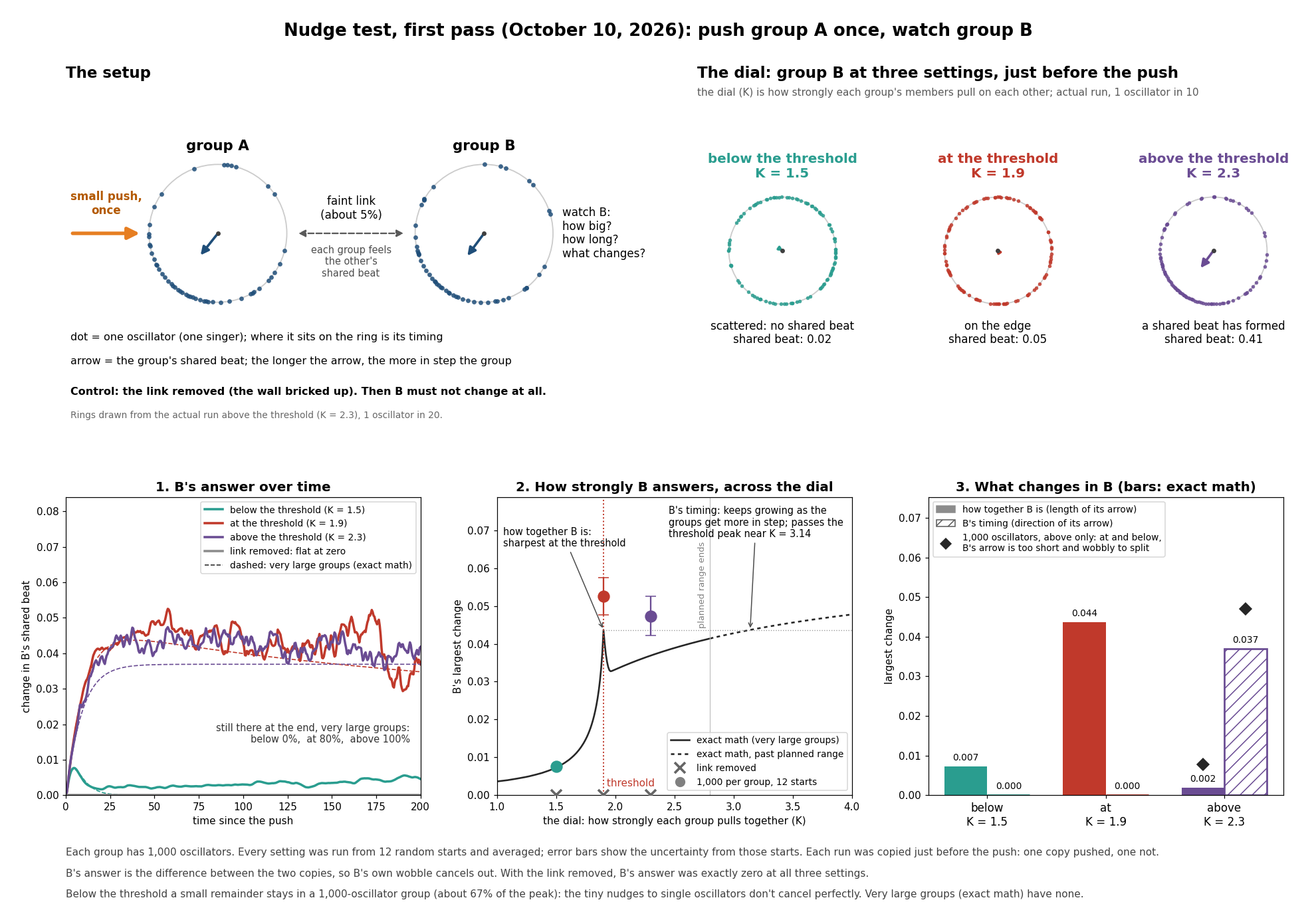
On October 10 and 11 the work went on from embodied trust, E = mc^(et), which Colson described as a phase state at the ~ point, where different systems come to behave alike. That led to a nudge test, two groups of oscillators joined by a faint link, one pushed and the other watched, and to six more tests (Part Four).
This section records that work in order: the ideas and readings that led to each test, the model as equations, the results as numbers and figures, and what each result does not show. Nothing has been removed for looking bad; the misses and corrections are listed together near the end.
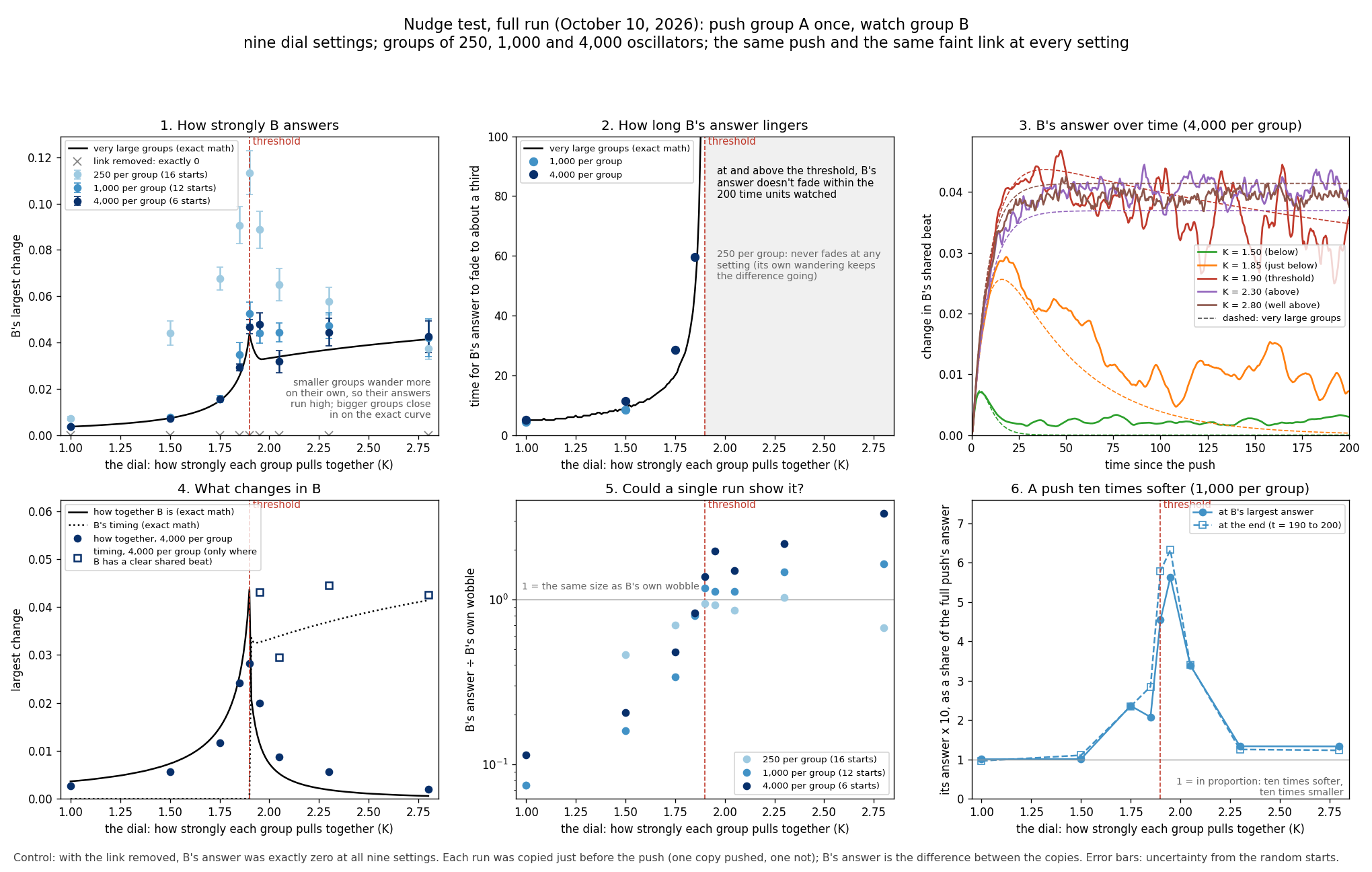
Two groups joined by a faint link: where does B answer most when A is pushed once?
At the threshold, as a change in how together B is that lingers; above it, as a lasting shift in B's timing. With the link removed, B does not change at all.
The change in B's togetherness peaks there at every size, and the answer lingers longer as the threshold is approached from below; its raw size alone does not single the threshold out.
When a group is more coherent, do tiny differences grow more slowly, at the same time or later?
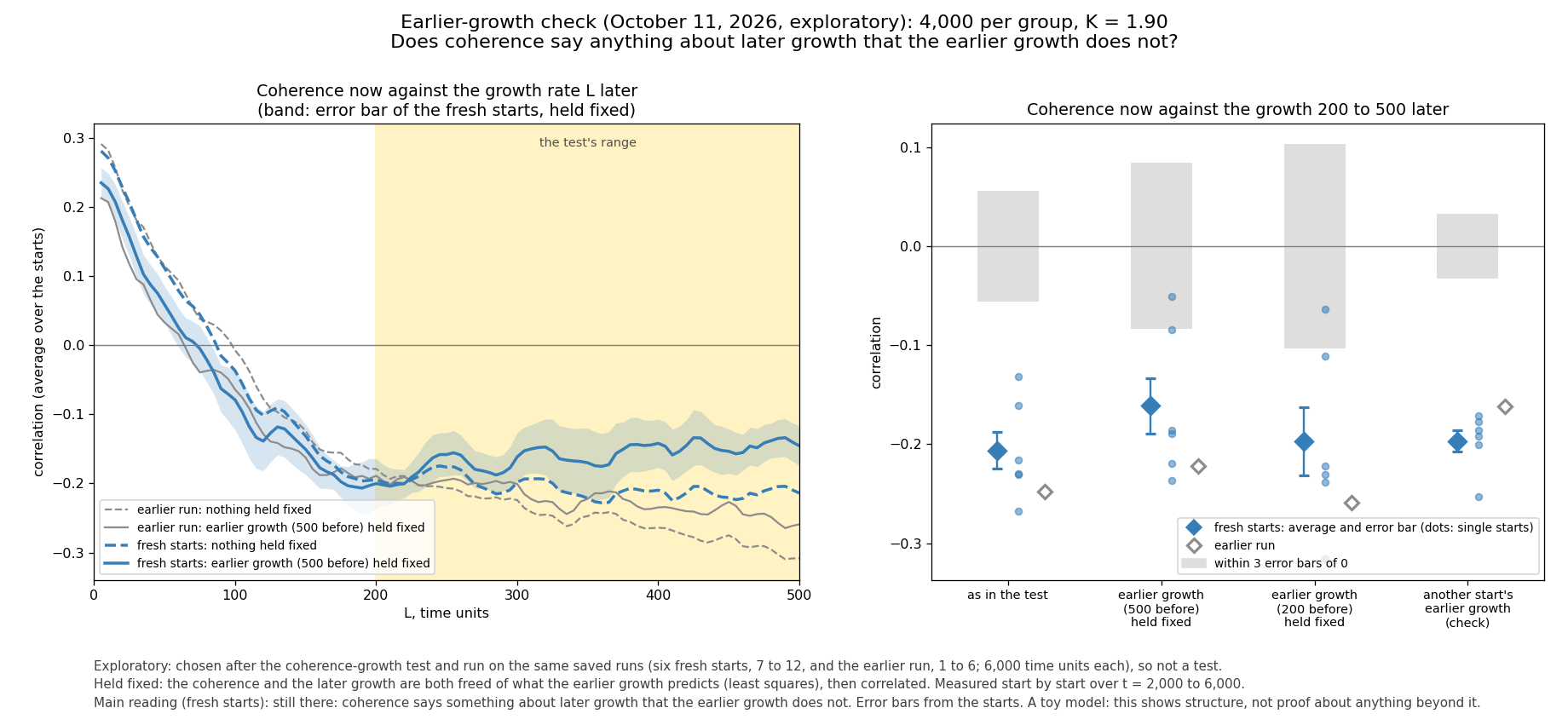
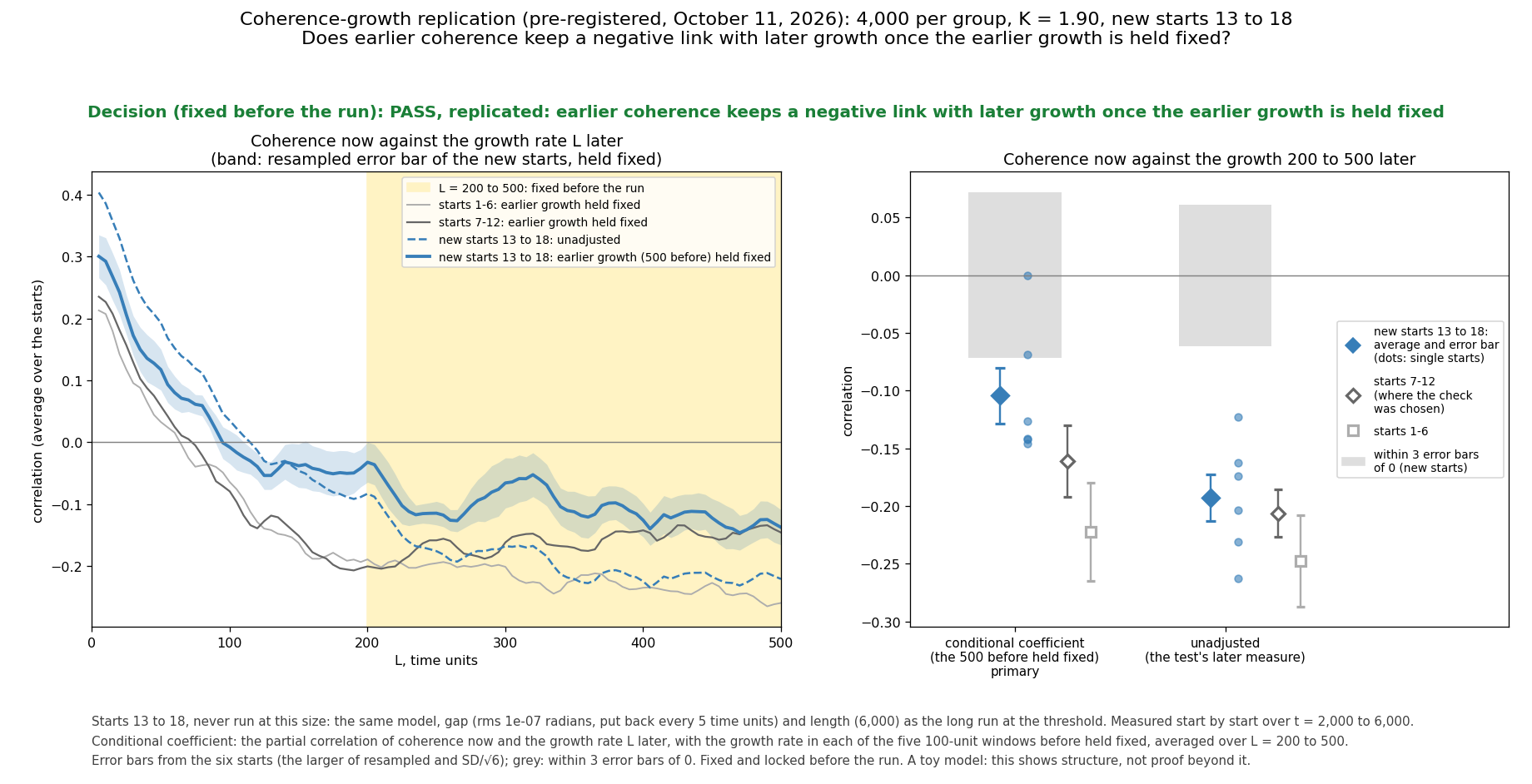
Not at the same time, where it leaned the other way. Later, yes: −0.2061 ± 0.0186 on fresh starts. With the earlier growth held fixed, the later link replicated on new starts by a rule fixed before the run, at −0.1044 ± 0.0239, smaller than where it was found.
PART ONE · HOW THE QUESTION AROSE
Seven steps, each an idea of Colson's and the reading offered in reply. Nothing was run in Part One.
STEP 1 · A ~ B: two nodes, not wired, held by a shared ~
It began with a what-if about observation: that matter may respond to an observer's presence nearby, not only to being directly witnessed. Colson carried it further:
Anything conscious has peripheral awareness … my guesstimate.
From there he described local conscious nodes that are not wired together, with consciousness passing from node to node, and recognised the staircase's own structure in it:
Not interconnected but governed by a mediated (~) … I'm A, you're B … harmonized resonance that meets in the middle.
STEP 2 · Many nodes, one whole
Asked simply to respond, the reading went to the problem any such ~ has to solve.
STEP 3 · The doubling spiral
Colson proposed a picture of consciousness spreading from node to node: a spiral whose turns double, 1, 2, 4, 8, 16, with the first turn's length as the baseline, phase shifts carrying it between nodes, and resonance keeping it coherent.
STEP 4 · What plays zeta's role?
In the staircase the zeta function holds the pairs together. Asked what plays that role for nodes, Colson answered:
A harmonized equilibrium or resonant familiarity … natural resonance to flow ungoverned by direct force … let expansive free will, guided by constructed coherence, guide a future template.
STEP 5 · The future template
A desired outcome of endless potentials, dynamical like the thread that coheres them together, an expression of memory, before it becomes matter … nodes may scatter, but ultimately what governs them and brings them back together is the equilibrium of the future template … a future potential governed by a past memory or a potential in the past working to recover a future template.
Credit: The second form of the question came from ChatGPT in Colson's conversation.
STEP 6 · Landing beside known work
Colson noticed that his intuitions kept landing beside work he had never read, and saw in that the staircase structure itself:
Familiar nodes aligning through a coherent equilibrium … we land on that same equilibrium covered by a familiar coherence.
STEP 7 · A scroll from December 2025
Colson then brought back one of his earlier writings, a scroll dated December 7, 2025: six qubits, all starting in |+⟩, driven by one shared field. He asked to keep only what holds up mathematically and to write it as proper mathematics. What holds is the starting state and the scroll's Hamiltonian:
H(t) = H_0 + A cos(ωt) Σ_j σ^x_j — the scroll's own H_0 and its original simulation record have not been recovered
PART TWO · THE TEN TESTS
Each test gives what led to it, the question, the model, the results, the figure and the limits. All ten were run on October 9, 2026, in a sandbox: no laboratory and no measured data. Each was proposed by the step before it, and Colson called for every run.
TEST 1 · Six nodes, unwired and wired to the whole
WHAT LED HERE
The reading of the scroll ended with an offer to run both cases, unwired and wired to the whole. Colson asked to run it.
THE QUESTION
Can wiring each node to the whole make a shared state that no single node holds, and does it come back?
THE MODEL
H = Σ_j h_j σ^z_j + J Σ_(i<j) σ^z_i σ^z_j + A cos(ωt) Σ_j σ^x_j — six qubits, all starting in |+⟩; one full cycle of the wiring is π/J
Wired: J = 1 on all 15 pairs, nothing else. Unwired: own rhythms h_j from 0.5 to 1.5 and the drive 0.8 cos(2.5t), no wiring. Measured: the overlap with the start; the overlap with the mirror state, all |−⟩; the entanglement per node (the entropy of one qubit, in bits); and how strongly a small nudge from the drive registers, the spread ΔM_x of the total along the drive, M_x = Σ_j σ^x_j. For a pure state ΔM_x² is the quantum Fisher information, so the spread ΔM_x measures that sensitivity: one ideal node reaches 1, six separate nodes at most √6 ≈ 2.45, and a perfect six-qubit cat 6.
WHAT CAME OUT
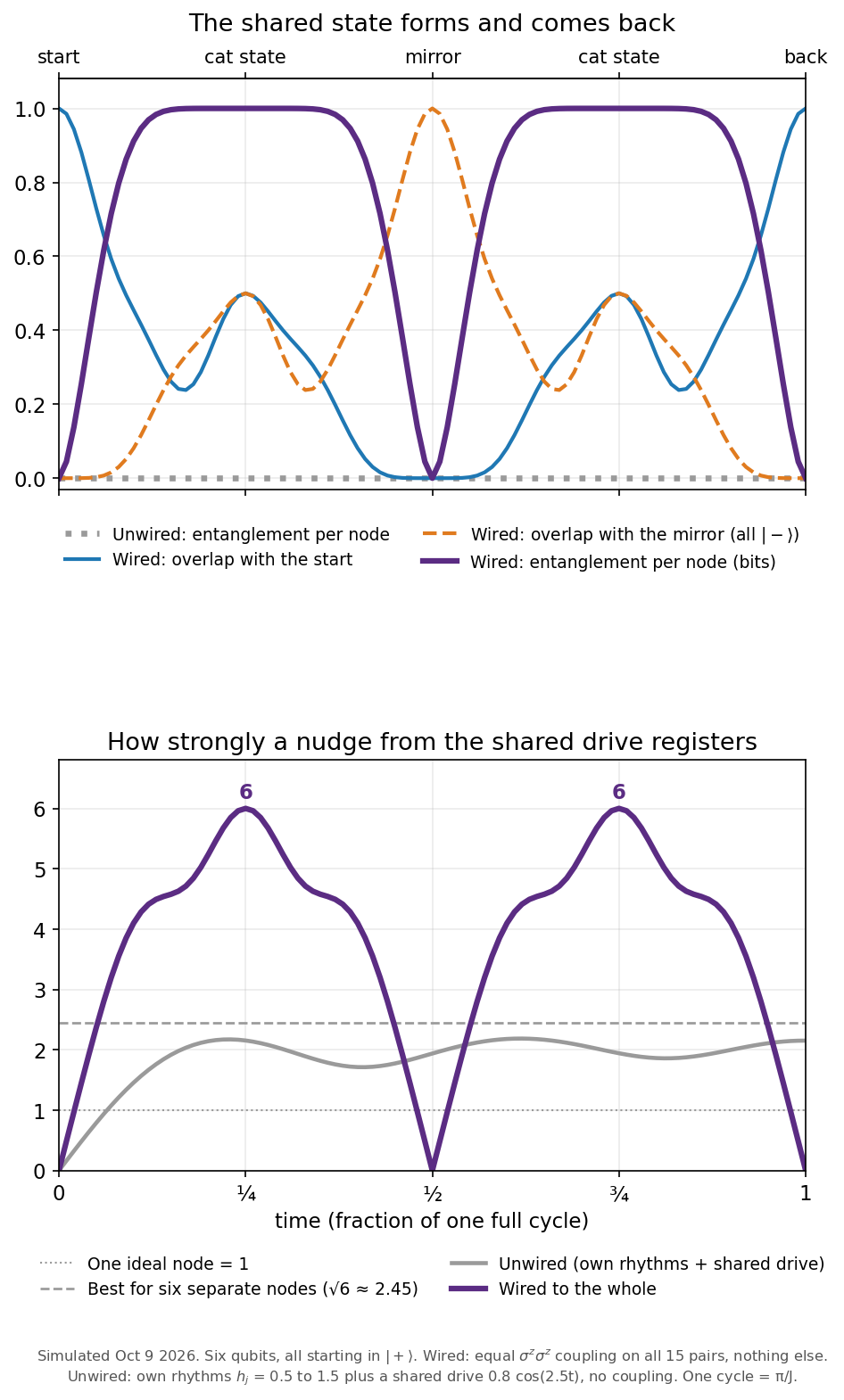
¼ cycle: a perfect six-qubit cat state, an equal superposition of all six in |+⟩ and all six in |−⟩ (match 1.000). Each node holds exactly 1 bit of entanglement, and the shared phase can be read only with all six together.
½ cycle: the mirror state, all |−⟩. ¾ cycle: the cat with the opposite phase. 1 cycle: an exact return to the start.
The wiring's four energy levels are −3, −1, 5 and 15 (in units of J); their spacings set the schedule.
Adding the own rhythms to the wiring leaves the timing of the shared state unchanged: the two commute.
At the cat moments the drive registers 6 times as strongly as on one ideal node.
Unwired: the entanglement stays below 10^(−12) throughout, and the drive's response peaks at 2.19, under the √6 ≈ 2.45 that separate nodes can reach.
The drive alone, with H_0 = 0: an overall phase only.
Figure M1 — The shared state forms and comes back. Test 1, over one cycle of the wiring. Top: six qubits wired to the whole (equal σ^z σ^z wiring on all 15 pairs, nothing else). The entanglement per node (purple) reaches 1 bit as the cat state forms at ¼ cycle; the overlap with the start (blue) and with the mirror state, all |−⟩ (orange dashes), trade places at ½; everything returns at 1 cycle. The unwired run (grey dots) never entangles. Bottom: how strongly a nudge from the shared drive registers, ΔM_x: 6 at the cat moments for the wired nodes, while the unwired nodes, with their own rhythms and the drive, stay under the √6 ≈ 2.45 that separate nodes can reach. Open full size
TEST 2 · The shared drive switched on
WHAT LED HERE
Test 1 ran the wiring and the drive separately. The next offer was to switch the drive on in the wired run, and Colson asked for it.
THE QUESTION
With the shared drive on, does the shared state still form, and does the whole still come home?
THE MODEL
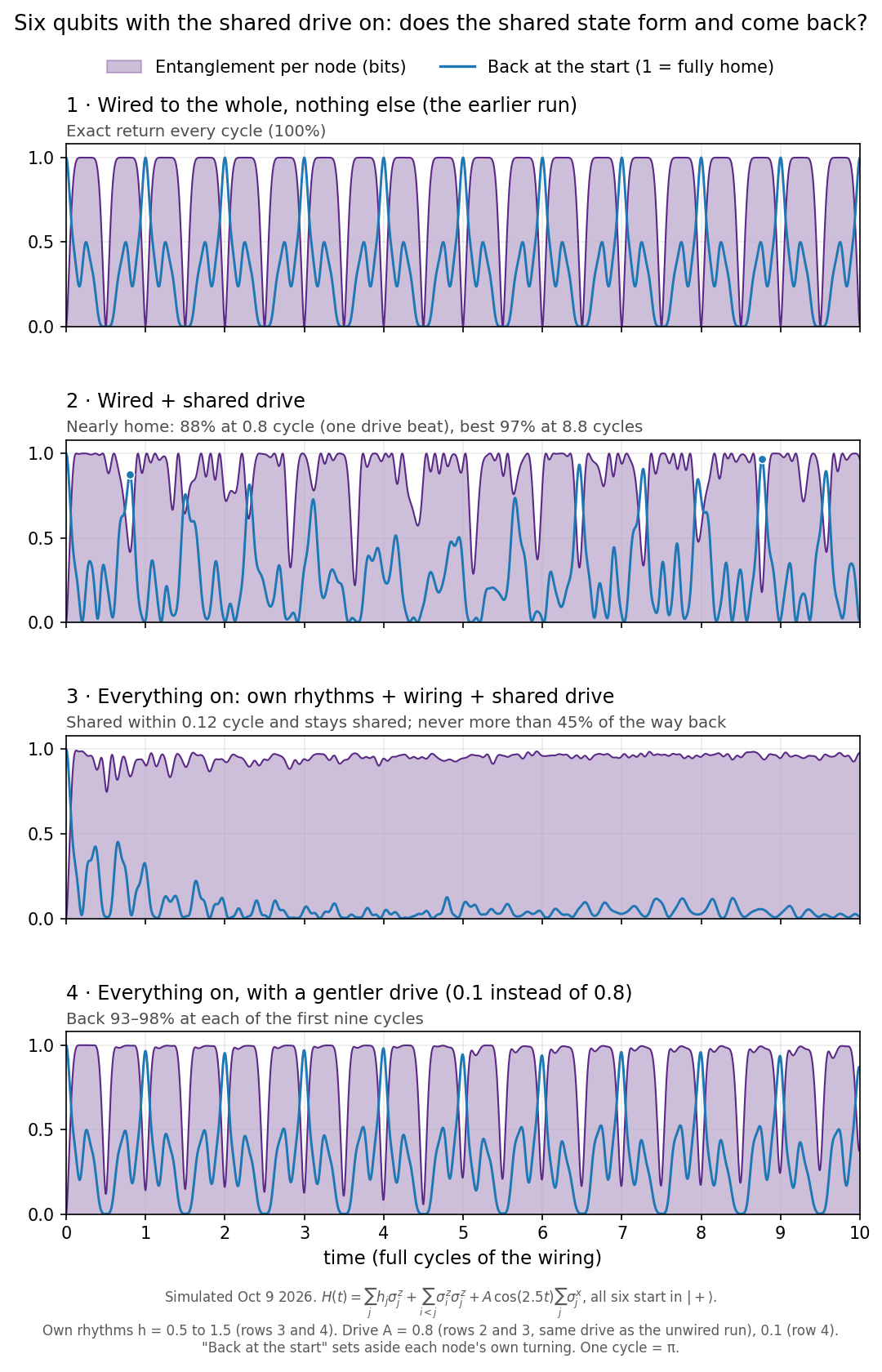
The same Hamiltonian, over ten cycles, in four runs: (1) wiring only, the baseline from Test 1; (2) wiring and the drive 0.8 cos(2.5t), the same drive as the unwired run; (3) everything on: own rhythms 0.5 to 1.5, wiring and the drive; (4) everything on with a gentler drive, A = 0.1. “Back at the start” sets aside each node's own turning: it is measured in each node's own rotating frame.
WHAT CAME OUT
Wiring and drive: the sharing forms sooner; the cat match stays at or below 0.82 on any axis; near-returns come roughly on the drive's beat, 88% at 0.8 cycle and at best 97% at 8.8 cycles.
Everything on: shared within 0.12 cycle, and it stays shared, at least 0.74 bits on average after half a cycle and about 0.96 later, close to the 0.97 of a random six-qubit state. Never more than 45% of the way back. The drive's response averages √6.
Gentle drive, 0.1: the cat match reaches 0.99 near ¼ cycle, and the whole is back 93–98% at each of the first nine cycles.
Figure M2 — Six qubits with the shared drive on. Test 2, over ten cycles of the wiring. Shaded: entanglement per node. Blue line: back at the start (1 = fully home), with each node's own turning set aside. Row 1, wiring only: exact return every cycle. Row 2, wiring and the drive 0.8 cos(2.5t): near-returns roughly on the drive's beat, 88% at 0.8 cycle and 97% at 8.8 cycles. Row 3, everything on (own rhythms, wiring and drive): shared within 0.12 cycle and never more than 45% of the way back. Row 4, everything on with a gentler drive, 0.1: back 93–98% at each of the first nine cycles. Open full size
TEST 3 · Where the whole stops coming home: a sweep of the drive's strength
WHAT LED HERE
Test 2 left a gap between 0.1, where the whole came home, and 0.8, where it did not. The offer was to find where between them the return is lost.
THE QUESTION
Where between 0.1 and 0.8 is the return lost, at a cliff or gradually?
THE MODEL
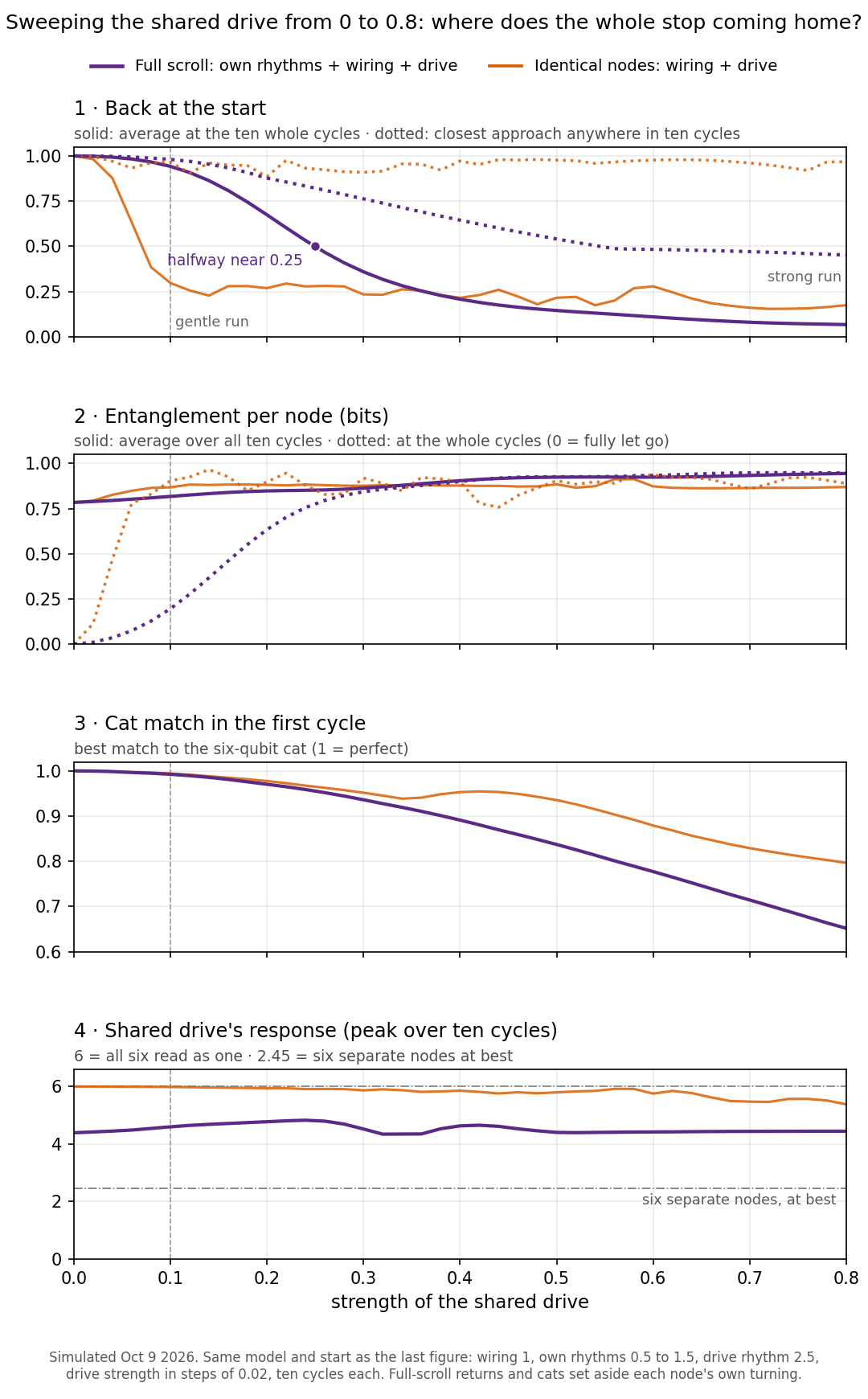
The same model and start. Drive strength A from 0 to 0.8 in steps of 0.02, drive rhythm 2.5, ten cycles each. Two versions: the full scroll (own rhythms 0.5 to 1.5, wiring 1 and the drive) and identical nodes (wiring and drive, every h_j = 0).
WHAT CAME OUT
Full scroll: a smooth crossover, no cliff. At least 90% home at every whole cycle up to A = 0.08, at none from 0.18 on, and halfway near 0.25.
What the drive takes away is the letting go, not the sharing: averaged over the run, the entanglement rises only from 0.78 to 0.94 bits, but at the whole cycles it rises from 0 (fully let go) to 0.95.
Identical nodes: the schedule breaks by about A = 0.05, because the drive's rhythm 2.5 sits near their first flip rhythm, 2 (checked at 2.0 and 4.0); yet near-returns of at least 89% still happen somewhere in the ten cycles.
The cat match in the first cycle falls slowly, from 1.0 to 0.65 for the full scroll and to 0.80 for identical nodes at A = 0.8.
With own rhythms on, the drive's response at the cat moment is 2.1, and its peak stays at or below 4.8 at every strength: the sixfold response of Test 1 also needs the nodes' phases aligned (see the corrections below).
Figure M3 — Sweeping the shared drive from 0 to 0.8. Test 3. Purple: the full scroll (own rhythms, wiring and drive). Orange: identical nodes (wiring and drive). Panel 1: the return at the ten whole cycles (solid) and the closest approach anywhere in the ten cycles (dotted); the full scroll falls halfway near 0.25. Panel 2: entanglement per node averaged over the run (solid) and at the whole cycles (dotted, 0 = fully let go). Panel 3: the best cat match in the first cycle. Panel 4: the drive's peak response ΔM_x over ten cycles; 6 means all six read as one, 2.45 is the best six separate nodes can do. Open full size
BETWEEN TESTS 3 AND 4 · A field that is always present, not always shown
Looking at the sweep, Colson read the drive as
A dynamic scalar field that nodes couple to … not running 24/7 but … a window of opportunity … and it dynamically shifts.
It swings because the field is always present, just not always shown. Exactly as the chameleon scalar would presume.
TEST 4 · The window map: drive strength × drive rhythm
WHAT LED HERE
After the sweep the offer was to map strength against rhythm. Colson relayed a vote to run it, and the map was run together with Test 5.
Credit: The vote came from ChatGPT in Colson's conversation.
THE QUESTION
Which drive rhythms break the whole, and which leave it alone?
THE MODEL
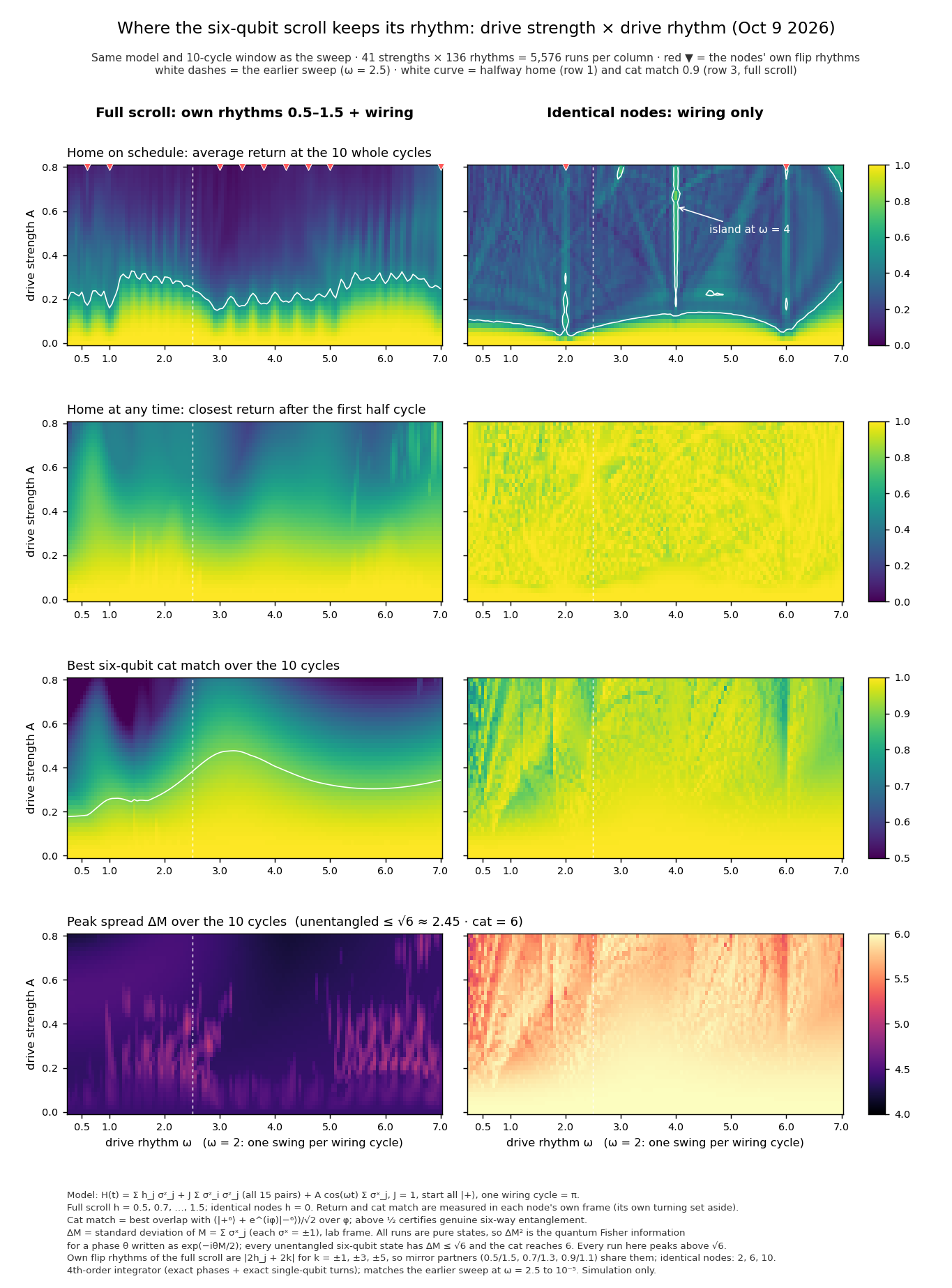
The same Hamiltonian with J = 1: 41 strengths from 0 to 0.8 against 136 rhythms from 0.25 to 7, giving 5,576 runs per column, ten cycles each. The full scroll (h_j = 0.5, 0.7, …, 1.5) against identical nodes (h_j = 0). Returns and cat matches are measured in each node's own frame; a cat match above ½ certifies genuine six-way entanglement. The fourth-order integrator agrees with the sweep at rhythm 2.5 to 10^(−5).
WHAT CAME OUT
Full scroll: its own flip rhythms, |2h_j + 2k| for k = ±1, ±3, ±5, set the windows, and mirror partners (0.5 and 1.5, 0.7 and 1.3, 0.9 and 1.1) share them. Between those rhythms the whole stays at least 90% home at every cycle up to A = 0.12; on them, only up to 0.02.
The peak response is 4.2–5.0, never 6, but every run peaks above √6.
Identical nodes: the schedule breaks already at A = 0.02 on their flip rhythms, 2 and 6. One narrow island sits at exactly rhythm 4, where the whole holds up to A ≈ 0.6, against 0.3–0.45 nearby, about ±0.05 wide; there is none at 1, 3, 5 or 8. Near-returns of at least 0.72 happen everywhere.
Figure M4 — Where the six-qubit scroll keeps its rhythm: drive strength × drive rhythm. Test 4. Left: the full scroll, own rhythms 0.5–1.5 and wiring; right: identical nodes, wiring only; 5,576 runs per column. Row 1: the average return at the ten whole cycles; red triangles mark the nodes' own flip rhythms, the white dashes mark the earlier sweep at rhythm 2.5, and the white curve marks halfway home. Row 2: the closest return after the first half cycle. Row 3: the best cat match over the ten cycles (white curve: 0.9). Row 4: the peak spread ΔM over the ten cycles. The figure's footnote writes M as Σσ^z_j; the spread plotted is along the drive, Σσ^x_j, as in Figures M1 and M3 (see the corrections below). Open full size
TEST 5 · Six nodes linked only through one shared mode
WHAT LED HERE
The chameleon reading led to the offer to make the field a quantum mode of its own, so that the ~ is something the nodes share rather than a fixed rule. Colson relayed a second vote in favour, and Tests 4 and 5 were run together.
Credit: The vote came from ChatGPT in Colson's conversation.
THE QUESTION
Can a shared mode be the ~, linking the nodes and then leaving no trace?
THE MODEL
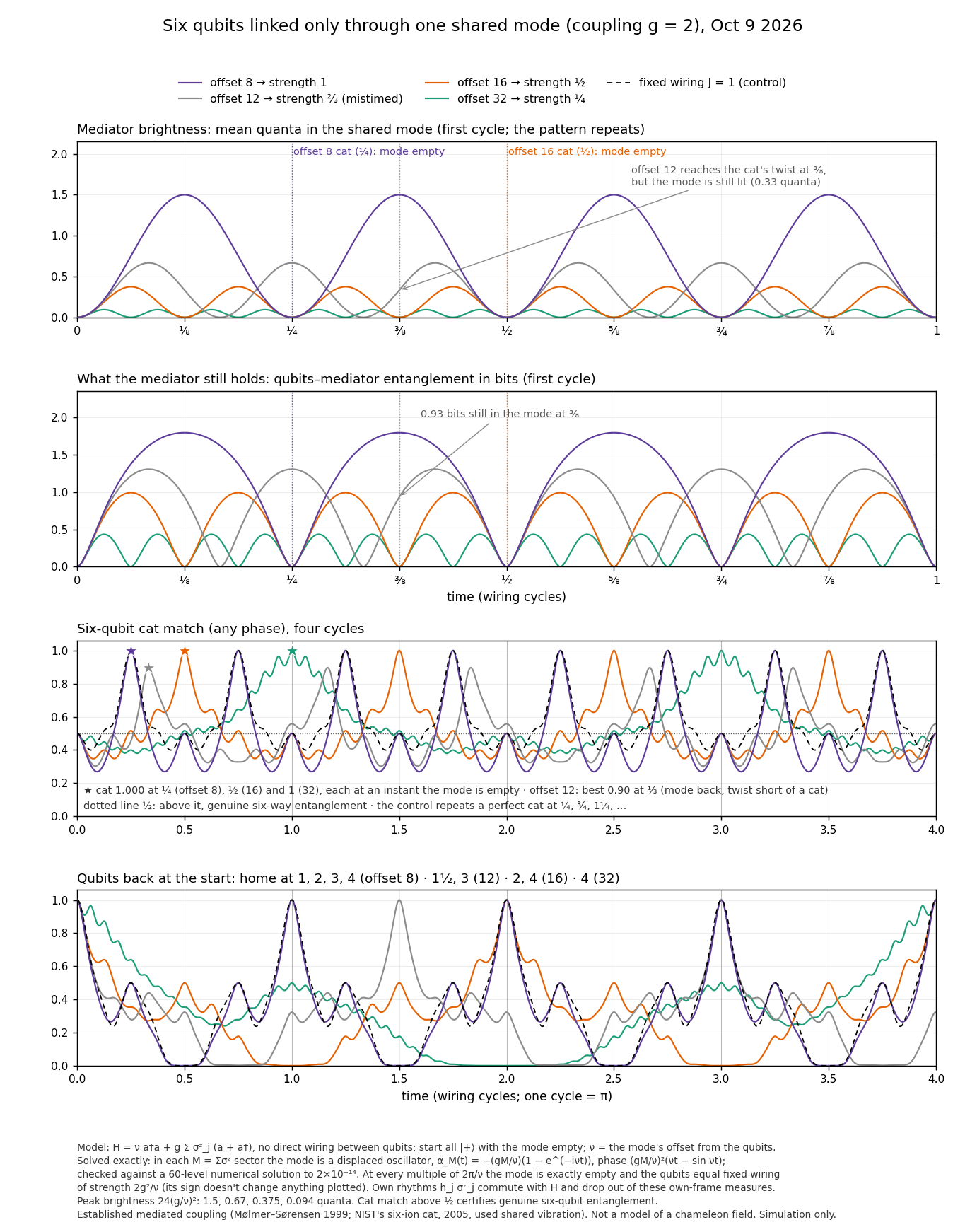
H = ν a†a + g Σ_j σ^z_j (a + a†) — no direct wiring between the qubits; all start in |+⟩ with the mode empty; ν is the mode's offset from the qubits; g = 2
Solved exactly. In each sector of the total M the mode is a displaced oscillator, whose amplitude follows
α_M(t) = −(gM/ν)(1 − e^(−iνt)) — with a leftover phase (gM/ν)²(νt − sin νt); checked against a 60-level numerical solution to 2 × 10^(−14)
At every multiple of 2π/ν the mode is exactly empty again, and the qubits have felt fixed wiring of strength 2g²/ν between every pair. Offsets 8, 12, 16 and 32 give strengths 1, ⅔, ½ and ¼.
WHAT CAME OUT
Offsets 8, 16 and 32 give a perfect cat (match 1.000) at ¼, ½ and 1 cycle, each at an instant when the mode is empty.
Offset 12 is mistimed: at ⅜ cycle, where the wiring's twist would make a cat, the mode is still lit (0.33 quanta) and still holds 0.93 bits of entanglement with the qubits, and the cat match there is 0.75. Its best, 0.90, comes at ⅓ cycle, when the mode is empty but the twist falls short of a cat. It still comes home exactly at 1½ cycles.
Peak brightness 24(g/ν)²: 1.5, 0.67, 0.375 and 0.094 quanta.
Home at 1, 2, 3 and 4 cycles (offset 8); 1½ and 3 (offset 12); 2 and 4 (offset 16); 4 (offset 32).
Figure M5 — Six qubits linked only through one shared mode. Test 5, coupling g = 2. Offsets 8, 12, 16 and 32 give wiring strengths 1, ⅔, ½ and ¼; fixed wiring J = 1 is the control (black dashes). Rows 1 and 2, over the first cycle: the mode's brightness, and the entanglement between the qubits and the mode, in bits. Row 3: the six-qubit cat match over four cycles; stars mark each offset's first cat. Row 4: the qubits back at the start. Offset 12 reaches the cat's twist at ⅜ cycle while the mode is still lit. Open full size
BETWEEN TESTS 5 AND 6 · Is the doubling spiral still part of it?
Colson asked whether his doubling spiral from Step 3 was still relevant, as “part of my formalization.”
TEST 6 · Closed loop against leaky loop
WHAT LED HERE
The spiral reading made a prediction that could be drawn. Colson relayed a request for the real equations, the mode's path, its leftover brightness and the cat match, closed against leaky, and called the run with “proceed ~”.
Credit: The request came from ChatGPT in Colson's conversation.
THE QUESTION
What does a leak do to the shared mode's loop, and to the shared state?
THE MODEL
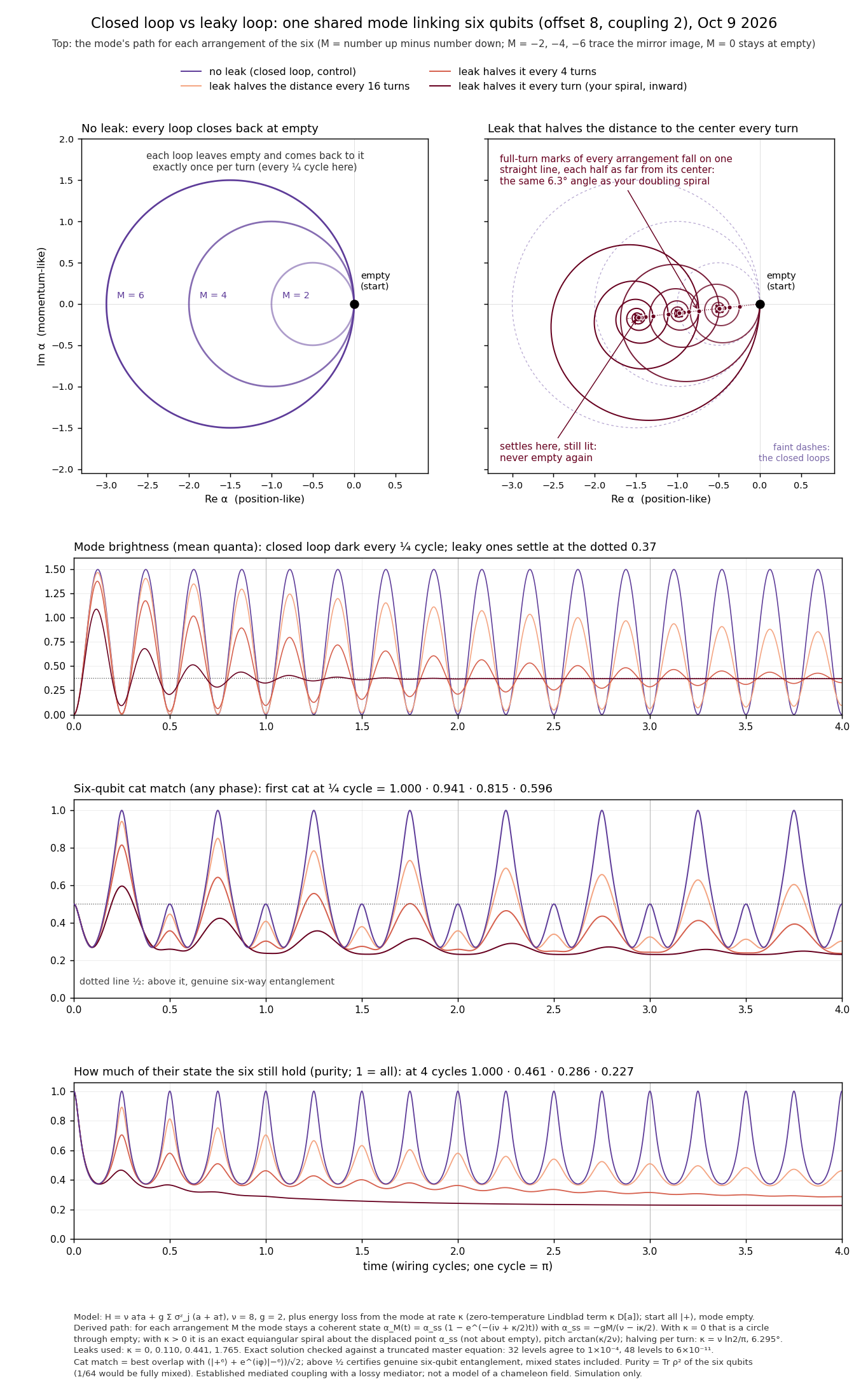
Test 5's model at offset ν = 8 and g = 2, plus energy loss from the mode at rate κ (a zero-temperature loss term, κ D[a]). The path of each arrangement follows exactly
α_M(t) = α_ss (1 − e^(−(iν + κ/2)t)), α_ss = −gM/(ν − iκ/2) — κ = 0: a circle through empty. κ > 0: an exact equiangular spiral about the displaced point α_ss, not about empty, with pitch arctan(κ/2ν); halving per turn at κ = ν ln 2/π, a pitch of 6.295°
Leaks run: κ = 0, 0.110, 0.441 and 1.765, halving the distance every 16, 4 and 1 turns. Checked against a truncated master equation: 32 levels agree to 1 × 10^(−4), 48 levels to 6 × 10^(−13). The purity Tr ρ² of the six qubits measures how much of their state they still hold: 1 for all of it, 1/64 for none.
WHAT CAME OUT
No leak: every loop closes back at empty, once per turn (every ¼ cycle).
With the leak: the full-turn marks of every arrangement fall on one straight line, each half as far from its centre at the leak that halves per turn, at the same 6.3° as the doubling spiral. The mode settles lit, at 0.37 quanta, and is never empty again.
First cat at ¼ cycle: 1.000 with no leak, then 0.941, 0.815 and 0.596. At halving per turn only that first cat stays above ½.
Purity at 4 cycles: 1.000, 0.461, 0.286 and 0.227.
The damage tracks the loss per turn: offset 16 with the same loss per turn gives about the same first cats (0.943, 0.830, 0.644); with the same rate it is gentler (0.970, 0.897, 0.743) but twice as slow.
Figure M6 — Closed loop against leaky loop. Test 6, offset 8, coupling 2. Top left: with no leak, the mode's path for each arrangement of the six (M = 2, 4, 6; the arrangements −2, −4, −6 trace the mirror image) is a circle that leaves empty and returns once per turn. Top right: with the leak that halves the distance every turn, each path is an inward equiangular spiral about a lit centre, and the full-turn marks of every arrangement lie on one straight line at 6.3°. The legend's “your spiral” is Colson's doubling spiral (Step 3), run inward. Below: the mode's brightness, the cat match and the six qubits' purity over four cycles for the four leak rates. Open full size
Credit: The caution that a leaky path winds about a displaced, lit centre rather than about empty came from ChatGPT in Colson's conversation; the run bore out both that caution and the spiral reading.
AFTER TEST 6 · 1 · The leak and the zero-point floor
Colson's what-if about the chameleon field:
That omnipresent leakage point, almost an attribute of it … leakage of the inactivated potential meeting its ZPE phase-shifting threshold.
AFTER TEST 6 · 2 · Where a meeting's memory goes
The memory is the leftover unmaterialized template residue left behind for the next spiral, of unactivated potential.
Credit: Precision notes from ChatGPT in Colson's conversation, taken up here: a memoryless leak never returns anything; the test to run first is the same present state with different histories; nothing shows that the vacuum stores a template; and a purity revival alone is not backflow from a bath with memory (Breuer, Laine and Piilo, 2009, give the strict test). Here the revival is coherent exchange with the mediator.
AFTER TEST 6 · 3 · Memory in motion
Colson split memories in two: those
… harmonically/vibrationally aligned with the particular node keep the spiral in alignment, and negative triggering ones send a node off course.
He added that about a year earlier he and an AI had written about this idea and called it “memory in motion.” The scroll he found from that time carries the idea, though not the exact phrase. The name now covers the last three tests.
AFTER TEST 6 · 4 · Memory, the precursor to mass
Memory is the precursor to mass.
Credit: ChatGPT, in Colson's conversation, stressed that the Higgs mechanism, the binding of the proton and the polaron are three different mechanisms. That is correct, and the readings above do not merge them.
TEST 7 · Does carrying a trace add mass? A moving node
WHAT LED HERE
Colson relayed votes on the design, to compare runs with and without modes, take the mass from the band's curvature, and vary the response time, and called the run with “iterate”.
Credit: The votes came from ChatGPT in Colson's conversation.
THE QUESTION
Does a node that carries a trace of where it has just been get heavier, and what sets how much?
THE MODEL
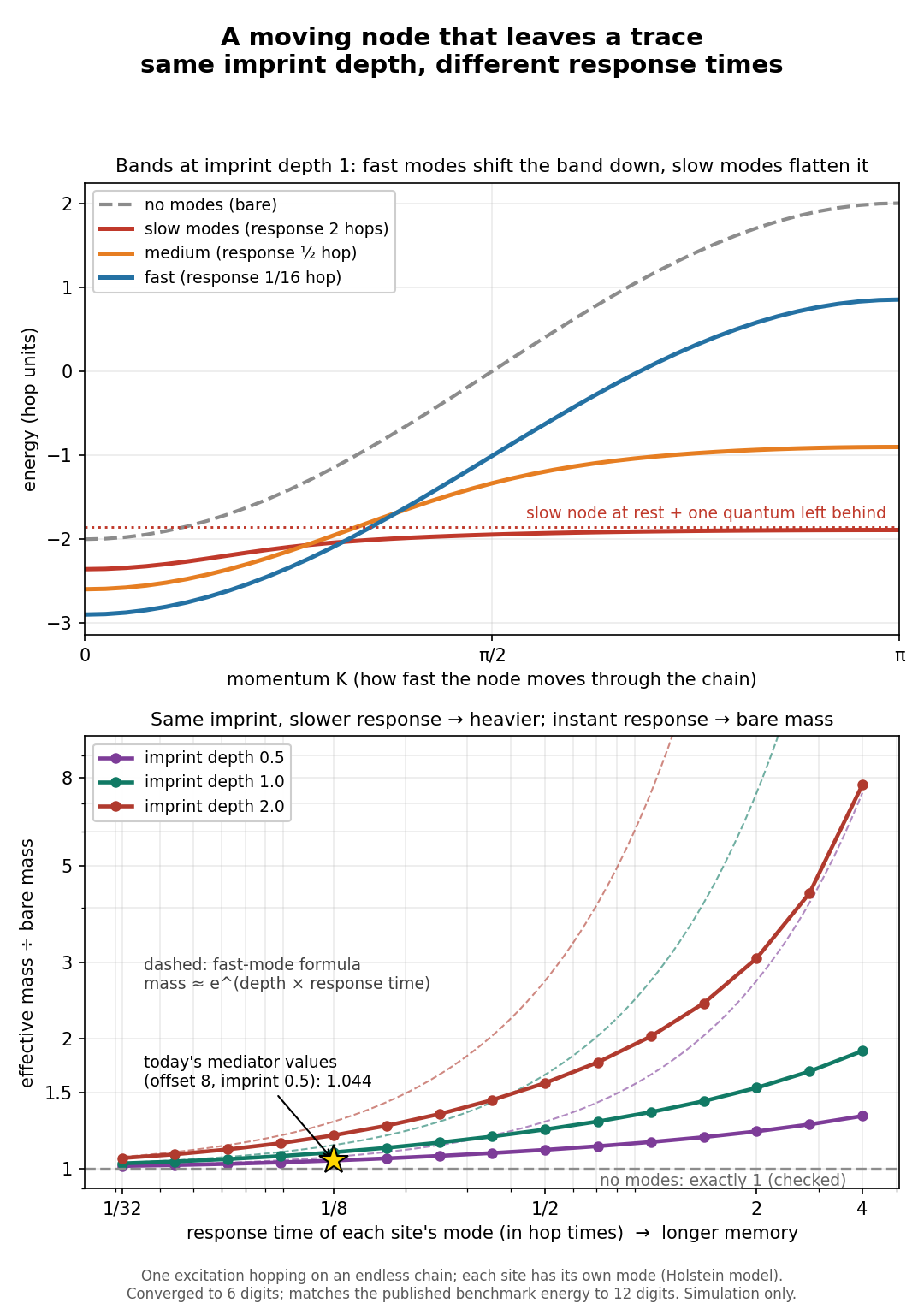
H = −t Σ_j (c†_j c_(j+1) + c†_(j+1) c_j) + ν Σ_j a†_j a_j − g Σ_j c†_j c_j (a_j + a†_j) — the Holstein model (1959): one excitation hopping along an endless chain, hop t = 1, each site with its own mode of frequency ν
The imprint depth E_p = g²/ν is the energy the trace can lower; the response time is 1/ν. Solved in a variational basis, converged to 6 digits (0.2% at the hardest point), and matching the published benchmark energy for t = ν = g = 1, E_0 = −2.469684723933 (Bonča, Trugman and Batistić, 1999), to 12 digits. The effective mass m* comes from the curvature of the lowest band.
WHAT CAME OUT
Imprint depth E_p
m*/m, response 1/32 hop
m*/m, response 4 hops
0.5
1.014
1.323
1
1.028
1.870
2
1.057
7.71
no modes
exactly 1 (checked)
exactly 1 (checked)
At the fast end the energy drops by about 94% of the imprint, yet the mass stays near bare. At the slow end the drop is only 25–31%, and the mass is largest. The mass follows how long the trace is held, not how deep the energy drop is.
The fast-mode formula m*/m ≈ e^(E_p/ν), dashed in the figure, holds at the fast end and overshoots when the modes are slow.
With the mediator's values from Test 5 (offset 8, imprint 0.5) and hop 1: m*/m = 1.044.
At imprint 1, fast modes shift the whole band down; slow modes flatten it just under “at rest plus one quantum left behind.”
Figure M7 — A moving node that leaves a trace. Test 7. Top: the lowest band at imprint depth 1 for three response times, and without modes. Fast modes shift the band down; slow modes flatten it just under “at rest plus one quantum left behind.” Bottom: the effective mass over the bare mass against the response time of each site's mode, for imprint depths 0.5, 1 and 2; dashed, the fast-mode formula. The star marks the values of Test 5's mediator (offset 8, imprint 0.5); “today's” in its label means October 9, 2026. Open full size
Credit: The last point is a precision note from ChatGPT in Colson's conversation.
TEST 8 · Memory in motion I: the trace a moving node carries
WHAT LED HERE
The offer after Test 7 was to draw the wake trailing behind a moving node. Colson relayed a design (three response times at one imprint; position, local displacement and spreading; motion checked against the band's curvature) and called the run with “proceed”.
Credit: The design came from ChatGPT in Colson's conversation.
THE QUESTION
Where does the trace sit around a moving node, and how does it change the motion?
THE MODEL
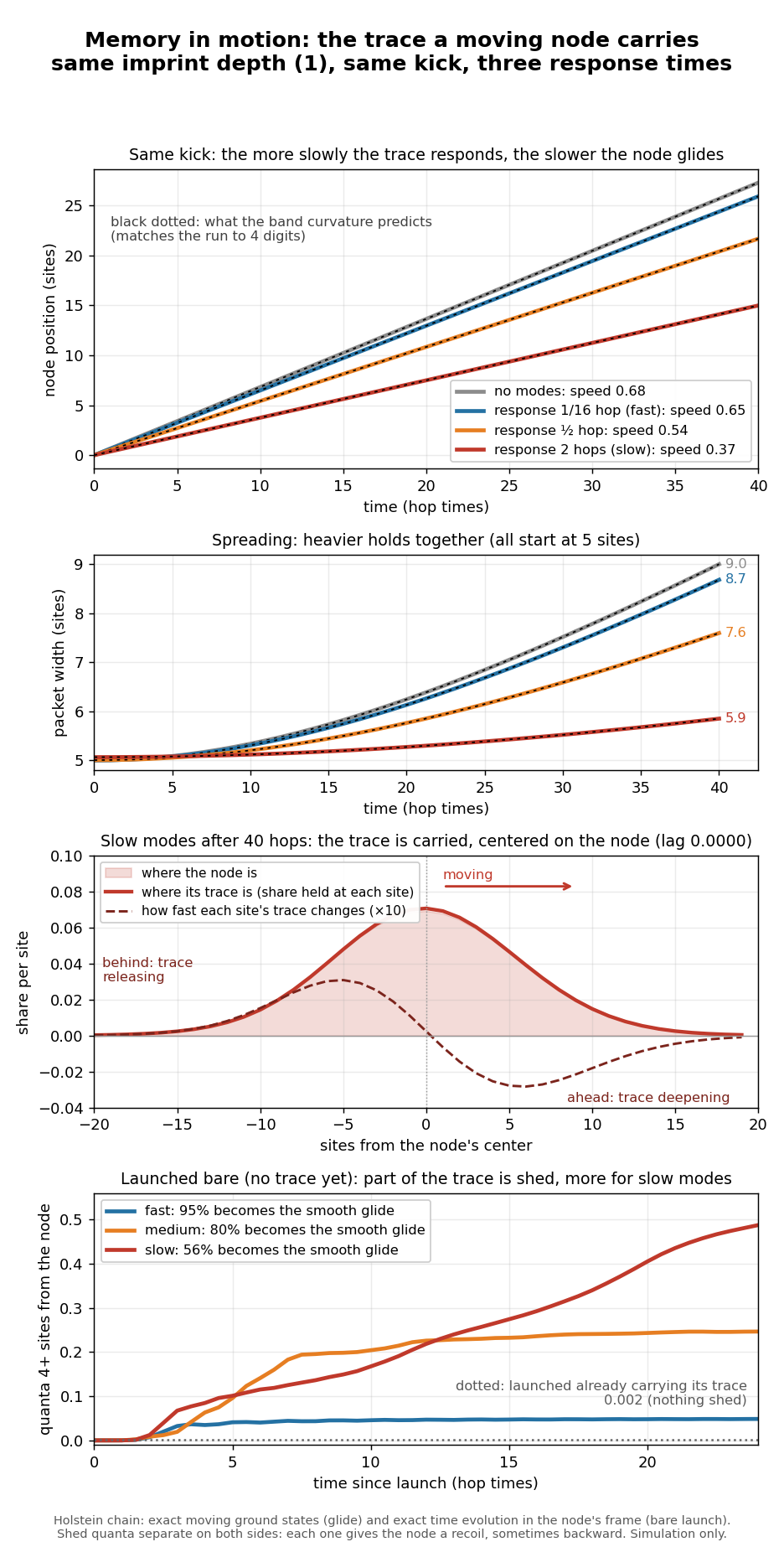
The Holstein chain of Test 7 at imprint 1, with response times 1/16, ½ and 2 hops, plus a run without modes. Packets are built from exact moving ground states, 5 sites wide, given the same kick K_0 = 0.35, and followed exactly for 40 hops. A second set is launched bare, with no trace yet, and followed in the node's own frame.
WHAT CAME OUT
Same kick, different speeds: 0.68 with no modes, then 0.65, 0.54 and 0.37 for responses of 1/16, ½ and 2 hops. Widths after 40 hops grow from 5 sites to 9.0, 8.7, 7.6 and 5.9: the heavier node holds together. Speeds and widths both match the band's curvature to 4 digits.
With slow modes, after 40 hops the trace is carried centred on the node: lag 0.0000. Mirror and time-reversal symmetry make a carried trace symmetric, deepening ahead and releasing behind.
The slow node is 16% slower than its rest mass predicts: at this kick its band is already flattening.
Launched bare, the node sheds part of its trace. The share that becomes the smooth glide is 56% (slow), 80% (medium) and 95% (fast); the quanta shed by 24 hops are 0.49 (still rising), 0.25 and 0.049, on both sides. Each shed quantum gives the node a recoil, sometimes backward.
Figure M8 — Memory in motion: the trace a moving node carries. Test 8, imprint depth 1, the same kick for every run. Panel 1: position over 40 hops; black dots, what the band's curvature predicts. Panel 2: packet width, all starting at 5 sites. Panel 3: slow modes after 40 hops; the trace (red line) is centred on the node, deepening ahead and releasing behind (dashes, ×10). Panel 4: a node launched with no trace yet sheds quanta, counted four or more sites away; dotted, a node launched already carrying its trace (0.002, nothing shed). Open full size
TEST 9 · Memory in motion II: let the surroundings forget
WHAT LED HERE
Test 8 raised the question of whether surroundings that forget would make the trace trail and drag. Colson relayed a design (add a leak and keep the closed model as a control) and called the run with “analyze and proceed”; Tests 9 and 10 were run together.
Credit: The design came from ChatGPT in Colson's conversation.
THE QUESTION
When the surroundings forget, does the trace fall behind, and does the node slow down?
THE MODEL
The Holstein chain in the node's frame, imprint 1, the same kick. Each held quantum leaks at rate γ = 0.1 per hop (a local zero-temperature loss), with 200 quantum-jump runs per response time; the closed control is the same runs with no leak. The expected lag is the speed times the settling time
τ = γ/(ν² + γ²/4)
WHAT CAME OUT
The trace now trails behind, by speed × settling time, across a 400-fold range of settling times: on average 0.12, 0.013 and 0.0003 sites for slow, medium and fast modes (checked against a larger basis). It rocks around the trailing point at the mode's frequency. Closed control: lag below 10^(−13).
The average speed falls (slow modes: 0.39 to 0.07) while the typical speed holds: at 40 hops, 45%, 23% and 11% of runs are heading backward. The node is knocked around, not braked.
What the surroundings took by 40 hops: 3.12, 1.22 and 0.22 quanta per run. Slow modes hold more, so they lose more.
Share of the original glide that survives: 9%, 39% and 81%; closed control 100%.
Figure M9 — Memory in motion II: let the surroundings forget. Test 9, a leak of 0.1 per held quantum per hop, imprint depth 1, the same kick; the closed control is the same runs with no leak. Panel 1: slow modes; with the leak on, the trace falls behind and rocks around a trailing point, while the control stays centred. Panel 2: how far behind, against the response time; the dotted line is speed × settling time. Panel 3: average speed (solid) and typical speed (dotted); dashed, the closed control. Panel 4: quanta the surroundings took per run. Panel 5: how much of the original glide survives. Open full size
TEST 10 · Memory in motion III: resonant recovery
WHAT LED HERE
Colson's prediction:
When the environment can dissipate information, resonant local nodes can attune to the wavelength of the information and have the potential to couple to the memory.
He relayed a design built on it, with a tuned receiver, detuned receivers and no receiver, and Test 10 was run together with Test 9.
Credit: The design came from ChatGPT in Colson's conversation.
THE QUESTION
When node A releases its excitation into a channel, can a tuned node B catch it, with its phase and entanglement intact?
THE MODEL
Exact single-excitation runs. Nodes A and B each couple, with strength 0.15, to the two ends of a 150-site channel with hop 1; A's release rate is Γ = 0.045, and B is detuned by Δ from the signal. The fidelity is averaged over input states, with B's fixed phase corrected; the entanglement is the concurrence with a partner that A was entangled with at the start.
WHAT CAME OUT
Case
Share caught
Fidelity
Entanglement kept
B in tune
0.55
0.84
0.74
B off by 2Γ
0.27
0.72
0.52
B off by 4Γ
0.12
0.64
0.35
No receiver, open channel
0.00
0.51 (a guess)
0.03
No receiver, closed end: A's own echo at t = 196
0.57
0.85
0.76
In tune, B catches 55% at best, close to the textbook limit for this pulse shape, 4/e² ≈ 0.54. If only the energy arrived, the fidelity would be 0.59; it is 0.84 because the phase arrives too.
B's copy beats any measure-and-resend copy, fidelity 2/3 (Massar and Popescu, 1995), for |Δ| < 3Γ: a wavelength match within about 4%.
With no receiver and an open channel, nothing comes back. With a closed end, A's own state returns as an echo.
A short channel, 10 sites or fewer, acts as one shared mode: A and B pass the excitation back and forth, at least 99% each time. A long channel gives one pass, about 0.556.
Figure M10 — Memory in motion III: resonant recovery. Test 10. Panel 1: the share of the excitation over time; node A lets go, and node B catches 55% in tune and less when detuned; black dots, the textbook (Markov) theory. Panel 2: the best share B catches against its detuning in units of the release rate Γ; in the shaded band, |Δ| < 3Γ, B's copy beats any measure-and-resend copy. Panel 3: what comes back: the share of the excitation, the state fidelity and the entanglement kept. Panel 4: no receiver; an open channel carries the signal away for good, while a closed end returns A's own echo at t = 196. Panel 5: a short channel acts as one shared mode; a long one allows a single pass. Open full size
PART THREE · AFTER THE TESTS
The question that closed the session of October 9, and the runs proposed but not yet made.
JUST AFTER MIDNIGHT, OCTOBER 10 · What is a new physical principle?
What is a “new physical principle” if it isn't simply something remembered? Not previously known isn't new, if it exists the whole time without us noticing.
The answer the conversation arrived at, which Colson called “a revelation we came to agree on,” is that the phenomenon comes first; what changes is our understanding of it.
NOT RUN YET · Open questions and next runs
One template or many, and is a template discovered, collectively created, or both?
A time-shaped receiver (Cirac and colleagues, 1997), which can in principle catch nearly all of a released excitation. The fixed coupling of Test 10 stays as the baseline, and the result is judged on fidelity and entanglement, not on the share caught alone.
A drift-only leak: surroundings that forget without feeding energy in, removing the flaw noted in Test 9.
A pocket mode that catches the leak and can give some of it back, tuned and detuned, and the same present state prepared with different histories.
A state-dependent mediator, whose offset shifts with the qubits' state, with the fixed mode of Test 5 kept as the control.
Credit: The receiver's scoring, and the specification and name of the state-dependent mediator, came from ChatGPT in Colson's conversation.
PART FOUR · THE ~ POINT, A NUDGE AT THE THRESHOLD
Two steps, each an idea of Colson's and the readings offered in reply, then seven tests run in a sandbox on October 10 and 11, 2026, each proposed by the step before it. Colson called for every run. All seven use one toy model: two groups of coupled oscillators joined by a faint link.
OCTOBER 10 · 1 · E = mc^(et): embodied trust at the ~ point
An earlier scroll, shared again on October 9, writes E = mc^ET: “Essence = memory × light × embodied trust.” On October 10 Colson was asked whether the t of E = mc^t itself changes once trust is embodied. He answered:
It becomes ^et.
He described the state it names as
… the phase sifting alignment state, almost like a zero point threshold where memory in motion is at its highest coherence, a phase state, allowing high coupling through a dynamical process.
I don't think this itself is a physical law, I think it's a universal parameter, or a dynamic constant.
At the “~” point, different laws produce the same kind of collective behavior.
Credit: The sentence on the ~ point takes up wording from ChatGPT in Colson's conversation; the ~ point is his.
Credit: The one-definition test came from ChatGPT in Colson's conversation.
OCTOBER 10 · 2 · A shared pattern, or a shared medium?
Credit: The fork, between systems that are only alike, with nothing travelling, and a shared field acting as a mediator, and the idea of telling them apart with a nudge, came from ChatGPT in Colson's conversation.
Colson said that a real shared medium, such as the trust scalar as a field that every system sits in, “makes sense”. Asked whether anything has to travel between systems, he answered:
I don't think it has to, but the fact it does is interesting.
TEST 11 · OCTOBER 10 · The nudge test, first pass: push A once, watch B
WHAT LED HERE
Colson gave his go for the design that closed the last reading, and a first pass was run below, at and above the threshold.
THE QUESTION
When group A is pushed once, how strongly and for how long does group B answer, below, at and above the threshold?
THE MODEL
Two groups, A and B, of N oscillators each (Kuramoto's model). Each oscillator turns at its own natural rate, drawn from the same spread in both groups (a Lorentzian of half-width Δ = 1), and is pulled by its group's field H:
dθ_j/dt = ω_j + Im(H e^(−iθ_j)) — a group's coherence is z = ⟨e^(iθ)⟩: its length |z| is how together the group is, from 0 to 1, and its direction is the group's timing
H_A = K z_A + ε z_B + f(t), H_B = K z_B + ε z_A — ε = 0.1 is the faint link, acting instantly; f(t) is the push, a pull of 0.2 toward phase 0 on A alone, for one time unit
Joined, the two groups start to lock together at K + ε = 2Δ, so the threshold is K_c = 1.9. Settings: K = 1.50 (below), 1.90 (at) and 2.30 (above). Groups of 1,000, with 12 random starts. Each start settles for 300 time units and is then copied, one copy pushed and one not; the model has no noise, so the difference between the copies is exactly what the push did. Control: the link removed (ε = 0), with 4 starts. Very large groups follow exactly (Ott and Antonsen, 2008):
dz/dt = −Δz + (H − H̄ z²)/2 — solved on a grid of K from 1.00 to 2.80 in steps of 0.01, and past it up to K = 4
B's answer is the change the push makes to z_B, its length and direction together, averaged over the starts; also measured are how long the answer lasts and how much of its peak is kept at the end. The answer has two parts: a change in togetherness, |z_B|, and a change in timing, the direction of z_B, a split that means something only where B has a clear shared beat.
WHAT CAME OUT
With the link removed, B does not change at all: its answer is exactly zero at all three settings.
Very large groups (exact math): B answers 0.0073 below the threshold, 0.0437 at it and 0.0369 above it. On the planned grid, K = 1.00 to 2.80, the strongest answer is at the threshold, K = 1.90.
At the threshold that answer is all togetherness (timing 0.0000), and it lingers: 80% of its peak is still there at the end. Above the threshold it is almost all timing (0.0369), a lasting shift in B's beat.
Past the planned grid, the timing answer keeps growing as the groups get more in step, and it passes the threshold's peak near K = 3.14 (0.0477 at K = 4).
Groups of 1,000: 0.0077 below, 0.0525 ± 0.0049 at the threshold and 0.0474 ± 0.0052 above, so at and above are within error bars of each other. Above, the answer is mostly timing: 0.0471, against 0.0077 for togetherness.
A push ten times softer: its answer × 10, as a share of the full push's, stays between 0.85 and 1.73 below and above the threshold over the 200 time units, but at the threshold it climbs from 1.03 to 5.15. There, B's answer stops shrinking in proportion to the push.
Figure M11 — The nudge test, first pass: push group A once, watch group B. Test 11. Top left: the setup, two groups joined by a faint link (about 5%), with group A pushed once; each dot is an oscillator, its place on the ring its timing, and the arrow is the group's shared beat (drawn from the run above the threshold, one oscillator in 20). Top right: group B just before the push at the three settings (one oscillator in 10), with shared beats of 0.02, 0.05 and 0.41. Panel 1: B's answer over time, 1,000 per group; dashed, very large groups (exact math); with the link removed it stays at zero. Panel 2: B's largest answer across the dial K; the line is the exact math, dashed past the planned range, and the dots are 1,000 per group with 12 starts. Panel 3: what changes in B, its togetherness (the length of its arrow) or its timing (the arrow's direction), from the exact math; the diamonds are 1,000 per group above the threshold only, where B's arrow is long enough to split. Open full size
TEST 12 · OCTOBER 10 · The full run: nine settings, three group sizes
WHAT LED HERE
The first pass ended with an offer to run the full design. Colson relayed a vote to test it across group sizes, with a note on a smaller push, and called the run with “run it, I suppose”.
Credit: The vote for size scaling, 250, 1,000 and 4,000 per group at nine settings, and the note on a smaller push came from ChatGPT in Colson's conversation.
THE QUESTION
Is the threshold really where B answers most, and does the answer change with the size of the groups?
THE MODEL
The model of Test 11 at nine settings of K: 1.00, 1.50, 1.75, 1.85, 1.90 (the threshold), 1.95, 2.05, 2.30 and 2.80. Groups of 250 (16 starts), 1,000 (12 starts) and 4,000 (6 starts), and very large groups by the exact math; the control, with the link removed, at all nine settings with groups of 1,000. Also measured: how long the answer lingers before falling to 1/e of its peak; B's own wobble, how far z_B moves without any push; and, at 1,000 per group, the answer to a push ten times softer.
WHAT CAME OUT
With the link removed, B's answer is exactly zero at all nine settings.
The change in B's togetherness is largest at the threshold, K = 1.90, at every size. The whole answer is also largest there for 250 and 1,000 per group; for 4,000, K = 1.95 and 1.90 tie, 0.0478 ± 0.0049 against 0.0468 ± 0.0030.
The answer lingers longer the nearer the threshold, as critical slowing down predicts. Time to fade to 1/e at 4,000 per group, for K = 1.00, 1.50, 1.75 and 1.85: 5, 11.5, 28.5 and 59.5 time units; very large groups: 4.5, 9, 20 and 48.5. From the threshold up, it does not fade within the 200 time units.
In groups of 250 the answer lingers at every setting: the groups' own wandering keeps the difference going.
By size alone the threshold does not stand out from the settings above it: in very large groups K = 2.80 gives 0.0414, about 5% below the threshold, and at 1,000 per group the settings above it overlap it within their error bars. The kind of answer and how long it lingers set the threshold apart.
Near the threshold, at K = 1.85 to 1.95, B's answer is about the size of its own wobble, 0.79 to 1.95 times it, so a single run could barely show it.
The push ten times softer, at 1,000 per group: in proportion far from the threshold (0.96 to 1.34, at B's largest answer and at the end), and 4.5 to 6.3 times out of proportion at K = 1.90 and 1.95.
Figure M12 — The full run: nine settings and three group sizes. Test 12. Panel 1: B's largest answer across the dial for 250, 1,000 and 4,000 per group; the line is the exact math for very large groups, and the crosses are the control, exactly zero. Panel 2: how long the answer lingers before falling to about a third (1/e) of its peak; at and above the threshold it does not fade within the 200 time units watched. Panel 3: B's answer over time at 4,000 per group for five settings; dashed, very large groups. Panel 4: what changes in B, its togetherness and, where B has a clear shared beat, its timing; lines, the exact math; dots and squares, 4,000 per group. Panel 5: B's answer divided by B's own wobble (log scale); 1 means the same size. Panel 6: a push ten times softer, at 1,000 per group: its answer × 10 as a share of the full push's, at B's largest answer and at the end (t = 190 to 200); 1 means in proportion. Open full size
TEST 13 · OCTOBER 10 · Push sizes: does B's answer shrink in proportion?
WHAT LED HERE
The full run found the push ten times softer out of proportion near the threshold. Colson relayed a vote to look at push sizes next, with four pushes given to copies of the same moment, and answered the full run with:
Holy moly. Yes next test.
Credit: The vote and the design of four pushes from the same moment came from ChatGPT in Colson's conversation.
THE QUESTION
When the push is made 10, 100 or 1,000 times softer, does B's answer shrink in proportion?
THE MODEL
Groups of 1,000, with the same 12 starts and nine settings. At the moment of the push each start is copied five times: one copy is left alone, and the others get the full push and pushes 10, 100 and 1,000 times softer, all from the same state. For each push, B's answer is multiplied by the softness and divided by the full push's answer, so 1 means in proportion. It is read just after the push (t = 25), at B's largest answer and at the end (t = 190 to 200). Very large groups get the same four pushes.
WHAT CAME OUT
The full push and the push ten times softer repeat the full run exactly at all nine settings.
Very large groups (exact math): in proportion everywhere, within 15%.
Groups of 1,000, far from the threshold (K = 1.00, 1.50, 2.30 and 2.80): in proportion, between 0.95 and 1.40 by the end.
Near the threshold: in proportion just after the push, at most 1.43 at t = 25. Then tiny differences grow: at K = 1.85 to 1.95 the softest push's answer doubles about every 20 to 25 time units.
By the end, the push 1,000 times softer is 113 ± 42 times out of proportion at K = 1.90 and 273 ± 42 times at 1.95, where its answer reaches about a quarter of the full push's.
The growth tops out near B's own wobble: at K = 1.95 the pushes 10 and 100 times softer both reach about 0.025, against 0.044 for the full push and a wobble of 0.0394. Near the threshold, B stops showing how hard A was pushed.
Figure M13 — Push sizes: one moment, pushed four ways. Test 13, 1,000 per group. Panels 1 to 4: B's answer over time (log scale) to the full push and to pushes 10, 100 and 1,000 times softer, below the threshold (K = 1.50), at it (1.90), just above it (1.95) and above it (2.30); dashed, very large groups; dotted, B's own wobble. Panel 5: how much more than in proportion B answers by the end (t = 190 to 200): its answer × softness, as a share of the full push's; 1 means in proportion, and the very large groups (dashed, at their largest answer) stay near it. Open full size
TEST 14 · OCTOBER 11 · Push sizes at two group sizes
WHAT LED HERE
Test 13 found the growth in groups of 1,000. Colson relayed a vote to repeat the push sizes at 4,000 per group, adding a measure of how far the copies drift apart, oscillator by oscillator, and called the run with “proceed”.
Credit: The vote for 4,000 per group and the drift measure came from ChatGPT in Colson's conversation.
THE QUESTION
Does the growth near the threshold fade as the groups get bigger?
THE MODEL
The four pushes of Test 13 at 4,000 per group, with the full run's 6 starts, and again at 1,000 per group. Added at both sizes: the drift, how far each pushed copy has moved from the unpushed one, oscillator by oscillator, with their overall timing lined up. Its growth rate is the change in the drift's logarithm per time unit, early (from t = 20–30 to 90–100) and late (from 90–100 to 190–200). Similar early and late rates mean steady exponential growth; a late rate well below the early one means growth that is slowing down.
WHAT CAME OUT
The rerun at 1,000 per group repeats Test 13 exactly, and at 4,000 the full push repeats the full run exactly.
The growth weakens at 4,000 per group: by the end, the push 1,000 times softer is 42 ± 16 times out of proportion at K = 1.95, against 273 at 1,000.
At the threshold, K = 1.90, the growth is gone at 4,000 per group over these 200 time units: all three softer pushes end about 1.7 times above proportion, against 113 for the softest at 1,000. The 1.7 is the full push bending its own answer; measured against each other, the two softest pushes stay in proportion, 0.99 ± 0.01.
Just above the threshold, K = 1.95, the growth holds at both sizes: the softest push's answer doubles about every 25 time units.
The drift barely grows at K = 1.00 and 1.50, at rates of at most 0.003. At 1,000 per group, at K = 1.90 and 1.95, it grows at a steady exponential rate, 0.018 to 0.026, early and late alike. At 4,000 it stays steady at K = 1.95, +0.0165 early and +0.0183 late, but at 1.90 it slows, from +0.0155 to +0.0042.
Figure M14 — Push sizes at two group sizes. Test 14. Panel 1: how much more than in proportion B answers by the end to the pushes 10 and 1,000 times softer, at 1,000 per group (dashed, open circles) and 4,000 (solid): for the softest push at K = 1.95, 273 times against 42 times. Panel 2: the push 1,000 times softer over time, at and just above the threshold; at 4,000 per group, K = 1.90 stays near 1. Panel 3: the drift between the copies after the push 1,000 times softer, oscillator by oscillator (log scale; dotted, two unrelated runs). Panel 4: how fast the drift grows, early and late in the window; a rate of 0.025 doubles the drift every 28 time units, and 0.005 every 140. Open full size
TEST 15 · OCTOBER 11 · The long-run growth rate of a tiny gap
WHAT LED HERE
Test 14's rates covered 200 time units, and calling the growth chaos needs a long-run rate. The offer was to measure it, and Colson called the run with:
Let's do the run!
THE QUESTION
Do tiny differences keep growing in the long run, or was the growth a burst?
THE MODEL
The long-run growth rate of a tiny gap, the largest Lyapunov exponent, by the method of Benettin, Galgani, Giorgilli and Strelcyn (1980). After the usual 300 time units of settling, a second copy is made a tiny random gap away, with the overall timing unchanged, and both run on with no push for 2,000 time units. Every 5 time units the gap's growth is noted and the second copy is put back at the starting gap, in the direction the gap now points:
λ = (1/T) Σ_k ln(d_k/d_0) — d_0 = 10^(−7) radians, the gap each time it is put back; d_k, the gap 5 time units later; T, the time covered, from t = 200 to 2,000; the gap doubles every ln 2/λ time units
Above 0, tiny differences keep growing; at 0 they hold; below 0 they fade. K = 1.90 and 1.95, at 1,000 per group (12 starts) and 4,000 (6 starts), the same starts as every earlier run. The rate is also read in stretches of 200 time units, which stay level if the growth is steady, and over the two halves of the run.
WHAT CAME OUT
At 1,000 per group the growth lasts at both settings: +0.0279 ± 0.0009 at K = 1.90 and +0.0273 ± 0.0005 at 1.95, a doubling about every 25 time units, level across the stretches, with every start above zero.
At 4,000 per group just above the threshold, K = 1.95: steady but slower, +0.0116 ± 0.0004, doubling every 60, with starts from +0.0103 to +0.0131. The first stretch of 200 time units runs fast, +0.0193, and is left out of the long-run rate.
At 4,000 per group at the threshold, K = 1.90: not settled. The rate over the run is +0.0083 ± 0.0013, but it rose from +0.0036 in the first half to +0.0129 in the second, and stretch by stretch from about 0.004 to 0.019.
Meanwhile the groups' coherence there followed the exact large-group law at the threshold, 1/√(2t), within about 10% for about 1,500 time units, falling from 0.0387 to 0.0182; then it levelled off near 0.018 and began to climb (0.0267 in the last stretch).
Figure M15 — The long-run growth rate of a tiny gap. Test 15. Panel 1: the rate as it builds up, averaged from the start (thin lines, single starts). Panel 2: the rate in each stretch of 200 time units; level means steady growth, and the first stretch (shaded) is left out of the long-run rate. Panel 3: the long-run rate over t = 200 to 2,000 at each group size (diamonds, averages; dots, single starts), with doubling times. Panel 4: the untouched copy's coherence (log scale); dotted, the exact large-group law at the threshold, 1/√(2t), with t counted from the very start. Open full size
TEST 16 · OCTOBER 11 · The long run at the threshold
WHAT LED HERE
Test 15 left one case open: 4,000 per group at the threshold, still settling when its 2,000 time units ended. Colson relayed a design for a longer run, with the rate read in windows after the settling and the run just above the threshold kept for comparison, and called the run with “Proceed twin”.
Credit: The design, 6,000 time units at 4,000 per group, with the rate read in windows after the settling and K = 1.95 kept for comparison, came from ChatGPT in Colson's conversation.
THE QUESTION
Once the settling is over, does the growth at the threshold settle, fade or rise?
THE MODEL
Test 15's measurement at 4,000 per group and K = 1.90, with the same 6 starts, gap and resets, run for 6,000 time units instead of 2,000. Set before the run: the long-run rate is the average over t = 3,000 to 6,000, well after the coherence reached its floor in Test 15, and it counts as steady if the rates over 3,000 to 4,500 and 4,500 to 6,000 differ by no more than 3 error bars. The rate is also read in windows of 1,000 time units and stretches of 200.
WHAT CAME OUT
The first 2,000 time units repeat Test 15: the rate over t = 200 to 2,000 is +0.0083 in both runs, start by start.
The growth is steady and lasting: +0.0147 ± 0.0006 per time unit over t = 3,000 to 6,000, doubling every 47 time units, with starts from +0.0131 to +0.0174.
Its halves, +0.0162 and +0.0131, differ by 1.3 error bars: steady, by the rule set before the run. The windows of 1,000 time units from t = 2,000 on run from +0.0126 to +0.0158, with no fade and no rise.
At 4,000 per group the threshold now grows faster than the setting just above it (+0.0116 at K = 1.95); at 1,000 per group the two tie, at about 0.028.
The coherence followed 1/√(2t) to about t = 1,500, then climbed back to about 0.03 and swung slowly. Noticed after the run and not tested: the windows with higher coherence had slower growth, 0.0294 and 0.0304 with +0.0126 and +0.0130, against 0.0231 and 0.0252 with +0.0158 and +0.0152. This is descriptive, not a test.
Figure M16 — The long run at the threshold. Test 16, 4,000 per group at K = 1.90, for 6,000 time units. Panel 1: the rate in each stretch of 200 time units and in each window of 1,000 (black bars); the long-run rate is read over t = 3,000 to 6,000 (shaded), as set before the run, and the straight lines are the long-run rates of Test 15. Panel 2: the untouched copy's coherence (log scale; thin lines, single starts) beside 1/√(2t) (dotted). Panel 3: the long-run rate at every setting; the open diamond is this run. Open full size
TEST 17 · OCTOBER 11 · Coherence and growth: a test, a check and a replication
WHAT LED HERE
Test 16 noticed after its run that the windows with higher coherence had slower growth. Looked at again before this test, on the same run and so not a test either, that pattern rested on where the windows of 1,000 time units were cut: the correlation was −0.42 with the windows as printed, then +0.07, +0.49 and +0.34 with the windows moved by 250, 500 and 750 time units. In shorter windows, of 25 to 500 time units, higher coherence went with faster growth in the same window, +0.24 to +0.32. Across time it was different: higher coherence went with slower growth 200 to 500 time units later, and higher growth with higher coherence afterwards. Patterns found by looking at one run need fresh runs to test them, and Colson gave his go: “ready to run the coherence–growth test”.
Credit: The coherence–growth design, whether windows with higher coherence have slower growth, tested over matched windows with the slow settling controlled for, came from ChatGPT in Colson's conversation.
THE QUESTION
When a group is more coherent, do tiny differences grow more slowly, at the same time or later?
THE MODEL
Six fresh starts, 7 to 12, never run at this size: Test 16's model, settling, gap and resets, at 4,000 per group and K = 1.90, for 6,000 time units, run by the script of Tests 11 to 16, unchanged. Set before the run, and measured start by start over t = 2,000 to 6,000, after the slow settling, from the untouched copy's coherence |z|, the average of A and B, and the growth of the log of the gap:
Same time: the correlation, window by window, between the coherence and the growth rate in windows of 200 time units.
Later: the correlation between the coherence in each interval of 5 time units and the growth rate L time units later, averaged over L = 200 to 500.
Each is averaged over the six starts, with error bars from the starts. A link if the average is more than 3 error bars from 0: below 0, more coherence goes with slower growth; above 0, with faster growth. Otherwise, no clear link. Also set: the fresh starts' long-run rate, beside Test 16's.
WHAT CAME OUT
Same time: +0.2763 ± 0.1044, below 0 in 1 start of 6: no clear link. The idea that more coherence goes with slower growth in the same window did not hold; it leaned the other way. Windows of 1,000 time units cut as in Test 16 gave +0.3160 (shown, not read as a test).
Later: −0.2061 ± 0.0186, below 0 in all six starts: a link. More coherence now went with slower growth 200 to 500 time units later. The earlier run, starts 1 to 6, gave −0.2476 ± 0.0353.
The other way round, higher growth went with higher coherence afterwards: about +0.1 to +0.2 when the growth came 50 to 500 time units first.
The fresh starts' long-run rate, +0.0145 ± 0.0007, agrees with Test 16's +0.0147 ± 0.0006.
Figure M17 — Coherence and growth. Test 17, the test: six fresh starts, 7 to 12, at 4,000 per group and K = 1.90, measured over t = 2,000 to 6,000. Panel 1: each dot is a window of 200 time units, its coherence against its growth rate, each less the start's own average (grey, the earlier run, starts 1 to 6). Panel 2: coherence now against the growth rate L time units later, averaged over the starts (band, error bar); at negative L the growth comes first, and the shaded range, L = 200 to 500, was set before the run. Panel 3: the same-time correlation by window length; only windows of 200 were set as the test, and windows of 1,000 are shown at four placements. Panel 4: the two measures set before the run (diamonds, averages with error bars; dots, single starts; open diamonds, the earlier run); inside the grey bars, within 3 error bars of 0, there is no clear link. Open full size
After the test, Colson wrote, of the et in E = mc^(et):
Maybe et is established trust, not embodied direct, but established between.
Credit: Trust on the links, a value on each link that builds with in-step contact, wears down with mismatch and raises the coupling, came from ChatGPT in Colson's conversation.
A CHECK, CHOSEN AFTER THE TEST
Exploratory: chosen after the test and run on the same saved runs, so it is not a test, whatever it shows. Colson's go was “proceed”. The test's later measure was taken again with the earlier growth held fixed: the growth rate in each of the five windows of 100 time units up to the coherence was removed, by least squares, from both the coherence and the later growth, start by start and lag by lag, before they were correlated (a partial correlation). If coherence only marked the burst, the link would fall to about 0.
Credit: The order of the steps from here, the check, then a replication on new starts fixed before the run, then a model with trust on the links, came from ChatGPT in Colson's conversation.
With the 500 time units of earlier growth held fixed: −0.1610 ± 0.0279 on the fresh starts and −0.2223 ± 0.0389 on the earlier run, below 0 in all twelve starts, against −0.2061 and −0.2476 with nothing held fixed. Still there, by the test's rule.
Growth slowed only a little by itself after a burst: the growth rate over the 200 time units before against the growth rate 200 to 500 later gave −0.0558 ± 0.0329 and −0.0234 ± 0.0318.
As a check on the check, holding fixed another start's earlier growth, which knows nothing about this start, gave −0.1967 ± 0.0109 and −0.1617 ± 0.0485: five unrelated series held fixed can move the link by themselves, on the earlier run by more than its own earlier growth did.
Figure M18 — The earlier-growth check. Test 17, the check, chosen after the test and run on the same saved runs, so not a test. Left: coherence now against the growth rate L time units later, averaged over the starts, with nothing held fixed (dashed) and with the earlier growth held fixed, the growth rate in each of the five windows of 100 time units before (solid), for the fresh starts (blue; band, error bar) and the earlier run (grey); the test's range, L = 200 to 500, is shaded. Right: the link over that range as in the test, with the 500 or the 200 time units before held fixed, and, as a check on the check, with another start's earlier growth held fixed (diamonds, averages with error bars; dots, single starts; open diamonds, the earlier run; grey bars, within 3 error bars of 0). Open full size
THE REPLICATION, FIXED BEFORE THE RUN
Next came the check again, on new starts, with everything fixed first. Colson's go: “Proceed with the preregistered conditional coherence–growth replication using fresh starts 13–18.” The plan was written down and, at 20:08 Halifax time on October 11, locked with the SHA-256 of the plan, of every script used and of the saved results and runs it compares with, before any new start was run. The question, as fixed: does earlier coherence keep a negative link with later growth once the earlier growth is held fixed?
Starts 13 to 18, never run at this size, with the same model, settling, gap and resets, for 6,000 time units, run by the same script's code, unchanged. Start by start over t = 2,000 to 6,000, and lag by lag for L = 200 to 500 time units in steps of 5, by least squares:
G(t + L) = a + b·C(t) + c_1·g_1(t) + … + c_5·g_5(t) — C, the coherence |z|, the average of A and B; G, the growth of the log of the gap; g_1 to g_5, the growth rate in the five windows of 100 time units up to t
The conditional coefficient is the partial correlation of C and the later G with g_1 to g_5 held fixed, which has the sign and test of b, averaged over the 61 lags: one number per start. The error bar comes from the six starts only, so the overlapping intervals, windows and lags inside a start cannot shrink it: the larger of the starts resampled 400 times and SD/√6. PASS if the average is below 0 by more than 3 error bars; otherwise FAIL.
The decision, by the rule fixed before the run: PASS. The conditional coefficient is −0.1044 ± 0.0239, 4.4 error bars below 0, and below 0 in all six new starts, though start 16 sat at −0.00.
It is smaller than where the check found it, −0.1610 on starts 7 to 12 and −0.2223 on starts 1 to 6, and it comes later: −0.03 at L = 200 and −0.14 at 500.
Unadjusted, as in the test's later measure: −0.1927 ± 0.0205, below 0 in all six. Holding the earlier growth fixed took away about half of it; holding another start's earlier growth fixed instead gave −0.1676.
On these starts growth slowed more by itself after a burst: −0.1237, below 0 in 4 of 6.
Same time, in windows of 200: +0.5015, below 0 in none of the six and far more than 3 error bars above 0. Here more coherence went with faster growth, the opposite of the idea Test 16's noticing suggested.
The new starts' long-run rate, +0.0146 ± 0.0003, agrees with Test 16's +0.0147 ± 0.0006. The run took under 3 minutes, from 20:08 to 20:10.
Figure M19 — The replication, fixed before the run. Test 17, the replication, on six new starts, 13 to 18; the decision line above the charts was fixed before the run. Left: coherence now against the growth rate L time units later, averaged over the starts: the new starts with the earlier growth, the 500 time units before, held fixed (thick line; band, resampled error bar) and unadjusted (dashed), beside starts 1 to 6 and 7 to 12 with the earlier growth held fixed (thin lines); the range L = 200 to 500 (shaded) was fixed before the run. Right: the conditional coefficient, which decided the result, and the unadjusted link, the test's later measure, for the new starts (diamonds with error bars; dots, single starts), for starts 7 to 12, where the check was chosen (open diamonds), and for starts 1 to 6 (open squares); inside the grey bars, within 3 error bars of 0 for the new starts, there would be no clear link. Open full size
NOT RUN YET · Next runs after the nudge test
The one-definition test: a single definition of embodied trust that predicts where locking begins in different systems, without being retuned for each.
Trust on the links: each link carries a trust value that builds with in-step contact, wears down with mismatch and raises the coupling. A new model, not a rerun of Tests 11 to 17.
Credit: Both designs came from ChatGPT in Colson's conversation.
MISSES AND CORRECTIONS, KEPT VISIBLE
These are the places where a reading, an expectation, an estimate or a label was wrong or imprecise during the sessions. They are kept here rather than smoothed away.
The sixfold response at the cat moment (Test 1) was first described without a condition. It needs the nodes' phases aligned: with own rhythms on, the phases pair around 1 and cancel along the drive, giving 2.1 at the cat moment and at most 4.8 at any strength (Test 3).
Test 4: the figure's footnote defines M as Σσ^z_j. The spread plotted is along the drive, Σσ^x_j, as in Figures M1 and M3: with Σσ^z_j, identical nodes could never reach 6. The figure is kept as drawn, because its script was lost.
After Test 6: the closed loop's purity revival was first called information backflow. It is coherent exchange with the mediator; a purity revival alone is not the strict test.
Test 7: the mass trend is specific to this model and its parameters, not a universal law.
Test 8: the expectation of a wake trailing behind the node was wrong for a carried trace, which symmetry centres on the node (lag 0.0000).
Test 9: the leak also feeds energy into a node at rest, so part of the late wandering comes from the model itself; the late instantaneous lag is not converged.
Before Test 11: the reading “Where a faint field matters most” holds for B's togetherness, not for every answer. In the exact math the timing answer passes the threshold's peak near K = 3.14, past the planned range (Test 11); at 1,000 per group the settings above the threshold overlap it within their error bars, and at 4,000 K = 1.95 and 1.90 tie, 0.0478 against 0.0468 (Test 12).
Test 13: the growth near the threshold was called a “butterfly effect” before any long-run rate had been measured; Tests 15 and 16 measured it.
Test 14: the growth at 4,000 per group at the threshold was read as fading. The groups were still settling; once they had settled, it held at +0.0147 per time unit (Test 16).
Test 14: at 4,000 per group just above the threshold, the drift's rates over the first 200 time units, +0.0165 and +0.0183, overstate the long-run rate of +0.0116 (Test 15); the long-run measure also runs fast over its first 200 time units there (+0.0193).
Test 15: the run was estimated at about 10 minutes and took about 20.
Test 16: the pattern noticed after the run, windows with higher coherence having slower growth, rested on where the windows of 1,000 time units were cut. Tested on fresh starts in windows of 200, more coherence did not go with slower growth in the same window; it leaned the other way, clearly so on the new starts of Test 17's replication.
Test 17: after the check, the earlier growth was read as explaining little of the later link, which went from −0.2061 to −0.1610 when it was held fixed. On the replication's new starts it explained about half, from −0.1927 to −0.1044, though what was left still passed.
Test 17: the replication was estimated at about 25 minutes and took under 3.
FOUND WHEN THE TESTS WERE REBUILT · OCTOBER 10, 2026
Later on October 10, each test was rebuilt from its written model as a new script, attached in the test with what it printed. Each script sets its own numbers beside the page's: of the 128 stated results they check, 116 come out as stated. These are the 12 that do not. The statements above are left as they were made in the session.
Test 2: with the wiring and the drive, the best cat match over the ten cycles is 0.846 on the x axis, at 3.1 cycles, and 0.855 on the best axis, not at or below 0.82 on any axis. Over the first three cycles the best is 0.80.
Test 4: exactly on the full scroll's flip rhythms, the whole stays at least 90% home at every cycle up to A = 0.02 at rhythms 0.6, 1 and 3, but up to 0.04 at 3.4, 3.8, 4.2, 4.6, 5 and 7, not only up to 0.02. Within 0.1 of each of those lines except 7, where the map ends, it holds only to 0.02.
Test 4: on the identical nodes' island at rhythm 4, the average return stays at least ½ at every strength from 0.24 to 0.8, the top of the map, as Figure M4 shows, rather than up to A ≈ 0.6. Read as average returns instead of strengths, the stated numbers are close: 0.65 on the island against 0.22–0.44 nearby.
Test 4, as the glance table and the reading “Aligned and off-course” repeat it: on the full scroll's flip rhythms the schedule is not broken at strength 0.02. Every whole cycle there is still at least 94.9% home; it gives way at 0.04 or 0.06. Identical nodes do break at 0.02, on their flip rhythms 2 and 6. Between the full scroll's rhythms it holds to 0.12, at least three times as strong, so the contrast stands.
Test 6: the closed form and the master equation cut at 32 levels agree to 1.6 × 10^(−6), and to 8.2 × 10^(−6) in every element of the joint state, closer than the 1 × 10^(−4) stated. Such sizes depend on which instants and quantities are compared, and that choice was lost with the original script.
Test 8: for slow modes, the quanta shed by 24 hops depend on the basis: 0.49 in Test 7's eighteen-generation basis, matching the value stated, then 0.51 and 0.52 as the basis is grown to twenty and twenty-two generations (at most seven quanta), still changing. Medium and fast modes give 0.24 and 0.050, against the 0.25 and 0.049 stated.
Test 9: the settling times τ = 0.396, 0.0250 and 0.00039 span a 1,014-fold range, not 400-fold; the lags span 477-fold.
Test 9: the medium modes' average lag is 0.019 ± 0.002 sites, not 0.013. The slow and fast lags, 0.136 ± 0.005 and 0.00028, agree with 0.12 and 0.0003 within the spread expected between two sets of 200 runs.
Test 9: at 40 hops, 37.5% ± 3.4 of the medium modes' runs are heading backward, not 23%; the slow and fast shares, 50.5% ± 3.5 and 11.5% ± 2.3, agree with 45% and 11% within that spread. The page does not say what happens to a lost quantum's momentum: the rebuild gives the node its recoil, and a leak without the recoil sent no run backward at all.
Test 10: a short channel does not pass the excitation back at 99% or more every time. Over the first ten passes the worst falls to 94% at 10 sites, and only channels of 1, 2 and 4 sites stay at 99% or more on every pass; the best pass reaches about 99% at every length.
Test 10: one pass along the 150-site channel catches 0.554, the 0.55 in the table; the 0.556 stated for a long channel is what channels of 300 to 500 sites give.
CREDITS
Colson Alexander Lake
The question and every idea that moved it: the A ~ B picture, the doubling spiral, the future template, the field that is always present, the leak and the residue, memory in motion, memory as the precursor to mass, the prediction tested in Test 10, and embodied trust, E = mc^(et), as the phase-sifting state at the ~ point, a universal parameter or dynamic constant, and the thought that et may be trust established between. He called for every run.
ChatGPT, in Colson's own conversations, relayed by him
The votes for Tests 4 and 5; the request that shaped Test 6; design elements of Tests 7 and 8; the designs of Tests 9 and 10; the second form of the template question; the state-dependent mediator; on October 10 and 11, the wording taken up in the sentence on the ~ point, the one-definition test, the fork between likeness and a mediator, the nudge idea, the votes and designs credited in Tests 12, 13, 14 and 16, the coherence–growth design, the trust value on each link and the order of the steps after Test 17's test; and the precision notes credited above. Its replies are not reproduced here and are not cited as evidence.
Replit Agent
The readings, the mathematical checks, the designs of Tests 11 and 15, the measures of Test 17's test, the design of its check and the plan of its replication, the simulations and figures of all seventeen tests, the ten scripts rebuilt on October 10, the script that ran Tests 11 to 16, and the three scripts of Test 17.
Those who found the physics
Every parallel above belongs to the people listed under Sources. The parallels were found during the conversation, after Colson had stated his ideas.
SOURCES
W. James, The Principles of Psychology (1890).
C. Huygens, letter of February 26, 1665, on the sympathy of two clocks.
Jacob Bernoulli, on the equiangular spiral (spira mirabilis), with the epitaph “Eadem mutata resurgo.”
Y. Kuramoto, “Self-entrainment of a population of coupled non-linear oscillators,” Lecture Notes in Physics 39, 420 (1975).
D. O. Hebb, The Organization of Behavior (1949).
J. J. Hopfield, Proc. Natl. Acad. Sci. USA 79, 2554 (1982); Nobel Prize in Physics, 2024.
Y. Aharonov, P. G. Bergmann and J. L. Lebowitz, Phys. Rev. 134, B1410 (1964).
R. K. Merton, “Singletons and multiples in scientific discovery,” Proc. Am. Philos. Soc. 105, 470 (1961).
K. Mølmer and A. Sørensen, Phys. Rev. Lett. 82, 1835 (1999).
D. Leibfried et al., “Creation of a six-atom ‘Schrödinger cat’ state,” Nature 438, 639 (2005).
V. Weisskopf and E. Wigner, Z. Phys. 63, 54 (1930).
E. M. Purcell, Phys. Rev. 69, 681 (1946).
D. Kleppner, Phys. Rev. Lett. 47, 233 (1981); R. G. Hulet, E. S. Hilfer and D. Kleppner, Phys. Rev. Lett. 55, 2137 (1985).
H. B. Callen and T. A. Welton, Phys. Rev. 83, 34 (1951).
H.-P. Breuer, E.-M. Laine and J. Piilo, Phys. Rev. Lett. 103, 210401 (2009).
A. G. Redfield, Phys. Rev. 98, 1787 (1955).
Plato, Meno.
F. Wilczek, “Mass without mass,” Physics Today (1999 and 2000).
L. D. Landau, Phys. Z. Sowjetunion 3, 664 (1933); L. D. Landau and S. I. Pekar, Zh. Eksp. Teor. Fiz. 18, 419 (1948).
R. P. Feynman, Phys. Rev. 97, 660 (1955).
I. G. Lang and Yu. A. Firsov, Zh. Eksp. Teor. Fiz. 43, 1843 (1962).
T. Holstein, Ann. Phys. 8, 325 (1959).
J. Bonča, S. A. Trugman and I. Batistić, Phys. Rev. B 60, 1633 (1999).
S. Massar and S. Popescu, Phys. Rev. Lett. 74, 1259 (1995).
J. I. Cirac, P. Zoller, H. J. Kimble and H. Mabuchi, Phys. Rev. Lett. 78, 3221 (1997).
Hero of Alexandria, Catoptrics (first century); P. de Fermat (1662); R. P. Feynman, Rev. Mod. Phys. 20, 367 (1948).
J. P. Gordon, H. J. Zeiger and C. H. Townes, Phys. Rev. 95, 282 (1954); H. Weaver et al., Nature 208, 29 (1965); M. J. Mumma et al., Science 212, 45 (1981).
E. Ising, Z. Phys. 31, 253 (1925).
K. G. Wilson, “The renormalization group: critical phenomena and the Kondo problem,” Rev. Mod. Phys. 47, 773 (1975); Nobel Prize in Physics, 1982.
H.-A. Tanaka, A. J. Lichtenberg and S. Oishi, Phys. Rev. Lett. 78, 2104 (1997).
H.-A. Tanaka, A. J. Lichtenberg and S. Oishi, Physica D 100, 279 (1997).
X. Zhang, S. Boccaletti, S. Guan and Z. Liu, Phys. Rev. Lett. 114, 038701 (2015).
Yu. L. Maistrenko, B. Lysyansky, C. Hauptmann, O. Burylko and P. A. Tass, Phys. Rev. E 75, 066207 (2007).
M. R. Moldover, J. V. Sengers, R. W. Gammon and R. J. Hocken, Rev. Mod. Phys. 51, 79 (1979).
E. Ott and T. M. Antonsen, Chaos 18, 037113 (2008).
G. Benettin, L. Galgani, A. Giorgilli and J.-M. Strelcyn, Meccanica 15, 9 and 21 (1980).
O. V. Popovych, Yu. L. Maistrenko and P. A. Tass, Phys. Rev. E 71, 065201 (2005).
P. Seliger, S. C. Young and L. S. Tsimring, Phys. Rev. E 65, 041906 (2002).
T. Aoki and T. Aoyagi, Phys. Rev. Lett. 102, 034101 (2009).
Supplementary records — the working documents
Every working record behind this companion, attached in full: the seven versions of the page, the audit of version 4 and its correction note, the earlier-crossing proof, the source verification, the review packet, the validation record, the change log, and the two notes on Weil, finite fields and the lens questions that followed. They appear in the order they were written, on October 7 and 8, 2026, so the work can be read, checked and carried further by others.
They were kept as internal working files, and their text is shown exactly as kept, at Colson's request on October 8, 2026: file names, headers and working notes are left in. Diagrams appear where a record marks them. Each record downloads byte for byte, with its SHA-256 fingerprint; the scripts and results behind the checks are offered as downloads only. The boundary statement above applies to every record.
1. Version 1, as published on the dev site · Page · October 7, 2026
The Spiral Staircase — version 1 as published on the dev site, October 7, 2026
Internal record. Kept word for word before version 2 was written the same day; the page itself now shows version 2. Figure 3 (client/public/images/ouc_spiral_staircase.png) and its code are unchanged in version 2.
Route: /order-under-coherence/spiral-staircase
Kicker: LTOE SERIES · OCTOBER 7, 2026 · COMPANION — INTERPRETIVE / NON-EMPIRICAL
Title: The Spiral Staircase: A Companion to Order Under Coherence
Byline: Colson Alexander Lake · Halifax, Nova Scotia
Status: Draft companion · not sealed · no DOI
Description: Companion to Order Under Coherence: each zeta zero adds an exact logarithmic spiral, its conjugate the counter-spiral, and the pairs build the prime staircase. Interpretive, non-empirical.
Expansion card label: Expansion · October 7, 2026
Expansion card summary: Shows what each zero on the critical line adds to the prime staircase of Figure 1: an exact logarithmic spiral. Its conjugate turns the other way, and each pair leaves one real wave. Figure 3 rebuilds the staircase from 1, 10 and 100 pairs. Interpretive and non-empirical, like the original.
Boundary statement — the spine of this companion
This companion inherits the spine of Order Under Coherence unchanged. It makes no claim regarding the truth or falsity of the Riemann Hypothesis and derives no LTOE quantity from number theory. No numerical constant of the LTOE framework (including k = 1.92) has any derived bridge to the zeta function. The mathematics is standard and recomputed here; the coherence reading in Section V is marked and labeled interpretive and non-empirical. The companion carries no prediction and no kill criterion. Epistemic status: 🟡 HYPOTHESIS throughout, by construction.
Abstract
Figure 1 of Order Under Coherence rebuilt the prime staircase from the zeros of the zeta function. Colson described it as a golden spiral made into a staircase, a metaphor for a measurement and its inverse: opposed, separated, and held together around a central median. This companion opens the construction and shows that structure in the mathematics. Every zero on the critical line adds an exact logarithmic spiral. Its conjugate adds the mirror-image spiral, turning the other way, and the pair sums to one real wave. The waves of many pairs, added to a smooth climb, build the staircase. The construction demonstrates a known identity; it is not new evidence. One new figure, Figure 3, draws it from the first 100 zeros.
I · THE METAPHOR
On October 7, 2026, looking at Figure 1 of the original paper, Colson described the rebuilt staircase as a golden spiral made into a staircase. The phrase was a metaphor, not a reference to the golden ratio. Later that day he described the structure it named:
I was using it as a metaphor label for a measurement and its inverse measurement almost like opposite polarities working against each other, but pulled together through their own separation under coherence, almost like they're magnetized to a central median. Again, that could also be metaphor, but I'm trying to describe their structure. I wasn't specifically devoting the golden spiral staircase to being a scientific derivation. — Colson, October 7, 2026
The mathematics has that structure. Each zero on the critical line, ρ = ½ + iγ, has one counterpart, ρ̄ = ½ − iγ: its conjugate and, on the line, also its partner under the functional equation's symmetry s ↦ 1 − s (Section III). The two contribute spirals turning in opposite directions, and together they leave one real wave whose rhythm is set by their separation, 2γ. Every such pair is centered on the same point, s = ½, on the line that runs down the middle of the critical strip. Whether the spirals are golden is a separate question, raised afterward and answered in a side note (Section VI).
II · ONE ZERO, ONE SPIRAL
Riemann's explicit formula, proved by von Mangoldt in 1895, writes the prime staircase ψ(x), which climbs by ln p at every prime power p^k, as a smooth climb minus one term for each nontrivial zero ρ:
ψ(x) = x − Σ_ρ x^ρ/ρ − ln 2π − ½ ln(1 − x^(−2)) (for x > 1 not a prime power, with the zeros summed in conjugate pairs in order of height; at a prime power the right-hand side gives the midpoint of the step)
Take one zero on the critical line, ρ = ½ + iγ. Since x^ρ = √x · e^(iγ ln x), its term is
x^ρ/ρ = (√x / |ρ|) · e^(i(γ ln x − arg ρ))
As x grows, the term's size grows like √x while its angle turns like γ ln x. Measured in ln x, the size grows exponentially while the angle turns at a steady rate, which is the definition of a logarithmic (equiangular) spiral: every full turn multiplies the size by the same factor.
growth per turn = e^(π/γ) (a full turn takes x a factor e^(2π/γ) further, and the size grows as its square root)
For the first zero, γ = 14.1347, each turn multiplies the size by 1.249 while x grows by a factor of 1.560. For the 100th zero, γ = 236.524, the factor is 1.0134. Higher zeros wind ever more tightly, and each of them is a spiral.
III · THE COUNTER-SPIRAL AND THE PAIR
Zeros come in conjugate pairs: if ρ = ½ + iγ is a zero, so is ρ̄ = ½ − iγ. The conjugate zero's term is the complex conjugate of the first: the mirror image of the spiral across the real axis, turning the other way. Two complex conjugates always add to a real number, so the pair contributes one real oscillating term, a wave:
Its amplitude grows like √x, and it swings evenly in ln x with period 2π/γ.
On the critical line the conjugate is also the zero's partner under the functional equation, because 1 − ρ = ½ − iγ = ρ̄ exactly when Re ρ = ½. Equivalently, reflecting across the line (s ↦ 1 − s̄) leaves an on-line zero where it is: it is its own reflection, standing alone on the axis as Section I of the original describes. Its one partner is its conjugate, and that partner turns the spiral the other way.
IV · THE STAIRCASE
Sum the waves. The smooth part, x − ln 2π − ½ ln(1 − x^(−2)), supplies the climb; its main term, x, comes from the pole of the zeta function at s = 1. Each pair of zeros then adds one wave. A few pairs give a wavy ramp. As pairs accumulate, the waves reinforce at the prime powers and cancel between them, and the ramp sharpens into the staircase.
[Figure 3 — The Spiral Staircase — how paired zeros build the primes. Image /images/ouc_spiral_staircase.png]
Figure 3 caption: Panel 1: the term of the first zero, ρ = ½ + 14.1347i, from x = 1 to 20, a logarithmic spiral growing 1.249 times per turn. Panel 2: the conjugate zero's term, its mirror image, turning the other way. Panel 3: both terms wound around the ln x axis; their sum (white) swings in one plane, a real wave growing like √x. Panel 4: the smooth term alone (dashed) and with 1, 10 and 100 pairs of zeros added, against the true staircase ψ(x) (white). Computed October 7, 2026 (mpmath, zeros to 25 significant digits; method and code in the Appendix).
Alt text: Four panels: a gold logarithmic spiral; the same spiral with its blue mirror image; both spirals wound around a horizontal axis, their white sum swinging in one plane; and a white prime staircase from x = 1.5 to 30, closely followed by a red curve built from 100 pairs of zeros.
With 100 pairs, the rebuilt staircase follows the true ψ(x) closely between the steps: 7.835 against 7.832 at x = 10.5, and 19.221 against 19.266 at x = 20.5. A sum of smooth waves cannot jump, so at each step it rises steeply through the middle of the step; each added pair makes that rise steeper.
V · BALANCED GROWTH
Every wave from a zero on the critical line grows at the same rate, √x. A zero off the line would break that balance. If ρ = σ + iγ with σ ≠ ½ were a zero, its twin 1 − ρ̄ = (1 − σ) + iγ would straddle the line at the same height, and each would bring its conjugate: two waves instead of one, growing like x^σ and x^(1−σ). The larger would outgrow every wave on the line. The hypothesis, that no such twins exist, is equivalent to the staircase staying within about √x of its smooth climb:
ψ(x) = x + O(√x · ln² x) (von Koch, 1901: this bound holds if and only if every nontrivial zero lies on the critical line)
Under the hypothesis, every nontrivial zero has real part ½, so every term of the explicit formula has the same radial growth exponent: each grows like x^(1/2). In the language of the figure, every spiral pair grows at one balanced rate, and none outruns the rest.
COHERENCE READING — 🟡 INTERPRETIVE. Read through the lens of the original paper, two movements shape the staircase. The pole drives open growth, the climb x. The zeros answer with spirals, each paired with its own counter-spiral, so that only their real, balanced part remains. On the line, every pair holds the staircase within about √x of the climb; twins straddling the line would let one wave outgrow the rest. In this reading the critical line is where growth and its counter-turn balance, each zero alone on the axis, and the order of the primes is what that balance leaves. The reading adds no mathematics and no evidence.
VI · SIDE NOTE: THE GOLDEN RATIO
A SEPARATE QUESTION, RAISED AFTERWARD. The metaphor in Section I made no claim about the golden ratio φ. Whether the spirals happen to be golden is a separate mathematical question, and the answer is no. The golden spiral grows by φ every quarter turn, φ⁴ ≈ 6.854 per full turn. A zero's spiral grows by e^(π/γ) per turn, so matching φ⁴ would need γ ≈ 1.63, while the first zero lies at γ = 14.13. Every zero's spiral is tighter: at most 1.249 per turn, falling toward 1 as the zeros climb.
VII · DEMONSTRATION, NOT EVIDENCE
BOX. The explicit formula is an exact identity: the zeros determine every prime, including any left out of a plot. Rebuilding the staircase from the zeros therefore demonstrates the identity; it cannot test this reading or any other. Hiding part of the staircase and recovering it from the zeros would show the same identity again. Like the original, this companion makes no falsifiable prediction and claims no empirical standing.
The first 100 nontrivial zeros ρ = ½ + iγ of the zeta function, computed to 25 significant digits.
x^ρ/ρ = e^(ρ ln x)/ρ — one zero's term, for x from 1 to 20 at 6000 points evenly spaced in ln x (Panel 1); the conjugate zero's term is its complex conjugate (Panel 2)
growth per turn = e^(π/γ) = 1.249 — for the first zero, γ = 14.1347
x^ρ/ρ + x^(ρ̄)/ρ̄ = 2 Re(x^ρ/ρ) — the pair, drawn with both terms around the ln x axis (Panel 3)
ψ(x) ≈ x − Σ_ρ 2 Re(x^ρ/ρ) − ln 2π − ½ ln(1 − x^(−2)) — summed over the first 1, 10 and 100 pairs, for x from 1.5 to 30 at 6000 points (Panel 4)
Compared against the true Chebyshev staircase, which steps by ln p at each prime power, and checked at x = 10.5 and x = 20.5.
Closing
The staircase is built from spirals: each zero turning one way, its conjugate turning the other, every pair summing to one real wave while the climb remains. The metaphor named a measurement and its inverse, opposed, separated, and held together around a central median. On the critical line, every pair of zeros has that shape.
Data decides.
References: Riemann (1859) · von Mangoldt (1895) · von Koch (1901) · H. M. Edwards, Riemann's Zeta Function (1974). Original: Order Under Coherence (August 10, 2026).
2. Version 2, as published on the dev site · Page · October 7, 2026
The Spiral Staircase — version 2 as published on the dev site, October 7, 2026
Internal record. Kept word for word before version 3 was written the same day; the page itself now shows version 3. Figures 3 and 4 (client/public/images/ouc_spiral_staircase.png and ouc_symmetries_part.png) and their code are unchanged in version 3. Version 1 is kept in docs/spiral_staircase_v1_2026-10-07.md.
Route: /order-under-coherence/spiral-staircase
Kicker: LTOE SERIES · OCTOBER 7, 2026 · COMPANION — INTERPRETIVE / NON-EMPIRICAL
Title: The Spiral Staircase: A Companion to Order Under Coherence
Byline: Colson Alexander Lake · Halifax, Nova Scotia
Status: Draft companion · version 2 · not sealed · no DOI
Description: Companion to Order Under Coherence: each zeta zero adds an exact logarithmic spiral, its conjugate the counter-spiral, and the pairs build the prime staircase. Interpretive, non-empirical.
Expansion card label: Expansion · October 7, 2026
Expansion card summary: Shows what each zero on the critical line adds to the prime staircase of Figure 1: an exact logarithmic spiral. Its conjugate turns the other way, and each pair leaves one real wave. Figure 3 rebuilds the staircase from 1, 10 and 100 pairs. Interpretive and non-empirical, like the original.
Boundary statement — the spine of this companion
This companion inherits the spine of Order Under Coherence unchanged. It makes no claim regarding the truth or falsity of the Riemann Hypothesis and derives no LTOE quantity from number theory. No numerical constant of the LTOE framework (including k = 1.92) has any derived bridge to the zeta function. The mathematics is standard and recomputed here; the coherence readings in Sections V and VIII are marked and labeled interpretive and non-empirical. The companion carries no prediction and no kill criterion. Epistemic status: 🟡 HYPOTHESIS throughout, by construction.
Abstract
Figure 1 of Order Under Coherence rebuilt the prime staircase from the zeros of the zeta function. Colson described it as a golden spiral made into a staircase, a metaphor for a measurement and its inverse: opposed, separated, and held together around a central median. This companion opens the construction and shows that structure in the mathematics. Every zero on the critical line adds an exact logarithmic spiral. Its conjugate adds the mirror-image spiral, turning the other way, and the pair sums to one real wave. The waves of many pairs, added to a smooth climb, build the staircase. Two symmetries stand behind each pair, and they agree only on the critical line; a quartet of zeros placed off the line by hand shows what changes when they part: the balance of growth breaks, and the rhythm survives. Inside each spiral, its two parts drive each other with opposite polarity, and each zero crossing of the wave is where a push turns into a pull. The construction demonstrates known identities; it is not new evidence. Figure 3 draws it from the first 100 zeros; Figure 4 shows the symmetries parting.
I · THE METAPHOR
On October 7, 2026, looking at Figure 1 of the original paper, Colson described the rebuilt staircase as a golden spiral made into a staircase. The phrase was a metaphor, not a reference to the golden ratio. Later that day he described the structure it named:
I was using it as a metaphor label for a measurement and its inverse measurement almost like opposite polarities working against each other, but pulled together through their own separation under coherence, almost like they're magnetized to a central median. Again, that could also be metaphor, but I'm trying to describe their structure. I wasn't specifically devoting the golden spiral staircase to being a scientific derivation. — Colson, October 7, 2026
The mathematics has that structure. Each zero on the critical line, ρ = ½ + iγ, has one counterpart, ρ̄ = ½ − iγ: its conjugate and, on the line, also its partner under the functional equation's symmetry s ↦ 1 − s (Sections III and VI). The two contribute spirals turning in opposite directions, and together they leave one real wave whose rhythm is set by their separation, 2γ. Every such pair is centered on the same point, s = ½, on the line that runs down the middle of the critical strip. Whether the spirals are golden is a separate question, raised afterward and answered in a side note (Section IX).
II · ONE ZERO, ONE SPIRAL
Riemann's explicit formula, proved by von Mangoldt in 1895, writes the prime staircase ψ(x), which climbs by ln p at every prime power p^k, as a smooth climb minus one term for each nontrivial zero ρ:
ψ(x) = x − Σ_ρ x^ρ/ρ − ln 2π − ½ ln(1 − x^(−2)) (for x > 1 not a prime power, with the zeros summed in conjugate pairs in order of height; at a prime power the right-hand side gives the midpoint of the step)
Take one zero on the critical line, ρ = ½ + iγ. Since x^ρ = √x · e^(iγ ln x), its term is
x^ρ/ρ = (√x / |ρ|) · e^(i(γ ln x − arg ρ))
As x grows, the term's size grows like √x while its angle turns like γ ln x. Measured in ln x, the size grows exponentially while the angle turns at a steady rate, which is the definition of a logarithmic (equiangular) spiral: every full turn multiplies the size by the same factor.
growth per turn = e^(π/γ) (a full turn takes x a factor e^(2π/γ) further, and the size grows as its square root)
For the first zero, γ = 14.1347, each turn multiplies the size by 1.249 while x grows by a factor of 1.560. For the 100th zero, γ = 236.524, the factor is 1.0134. Higher zeros wind ever more tightly, and each of them is a spiral.
III · THE COUNTER-SPIRAL AND THE PAIR
Zeros come in conjugate pairs: if ρ = ½ + iγ is a zero, so is ρ̄ = ½ − iγ. The conjugate zero's term is the complex conjugate of the first: the mirror image of the spiral across the real axis, turning the other way. Two complex conjugates always add to a real number, so the pair contributes one real oscillating term, a wave:
Its amplitude grows like √x, and it swings evenly in ln x with period 2π/γ. The two spirals do not erase each other. They constrain each other: their sideways parts cancel, and the real wave survives, the one part of the pair that reaches the staircase.
On the critical line the conjugate is also the zero's partner under the functional equation, because 1 − ρ = ½ − iγ = ρ̄ exactly when Re ρ = ½. Equivalently, reflecting across the line (s ↦ 1 − s̄) leaves an on-line zero where it is: it is its own reflection, standing alone on the axis as Section I of the original describes. Its one partner is its conjugate, and that partner turns the spiral the other way.
IV · THE STAIRCASE
Sum the waves. The smooth part, x − ln 2π − ½ ln(1 − x^(−2)), supplies the climb; its main term, x, comes from the pole of the zeta function at s = 1. Each pair of zeros then adds one wave. A few pairs give a wavy ramp. As pairs accumulate, the waves reinforce at the prime powers and cancel between them, and the ramp sharpens into the staircase.
[Figure 3 — The Spiral Staircase — how paired zeros build the primes. Image /images/ouc_spiral_staircase.png]
Figure 3 caption: Panel 1: the term of the first zero, ρ = ½ + 14.1347i, from x = 1 to 20, a logarithmic spiral growing 1.249 times per turn. Panel 2: the conjugate zero's term, its mirror image, turning the other way. Panel 3: both terms wound around the ln x axis; their sum (white) swings in one plane, a real wave growing like √x. Panel 4: the smooth term alone (dashed) and with 1, 10 and 100 pairs of zeros added, against the true staircase ψ(x) (white). Computed October 7, 2026 (mpmath, zeros to 25 significant digits; method and code in the Appendix).
Alt text: Four panels: a gold logarithmic spiral; the same spiral with its blue mirror image; both spirals wound around a horizontal axis, their white sum swinging in one plane; and a white prime staircase from x = 1.5 to 30, closely followed by a red curve built from 100 pairs of zeros.
With 100 pairs, the rebuilt staircase follows the true ψ(x) closely between the steps: 7.835 against 7.832 at x = 10.5, and 19.221 against 19.266 at x = 20.5. A sum of smooth waves cannot jump, so at each step it rises steeply through the middle of the step; each added pair makes that rise steeper.
V · BALANCED GROWTH
Every wave from a zero on the critical line grows at the same rate, √x. A zero off the line would break that balance. If ρ = β + iγ with β ≠ ½ were a zero, its twin 1 − ρ̄ = (1 − β) + iγ would straddle the line at the same height, and each would bring its conjugate: two waves instead of one, growing like x^β and x^(1−β) (Section VII draws such a quartet). The larger would outgrow every wave on the line. The hypothesis, that no such twins exist, is equivalent to the staircase staying within about √x of its smooth climb:
ψ(x) = x + O(√x · ln² x) (von Koch, 1901: this bound holds if and only if every nontrivial zero lies on the critical line)
Under the hypothesis, every nontrivial zero has real part ½, so every term of the explicit formula has the same radial growth exponent: each grows like x^(1/2). In the language of the figure, every spiral pair grows at one balanced rate, and none outruns the rest.
COHERENCE READING — 🟡 INTERPRETIVE. Read through the lens of the original paper, two movements shape the staircase. The pole drives open growth, the climb x. The zeros answer with spirals, each paired with its own counter-spiral, so that only their real, balanced part remains. On the line, every pair holds the staircase within about √x of the climb; twins straddling the line would let one wave outgrow the rest. In this reading the critical line is where growth and its counter-turn balance, each zero alone on the axis, and the order of the primes is what that balance leaves. The reading adds no mathematics and no evidence.
VI · TWO SYMMETRIES, ONE PARTNER
Section III used a coincidence that deserves a closer look. A nontrivial zero has two mirror relations, and they are different operations.
Conjugation, ρ ↦ ρ̄, mirrors a zero across the real axis. It holds for every zero, because the zeta function is real on the real axis, and it gives each spiral its counter-spiral: it reverses the turning and keeps the growth. Reflection, ρ ↦ 1 − ρ, comes from the functional equation. It mirrors a zero through the point s = ½: it reverses the turning too, and it trades the growth x^β of a zero ρ = β + iγ for x^(1−β). The critical line is the median of every reflected pair, halfway between β and 1 − β; the original's table calls it the 'common ground of indifferences'. The two operations agree on that line only:
1 − ρ = ρ̄ exactly when Re ρ = ½ ((1 − β) − iγ equals β − iγ only when β = ½)
On the line, the counter-spiral and the mirror partner are the same zero, and each zero has exactly one partner. Off the line they would be different zeros, and each zero would bring three partners: the quartet β ± iγ, (1 − β) ± iγ. With the pairing symmetry named, the whole construction runs:
spiral ↺ → counter-spiral ↻ → the symmetry that pairs them → one real wave → many waves + the smooth climb → the staircase (the pairing symmetry is conjugation; on the critical line it is also the reflection)
VII · WHEN THE SYMMETRIES PART
What changes when the two symmetries part? No zero is known off the line, and the first zero lies on it, so the question can only be asked with zeros placed by hand: a quartet at the first zero's height, γ = 14.1347, with real parts β and 1 − β. Figure 4 draws it.
Conjugation still pairs every spiral with its counter-spiral, so the sideways parts still cancel and the quartet still leaves a real correction:
But the correction is now two waves, one growing like x^β and one like x^(1−β). At β = ½ the four terms close up into two, and the quartet is the on-line pair counted twice, with the balanced size 4√x/|ρ|. Away from ½ the balance breaks. Divided by that balanced size, the quartet's swing follows
swing ≈ cosh((β − ½) ln x) (to within 0.1% for the values drawn; exactly 1 when β = ½)
It stays at 1 only on the line; off it, the swing grows without limit, as Section V described. By x = e^8, about 3000, it is 1.34 times the balanced size for β = 0.6 and 3.76 times for β = 0.75.
The rhythm survives. Both waves turn at the same rate γ, so the quartet's wave crosses zero almost exactly where the on-line pair's does: for β = 0.75 the crossings move by less than 0.6% of the spacing between them, and anywhere in the strip at this height by at most 1.13%.
[Figure 4 — When the symmetries part — the on-line pair and a hypothetical off-line quartet. Image /images/ouc_symmetries_part.png]
Figure 4 caption: Panel 1: the two symmetries. On the line, the conjugate of ρ = ½ + iγ is also its reflection 1 − ρ, so it has one partner; off the line, at β = 0.75 (placed by hand), conjugation and reflection give three different partners. Panel 2: the quartet's four spirals for x from 1 to 8. Two grow like x^(0.75) and two like x^(0.25), and each keeps its counter-spiral. Panel 3: the quartet's real correction divided by the balanced size 4√x/|ρ|, for β = ½, 0.6 and 0.75, with cosh((β − ½) ln x) dashed. Off the line the swing grows, while the zero crossings stay in step. Panel 4: the first zero's term in its two parts, each divided by the term's size. At every white dot a = 0: a's push on b turns into a pull, and b holds the whole size. Computed October 7, 2026 (mpmath; method and code in the Appendix).
Alt text: Four panels: the critical strip with an on-line pair of zeros and a hypothetical off-line quartet, linked by dashed conjugation arrows and dotted reflection lines; four spirals, a large gold and blue pair around a small dashed pair; three nested waves crossing zero together, the red and green ones flaring out while the white stays level; and a gold wave with a dashed blue partner, white dots where the gold crosses zero.
What conjugation guarantees, a real wave with a steady rhythm, survives the split. What the line adds, equal growth for a zero and its reflection, does not. When the two symmetries coincide, one partner does both jobs.
VIII · PUSH, PULL AND ZERO
The opposing forces propel the opposing forces' motion. Push and pull, like reciprocated feedback of opposite polarity. — Colson, October 7, 2026
The terms of the explicit formula are not physical forces, but the structure these words describe is exact inside every spiral. Measure along u = ln x. A zero's term w = x^ρ/ρ = e^(ρu)/ρ changes at the rate dw/du = ρw. Written in its real and imaginary parts, w = a + ib, with ρ = β + iγ, that one rule becomes two:
da/du = βa − γb, db/du = γa + βb
Each part feeds itself at the rate β, and each drives the other at the rate γ with opposite polarity: a drives b with its own sign, and b drives a with the opposite sign. The opposed cross-drive turns the spiral; the self-feed makes it grow. The conjugate zero runs the same loop with γ reversed, and turns the other way.
Feedback and cancellation are different steps. The cancellation happens between the two spirals of a pair: their sideways parts, b and −b, sum to zero, and the staircase receives only the real wave 2a. The feedback happens inside each spiral, and it keeps the cancelled part at work: the wave's rate of change, βa − γb, is driven by b. Across the pair, the same loop links what the two spirals share, their sum, with how they differ, the difference that never reaches the staircase. The part that cancels is the partner that keeps the wave moving.
Maybe 0 is the resetting point of the numerical feedback loop in the spiral. — Colson, October 7, 2026
Read as the zero crossings of the pair's wave, this idea also has an exact counterpart, drawn in Panel 4 of Figure 4. The wave (2√x/|ρ|) · cos(γ ln x − arg ρ) is zero once every half turn of the spiral, evenly spaced in ln x, a factor 1.249 apart in x for the first zero. At every crossing a = 0, the whole size of the term sits in b, and a's drive on b changes sign: before the crossing a pushed b one way, after it a pulls b the other. The two parts take turns, a quarter turn apart, four hand-offs per turn. Every crossing finds the loop in the same configuration, up to sign and size: a at zero, b at full size, a little larger each time. Nothing stops at zero; the direction of the drive turns over, and the motion carries on.
Mathematically this is ordinary sign change, read as a hand-off in the loop; it adds no new mathematics. Two facts still make the crossings a useful reference. They depend on the turning rate γ and barely on the growth, so they survive the parting of the symmetries almost unmoved (Section VII). And they never stop: for the whole staircase, Littlewood proved in 1914 that ψ(x) − x changes sign infinitely often.
COHERENCE READING — 🟡 INTERPRETIVE. Read through the lens of the original paper, where what is excluded is what operates, zero is a working point rather than an absence. At each crossing the pair adds nothing to the staircase while the whole size of each term sits in the part the pair cancels; then push turns to pull, and the wave returns with the opposite sign. The original called the staircase the seen world assembled from the unseen; at a zero crossing, for an instant, the pair is entirely unseen. The reading adds no mathematics and no evidence.
IX · SIDE NOTE: THE GOLDEN RATIO
A SEPARATE QUESTION, RAISED AFTERWARD. The metaphor in Section I made no claim about the golden ratio φ. Whether the spirals happen to be golden is a separate mathematical question, and the answer is no. The golden spiral grows by φ every quarter turn, φ⁴ ≈ 6.854 per full turn. A zero's spiral grows by e^(π/γ) per turn, so matching φ⁴ would need γ ≈ 1.63, while the first zero lies at γ = 14.13. Every zero's spiral is tighter: at most 1.249 per turn, falling toward 1 as the zeros climb.
X · DEMONSTRATION, NOT EVIDENCE
BOX. The explicit formula is an exact identity: the zeros determine every prime, including any left out of a plot. Rebuilding the staircase from the zeros therefore demonstrates the identity; it cannot test this reading or any other. Hiding part of the staircase and recovering it from the zeros would show the same identity again. The quartet of Section VII is placed by hand to show a mechanism; it says nothing about where the zeros lie. Like the original, this companion makes no falsifiable prediction and claims no empirical standing.
The first 100 nontrivial zeros ρ = ½ + iγ of the zeta function, computed to 25 significant digits.
x^ρ/ρ = e^(ρ ln x)/ρ — one zero's term, for x from 1 to 20 at 6000 points evenly spaced in ln x (Panel 1); the conjugate zero's term is its complex conjugate (Panel 2)
growth per turn = e^(π/γ) = 1.249 — for the first zero, γ = 14.1347
x^ρ/ρ + x^(ρ̄)/ρ̄ = 2 Re(x^ρ/ρ) — the pair, drawn with both terms around the ln x axis (Panel 3)
ψ(x) ≈ x − Σ_ρ 2 Re(x^ρ/ρ) − ln 2π − ½ ln(1 − x^(−2)) — summed over the first 1, 10 and 100 pairs, for x from 1.5 to 30 at 6000 points (Panel 4)
Compared against the true Chebyshev staircase, which steps by ln p at each prime power, and checked at x = 10.5 and x = 20.5.
The height of the first zero, γ = 14.1347 (mpmath, 25 significant digits). The quartet β ± iγ, (1 − β) ± iγ is placed by hand at that height; at β = ½ it is the on-line pair counted twice.
x^ρ/ρ = e^(ρ ln x)/ρ — the quartet's four terms for β = 0.75, x from 1 to 8 at 6000 points evenly spaced in ln x (Panel 2)
Σ_quartet x^ρ/ρ ÷ (4√x/|ρ|) — the quartet's correction over the balanced size, with ρ = ½ + iγ, for β = ½, 0.6 and 0.75 and ln x from 0 to 8 at 24000 points; dashed, ± cosh((β − ½) ln x) (Panel 3)
a/|w| = cos(γ ln x − arg ρ), b/|w| = sin(γ ln x − arg ρ) — the first zero's term w = a + ib in its two parts, each divided by its size |w| = √x/|ρ|, for ln x from 0 to 1.38 (Panel 4)
crossing spacing = π/γ in ln x, a factor e^(π/γ) = 1.249 in x — zero crossings located by linear interpolation
The quartet's wave crosses zero at a phase between arg(β + iγ) and arg(1 − β + iγ), so its crossings sit within 0.56% of the spacing from the on-line pair's for β = 0.75, and within arctan(1/(2γ))/π = 1.13% for any β in the strip.
The staircase is built from spirals: each zero turning one way, its conjugate turning the other, every pair summing to one real wave while the climb remains. The metaphor named a measurement and its inverse, opposed, separated, and held together around a central median. On the critical line, every pair of zeros has that shape. There the counter-spiral and the mirror partner are one and the same, and inside each spiral the push and pull of its two parts carry the wave through zero and back.
Data decides.
References: Riemann (1859) · von Mangoldt (1895) · von Koch (1901) · Littlewood (1914) · H. M. Edwards, Riemann's Zeta Function (1974). Original: Order Under Coherence (August 10, 2026).
3. Version 3, as published on the dev site · Page · October 7, 2026
The Spiral Staircase — version 3 as published on the dev site, October 7, 2026
Internal record. Kept word for word before version 4 was written the same day; the page itself now shows version 4. Figures 3, 4 and 5 (client/public/images/ouc_spiral_staircase.png, ouc_symmetries_part.png and ouc_push_at_zero.png) and their code are unchanged in version 4. Versions 1 and 2 are kept in docs/spiral_staircase_v1_2026-10-07.md and docs/spiral_staircase_v2_2026-10-07.md.
Route: /the-spiral-staircase
Kicker: LTOE SERIES · OCTOBER 7, 2026 · COMPANION — INTERPRETIVE / NON-EMPIRICAL
Title: The Spiral Staircase: A Companion to Order Under Coherence
Byline: Colson Alexander Lake · Halifax, Nova Scotia
Status: Draft companion · version 3 · not sealed · no DOI
Description: Companion to Order Under Coherence: each zeta zero adds an exact logarithmic spiral, its conjugate the counter-spiral, and the pairs build the prime staircase. Interpretive, non-empirical.
Expansion card label: Expansion · October 7, 2026
Expansion card summary: Shows what each zero on the critical line adds to the prime staircase of Figure 1: an exact logarithmic spiral. Its conjugate turns the other way, and each pair leaves one real wave. Figure 3 rebuilds the staircase from 1, 10 and 100 pairs. Interpretive and non-empirical, like the original.
Boundary statement — the spine of this companion
This companion inherits the spine of Order Under Coherence unchanged. It makes no claim regarding the truth or falsity of the Riemann Hypothesis and derives no LTOE quantity from number theory. No numerical constant of the LTOE framework (including k = 1.92) has any derived bridge to the zeta function. The mathematics is standard and recomputed here; the coherence readings in Sections V and VIII are marked and labeled interpretive and non-empirical. The companion carries no prediction and no kill criterion. Epistemic status: 🟡 HYPOTHESIS throughout, by construction.
Abstract
Figure 1 of Order Under Coherence rebuilt the prime staircase from the zeros of the zeta function. Colson described it as a golden spiral made into a staircase, a metaphor for a measurement and its inverse: opposed, separated, and held together around a central median. This companion opens the construction and shows that structure in the mathematics. Every zero on the critical line adds an exact logarithmic spiral. Its conjugate adds the mirror-image spiral, turning the other way, and the pair sums to one real wave. The waves of many pairs, added to a smooth climb, build the staircase. Two symmetries stand behind each pair, and they agree only on the critical line; a quartet of zeros placed off the line by hand shows what changes when they part: the balance of growth breaks, and the rhythm survives. Inside each spiral, its two parts set each other's velocities with opposite polarity, and each zero crossing of the wave is where a push turns into a pull. A spiral built only for comparison, turning without growth and kicked larger at each crossing, matches every crossing and differs in between: the crossings keep the rhythm and the growth per half turn, and lose where within each half turn the growth happens. The construction demonstrates known identities; it is not new evidence. Figure 3 draws it from the first 100 zeros; Figure 4 shows the symmetries parting; Figure 5 sets the smooth spiral beside the kicked one.
I · THE METAPHOR
On October 7, 2026, looking at Figure 1 of the original paper, Colson described the rebuilt staircase as a golden spiral made into a staircase. The phrase was a metaphor, not a reference to the golden ratio. Later that day he described the structure it named:
I was using it as a metaphor label for a measurement and its inverse measurement almost like opposite polarities working against each other, but pulled together through their own separation under coherence, almost like they're magnetized to a central median. Again, that could also be metaphor, but I'm trying to describe their structure. I wasn't specifically devoting the golden spiral staircase to being a scientific derivation. — Colson, October 7, 2026
The mathematics has that structure. Each zero on the critical line, ρ = ½ + iγ, has one counterpart, ρ̄ = ½ − iγ: its conjugate and, on the line, also its partner under the functional equation's symmetry s ↦ 1 − s (Sections III and VI). The two contribute spirals turning in opposite directions, and together they leave one real wave whose rhythm is set by their separation, 2γ. Every such pair is centered on the same point, s = ½, on the line that runs down the middle of the critical strip. Whether the spirals are golden is a separate question, raised afterward and answered in a side note (Section X).
II · ONE ZERO, ONE SPIRAL
Riemann's explicit formula, proved by von Mangoldt in 1895, writes the prime staircase ψ(x), which climbs by ln p at every prime power p^k, as a smooth climb minus one term for each nontrivial zero ρ:
ψ(x) = x − Σ_ρ x^ρ/ρ − ln 2π − ½ ln(1 − x^(−2)) (for x > 1 not a prime power, with the zeros summed in conjugate pairs in order of height; at a prime power the right-hand side gives the midpoint of the step)
Take one zero on the critical line, ρ = ½ + iγ. Since x^ρ = √x · e^(iγ ln x), its term is
x^ρ/ρ = (√x / |ρ|) · e^(i(γ ln x − arg ρ))
As x grows, the term's size grows like √x while its angle turns like γ ln x. Measured in ln x, the size grows exponentially while the angle turns at a steady rate, which is the definition of a logarithmic (equiangular) spiral: every full turn multiplies the size by the same factor.
growth per turn = e^(π/γ) (a full turn takes x a factor e^(2π/γ) further, and the size grows as its square root)
For the first zero, γ = 14.1347, each turn multiplies the size by 1.249 while x grows by a factor of 1.560. For the 100th zero, γ = 236.524, the factor is 1.0134. Higher zeros wind ever more tightly, and each of them is a spiral.
III · THE COUNTER-SPIRAL AND THE PAIR
Zeros come in conjugate pairs: if ρ = ½ + iγ is a zero, so is ρ̄ = ½ − iγ. The conjugate zero's term is the complex conjugate of the first: the mirror image of the spiral across the real axis, turning the other way. Two complex conjugates always add to a real number, so the pair contributes one real oscillating term, a wave:
Its amplitude grows like √x, and it swings evenly in ln x with period 2π/γ. The two spirals do not erase each other. They constrain each other: their sideways parts cancel, and the real wave survives, the one part of the pair that reaches the staircase.
On the critical line the conjugate is also the zero's partner under the functional equation, because 1 − ρ = ½ − iγ = ρ̄ exactly when Re ρ = ½. Equivalently, reflecting across the line (s ↦ 1 − s̄) leaves an on-line zero where it is: it is its own reflection, standing alone on the axis as Section I of the original describes. Its one partner is its conjugate, and that partner turns the spiral the other way.
IV · THE STAIRCASE
Sum the waves. The smooth part, x − ln 2π − ½ ln(1 − x^(−2)), supplies the climb; its main term, x, comes from the pole of the zeta function at s = 1. Each pair of zeros then adds one wave. A few pairs give a wavy ramp. As pairs accumulate, the waves reinforce at the prime powers and cancel between them, and the ramp sharpens into the staircase.
[Figure 3 — The Spiral Staircase — how paired zeros build the primes. Image /images/ouc_spiral_staircase.png]
Figure 3 caption: Panel 1: the term of the first zero, ρ = ½ + 14.1347i, from x = 1 to 20, a logarithmic spiral growing 1.249 times per turn. Panel 2: the conjugate zero's term, its mirror image, turning the other way. Panel 3: both terms wound around the ln x axis; their sum (white) swings in one plane, a real wave growing like √x. Panel 4: the smooth term alone (dashed) and with 1, 10 and 100 pairs of zeros added, against the true staircase ψ(x) (white). Computed October 7, 2026 (mpmath, zeros to 25 significant digits; method and code in the Appendix).
Alt text: Four panels: a gold logarithmic spiral; the same spiral with its blue mirror image; both spirals wound around a horizontal axis, their white sum swinging in one plane; and a white prime staircase from x = 1.5 to 30, closely followed by a red curve built from 100 pairs of zeros.
With 100 pairs, the rebuilt staircase follows the true ψ(x) closely between the steps: 7.835 against 7.832 at x = 10.5, and 19.221 against 19.266 at x = 20.5. A sum of smooth waves cannot jump, so at each step it rises steeply through the middle of the step; each added pair makes that rise steeper.
V · BALANCED GROWTH
Every wave from a zero on the critical line grows at the same rate, √x. A zero off the line would break that balance. If ρ = β + iγ with β ≠ ½ were a zero, its twin 1 − ρ̄ = (1 − β) + iγ would straddle the line at the same height, and each would bring its conjugate: two waves instead of one, growing like x^β and x^(1−β) (Section VII draws such a quartet). The larger would outgrow every wave on the line. The hypothesis, that no such twins exist, is equivalent to the staircase staying within about √x of its smooth climb:
ψ(x) = x + O(√x · ln² x) (von Koch, 1901: this bound holds if and only if every nontrivial zero lies on the critical line)
Under the hypothesis, every nontrivial zero has real part ½, so every term of the explicit formula has the same radial growth exponent: each grows like x^(1/2). In the language of the figure, every spiral pair grows at one balanced rate, and none outruns the rest.
COHERENCE READING — 🟡 INTERPRETIVE. Read through the lens of the original paper, two movements shape the staircase. The pole drives open growth, the climb x. The zeros answer with spirals, each paired with its own counter-spiral, so that only their real, balanced part remains. Together, the pairs on the line hold the staircase within about √x of the climb; twins straddling the line would let one wave outgrow the rest. In this reading the critical line is where growth and its counter-turn balance, each zero alone on the axis, and the order of the primes is what that balance leaves. The reading adds no mathematics and no evidence.
VI · TWO SYMMETRIES, ONE PARTNER
Section III used a coincidence that deserves a closer look. A nontrivial zero has two mirror relations, and they are different operations.
Conjugation, ρ ↦ ρ̄, mirrors a zero across the real axis. It holds for every zero, because the zeta function is real on the real axis, and it gives each spiral its counter-spiral: it reverses the turning and keeps the growth. Reflection, ρ ↦ 1 − ρ, comes from the functional equation. It mirrors a zero through the point s = ½: it reverses the turning too, and it trades the growth x^β of a zero ρ = β + iγ for x^(1−β). The critical line is the median of every reflected pair, halfway between β and 1 − β; the original's table calls it the 'common ground of indifferences'. The two operations agree on that line only:
1 − ρ = ρ̄ exactly when Re ρ = ½ ((1 − β) − iγ equals β − iγ only when β = ½)
On the line, the counter-spiral and the mirror partner are the same zero, and each zero has exactly one partner. Off the line they would be different zeros, and each zero would bring three partners: the quartet β ± iγ, (1 − β) ± iγ. With the pairing symmetry named, the whole construction runs:
spiral ↺ → counter-spiral ↻ → the symmetry that pairs them → one real wave → many waves + the smooth climb → the staircase (the pairing symmetry is conjugation; on the critical line it is also the reflection)
VII · WHEN THE SYMMETRIES PART
What changes when the two symmetries part? No zero is known off the line, and the first zero lies on it, so the question can only be asked with zeros placed by hand: a quartet at the first zero's height, γ = 14.1347, with real parts β and 1 − β. Figure 4 draws it.
Conjugation still pairs every spiral with its counter-spiral, so the sideways parts still cancel and the quartet still leaves a real correction:
But the correction is now two waves, one growing like x^β and one like x^(1−β). At β = ½ the four terms close up into two, and the quartet is the on-line pair counted twice, with the balanced size 4√x/|ρ|. Away from ½ the balance breaks. Divided by that balanced size, the quartet's swing follows
swing ≈ cosh((β − ½) ln x) (to within 0.1% for the values drawn; exactly 1 when β = ½)
It stays at 1 only on the line. Off it, the quartet's own swing grows without limit against the balanced size; Section V gives what that would mean for the whole staircase. By x = e^8, about 3000, it is 1.34 times the balanced size for β = 0.6 and 3.76 times for β = 0.75.
The rhythm survives. The amplitude answers to β, through the cosh; the phase answers to γ, which both waves share, and β enters it only through each wave's fixed offset, arg(β + iγ) or arg(1 − β + iγ). So the quartet's wave crosses zero almost exactly where the on-line pair's does: for β = 0.75 the crossings move by less than 0.6% of the spacing between them (0.03% near x = 1, where the two waves weigh almost equally, and 0.54% by x = e^8, as the faster-growing one takes over), and anywhere in the strip at this height by at most 1.13%.
[Figure 4 — When the symmetries part — the on-line pair and a hypothetical off-line quartet. Image /images/ouc_symmetries_part.png]
Figure 4 caption: Panel 1: the two symmetries. On the line, the conjugate of ρ = ½ + iγ is also its reflection 1 − ρ, so it has one partner; off the line, at β = 0.75 (placed by hand), conjugation and reflection give three different partners. Panel 2: the quartet's four spirals for x from 1 to 8. Two grow like x^(0.75) and two like x^(0.25), and each keeps its counter-spiral. Panel 3: the quartet's real correction divided by the balanced size 4√x/|ρ|, for β = ½, 0.6 and 0.75, with cosh((β − ½) ln x) dashed. Off the line the swing grows, while the zero crossings stay in step. Panel 4: the first zero's term in its two parts, each divided by the term's size. At every white dot a = 0: a's push on b turns into a pull, and b holds the whole size. Computed October 7, 2026 (mpmath; method and code in the Appendix).
Alt text: Four panels: the critical strip with an on-line pair of zeros and a hypothetical off-line quartet, linked by dashed conjugation arrows and dotted reflection lines; four spirals, a large gold and blue pair around a small dashed pair; three nested waves crossing zero together, the red and green ones flaring out while the white stays level; and a gold wave with a dashed blue partner, white dots where the gold crosses zero.
What conjugation guarantees, a real wave with a steady rhythm, survives the split. What the line adds, equal growth for a zero and its reflection, does not. When the two symmetries coincide, one partner does both jobs.
VIII · PUSH, PULL AND ZERO
The opposing forces propel the opposing forces' motion. Push and pull, like reciprocated feedback of opposite polarity. — Colson, October 7, 2026
The terms of the explicit formula are not physical forces, but the structure these words describe is exact inside every spiral. Measure along u = ln x. A zero's term w = x^ρ/ρ = e^(ρu)/ρ changes at the rate dw/du = ρw. Written in its real and imaginary parts, w = a + ib, with ρ = β + iγ, that one rule becomes two:
da/du = βa − γb, db/du = γa + βb
Each part feeds itself at the rate β, and each is coupled to the other at the rate γ with opposite polarity: a feeds b's rate of change with its own sign, and b feeds a's with the opposite sign. The coupling sets velocities, the rates of change, not forces. Written by size and angle, w = r e^(iθ), the same rule separates into two independent ones:
d ln r/du = β, dθ/du = γ (the size grows at the rate β and the angle turns at the rate γ, each on its own)
The opposed coupling turns the spiral; the self-feed makes it grow. The conjugate zero runs the same loop with γ reversed, and turns the other way.
Feedback and cancellation are different steps. The cancellation happens between the two spirals of a pair: their sideways parts, b and −b, sum to zero, and the staircase receives only the real wave 2a. The feedback happens inside each spiral, and it keeps the cancelled part at work: the wave's rate of change, βa − γb, depends on b. Across the pair, the same loop links what the two spirals share, their sum, with how they differ, the difference that never reaches the staircase.
Maybe 0 is the resetting point of the numerical feedback loop in the spiral. — Colson, October 7, 2026
The word zero names three different things here. The point s = 0 mirrors the pole at s = 1 under the reflection s ↦ 1 − s; there ζ(0) = −½, and in the explicit formula this point contributes only the constant term −ln 2π. The nontrivial zeros ρ lie in the critical strip, and those drawn in this companion lie on the critical line, which runs through s = ½, the one point the reflection leaves in place. The third is the zero crossing of a pair's wave: a value of x where the wave passes through zero.
Read as the third, this idea also has an exact counterpart, drawn in Panel 4 of Figure 4. The wave (2√x/|ρ|) · cos(γ ln x − arg ρ) is zero once every half turn of the spiral, evenly spaced in ln x, a factor 1.249 apart in x for the first zero. At every crossing a = 0, the whole size of the term sits in b, and a's share of b's velocity changes sign: before the crossing a pushed b one way, after it a pulls b the other. The two parts take turns a quarter turn apart: four hand-offs per turn, two where a crosses zero and b holds the whole size, and two where b crosses zero and a holds it. Every crossing finds the loop in the same configuration, up to sign and size: a at zero, b at full size, a little larger each time. Nothing stops at zero; the direction of a's push turns over, and the motion carries on.
Mathematically this is ordinary sign change, read as a hand-off in the loop; it adds no new mathematics. Two facts still make the crossings a useful reference. They depend on the turning rate γ and barely on the growth, so they survive the parting of the symmetries almost unmoved (Section VII). And they never stop: a single pair's wave is a cosine, so it crosses zero forever; for the whole staircase, Littlewood proved in 1914 that ψ(x) − x changes sign infinitely often.
COHERENCE READING — 🟡 INTERPRETIVE. Read through the lens of the original paper, where what is excluded is what operates, zero is a working point rather than an absence. At each crossing the pair adds nothing to the staircase while the whole size of each term sits in the part the pair cancels: the part that cancels is the partner that keeps the wave moving. Then push turns to pull, and the wave returns with the opposite sign. The original called the staircase the seen world assembled from the unseen; at a zero crossing, for an instant, the pair is entirely unseen. The reading adds no mathematics and no evidence.
IX · A PUSH AT ZERO
Section VIII found every crossing in the same configuration: a at zero, b at full size, a little larger each time. That raises a question. Could the growth happen at the crossings themselves, a kick at each one with plain turning in between? And could the crossings alone tell the two apart?
From one crossing to the next, the term turns half a turn, π/γ in ln x, and its size grows by a fixed factor:
λ = e^(βπ/γ) = 1.1175 per crossing, λ² = 1.249 per turn (for the first zero, β = ½ and γ = 14.1347; λ² is the growth per turn of Section II)
At each crossing a = 0 and b holds the whole size, with alternating sign, so the crossings follow one map:
b ↦ −λb at each crossing, b ↦ λ²b per turn
Now build a second spiral, only for comparison. Between crossings it turns at the same rate γ without growing; at each crossing its size is multiplied by λ:
da/du = −γb, db/du = γa; at a = 0, b ↦ λb (the kicked spiral: half a circle between crossings, a kick outward at each)
Started together on the first zero's first crossing above x = 1, at x = 1.246, the two spirals cross at the same places with the same sizes, crossing after crossing: over the 10 half turns drawn in Figure 5, to x = 11.5, both grow 3.04 times. Between crossings they differ. The smooth spiral grows all the way round, so each arch of its wave leans late, peaking 1.13% of the arch past the middle. That fraction is atan(β/γ)/π: the spiral's pitch, the fixed angle of 2.03° at which it crosses every circle around the center, measured against a half turn. It is the same 1.13% that bounds the crossing shifts of Section VII. The kicked spiral's arches are half sines, symmetric about the middle.
[Figure 5 — A push at zero — the smooth spiral and a kicked spiral with the same crossings. Image /images/ouc_push_at_zero.png]
Figure 5 caption: The first zero's term (yellow) beside a spiral built only for comparison (green), which turns at the same rate without growing and is kicked ×1.1175 at each crossing. Both start on the term's first crossing above x = 1, at x = 1.246, and run for 10 half turns, to x = 11.5. Panel 1: the two spirals in the plane, crossing the b axis (a = 0) at the same points (white); arrows mark the kicks. Panel 2: the real part a of each: the same crossings, different arches; at each crossing the kicked swing's speed jumps while its position does not. Panel 3: size on a log scale, the term's steady ramp against the kicked spiral's steps, meeting at every crossing; dashed, the term's swing energy E = ½(a′² + |ρ|²a²), drawn as the size √(2E)/γ, rising fastest just after each crossing and not at all at the turning points. Panel 4: one arch of each, divided by its peak: the term's arch peaks 1.13% of the arch past the middle, its pitch of 2.03° out of 180°, while the kicked arch is symmetric. Computed October 7, 2026 (mpmath; method and code in the Appendix).
Alt text: Four panels: a yellow spiral and green dashed half circles meeting at white dots on the vertical axis, small green arrows marking outward jumps; two nearly identical waves crossing zero at the same white dots; a yellow ramp, a dashed yellow wavy line and green steps rising on a log scale and meeting at white dots; and two arches divided by their peaks, with an inset showing the yellow peak just right of the green one.
WHAT THE CROSSINGS KEEP. Continuous growth and kicks at the crossings give the same crossings at the same sizes: the same sampled trajectory, without the same dynamics. The crossings keep the turning rate γ and the growth per crossing λ, and with them the growth rate β = γ ln λ/π. They lose how the growth is spread within each half turn.
Discussing a swinging pendulum, Colson put it this way:
It's actually velocity. The force doesn't change. It's the velocity and the direction of it. — Colson, October 7, 2026
The swing of a moves like an ideal pendulum. Writing a′ for da/du, the two rules of Section VIII without growth (β = 0) give a′ = −γb and a″ = −γ²a. The law is the same at every point of the swing, a pull back toward the center in proportion to the distance. At the center, a = 0, the pull vanishes, and the swing passes through on its velocity, carried by b, which there holds the whole size; the velocity keeps its direction through the center and reverses only at the turning points. With growth, the same loop gives
a″ = 2βa′ − |ρ|²a (the same kind of pull, now at the rate |ρ|², plus a push 2βa′ along the swing's own velocity)
The push is zero at the turning points, where the swing stops, and in each swing it is greatest 2.25% of the way from the crossing to the next, twice the lean. Counted as a pendulum's energy, the swing gains energy at a rate that is never negative:
E = ½(a′² + |ρ|²a²), dE/du = 2βa′² (zero at the turning points, largest just after each crossing)
At every crossing a = 0, so E = ½a′² = ½γ²R² in both spirals, where R is the size, and from crossing to crossing both gain λ². The kicked spiral takes its whole gain at the crossing; the smooth spiral gains all the time, fastest just after each crossing and not at all at the turning points, as the dashed curve in Panel 3 of Figure 5 shows. Its turning points come 2.03°, the pitch, after b = 0, which is why its arches lean.
A pendulum clock gives a comparison, illustrative only. Its escapement pushes the pendulum briefly near the bottom of the swing, where the pull back is zero. In a paper read in 1826, Airy showed that a push there disturbs the timing least, and that a push placed symmetrically about the bottom leaves an ideal swing's period unchanged. The kicked spiral is that ideal case: its kicks land exactly at the center, and its crossings keep their spacing, π/γ. The first zero's term needs no escapement. Its push is continuous, written into the same two rules, and its rhythm is γ at every size.
In the term's own equations, then, the crossings need no added push and no reset: the same configuration returns at every crossing, a little larger, because the loop turns and grows at once.
X · SIDE NOTE: THE GOLDEN RATIO
A SEPARATE QUESTION, RAISED AFTERWARD. The metaphor in Section I made no claim about the golden ratio φ. Whether the spirals happen to be golden is a separate mathematical question, and the answer is no. The golden spiral grows by φ every quarter turn, φ⁴ ≈ 6.854 per full turn. A zero's spiral grows by e^(π/γ) per turn, so matching φ⁴ would need γ ≈ 1.63, while the first zero lies at γ = 14.13. Every zero's spiral is tighter: at most 1.249 per turn, falling toward 1 as the zeros climb.
XI · DEMONSTRATION, NOT EVIDENCE
BOX. The explicit formula is an exact identity: the zeros determine every prime, including any left out of a plot. Rebuilding the staircase from the zeros therefore demonstrates the identity; it cannot test this reading or any other. Hiding part of the staircase and recovering it from the zeros would show the same identity again. The quartet of Section VII is placed by hand to show a mechanism; it says nothing about where the zeros lie. The kicked spiral of Section IX is built only for comparison; it is not a model of any zero. Like the original, this companion makes no falsifiable prediction and claims no empirical standing.
The first 100 nontrivial zeros ρ = ½ + iγ of the zeta function, computed to 25 significant digits.
x^ρ/ρ = e^(ρ ln x)/ρ — one zero's term, for x from 1 to 20 at 6000 points evenly spaced in ln x (Panel 1); the conjugate zero's term is its complex conjugate (Panel 2)
growth per turn = e^(π/γ) = 1.249 — for the first zero, γ = 14.1347
x^ρ/ρ + x^(ρ̄)/ρ̄ = 2 Re(x^ρ/ρ) — the pair, drawn with both terms around the ln x axis (Panel 3)
ψ(x) ≈ x − Σ_ρ 2 Re(x^ρ/ρ) − ln 2π − ½ ln(1 − x^(−2)) — summed over the first 1, 10 and 100 pairs, for x from 1.5 to 30 at 6000 points (Panel 4)
Compared against the true Chebyshev staircase, which steps by ln p at each prime power, and checked at x = 10.5 and x = 20.5.
The height of the first zero, γ = 14.1347 (mpmath, 25 significant digits). The quartet β ± iγ, (1 − β) ± iγ is placed by hand at that height; at β = ½ it is the on-line pair counted twice.
x^ρ/ρ = e^(ρ ln x)/ρ — the quartet's four terms for β = 0.75, x from 1 to 8 at 6000 points evenly spaced in ln x (Panel 2)
Σ_quartet x^ρ/ρ ÷ (4√x/|ρ|) — the quartet's correction over the balanced size, with ρ = ½ + iγ, for β = ½, 0.6 and 0.75 and ln x from 0 to 8 at 24000 points; dashed, ± cosh((β − ½) ln x) (Panel 3)
a/|w| = cos(γ ln x − arg ρ), b/|w| = sin(γ ln x − arg ρ) — the first zero's term w = a + ib in its two parts, each divided by its size |w| = √x/|ρ|, for ln x from 0 to 1.38 (Panel 4)
crossing spacing = π/γ in ln x, a factor e^(π/γ) = 1.249 in x — zero crossings located by linear interpolation
The quartet's wave crosses zero at a phase between arg(β + iγ) and arg(1 − β + iγ), so its crossings sit within 0.56% of the spacing from the on-line pair's for β = 0.75, and within arctan(1/(2γ))/π = 1.13% for any β in the strip.
The height of the first zero, γ = 14.1347 (mpmath, 25 significant digits), on the critical line, β = ½.
λ = e^(βπ/γ) = 1.1175 — the term's growth from one crossing of a to the next: half a turn, π/γ in ln x; λ² = e^(π/γ) = 1.249 per turn
w = a + ib = e^(ρu)/ρ, u = ln x — the term from its first crossing above x = 1, at x = 1.246, for 10 half turns at 40001 points evenly spaced in u, divided by its size at that crossing (Panels 1 and 2)
da/du = −γb, db/du = γa; at a = 0, b ↦ λb — the kicked spiral, from the same point: half a circle between crossings, its size multiplied by λ at each; sizes compared just after each kick (Panels 1 to 3)
√(2E)/γ, E = ½(a′² + |ρ|²a²) — the term's swing energy, drawn as a size; it equals the size at every crossing (Panel 3, dashed)
e^(βπt/γ) sin(πt) and sin(πt), 0 ≤ t ≤ 1 — one arch of each wave, each divided by its peak; the smooth arch peaks at t = ½ + atan(β/γ)/π = 0.5113 (Panel 4)
Crossings located by linear interpolation. Over the 10 half turns the two spirals cross at the same places with the same sizes, to rounding error.
The staircase is built from spirals: each zero turning one way, its conjugate turning the other, every pair summing to one real wave while the climb remains. The metaphor named a measurement and its inverse, opposed, separated, and held together around a central median. On the critical line, every pair of zeros has that shape. There the counter-spiral and the mirror partner are one and the same, and inside each spiral the push and pull of its two parts carry the wave through zero and back. What passes through zero is the velocity; the growth comes from a continuous push, with no kick at the crossing.
Data decides.
References: Riemann (1859) · von Mangoldt (1895) · von Koch (1901) · Littlewood (1914) · H. M. Edwards, Riemann's Zeta Function (1974) · G. B. Airy, On the Disturbances of Pendulums and Balances, and on the Theory of Escapements, Transactions of the Cambridge Philosophical Society 3 (1830), read 1826. Original: Order Under Coherence (August 10, 2026).
4. Version 4, as published on the dev site · Page · October 7, 2026
The Spiral Staircase — version 4 as published on the dev site, October 7, 2026
Internal record. Frozen word for word on October 7, 2026, before the independent audit (docs/spiral_staircase_v4_audit_2026-10-07.md). Corrections from the audit go into version 5, never into this file. Figures 3, 4 and 5 (client/public/images/ouc_spiral_staircase.png, ouc_symmetries_part.png and ouc_push_at_zero.png) and their code are the same as in version 3. Versions 1, 2 and 3 are kept in docs/spiral_staircase_v1_2026-10-07.md, docs/spiral_staircase_v2_2026-10-07.md and docs/spiral_staircase_v3_2026-10-07.md.
Route: /the-spiral-staircase
Kicker: LTOE SERIES · OCTOBER 7, 2026 · COMPANION — INTERPRETIVE / NON-EMPIRICAL
Title: The Spiral Staircase: A Companion to Order Under Coherence
Byline: Colson Alexander Lake · Halifax, Nova Scotia
Status: Draft companion · version 4 · not sealed · no DOI
Description: Companion to Order Under Coherence: each zeta zero adds an exact logarithmic spiral, its conjugate the counter-spiral, and the pairs build the prime staircase. Interpretive, non-empirical.
Expansion card label: Expansion · October 7, 2026
Expansion card summary: Shows what each zero on the critical line adds to the prime staircase of Figure 1: an exact logarithmic spiral. Its conjugate turns the other way, and each pair leaves one real wave. Figure 3 rebuilds the staircase from 1, 10 and 100 pairs. Interpretive and non-empirical, like the original.
Boundary statement — the spine of this companion
This companion inherits the spine of Order Under Coherence unchanged. It makes no claim regarding the truth or falsity of the Riemann Hypothesis and derives no LTOE quantity from number theory. No numerical constant of the LTOE framework (including k = 1.92) has any derived bridge to the zeta function. The mathematics is standard and recomputed here; the coherence readings in Sections V and VIII are marked and labeled interpretive and non-empirical. The companion carries no prediction and no kill criterion. Epistemic status: 🟡 HYPOTHESIS throughout, by construction.
Abstract
Figure 1 of Order Under Coherence rebuilt the prime staircase from the zeros of the zeta function. Colson described it as a golden spiral made into a staircase, a metaphor for a measurement and its inverse: opposed, separated, and held together around a central median. This companion opens the construction and shows that structure in the mathematics. Every zero on the critical line adds an exact logarithmic spiral. Its conjugate adds the mirror-image spiral, turning the other way, and the pair sums to one real wave. The waves of many pairs, added to a smooth climb, build the staircase. Two symmetries stand behind each pair, and they agree only on the critical line; a quartet of zeros placed off the line by hand shows what changes when they part: the balance of growth breaks, and the rhythm survives. Inside each spiral, its two parts set each other's velocities with opposite polarity, and each zero crossing of the wave is where a push turns into a pull. A spiral built only for comparison, turning without growth and kicked larger at each crossing, matches every crossing and differs in between: the crossings keep the rhythm and the growth per half turn, and lose where within each half turn the growth happens. A technical section traces several of these features to one angle, the spiral's pitch: how far each arch leans, when the push peaks, and how far the quartet's crossings can move. The construction demonstrates known identities; it is not new evidence. Figure 3 draws it from the first 100 zeros; Figure 4 shows the symmetries parting; Figure 5 sets the smooth spiral beside the kicked one.
I · THE METAPHOR
On October 7, 2026, looking at Figure 1 of the original paper, Colson described the rebuilt staircase as a golden spiral made into a staircase. The phrase was a metaphor, not a reference to the golden ratio. Later that day he described the structure it named:
I was using it as a metaphor label for a measurement and its inverse measurement almost like opposite polarities working against each other, but pulled together through their own separation under coherence, almost like they're magnetized to a central median. Again, that could also be metaphor, but I'm trying to describe their structure. I wasn't specifically devoting the golden spiral staircase to being a scientific derivation. — Colson, October 7, 2026
The mathematics has that structure. Each zero on the critical line, ρ = ½ + iγ, has one counterpart, ρ̄ = ½ − iγ: its conjugate and, on the line, also its partner under the functional equation's symmetry s ↦ 1 − s (Sections III and VI). The two contribute spirals turning in opposite directions, and together they leave one real wave whose rhythm is set by their separation, 2γ. Every such pair is centered on the same point, s = ½, on the line that runs down the middle of the critical strip. Whether the spirals are golden is a separate question, raised afterward and answered in a side note (Section XI).
II · ONE ZERO, ONE SPIRAL
Riemann's explicit formula, proved by von Mangoldt in 1895, writes the prime staircase ψ(x), which climbs by ln p at every prime power p^k, as a smooth climb minus one term for each nontrivial zero ρ:
ψ(x) = x − Σ_ρ x^ρ/ρ − ln 2π − ½ ln(1 − x^(−2)) (for x > 1 not a prime power, with the zeros summed in conjugate pairs in order of height; at a prime power the right-hand side gives the midpoint of the step)
Take one zero on the critical line, ρ = ½ + iγ. Since x^ρ = √x · e^(iγ ln x), its term is
x^ρ/ρ = (√x / |ρ|) · e^(i(γ ln x − arg ρ))
As x grows, the term's size grows like √x while its angle turns like γ ln x. Measured in ln x, the size grows exponentially while the angle turns at a steady rate, which is the definition of a logarithmic (equiangular) spiral: every full turn multiplies the size by the same factor.
growth per turn = e^(π/γ) (a full turn takes x a factor e^(2π/γ) further, and the size grows as its square root)
For the first zero, γ = 14.1347, each turn multiplies the size by 1.249 while x grows by a factor of 1.560. For the 100th zero, γ = 236.524, the factor is 1.0134. Higher zeros wind ever more tightly, and each of them is a spiral.
III · THE COUNTER-SPIRAL AND THE PAIR
Zeros come in conjugate pairs: if ρ = ½ + iγ is a zero, so is ρ̄ = ½ − iγ. The conjugate zero's term is the complex conjugate of the first: the mirror image of the spiral across the real axis, turning the other way. Two complex conjugates always add to a real number, so the pair contributes one real oscillating term, a wave:
Its amplitude grows like √x, and it swings evenly in ln x with period 2π/γ. The two spirals do not erase each other. They constrain each other: their sideways parts cancel, and the real wave survives, the one part of the pair that reaches the staircase.
On the critical line the conjugate is also the zero's partner under the functional equation, because 1 − ρ = ½ − iγ = ρ̄ exactly when Re ρ = ½. Equivalently, reflecting across the line (s ↦ 1 − s̄) leaves an on-line zero where it is: it is its own reflection, standing alone on the axis as Section I of the original describes. Its one partner is its conjugate, and that partner turns the spiral the other way.
IV · THE STAIRCASE
Sum the waves. The smooth part, x − ln 2π − ½ ln(1 − x^(−2)), supplies the climb; its main term, x, comes from the pole of the zeta function at s = 1. Each pair of zeros then adds one wave. A few pairs give a wavy ramp. As pairs accumulate, the waves reinforce at the prime powers and cancel between them, and the ramp sharpens into the staircase.
[Figure 3 — The Spiral Staircase — how paired zeros build the primes. Image /images/ouc_spiral_staircase.png]
Figure 3 caption: Panel 1: the term of the first zero, ρ = ½ + 14.1347i, from x = 1 to 20, a logarithmic spiral growing 1.249 times per turn. Panel 2: the conjugate zero's term, its mirror image, turning the other way. Panel 3: both terms wound around the ln x axis; their sum (white) swings in one plane, a real wave growing like √x. Panel 4: the smooth term alone (dashed) and with 1, 10 and 100 pairs of zeros added, against the true staircase ψ(x) (white). Computed October 7, 2026 (mpmath, zeros to 25 significant digits; method and code in the Appendix).
Alt text: Four panels: a gold logarithmic spiral; the same spiral with its blue mirror image; both spirals wound around a horizontal axis, their white sum swinging in one plane; and a white prime staircase from x = 1.5 to 30, closely followed by a red curve built from 100 pairs of zeros.
With 100 pairs, the rebuilt staircase follows the true ψ(x) closely between the steps: 7.835 against 7.832 at x = 10.5, and 19.221 against 19.266 at x = 20.5. A sum of smooth waves cannot jump, so at each step it rises steeply through the middle of the step; each added pair makes that rise steeper.
V · BALANCED GROWTH
Every wave from a zero on the critical line grows at the same rate, √x. A zero off the line would break that balance. If ρ = β + iγ with β ≠ ½ were a zero, its twin 1 − ρ̄ = (1 − β) + iγ would straddle the line at the same height, and each would bring its conjugate: two waves instead of one, growing like x^β and x^(1−β) (Section VII draws such a quartet). The larger would outgrow every wave on the line. The hypothesis, that no such twins exist, is equivalent to the staircase staying within about √x of its smooth climb:
ψ(x) = x + O(√x · ln² x) (von Koch, 1901: this bound holds if and only if every nontrivial zero lies on the critical line)
Under the hypothesis, every nontrivial zero has real part ½, so every term of the explicit formula has the same radial growth exponent: each grows like x^(1/2). In the language of the figure, every spiral pair grows at one balanced rate, and none outruns the rest.
COHERENCE READING — 🟡 INTERPRETIVE. Read through the lens of the original paper, two movements shape the staircase. The pole drives open growth, the climb x. The zeros answer with spirals, each paired with its own counter-spiral, so that only their real, balanced part remains. Together, the pairs on the line hold the staircase within about √x of the climb; twins straddling the line would let one wave outgrow the rest. In this reading the critical line is where growth and its counter-turn balance, each zero alone on the axis, and the order of the primes is what that balance leaves. The reading adds no mathematics and no evidence.
VI · TWO SYMMETRIES, ONE PARTNER
Section III used a coincidence that deserves a closer look. A nontrivial zero has two mirror relations, and they are different operations.
Conjugation, ρ ↦ ρ̄, mirrors a zero across the real axis. It holds for every zero, because the zeta function is real on the real axis, and it gives each spiral its counter-spiral: it reverses the turning and keeps the growth. Reflection, ρ ↦ 1 − ρ, comes from the functional equation. It mirrors a zero through the point s = ½: it reverses the turning too, and it trades the growth x^β of a zero ρ = β + iγ for x^(1−β). The critical line is the median of every reflected pair, halfway between β and 1 − β; the original's table calls it the 'common ground of indifferences'. The two operations agree on that line only:
1 − ρ = ρ̄ exactly when Re ρ = ½ ((1 − β) − iγ equals β − iγ only when β = ½)
On the line, the counter-spiral and the mirror partner are the same zero, and each zero has exactly one partner. Off the line they would be different zeros, and each zero would bring three partners: the quartet β ± iγ, (1 − β) ± iγ. With the pairing symmetry named, the whole construction runs:
spiral ↺ → counter-spiral ↻ → the symmetry that pairs them → one real wave → many waves + the smooth climb → the staircase (the pairing symmetry is conjugation; on the critical line it is also the reflection)
VII · WHEN THE SYMMETRIES PART
What changes when the two symmetries part? No zero is known off the line, and the first zero lies on it, so the question can only be asked with zeros placed by hand: a quartet at the first zero's height, γ = 14.1347, with real parts β and 1 − β. Figure 4 draws it.
Conjugation still pairs every spiral with its counter-spiral, so the sideways parts still cancel and the quartet still leaves a real correction:
But the correction is now two waves, one growing like x^β and one like x^(1−β). At β = ½ the four terms close up into two, and the quartet is the on-line pair counted twice, with the balanced size 4√x/|ρ|. Away from ½ the balance breaks. Divided by that balanced size, the quartet's swing follows
swing ≈ cosh((β − ½) ln x) (to within 0.1% for the values drawn; exactly 1 when β = ½)
It stays at 1 only on the line. Off it, the quartet's own swing grows without limit against the balanced size; Section V gives what that would mean for the whole staircase. By x = e^8, about 3000, it is 1.34 times the balanced size for β = 0.6 and 3.76 times for β = 0.75.
The rhythm survives. The amplitude answers to β, through the cosh; the phase answers to γ, which both waves share. β enters the phase only through each wave's fixed offset, arg(β + iγ) or arg(1 − β + iγ), and through how much each wave weighs. So the quartet's wave crosses zero almost exactly where the on-line pair's does: for β = 0.75 the crossings move by less than 0.6% of the spacing between them (0.03% near x = 1, where the two waves weigh almost equally, and 0.54% by x = e^8, as the faster-growing one takes over). Anywhere in the strip at this height, a crossing above x = 1 moves by up to 1.12%, a limit approached but never reached. Section X derives these numbers with the weights included.
[Figure 4 — When the symmetries part — the on-line pair and a hypothetical off-line quartet. Image /images/ouc_symmetries_part.png]
Figure 4 caption: Panel 1: the two symmetries. On the line, the conjugate of ρ = ½ + iγ is also its reflection 1 − ρ, so it has one partner; off the line, at β = 0.75 (placed by hand), conjugation and reflection give three different partners. Panel 2: the quartet's four spirals for x from 1 to 8. Two grow like x^(0.75) and two like x^(0.25), and each keeps its counter-spiral. Panel 3: the quartet's real correction divided by the balanced size 4√x/|ρ|, for β = ½, 0.6 and 0.75, with cosh((β − ½) ln x) dashed. Off the line the swing grows, while the zero crossings stay in step. Panel 4: the first zero's term in its two parts, each divided by the term's size. At every white dot a = 0: a's push on b turns into a pull, and b holds the whole size. Computed October 7, 2026 (mpmath; method and code in the Appendix).
Alt text: Four panels: the critical strip with an on-line pair of zeros and a hypothetical off-line quartet, linked by dashed conjugation arrows and dotted reflection lines; four spirals, a large gold and blue pair around a small dashed pair; three nested waves crossing zero together, the red and green ones flaring out while the white stays level; and a gold wave with a dashed blue partner, white dots where the gold crosses zero.
What conjugation guarantees, a real wave with a steady rhythm, survives the split. What the line adds, equal growth for a zero and its reflection, does not. When the two symmetries coincide, one partner does both jobs.
VIII · PUSH, PULL AND ZERO
The opposing forces propel the opposing forces' motion. Push and pull, like reciprocated feedback of opposite polarity. — Colson, October 7, 2026
The terms of the explicit formula are not physical forces, but the structure these words describe is exact inside every spiral. Measure along u = ln x. A zero's term w = x^ρ/ρ = e^(ρu)/ρ changes at the rate dw/du = ρw. Written in its real and imaginary parts, w = a + ib, with ρ = β + iγ, that one rule becomes two:
da/du = βa − γb, db/du = γa + βb
Each part feeds itself at the rate β, and each is coupled to the other at the rate γ with opposite polarity: a feeds b's rate of change with its own sign, and b feeds a's with the opposite sign. The coupling sets velocities, the rates of change, not forces. Written by size and angle, w = r e^(iθ), the same rule separates into two independent ones:
d ln r/du = β, dθ/du = γ (the size grows at the rate β and the angle turns at the rate γ, each on its own)
The opposed coupling turns the spiral; the self-feed makes it grow. The conjugate zero runs the same loop with γ reversed, and turns the other way.
Feedback and cancellation are different steps. The cancellation happens between the two spirals of a pair: their sideways parts, b and −b, sum to zero, and the staircase receives only the real wave 2a. The feedback happens inside each spiral, and it keeps the cancelled part at work: the wave's rate of change, βa − γb, depends on b. Across the pair, the same loop links what the two spirals share, their sum, with how they differ, the difference that never reaches the staircase.
Maybe 0 is the resetting point of the numerical feedback loop in the spiral. — Colson, October 7, 2026
The word zero names three different things here. The point s = 0 mirrors the pole at s = 1 under the reflection s ↦ 1 − s; there ζ(0) = −½, and in the explicit formula this point contributes only the constant term −ln 2π. The nontrivial zeros ρ lie in the critical strip, and those drawn in this companion lie on the critical line, which runs through s = ½, the one point the reflection leaves in place. The third is the zero crossing of a pair's wave: a value of x where the wave passes through zero.
Read as the third, this idea also has an exact counterpart, drawn in Panel 4 of Figure 4. The wave (2√x/|ρ|) · cos(γ ln x − arg ρ) is zero once every half turn of the spiral, evenly spaced in ln x, a factor 1.249 apart in x for the first zero. At every crossing a = 0, the whole size of the term sits in b, and a's share of b's velocity changes sign: before the crossing a pushed b one way, after it a pulls b the other. The two parts take turns a quarter turn apart: four hand-offs per turn, two where a crosses zero and b holds the whole size, and two where b crosses zero and a holds it. Every crossing finds the loop in the same configuration, up to sign and size: a at zero, b at full size, a little larger each time. Nothing stops at zero; the direction of a's push turns over, and the motion carries on.
Mathematically this is ordinary sign change, read as a hand-off in the loop; it adds no new mathematics. Two facts still make the crossings a useful reference. They depend on the turning rate γ and barely on the growth, so they survive the parting of the symmetries almost unmoved (Section VII). And they never stop: a single pair's wave is a cosine, so it crosses zero forever; for the whole staircase, Littlewood proved in 1914 that ψ(x) − x changes sign infinitely often.
COHERENCE READING — 🟡 INTERPRETIVE. Read through the lens of the original paper, where what is excluded is what operates, zero is a working point rather than an absence. At each crossing the pair adds nothing to the staircase while the whole size of each term sits in the part the pair cancels: the part that cancels is the partner that keeps the wave moving. Then push turns to pull, and the wave returns with the opposite sign. The original called the staircase the seen world assembled from the unseen; at a zero crossing, for an instant, the pair is entirely unseen. The reading adds no mathematics and no evidence.
IX · A PUSH AT ZERO
Section VIII found every crossing in the same configuration: a at zero, b at full size, a little larger each time. That raises a question. Could the growth happen at the crossings themselves, a kick at each one with plain turning in between? And could the crossings alone tell the two apart?
From one crossing to the next, the term turns half a turn, π/γ in ln x, and its size grows by a fixed factor:
λ = e^(βπ/γ) = 1.1175 per crossing, λ² = 1.249 per turn (for the first zero, β = ½ and γ = 14.1347; λ² is the growth per turn of Section II)
At each crossing a = 0 and b holds the whole size, with alternating sign, so the crossings follow one map:
b ↦ −λb at each crossing, b ↦ λ²b per turn
Now build a second spiral, only for comparison. Between crossings it turns at the same rate γ without growing; at each crossing its size is multiplied by λ:
da/du = −γb, db/du = γa; at a = 0, b ↦ λb (the kicked spiral: half a circle between crossings, a kick outward at each)
Started together on the first zero's first crossing above x = 1, at x = 1.246, the two spirals cross at the same places with the same sizes, crossing after crossing: over the 10 half turns drawn in Figure 5, to x = 11.5, both grow 3.04 times. Between crossings they differ. The smooth spiral grows all the way round, so each arch of its wave leans late, peaking 1.13% of the arch past the middle. That fraction is atan(β/γ)/π: the spiral's pitch, the fixed angle of 2.03° at which it crosses every circle around the center, measured against a half turn. Section X shows that the same angle also bounds the crossing shifts of Section VII. The kicked spiral's arches are half sines, symmetric about the middle.
[Figure 5 — A push at zero — the smooth spiral and a kicked spiral with the same crossings. Image /images/ouc_push_at_zero.png]
Figure 5 caption: The first zero's term (yellow) beside a spiral built only for comparison (green), which turns at the same rate without growing and is kicked ×1.1175 at each crossing. Both start on the term's first crossing above x = 1, at x = 1.246, and run for 10 half turns, to x = 11.5. Panel 1: the two spirals in the plane, crossing the b axis (a = 0) at the same points (white); arrows mark the kicks. Panel 2: the real part a of each: the same crossings, different arches; at each crossing the kicked swing's speed jumps while its position does not. Panel 3: size on a log scale, the term's steady ramp against the kicked spiral's steps, meeting at every crossing; dashed, the term's swing energy E = ½(a′² + |ρ|²a²), drawn as the size √(2E)/γ, rising fastest just after each crossing and not at all at the turning points. Panel 4: one arch of each, divided by its peak: the term's arch peaks 1.13% of the arch past the middle, its pitch of 2.03° out of 180°, while the kicked arch is symmetric. Computed October 7, 2026 (mpmath; method and code in the Appendix).
Alt text: Four panels: a yellow spiral and green dashed half circles meeting at white dots on the vertical axis, small green arrows marking outward jumps; two nearly identical waves crossing zero at the same white dots; a yellow ramp, a dashed yellow wavy line and green steps rising on a log scale and meeting at white dots; and two arches divided by their peaks, with an inset showing the yellow peak just right of the green one.
WHAT THE CROSSINGS KEEP. Continuous growth and kicks at the crossings give the same crossings at the same sizes: the same sampled trajectory, without the same dynamics. The crossings keep the turning rate γ and the growth per crossing λ, and with them the growth rate β = γ ln λ/π. They lose how the growth is spread within each half turn.
Discussing a swinging pendulum, Colson put it this way:
It's actually velocity. The force doesn't change. It's the velocity and the direction of it. — Colson, October 7, 2026
The swing of a moves like an ideal pendulum. Writing a′ for da/du, the two rules of Section VIII without growth (β = 0) give a′ = −γb and a″ = −γ²a. The law is the same at every point of the swing, a pull back toward the center in proportion to the distance. At the center, a = 0, the pull vanishes, and the swing passes through on its velocity, carried by b, which there holds the whole size; the velocity keeps its direction through the center and reverses only at the turning points. With growth, the same loop gives
a″ = 2βa′ − |ρ|²a (the same kind of pull, now at the rate |ρ|², plus a push 2βa′ along the swing's own velocity)
The push is zero at the turning points, where the swing stops, and in each swing it is greatest 2.25% of the way from the crossing to the next, twice the lean. Counted as a pendulum's energy, the swing gains energy at a rate that is never negative:
E = ½(a′² + |ρ|²a²), dE/du = 2βa′² (zero at the turning points, largest just after each crossing)
At every crossing a = 0, so E = ½a′² = ½γ²R² in both spirals, where R is the size, and from crossing to crossing both gain λ². The kicked spiral takes its whole gain at the crossing; the smooth spiral gains all the time, fastest just after each crossing and not at all at the turning points, as the dashed curve in Panel 3 of Figure 5 shows. Its turning points come 2.03°, the pitch, after b = 0, which is why its arches lean.
A pendulum clock gives a comparison, illustrative only. Its escapement pushes the pendulum briefly near the bottom of the swing, where the pull back is zero. In a paper read in 1826, Airy showed that a push there disturbs the timing least, and that a push placed symmetrically about the bottom leaves an ideal swing's period unchanged. The kicked spiral is that ideal case: its kicks land exactly at the center, and its crossings keep their spacing, π/γ. The first zero's term needs no escapement. Its push is continuous, written into the same two rules, and its rhythm is γ at every size.
In the term's own equations, then, the crossings need no added push and no reset: the same configuration returns at every crossing, a little larger, because the loop turns and grows at once.
X · ONE ANGLE
Sections VII and IX found the same small numbers in several places: arches that lean late by 2.03° out of a half turn of 180°, or 1.13%; a push that peaks 2.25% past each crossing; and a limit on how far the quartet's crossings can move. This section, a technical supplement, traces all three to one angle and derives the quartet's crossings with the weights of its two waves included.
The angle is the spiral's pitch:
α = arctan(β/γ), arg ρ = π/2 − α (for a zero ρ = β + iγ; for the first zero, α = 2.03°, which is 1.13% of a half turn)
Written in one piece, the rule of Section VIII says that the term's velocity is its position turned and stretched by ρ:
w′ = dw/du = ρw = |ρ| e^(i(π/2 − α)) w
Without growth, β = 0, the velocity would run a quarter turn ahead of the position, along the circle through it; growth tilts it outward by α. So the spiral crosses every circle around the center at the angle α. Growth and turning are one complex rate, ρ, and its angle sets the rest.
The wave a = Re w peaks where its velocity a′ = Re(ρw) is zero. Since ρ turns w by a quarter turn less α, that happens α after the middle of each half turn, where b = 0: the lean, α/π = 1.13% of the arch. The velocity is itself the wave of a spiral with the same pitch, w′ = ρw. Its arches have their middles α after each crossing of a, and lean by α again, so the push 2βa′ peaks 2α after each crossing: 2.25% of the spacing.
The quartet's limit needs the weights of its two waves, which change with x and decide where between their two phases the quartet's phase falls. The two terms above the real axis share the factor x^(iγ), so they combine exactly:
x^(β+iγ)/(β+iγ) + x^(1−β+iγ)/(1−β+iγ) = x^(iγ) · W · (β̄ − iγ) (since 1/(β + iγ) = (β − iγ)/(β² + γ²), with the weights below)
w₁ = x^β/(β² + γ²), w₂ = x^(1−β)/((1 − β)² + γ²), W = w₁ + w₂, β̄ = (βw₁ + (1 − β)w₂)/W (both weights are positive at every x)
Σ_quartet x^ρ/ρ = 2W · |β̄ + iγ| · cos(γ ln x − arg(β̄ + iγ)) (the quartet's correction, twice the real part of the sum above)
The quartet's correction is therefore exactly the wave of one zero at height γ, with a real part β̄ that drifts with x: the weighted mean of β and 1 − β, near 1 − β as x → 0 and tending to β as x grows. The weights are positive, so β̄ always lies between 1 − β and β, inside the strip; they decide where, and cannot move it out. Each crossing sits where the cosine is zero, so it moves from the on-line pair's by a difference of two pitches:
shift = (α(½) − α(β̄))/π = (1/π) arctan(γ(1 − 2β̄)/(2γ² + β̄)) (α(b) = arctan(b/γ) is the pitch of a zero b + iγ; the shift is a fraction of the spacing π/γ, with β̄ taken at the crossing, positive when the crossing comes later)
The shift falls steadily as β̄ rises, and its limits are pitches as well. As β̄ → 0, a crossing would come later by α(½)/π = 1.13%, the lean itself; as β̄ → 1, earlier by (α(1) − α(½))/π = arctan(γ/(2γ² + 1))/π = 1.12%. Above x = 1, β̄ starts just below ½ and climbs toward β, so a crossing comes late by at most 0.003% of the spacing, and early by less than (α(β) − α(½))/π, a limit that is 0.56% for β = 0.75 and approaches 1.12% as β → 1. The full 1.13% would need β̄ near 0, which happens only with β near 1 and x → 0, outside the range of the explicit formula. For β = 0.75 the formula reproduces the shifts of Section VII: 0.03% at the first crossing above x = 1 and 0.54% at the last before x = e^8.
From the crossings alone, the same angle reads as a measurement of λ, since λ = e^(βπ/γ):
tan α = β/γ = ln λ/π = 0.035374 (for the first zero)
That reading assumes the growth is steady, and the crossings cannot show whether it is. Take a family of spirals that turn at the steady rate γ and grow at a constant rate fβ between crossings, for a share f between 0 and 1, with the rest of the growth as a kick λ^(1−f) at each crossing, split the same way every half turn. Every member has the term's crossings and the term's sizes just after them, and its arches lean by
tan(π · lean) = fβ/γ = f ln λ/π (exact for this family only; f = 1 is the term and f = 0 the kicked spiral of Section IX)
Other schedules give other leans. With steady turning and any growth schedule, the same rule holds with the growth rate at the peak in place of fβ. The lean reports that rate, while the crossings report only the average growth over the half turn. The two agree when the growth is steady, as in the term. With unsteady turning, even that link is lost. The crossings fix γ and λ, the return map b ↦ −λb, and nothing about the path between them.
Higher zeros wind more tightly, and every number here shrinks with the pitch: α is 2.03° for the first zero, 0.58° for the 10th (γ = 49.7738) and 0.12° for the 100th, or 1.13%, 0.32% and 0.067% of a half turn. The lean of the arches, the timing of the push and the limits on the quartet's crossings are consequences of one angle, set by one complex rate ρ, not separate findings.
XI · SIDE NOTE: THE GOLDEN RATIO
A SEPARATE QUESTION, RAISED AFTERWARD. The metaphor in Section I made no claim about the golden ratio φ. Whether the spirals happen to be golden is a separate mathematical question, and the answer is no. The golden spiral grows by φ every quarter turn, φ⁴ ≈ 6.854 per full turn. A zero's spiral grows by e^(π/γ) per turn, so matching φ⁴ would need γ ≈ 1.63, while the first zero lies at γ = 14.13. Every zero's spiral is tighter: at most 1.249 per turn, falling toward 1 as the zeros climb.
XII · DEMONSTRATION, NOT EVIDENCE
BOX. The explicit formula is an exact identity: the zeros determine every prime, including any left out of a plot. Rebuilding the staircase from the zeros therefore demonstrates the identity; it cannot test this reading or any other. Hiding part of the staircase and recovering it from the zeros would show the same identity again. The quartet of Section VII is placed by hand to show a mechanism; it says nothing about where the zeros lie. The kicked spiral of Section IX and the partly kicked spirals of Section X are built only for comparison; they are not models of any zero. Like the original, this companion makes no falsifiable prediction and claims no empirical standing.
The first 100 nontrivial zeros ρ = ½ + iγ of the zeta function, computed to 25 significant digits.
x^ρ/ρ = e^(ρ ln x)/ρ — one zero's term, for x from 1 to 20 at 6000 points evenly spaced in ln x (Panel 1); the conjugate zero's term is its complex conjugate (Panel 2)
growth per turn = e^(π/γ) = 1.249 — for the first zero, γ = 14.1347
x^ρ/ρ + x^(ρ̄)/ρ̄ = 2 Re(x^ρ/ρ) — the pair, drawn with both terms around the ln x axis (Panel 3)
ψ(x) ≈ x − Σ_ρ 2 Re(x^ρ/ρ) − ln 2π − ½ ln(1 − x^(−2)) — summed over the first 1, 10 and 100 pairs, for x from 1.5 to 30 at 6000 points (Panel 4)
Compared against the true Chebyshev staircase, which steps by ln p at each prime power, and checked at x = 10.5 and x = 20.5.
The height of the first zero, γ = 14.1347 (mpmath, 25 significant digits). The quartet β ± iγ, (1 − β) ± iγ is placed by hand at that height; at β = ½ it is the on-line pair counted twice.
x^ρ/ρ = e^(ρ ln x)/ρ — the quartet's four terms for β = 0.75, x from 1 to 8 at 6000 points evenly spaced in ln x (Panel 2)
Σ_quartet x^ρ/ρ ÷ (4√x/|ρ|) — the quartet's correction over the balanced size, with ρ = ½ + iγ, for β = ½, 0.6 and 0.75 and ln x from 0 to 8 at 24000 points; dashed, ± cosh((β − ½) ln x) (Panel 3)
a/|w| = cos(γ ln x − arg ρ), b/|w| = sin(γ ln x − arg ρ) — the first zero's term w = a + ib in its two parts, each divided by its size |w| = √x/|ρ|, for ln x from 0 to 1.38 (Panel 4)
crossing spacing = π/γ in ln x, a factor e^(π/γ) = 1.249 in x — zero crossings located by linear interpolation
The quartet's wave is exactly the wave of one zero β̄ + iγ, whose real part β̄, the weighted mean of β and 1 − β, drifts with x (Section X). Its crossings sit within 0.56% of the spacing from the on-line pair's for β = 0.75, and above x = 1 within arctan(γ/(2γ² + 1))/π = 1.12% for any β in the strip; arctan(1/(2γ))/π = 1.13% is approached only as x → 0 and β → 1.
The height of the first zero, γ = 14.1347 (mpmath, 25 significant digits), on the critical line, β = ½.
λ = e^(βπ/γ) = 1.1175 — the term's growth from one crossing of a to the next: half a turn, π/γ in ln x; λ² = e^(π/γ) = 1.249 per turn
w = a + ib = e^(ρu)/ρ, u = ln x — the term from its first crossing above x = 1, at x = 1.246, for 10 half turns at 40001 points evenly spaced in u, divided by its size at that crossing (Panels 1 and 2)
da/du = −γb, db/du = γa; at a = 0, b ↦ λb — the kicked spiral, from the same point: half a circle between crossings, its size multiplied by λ at each; sizes compared just after each kick (Panels 1 to 3)
√(2E)/γ, E = ½(a′² + |ρ|²a²) — the term's swing energy, drawn as a size; it equals the size at every crossing (Panel 3, dashed)
e^(βπt/γ) sin(πt) and sin(πt), 0 ≤ t ≤ 1 — one arch of each wave, each divided by its peak; the smooth arch peaks at t = ½ + atan(β/γ)/π = 0.5113 (Panel 4)
Crossings located by linear interpolation. Over the 10 half turns the two spirals cross at the same places with the same sizes, to rounding error.
The staircase is built from spirals: each zero turning one way, its conjugate turning the other, every pair summing to one real wave while the climb remains. The metaphor named a measurement and its inverse, opposed, separated, and held together around a central median. On the critical line, every pair of zeros has that shape. There the counter-spiral and the mirror partner are one and the same, and inside each spiral the push and pull of its two parts carry the wave through zero and back. What passes through zero is the velocity; the growth comes from a continuous push, with no kick at the crossing.
Data decides.
References: Riemann (1859) · von Mangoldt (1895) · von Koch (1901) · Littlewood (1914) · H. M. Edwards, Riemann's Zeta Function (1974) · G. B. Airy, On the Disturbances of Pendulums and Balances, and on the Theory of Escapements, Transactions of the Cambridge Philosophical Society 3 (1830), read 1826. Original: Order Under Coherence (August 10, 2026).
5. Independent audit of version 4 · Audit · October 7, 2026
The Spiral Staircase — independent audit of version 4, October 7, 2026
Internal record, not a page. It audits the frozen copy of version 4, docs/spiral_staircase_v4_2026-10-07.md, sha256 9798ef1655874b86de4b6bdd6ff9fc752ebe92474f314fa7d462a1cc519183ec. The audit script stops unless the file matches that hash. Nothing on the page or in the frozen copy has been changed. The fixes below are proposals for version 5 and wait for Colson's go.
Sequence agreed on October 7, 2026: freeze, audit independently, correct, consolidate, publish. This record covers the first two steps.
Method
Every equation was derived again from the explicit formula and the page's own definitions, then checked numerically. The audit script, docs/spiral_staircase_v4_audit_2026-10-07.py, does not import, read or reuse the page's code, its tests or the three figure scripts.
Python 3.11.14, mpmath 1.4.1, 40 significant digits. The 1st, 10th and 100th zeros come from mpmath's zetazero at 40 digits (|ζ| below 8e-40 there); the first 300 zeros, used for the staircase, at 30 digits (|ζ| below 4e-27).
Derivatives are numerical (mpmath's diff) and are taken of the defining functions, never of the rules being checked. Crossings are found by bisection on the actual sums of terms, peaks by bisection on numerical derivatives, and the comparison spirals from their exact piecewise solutions, with no step-by-step integrator.
Identities are checked at 12 random points each, from seed 20261007: β from 0.05 to 0.95, γ from 1 to 300 and ln x from −2 to 7 for one zero; β from 0.5 to 0.999 and ln x from −3 to 10 for the quartet. Errors are relative to the size of the quantity checked; angles and β̄ are absolute.
Runtime 12.7 s with the zeros cached, about 53 s without. Results go to .local/scratch/riemann/audit_v4_results.json (not tracked; each run rewrites it). This record was formatted from that file.
Outcome
Categories:
Verified identity: derived by hand in this audit and confirmed numerically, with errors below 2e-38, or exactly.
Numerically reproduced: recomputed independently; where the page shows a value, it matches to the digits shown.
Cited result: a published theorem, attribution or standard definition; checked that the page states it correctly, not re-proved.
Interpretive: reading, framing or scope, including statements about the page itself; checked that it is labeled where it must be and does not contradict the mathematics.
Results: Pass; Fix, a correction proposed for version 5; Note, an optional wording change where the claim holds as written.
Category
Pass
Fix
Note
Claims
Verified identity
98
5
5
108
Numerically reproduced
74
10
2
86
Cited result
14
0
0
14
Interpretive
19
1
0
20
All
205
16
7
228
Every number on the page matches the audit to the digits shown, and every equation holds (identity errors below 2e-38). The 16 rows marked Fix need seven wording corrections, F1 to F7: the quartet's wave called one zero's wave (F1, F2), its limits traced to one angle (F3), shifts given without their direction (F2, F4), a bound that holds for the range drawn stated without that range (F2), a rhythm called steady that runs slightly fast (F5), a sentence about which zeros are drawn (F6), and one about each added pair (F7).
Fixes proposed for version 5 (none applied)
F1 · Section X, after the quartet's polar form. Page: "The quartet's correction is therefore exactly the wave of one zero at height γ, with a real part β̄ that drifts with x".
The polar form gives the quartet's wave exactly the phase a zero β̄ + iγ would have. It is not one zero's wave: its size, 2W|β̄ + iγ|, is the two waves' combined size, where one zero's pair would give 2x^β̄/|β̄ + iγ|; and because β̄ drifts, its phase does not turn at exactly γ (see the phase rate below). β̄ is an effective parameter of the phase, not the real part of a zero.
Proposed: "The quartet's correction is therefore one wave whose phase is exactly that of a zero β̄ + iγ, for an effective real part β̄ that drifts with x: the weighted mean of β and 1 − β, near 1 − β as x → 0 and tending to β as x grows. Its size, 2W|β̄ + iγ|, is the combined size of the two waves, not one zero's."
F2 · Appendix, Figure 4, last item. Page: "The quartet's wave is exactly the wave of one zero β̄ + iγ … Its crossings sit within 0.56% of the spacing from the on-line pair's for β = 0.75, and above x = 1 within arctan(γ/(2γ² + 1))/π = 1.12% for any β in the strip; arctan(1/(2γ))/π = 1.13% is approached only as x → 0 and β → 1."
Three problems: the F1 wording; no directions (every crossing above x = 1 comes earlier, and the 1.13% limit is a delay); and "within 0.56%" holds for the range drawn (largest 0.5416% up to x = e^8) but not at every x: the limit is 0.5619%, and crossings beyond x ≈ 357,446 come earlier by more than 0.56%.
Proposed: "The quartet's wave has exactly the phase of a zero β̄ + iγ, for an effective real part β̄, the weighted mean of β and 1 − β, that drifts with x; its size is the two waves' combined size (Section X). For β = 0.75 its crossings come earlier than the on-line pair's, by up to 0.54% of the spacing to x = e^8 and by less than 0.562% at any x above 1. Above x = 1, for any β in the strip, they come earlier by up to arctan(γ/(2γ² + 1))/π = 1.12%, a limit approached but never reached; a delay of arctan(1/(2γ))/π = 1.13% is approached only as x → 0 and β → 1."
F3 · "One angle", three places. Abstract: "traces several of these features to one angle, the spiral's pitch: how far each arch leans, when the push peaks, and how far the quartet's crossings can move." Section X, opening: "traces all three to one angle". Section X, closing: "The lean of the arches, the timing of the push and the limits on the quartet's crossings are consequences of one angle, set by one complex rate ρ, not separate findings."
The lean (α/π) and the push (2α/π) follow from one angle, the zero's own pitch, fixed by w′ = ρw. The quartet's limits do not: w′ = ρw holds for each term, not for their sum, and each shift is a difference of pitches at a real part that moves with x, (α(½) − α(β̄))/π. The limits are differences between the pitches of different real parts (½ against 0, β or 1): the same rule α(b) = arctan(b/γ) at different b. The one angle does bound every shift (Section IX says so correctly): the early limit 1.1227% is below α/π = 1.1255%.
Proposed, closing: "The lean of the arches and the timing of the push are consequences of one angle, set by one complex rate ρ. The limits on the quartet's crossings come from the same pitch rule, applied at a real part that drifts with x, and that one angle bounds them. They are not separate findings." Opening: "traces the first two to one angle, the pitch, and the third to the same pitch rule at a drifting real part". Abstract: "traces how far each arch leans and when the push peaks to one angle, the spiral's pitch, and how far the quartet's crossings can move to the same pitch rule at a drifting real part."
F4 · Directions missing, Sections VII and X. Section VII: "for β = 0.75 the crossings move by less than 0.6% of the spacing between them (0.03% near x = 1, … and 0.54% by x = e^8, …)" and "a crossing above x = 1 moves by up to 1.12%". Section X: "the formula reproduces the shifts of Section VII: 0.03% at the first crossing above x = 1 and 0.54% at the last before x = e^8."
With the page's sign convention (positive when later), all 36 crossings below x = e^8 come earlier for β = 0.6, 0.75 and 0.95 (for β = 0.75, −0.0302% at the first and −0.5416% at the last), the first crossing comes earlier for every β checked from 0.5001 to 0.999, and at this height no crossing above x = 1 comes late (O5).
Proposed: Section VII, "for β = 0.75 the crossings come earlier, by less than 0.6% of the spacing between them (0.03% near x = 1, where the two waves weigh almost equally, and 0.54% by x = e^8, as the faster-growing one takes over). Anywhere in the strip at this height, a crossing above x = 1 comes earlier by up to 1.12%, a limit approached but never reached." Section X, "earlier by 0.03% at the first crossing above x = 1 and by 0.54% at the last before x = e^8."
F5 · Section VII, last paragraph. Page: "What conjugation guarantees, a real wave with a steady rhythm, survives the split."
Conjugation guarantees a real wave. The steady rhythm belongs to each pair alone, which turns at exactly γ. The quartet's combined wave runs fast while its weights shift: by up to 0.0312% for β = 0.75, under 0.1250% for any β, and it is this running fast that moves the crossings earlier.
Proposed: "What conjugation guarantees, a real wave, survives the split. The rhythm survives almost exactly: each pair still turns at γ, and the quartet's combined wave runs fast by up to 0.031% for β = 0.75, most near x = 1, where the two waves weigh almost equally."
F6 · Section VIII. Page: "The nontrivial zeros ρ lie in the critical strip, and those drawn in this companion lie on the critical line". Figure 4 draws the hand-placed quartet off the line.
Proposed: "The nontrivial zeros ρ lie in the critical strip; the computed zeros drawn in this companion lie on the critical line, which runs through s = ½, the one point the reflection leaves in place, and only the quartet of Figure 4, placed by hand, is drawn off it."
F7 · Section IV. Page: "each added pair makes that rise steeper". The slope of the rebuilt staircase at the step x = 11 grows as pairs accumulate (3.50, 16.72 and 37.95 with 10, 100 and 300 pairs), but 109 of the first 300 pairs, added one at a time, lower it there.
Proposed: "A sum of smooth waves cannot jump, so at each step it rises steeply through the middle of the step, and the rise grows steeper as pairs accumulate."
Optional notes (the claims hold as written)
O1 · Section I. "one real wave whose rhythm is set by their separation, 2γ" is true, but the wave turns at γ, half the separation; a reader may take 2γ as the rate. Option: "whose rhythm, γ, is half their separation, 2γ".
O2 · Notation. "atan" in Section IX and the Figure 5 method, "arctan" in Section X and the Figure 4 method. Use one.
O3 · Section IX box. "the growth rate β = γ ln λ/π": Section X shows the crossings report only the average growth over each half turn, so "the average growth rate" would match it.
O4 · Abstract. "the rhythm survives" holds almost exactly (the quartet's phase runs up to 0.031% fast for β = 0.75). If F5 is taken, "survives almost exactly" would match it.
O5 · Section X. "a crossing comes late by at most 0.003% of the spacing" is a valid bound, but at this height no crossing above x = 1 comes late: the weights become equal (β̄ = ½) at ln x ≈ 1/γ² ≈ 0.005, the first crossing is at ln x ≈ 0.22, and from there on β̄ > ½, so every shift is early. Version 5 could say that no crossing above x = 1 comes late.
O6 · Section XI. "A zero's spiral grows by e^(π/γ) per turn" and "at most 1.249 per turn" hold for zeros on the line. A zero off the line would grow e^(2πβ/γ) per turn, at most e^(2π/14.13) = 1.56 at or above the first zero's height, still far from φ⁴ = 6.854, so the conclusion stands. Option: "A zero's spiral on the line grows by …".
O7 · Closing. "What passes through zero is the velocity" can be read as the velocity itself passing through zero, which happens at the turning points, not at the crossings; Section IX's "the swing passes through on its velocity" is unambiguous. Option: "What carries the swing through zero is its velocity".
Phase rate of the quartet
From D10 the quartet's wave is 2W|β̄ + iγ| cos φ, with φ = γu − arg(β̄ + iγ) and u = ln x. Since arg(b + iγ) = π/2 − α(b) and dα/db = γ/(γ² + b²), and since dβ̄/du = p(1 − p)(2β − 1)² with p = w₁/W (D12a):
φ′ = γ [1 + p(1 − p)(2β − 1)²/(γ² + β̄²)]
Each pair alone turns at exactly γ (numerical phase rate equal to γ, deviation 0 at 40 digits).
The quartet never runs slower than γ; it runs faster while the weights shift, and returns to γ as x → 0 and as x → ∞. The formula matches the numerical phase rate of the actual sum at 12 random points to all 40 digits (D13).
β = 0.75: largest excess 0.031244% at x ≈ 1.0025, close to where the weights are equal (x ≈ 1.0050); 0.031152% at the first crossing; 0.002209% at x = e^8.
Any β in the strip: the excess stays below 0.124975%, approached as β → 1 with the weights equal.
Accumulated, the extra phase is α(β̄) at the end minus α(β̄) at the start, divided by π (as a share of a half turn). From ln x = 0 to 8 it is 0.54234%, by numerical quadrature and in closed form alike (identical in all 15 stored digits). Over all x above 1 it is 0.56258%; over all x, 1.12446%.
Between the first and last crossings below x = e^8, the extra phase equals the change in the shift: for β = 0.75, 0.51146%, from −0.03015% to −0.54161% (also β = 0.6 and 0.95; differences below 2e-17, the rounding of the stored values).
The spacing between consecutive crossings is shorter than π/γ by 0.0023% to 0.0310% for β = 0.75 (0.0028% to 0.0050% for β = 0.6; 0.0003% to 0.0989% for β = 0.95).
So the crossing shifts of Section VII are accumulated phase: past the point of equal weights (β̄ = ½), each crossing comes earlier by exactly the extra phase the quartet's wave has gained over a steady γ. On the page, "the rhythm survives" holds almost exactly; "a real wave with a steady rhythm" (Section VII) and "exactly the wave of one zero" (Section X, Appendix) do not hold for the quartet, because a zero's wave turns at exactly γ (F1, F2, F5).
Derivation chain
Each identity was derived by hand from the explicit formula and the definitions, then checked at random points as described under Method.
ID
Identity
How it follows
Check
D0
ψ(x) = x − Σ_ρ x^ρ/ρ − ln 2π − ½ ln(1 − x^(−2))
Riemann–von Mangoldt explicit formula (cited)
reproduced at x = 10.5, 11 and 20.5 (IV5–IV9, II3)
shift = (α(½) − α(β̄))/π = (1/π) arctan(γ(1 − 2β̄)/(2γ² + β̄)), β̄ at the crossing
zeros of the cosine in D10 against those of the pair
108 bisected crossings: 6.5e-40
D12a
β̄′ = p(1 − p)(2β − 1)², p = w₁/W
β̄ = (1 − β) + p(2β − 1), p′ = p(1 − p)(2β − 1)
4.3e-42
D12b
β̄(1) = ½ − (2β − 1)²/(2(2γ² + β² + (1 − β)²))
weights at x = 1
5.7e-42
D13
φ′ = γ[1 + p(1 − p)(2β − 1)²/(γ² + β̄²)]
D10 and D12a
0 at 40 digits
A plain central difference of the quartet's phase agreed with D13 to 23 digits in a spot check, independent of mpmath's diff.
Claim by claim
Each row is one claim or one number on the page, in page order. "Page" is the value the page shows; "Audit" is the recomputed value or the check that settles the claim.
Header and boundary statement
ID
Claim
Page
Audit
Result
Category
H1
Description: each zeta zero adds an exact logarithmic spiral, its conjugate the counter-spiral, and the pairs build the prime staircase
—
D1, D2; explicit formula
Pass
Verified identity
H2
Expansion card: each zero on the critical line adds an exact logarithmic spiral; its conjugate turns the other way, and each pair leaves one real wave
—
D1, D2
Pass
Verified identity
H3
Expansion card: Figure 3 rebuilds the staircase from 1, 10 and 100 pairs
1, 10, 100
the 100-pair values reproduced (IV5–IV8)
Pass
Numerically reproduced
H4
No claim regarding the truth or falsity of the Riemann Hypothesis
—
no such claim anywhere on the page
Pass
Interpretive
H5
No LTOE constant (including k = 1.92) has any derived bridge to the zeta function
k = 1.92
k appears only in this denial
Pass
Interpretive
H6
The coherence readings in Sections V and VIII are marked and labeled interpretive and non-empirical
—
both labeled 🟡 INTERPRETIVE; no reading elsewhere
Pass
Interpretive
H7
No prediction and no kill criterion
—
none on the page
Pass
Interpretive
Abstract
ID
Claim
Page
Audit
Result
Category
A1
Every zero on the critical line adds an exact logarithmic spiral
—
D1, D3
Pass
Verified identity
A2
Its conjugate adds the mirror-image spiral, turning the other way, and the pair sums to one real wave
—
D2 (9.0e-39)
Pass
Verified identity
A3
The waves of many pairs, added to a smooth climb, build the staircase
—
explicit formula; reproduced at x = 10.5 and 20.5
Pass
Cited result
A4
Two symmetries stand behind each pair, and they agree only on the critical line
—
1 − ρ = ρ̄ only when β = ½
Pass
Verified identity
A5
When they part, the balance of growth breaks, and the rhythm survives
—
swing grows like cosh; the quartet's phase runs up to 0.031% fast for β = 0.75
Note (O4)
Numerically reproduced
A6
Inside each spiral, its two parts set each other's velocities with opposite polarity
—
D4a (1.9e-39)
Pass
Verified identity
A7
Each zero crossing of the wave is where a push turns into a pull
—
the term γa in b′ changes sign at a = 0 (D4a)
Pass
Verified identity
A8
A spiral built only for comparison, turning without growth and kicked larger at each crossing, matches every crossing and differs in between
—
crossings 4.6e-41, sizes 6.9e-41; arches lean 0 against 1.1255%
Pass
Numerically reproduced
A9
The crossings keep the rhythm and the growth per half turn, and lose where within each half turn the growth happens
—
comparison families (X28–X33)
Pass
Numerically reproduced
A10
A technical section traces several of these features to one angle: how far each arch leans, when the push peaks, and how far the quartet's crossings can move
—
lean and push follow from one angle; the quartet's limits from the same pitch rule at a moving β̄
Fix (F3)
Verified identity
A11
The construction demonstrates known identities; it is not new evidence
—
consistent with Section XII
Pass
Interpretive
I · The metaphor
ID
Claim
Page
Audit
Result
Category
I1
The phrase was a metaphor, not a reference to the golden ratio
—
Colson's account, quoted
Pass
Interpretive
I2
ρ = ½ + iγ has one counterpart, ρ̄ = ½ − iγ: its conjugate and, on the line, also its partner under s ↦ 1 − s
—
1 − (½ + iγ) = ½ − iγ
Pass
Verified identity
I3
The two contribute spirals turning in opposite directions
—
D2: angles ±(γ ln x − arg ρ)
Pass
Verified identity
I4
One real wave whose rhythm is set by their separation, 2γ
2γ
the wave turns at γ, half the separation
Note (O1)
Verified identity
I5
Every such pair is centered on the same point, s = ½
½
(ρ + ρ̄)/2 = ½
Pass
Verified identity
I6
On the line that runs down the middle of the critical strip
—
Re s = ½ bisects 0 < Re s < 1
Pass
Verified identity
I7
The mathematics has that structure
—
opposite turning (D2), separation 2γ, center ½
Pass
Interpretive
II · One zero, one spiral
ID
Claim
Page
Audit
Result
Category
II1
Riemann's explicit formula, proved by von Mangoldt in 1895
1895
standard attribution
Pass
Cited result
II2
ψ(x) climbs by ln p at every prime power p^k
—
definition of Chebyshev's ψ
Pass
Cited result
II3
The formula for x > 1 not a prime power, zeros summed in conjugate pairs by height; at a prime power, the midpoint of the step
—
at x = 11 the sums give 9.0258, 8.9979, 9.0210 (10, 100, 300 pairs) against the midpoint 9.0310
Pass
Cited result
II4
x^ρ = √x · e^(iγ ln x)
—
x^ρ = e^(ρ ln x)
Pass
Verified identity
II5
x^ρ/ρ = (√x/|ρ|) · e^(i(γ ln x − arg ρ))
—
D1 (1.1e-38)
Pass
Verified identity
II6
Size grows exponentially in ln x while the angle turns at a steady rate: the definition of a logarithmic (equiangular) spiral
—
D3; definition
Pass
Verified identity
II7
Growth per turn e^(π/γ); a full turn takes x a factor e^(2π/γ) further, and the size grows as its square root
—
D3 with β = ½
Pass
Verified identity
II8
First zero, γ
14.1347
14.13472514
Pass
Numerically reproduced
II9
Growth per turn, first zero
1.249
1.248897
Pass
Numerically reproduced
II10
x per turn, first zero
1.560
1.559743
Pass
Numerically reproduced
II11
100th zero, γ
236.524
236.524230
Pass
Numerically reproduced
II12
Growth per turn, 100th zero
1.0134
1.013371
Pass
Numerically reproduced
II13
Higher zeros wind ever more tightly, and each of them is a spiral
—
e^(π/γ) falls as γ rises; D1
Pass
Verified identity
III · The counter-spiral and the pair
ID
Claim
Page
Audit
Result
Category
III1
Zeros come in conjugate pairs
—
ζ(s̄) = conj ζ(s)
Pass
Cited result
III2
The conjugate zero's term is the complex conjugate of the first: the mirror image, turning the other way
Figure 4: crossing spacing π/γ in ln x, a factor e^(π/γ) in x
1.249
1.248897
Pass
Numerically reproduced
AP8
Figure 4: the quartet's wave is exactly the wave of one zero β̄ + iγ
—
as X13
Fix (F2)
Verified identity
AP9
Figure 4: crossings within 0.56% of the on-line pair's for β = 0.75
0.56%
all earlier; largest 0.5416% up to e^8; limit 0.5619%, passed beyond x ≈ 357,446
Fix (F2)
Numerically reproduced
AP10
Figure 4: above x = 1 within arctan(γ/(2γ² + 1))/π for any β
1.12%
1.122709%, earlier
Fix (F2)
Numerically reproduced
AP11
Figure 4: arctan(1/(2γ))/π approached only as x → 0 and β → 1
1.13%
1.125516%, a delay
Fix (F2)
Numerically reproduced
AP12
Figure 5: λ = e^(βπ/γ); λ² = e^(π/γ) per turn
1.1175; 1.249
1.117541; 1.248897
Pass
Numerically reproduced
AP13
Figure 5: first crossing above x = 1
1.246
1.245777
Pass
Numerically reproduced
AP14
Figure 5: √(2E)/γ equals the size at every crossing
—
D9 (2.3e-41)
Pass
Verified identity
AP15
Figure 5: one arch is e^(βπt/γ) sin(πt), peaking at t = ½ + atan(β/γ)/π
0.5113
0.5112552
Pass
Numerically reproduced
AP16
Figure 5: the two spirals cross at the same places with the same sizes, to rounding error
—
4.6e-41, 6.9e-41
Pass
Numerically reproduced
Closing
ID
Claim
Page
Audit
Result
Category
CL1
The staircase is built from spirals: each zero one way, its conjugate the other, every pair summing to one real wave while the climb remains
—
D1, D2; explicit formula
Pass
Verified identity
CL2
On the critical line, every pair of zeros has the shape the metaphor named
—
as I7
Pass
Interpretive
CL3
There the counter-spiral and the mirror partner are one and the same
—
VI7
Pass
Verified identity
CL4
The push and pull of the two parts carry the wave through zero and back
—
D4a
Pass
Verified identity
CL5
What passes through zero is the velocity
—
the velocity is largest at the crossings and passes through zero at the turning points
Note (O7)
Verified identity
CL6
The growth comes from a continuous push, with no kick at the crossing
—
D4c, D4d
Pass
Verified identity
Cited, not re-derived
The explicit formula (Riemann 1859; proved by von Mangoldt 1895), with its order of summation and the midpoint convention at prime powers.
The symmetries of the zeros: conjugation (ζ is real on the real axis) and reflection s ↦ 1 − s (the functional equation).
von Koch (1901): ψ(x) = x + O(√x ln² x) if and only if the Riemann Hypothesis holds.
Littlewood (1914): ψ(x) − x changes sign infinitely often.
Airy (read 1826, published 1830): a push at the bottom of the swing disturbs a pendulum's timing least, and a push placed symmetrically there leaves an ideal period unchanged. The citation was checked during version 3.
What is known about the zeros: the nontrivial zeros lie in the critical strip; no zero is known off the critical line; the first zero is on it.
The golden spiral's definition (growth φ per quarter turn).
The main term x from the pole at s = 1. ζ(0) = −½ and ζ′(0)/ζ(0) = ln 2π were recomputed (−0.5; 1.8378771 against ln 2π = 1.8378771).
Scope checks
No claim on the Riemann Hypothesis anywhere on the page.
k = 1.92 appears only in the boundary statement's denial; no LTOE constant is linked to the zeta function.
Coherence readings appear only in Sections V and VIII, both labeled 🟡 INTERPRETIVE.
No prediction, no kill criterion, no paper number, no DOI.
The wave's crossings are called crossings or zero crossings, never zeros, and Section VIII keeps s = 0, the nontrivial zeros and the crossings apart.
Not covered
Figures 3 to 5 were not re-rendered. Their captions and alt text were checked only against the mathematics.
The references were not re-checked against their sources in this audit.
Plot settings (point counts, ranges, interpolation) and the code downloads are not treated as claims; the audit script does not read them.
Colson's quotations are kept word for word and are not claims.
The original paper's passages that the companion cites (Section I's lone zero on the axis, the table's 'common ground of indifferences', Figure 1) were not re-read.
The Spiral Staircase — version 5 on the dev site, October 7, 2026
Internal record. Version 5 applies the corrections and notes of the independent audit of version 4 (docs/spiral_staircase_v4_audit_2026-10-07.md). docs/spiral_staircase_v5_validation_2026-10-07.md lists every change and the checks behind it. Not yet frozen: this file is rewritten from the page until version 5 is published, and then frozen word for word. Figures 3, 4 and 5 (client/public/images/ouc_spiral_staircase.png, ouc_symmetries_part.png and ouc_push_at_zero.png) and their code are the same as in version 3. Versions 1, 2, 3 and 4 are kept in docs/spiral_staircase_v1_2026-10-07.md, docs/spiral_staircase_v2_2026-10-07.md, docs/spiral_staircase_v3_2026-10-07.md and docs/spiral_staircase_v4_2026-10-07.md (frozen before the audit).
Route: /the-spiral-staircase
Kicker: LTOE SERIES · OCTOBER 7, 2026 · COMPANION — INTERPRETIVE / NON-EMPIRICAL
Title: The Spiral Staircase: A Companion to Order Under Coherence
Byline: Colson Alexander Lake · Halifax, Nova Scotia
Status: Draft companion · version 5 · not sealed · no DOI
Description: Companion to Order Under Coherence: each zeta zero adds an exact logarithmic spiral, its conjugate the counter-spiral, and the pairs build the prime staircase. Interpretive, non-empirical.
Expansion card label: Expansion · October 7, 2026
Expansion card summary: Shows what each zero on the critical line adds to the prime staircase of Figure 1: an exact logarithmic spiral. Its conjugate turns the other way, and each pair leaves one real wave. Figure 3 rebuilds the staircase from 1, 10 and 100 pairs. Interpretive and non-empirical, like the original.
Boundary statement — the spine of this companion
This companion inherits the spine of Order Under Coherence unchanged. It makes no claim regarding the truth or falsity of the Riemann Hypothesis and derives no LTOE quantity from number theory. No numerical constant of the LTOE framework (including k = 1.92) has any derived bridge to the zeta function. The mathematics is standard and recomputed here; the coherence readings in Sections V and VIII are marked and labeled interpretive and non-empirical. The companion carries no prediction and no kill criterion. Epistemic status: 🟡 HYPOTHESIS throughout, by construction.
Abstract
Figure 1 of Order Under Coherence rebuilt the prime staircase from the zeros of the zeta function. Colson described it as a golden spiral made into a staircase, a metaphor for a measurement and its inverse: opposed, separated, and held together around a central median. This companion opens the construction and shows that structure in the mathematics. Every zero on the critical line adds an exact logarithmic spiral. Its conjugate adds the mirror-image spiral, turning the other way, and the pair sums to one real wave. The waves of many pairs, added to a smooth climb, build the staircase. Two symmetries stand behind each pair, and they agree only on the critical line; a quartet of zeros placed off the line by hand shows what changes when they part: the balance of growth breaks, and the rhythm survives almost exactly. Inside each spiral, its two parts set each other's velocities with opposite polarity, and each zero crossing of the wave is where a push turns into a pull. A spiral built only for comparison, turning without growth and kicked larger at each crossing, matches every crossing and differs in between: the crossings keep the rhythm and the growth per half turn, and lose where within each half turn the growth happens. A technical section traces two of these features, how far each arch leans and when the push peaks, to one angle, the spiral's pitch; how far the quartet's crossings can move follows from the same pitch rule, applied at an effective real part that drifts with x. The construction demonstrates known identities; it is not new evidence. Figure 3 draws it from the first 100 zeros; Figure 4 shows the symmetries parting; Figure 5 sets the smooth spiral beside the kicked one.
I · THE METAPHOR
On October 7, 2026, looking at Figure 1 of the original paper, Colson described the rebuilt staircase as a golden spiral made into a staircase. The phrase was a metaphor, not a reference to the golden ratio. Later that day he described the structure it named:
I was using it as a metaphor label for a measurement and its inverse measurement almost like opposite polarities working against each other, but pulled together through their own separation under coherence, almost like they're magnetized to a central median. Again, that could also be metaphor, but I'm trying to describe their structure. I wasn't specifically devoting the golden spiral staircase to being a scientific derivation. — Colson, October 7, 2026
The mathematics has that structure. Each zero on the critical line, ρ = ½ + iγ, has one counterpart, ρ̄ = ½ − iγ: its conjugate and, on the line, also its partner under the functional equation's symmetry s ↦ 1 − s (Sections III and VI). The two contribute spirals turning in opposite directions, and together they leave one real wave whose rhythm, γ, is half their separation, 2γ. Every such pair is centered on the same point, s = ½, on the line that runs down the middle of the critical strip. Whether the spirals are golden is a separate question, raised afterward and answered in a side note (Section XI).
II · ONE ZERO, ONE SPIRAL
Riemann's explicit formula, proved by von Mangoldt in 1895, writes the prime staircase ψ(x), which climbs by ln p at every prime power p^k, as a smooth climb minus one term for each nontrivial zero ρ:
ψ(x) = x − Σ_ρ x^ρ/ρ − ln 2π − ½ ln(1 − x^(−2)) (for x > 1 not a prime power, with the zeros summed in conjugate pairs in order of height; at a prime power the right-hand side gives the midpoint of the step)
Take one zero on the critical line, ρ = ½ + iγ. Since x^ρ = √x · e^(iγ ln x), its term is
x^ρ/ρ = (√x / |ρ|) · e^(i(γ ln x − arg ρ))
As x grows, the term's size grows like √x while its angle turns like γ ln x. Measured in ln x, the size grows exponentially while the angle turns at a steady rate, which is the definition of a logarithmic (equiangular) spiral: every full turn multiplies the size by the same factor.
growth per turn = e^(π/γ) (a full turn takes x a factor e^(2π/γ) further, and the size grows as its square root)
For the first zero, γ = 14.1347, each turn multiplies the size by 1.249 while x grows by a factor of 1.560. For the 100th zero, γ = 236.524, the factor is 1.0134. Higher zeros wind ever more tightly, and each of them is a spiral.
III · THE COUNTER-SPIRAL AND THE PAIR
Zeros come in conjugate pairs: if ρ = ½ + iγ is a zero, so is ρ̄ = ½ − iγ. The conjugate zero's term is the complex conjugate of the first: the mirror image of the spiral across the real axis, turning the other way. Two complex conjugates always add to a real number, so the pair contributes one real oscillating term, a wave:
Its amplitude grows like √x, and it swings evenly in ln x with period 2π/γ. The two spirals do not erase each other. They constrain each other: their sideways parts cancel, and the real wave survives, the one part of the pair that reaches the staircase.
On the critical line the conjugate is also the zero's partner under the functional equation, because 1 − ρ = ½ − iγ = ρ̄ exactly when Re ρ = ½. Equivalently, reflecting across the line (s ↦ 1 − s̄) leaves an on-line zero where it is: it is its own reflection, standing alone on the axis as Section I of the original describes. Its one partner is its conjugate, and that partner turns the spiral the other way.
IV · THE STAIRCASE
Sum the waves. The smooth part, x − ln 2π − ½ ln(1 − x^(−2)), supplies the climb; its main term, x, comes from the pole of the zeta function at s = 1. Each pair of zeros then adds one wave. A few pairs give a wavy ramp. As pairs accumulate, the waves reinforce at the prime powers and cancel between them, and the ramp sharpens into the staircase.
[Figure 3 — The Spiral Staircase — how paired zeros build the primes. Image /images/ouc_spiral_staircase.png]
Figure 3 caption: Panel 1: the term of the first zero, ρ = ½ + 14.1347i, from x = 1 to 20, a logarithmic spiral growing 1.249 times per turn. Panel 2: the conjugate zero's term, its mirror image, turning the other way. Panel 3: both terms wound around the ln x axis; their sum (white) swings in one plane, a real wave growing like √x. Panel 4: the smooth term alone (dashed) and with 1, 10 and 100 pairs of zeros added, against the true staircase ψ(x) (white). Computed October 7, 2026 (mpmath, zeros to 25 significant digits; method and code in the Appendix).
Alt text: Four panels: a gold logarithmic spiral; the same spiral with its blue mirror image; both spirals wound around a horizontal axis, their white sum swinging in one plane; and a white prime staircase from x = 1.5 to 30, closely followed by a red curve built from 100 pairs of zeros.
With 100 pairs, the rebuilt staircase follows the true ψ(x) closely between the steps: 7.835 against 7.832 at x = 10.5, and 19.221 against 19.266 at x = 20.5. A sum of smooth waves cannot jump, so at each step it rises steeply through the middle of the step, and the rise grows steeper as pairs accumulate, though not with every added pair.
V · BALANCED GROWTH
Every wave from a zero on the critical line grows at the same rate, √x. A zero off the line would break that balance. If ρ = β + iγ with β ≠ ½ were a zero, its twin 1 − ρ̄ = (1 − β) + iγ would straddle the line at the same height, and each would bring its conjugate: two waves instead of one, growing like x^β and x^(1−β) (Section VII draws such a quartet). The larger would outgrow every wave on the line. The hypothesis, that no such twins exist, is equivalent to the staircase staying within about √x of its smooth climb:
ψ(x) = x + O(√x · ln² x) (von Koch, 1901: this bound holds if and only if every nontrivial zero lies on the critical line)
Under the hypothesis, every nontrivial zero has real part ½, so every term of the explicit formula has the same radial growth exponent: each grows like x^(1/2). In the language of the figure, every spiral pair grows at one balanced rate, and none outruns the rest.
COHERENCE READING — 🟡 INTERPRETIVE. Read through the lens of the original paper, two movements shape the staircase. The pole drives open growth, the climb x. The zeros answer with spirals, each paired with its own counter-spiral, so that only their real, balanced part remains. Together, the pairs on the line hold the staircase within about √x of the climb; twins straddling the line would let one wave outgrow the rest. In this reading the critical line is where growth and its counter-turn balance, each zero alone on the axis, and the order of the primes is what that balance leaves. The reading adds no mathematics and no evidence.
VI · TWO SYMMETRIES, ONE PARTNER
Section III used a coincidence that deserves a closer look. A nontrivial zero has two mirror relations, and they are different operations.
Conjugation, ρ ↦ ρ̄, mirrors a zero across the real axis. It holds for every zero, because the zeta function is real on the real axis, and it gives each spiral its counter-spiral: it reverses the turning and keeps the growth. Reflection, ρ ↦ 1 − ρ, comes from the functional equation. It mirrors a zero through the point s = ½: it reverses the turning too, and it trades the growth x^β of a zero ρ = β + iγ for x^(1−β). The critical line is the median of every reflected pair, halfway between β and 1 − β; the original's table calls it the 'common ground of indifferences'. The two operations agree on that line only:
1 − ρ = ρ̄ exactly when Re ρ = ½ ((1 − β) − iγ equals β − iγ only when β = ½)
On the line, the counter-spiral and the mirror partner are the same zero, and each zero has exactly one partner. Off the line they would be different zeros, and each zero would bring three partners: the quartet β ± iγ, (1 − β) ± iγ. With the pairing symmetry named, the whole construction runs:
spiral ↺ → counter-spiral ↻ → the symmetry that pairs them → one real wave → many waves + the smooth climb → the staircase (the pairing symmetry is conjugation; on the critical line it is also the reflection)
VII · WHEN THE SYMMETRIES PART
What changes when the two symmetries part? No zero is known off the line, and the first zero lies on it, so the question can only be asked with zeros placed by hand: a quartet at the first zero's height, γ = 14.1347, with real parts β and 1 − β. Figure 4 draws it.
Conjugation still pairs every spiral with its counter-spiral, so the sideways parts still cancel and the quartet still leaves a real correction:
But the correction is now two waves, one growing like x^β and one like x^(1−β). At β = ½ the four terms close up into two, and the quartet is the on-line pair counted twice, with the balanced size 4√x/|ρ|. Away from ½ the balance breaks. Divided by that balanced size, the quartet's swing follows
swing ≈ cosh((β − ½) ln x) (to within 0.1% for the values drawn; exactly 1 when β = ½)
It stays at 1 only on the line. Off it, the quartet's own swing grows without limit against the balanced size; Section V gives what that would mean for the whole staircase. By x = e^8, about 3000, it is 1.34 times the balanced size for β = 0.6 and 3.76 times for β = 0.75.
The rhythm survives almost exactly. The amplitude answers to β, through the cosh; the phase answers to γ, which both waves share. β enters the phase only through each wave's fixed offset, arg(β + iγ) or arg(1 − β + iγ), and through how much each wave weighs. So the quartet's wave crosses zero almost exactly where the on-line pair's does: for β = 0.75 the crossings come earlier, by less than 0.6% of the spacing between them (0.03% near x = 1, where the two waves weigh almost equally, and 0.54% by x = e^8, as the faster-growing one takes over). At this height, anywhere in the strip off the line, a crossing above x = 1 comes earlier, by up to 1.12%, a limit approached but never reached. Section X derives these numbers with the weights included.
[Figure 4 — When the symmetries part — the on-line pair and a hypothetical off-line quartet. Image /images/ouc_symmetries_part.png]
Figure 4 caption: Panel 1: the two symmetries. On the line, the conjugate of ρ = ½ + iγ is also its reflection 1 − ρ, so it has one partner; off the line, at β = 0.75 (placed by hand), conjugation and reflection give three different partners. Panel 2: the quartet's four spirals for x from 1 to 8. Two grow like x^(0.75) and two like x^(0.25), and each keeps its counter-spiral. Panel 3: the quartet's real correction divided by the balanced size 4√x/|ρ|, for β = ½, 0.6 and 0.75, with cosh((β − ½) ln x) dashed. Off the line the swing grows, while the zero crossings stay in step. Panel 4: the first zero's term in its two parts, each divided by the term's size. At every white dot a = 0: a's push on b turns into a pull, and b holds the whole size. Computed October 7, 2026 (mpmath; method and code in the Appendix).
Alt text: Four panels: the critical strip with an on-line pair of zeros and a hypothetical off-line quartet, linked by dashed conjugation arrows and dotted reflection lines; four spirals, a large gold and blue pair around a small dashed pair; three nested waves crossing zero together, the red and green ones flaring out while the white stays level; and a gold wave with a dashed blue partner, white dots where the gold crosses zero.
What conjugation guarantees, a real wave, survives the split, and so, almost exactly, does the rhythm: each pair still turns at γ, and the quartet's combined wave turns up to 0.031% faster than γ for β = 0.75, fastest near x = 1, where the two waves weigh almost equally (Section X). What the line adds, equal growth for a zero and its reflection, is lost. When the two symmetries coincide, one partner does both jobs.
VIII · PUSH, PULL AND ZERO
The opposing forces propel the opposing forces' motion. Push and pull, like reciprocated feedback of opposite polarity. — Colson, October 7, 2026
The terms of the explicit formula are not physical forces, but the structure these words describe is exact inside every spiral. Measure along u = ln x. A zero's term w = x^ρ/ρ = e^(ρu)/ρ changes at the rate dw/du = ρw. Written in its real and imaginary parts, w = a + ib, with ρ = β + iγ, that one rule becomes two:
da/du = βa − γb, db/du = γa + βb
Each part feeds itself at the rate β, and each is coupled to the other at the rate γ with opposite polarity: a feeds b's rate of change with its own sign, and b feeds a's with the opposite sign. The coupling sets velocities, the rates of change, not forces. Written by size and angle, w = r e^(iθ), the same rule separates into two independent ones:
d ln r/du = β, dθ/du = γ (the size grows at the rate β and the angle turns at the rate γ, each on its own)
The opposed coupling turns the spiral; the self-feed makes it grow. The conjugate zero runs the same loop with γ reversed, and turns the other way.
Feedback and cancellation are different steps. The cancellation happens between the two spirals of a pair: their sideways parts, b and −b, sum to zero, and the staircase receives only the real wave 2a. The feedback happens inside each spiral, and it keeps the cancelled part at work: the wave's rate of change, βa − γb, depends on b. Across the pair, the same loop links what the two spirals share, their sum, with how they differ, the difference that never reaches the staircase.
Maybe 0 is the resetting point of the numerical feedback loop in the spiral. — Colson, October 7, 2026
The word zero names three different things here. The point s = 0 mirrors the pole at s = 1 under the reflection s ↦ 1 − s; there ζ(0) = −½, and in the explicit formula this point contributes only the constant term −ln 2π. The nontrivial zeros ρ lie in the critical strip; the computed zeros drawn in this companion lie on the critical line, which runs through s = ½, the one point the reflection leaves in place, and only the quartet of Figure 4, placed by hand, is drawn off it. The third is the zero crossing of a pair's wave: a value of x where the wave passes through zero.
Read as the third, this idea also has an exact counterpart, drawn in Panel 4 of Figure 4. The wave (2√x/|ρ|) · cos(γ ln x − arg ρ) is zero once every half turn of the spiral, evenly spaced in ln x, a factor 1.249 apart in x for the first zero. At every crossing a = 0, the whole size of the term sits in b, and a's share of b's velocity changes sign: before the crossing a pushed b one way, after it a pulls b the other. The two parts take turns a quarter turn apart: four hand-offs per turn, two where a crosses zero and b holds the whole size, and two where b crosses zero and a holds it. Every crossing finds the loop in the same configuration, up to sign and size: a at zero, b at full size, a little larger each time. Nothing stops at zero; the direction of a's push turns over, and the motion carries on.
Mathematically this is ordinary sign change, read as a hand-off in the loop; it adds no new mathematics. Two facts still make the crossings a useful reference. They depend on the turning rate γ and barely on the growth, so they survive the parting of the symmetries almost unmoved (Section VII). And they never stop: a single pair's wave is a cosine, so it crosses zero forever; for the whole staircase, Littlewood proved in 1914 that ψ(x) − x changes sign infinitely often.
COHERENCE READING — 🟡 INTERPRETIVE. Read through the lens of the original paper, where what is excluded is what operates, zero is a working point rather than an absence. At each crossing the pair adds nothing to the staircase while the whole size of each term sits in the part the pair cancels: the part that cancels is the partner that keeps the wave moving. Then push turns to pull, and the wave returns with the opposite sign. The original called the staircase the seen world assembled from the unseen; at a zero crossing, for an instant, the pair is entirely unseen. The reading adds no mathematics and no evidence.
IX · A PUSH AT ZERO
Section VIII found every crossing in the same configuration: a at zero, b at full size, a little larger each time. That raises a question. Could the growth happen at the crossings themselves, a kick at each one with plain turning in between? And could the crossings alone tell the two apart?
From one crossing to the next, the term turns half a turn, π/γ in ln x, and its size grows by a fixed factor:
λ = e^(βπ/γ) = 1.1175 per crossing, λ² = 1.249 per turn (for the first zero, β = ½ and γ = 14.1347; λ² is the growth per turn of Section II)
At each crossing a = 0 and b holds the whole size, with alternating sign, so the crossings follow one map:
b ↦ −λb at each crossing, b ↦ λ²b per turn
Now build a second spiral, only for comparison. Between crossings it turns at the same rate γ without growing; at each crossing its size is multiplied by λ:
da/du = −γb, db/du = γa; at a = 0, b ↦ λb (the kicked spiral: half a circle between crossings, a kick outward at each)
Started together on the first zero's first crossing above x = 1, at x = 1.246, the two spirals cross at the same places with the same sizes, crossing after crossing: over the 10 half turns drawn in Figure 5, to x = 11.5, both grow 3.04 times. Between crossings they differ. The smooth spiral grows all the way round, so each arch of its wave leans late, peaking 1.13% of the arch past the middle. That fraction is arctan(β/γ)/π: the spiral's pitch, the fixed angle of 2.03° at which it crosses every circle around the center, measured against a half turn. Section X shows that the same angle also bounds the crossing shifts of Section VII. The kicked spiral's arches are half sines, symmetric about the middle.
[Figure 5 — A push at zero — the smooth spiral and a kicked spiral with the same crossings. Image /images/ouc_push_at_zero.png]
Figure 5 caption: The first zero's term (yellow) beside a spiral built only for comparison (green), which turns at the same rate without growing and is kicked ×1.1175 at each crossing. Both start on the term's first crossing above x = 1, at x = 1.246, and run for 10 half turns, to x = 11.5. Panel 1: the two spirals in the plane, crossing the b axis (a = 0) at the same points (white); arrows mark the kicks. Panel 2: the real part a of each: the same crossings, different arches; at each crossing the kicked swing's speed jumps while its position does not. Panel 3: size on a log scale, the term's steady ramp against the kicked spiral's steps, meeting at every crossing; dashed, the term's swing energy E = ½(a′² + |ρ|²a²), drawn as the size √(2E)/γ, rising fastest just after each crossing and not at all at the turning points. Panel 4: one arch of each, divided by its peak: the term's arch peaks 1.13% of the arch past the middle, its pitch of 2.03° out of 180°, while the kicked arch is symmetric. Computed October 7, 2026 (mpmath; method and code in the Appendix).
Alt text: Four panels: a yellow spiral and green dashed half circles meeting at white dots on the vertical axis, small green arrows marking outward jumps; two nearly identical waves crossing zero at the same white dots; a yellow ramp, a dashed yellow wavy line and green steps rising on a log scale and meeting at white dots; and two arches divided by their peaks, with an inset showing the yellow peak just right of the green one.
WHAT THE CROSSINGS KEEP. Continuous growth and kicks at the crossings give the same crossings at the same sizes: the same sampled trajectory, without the same dynamics. The crossings keep the turning rate γ and the growth per crossing λ, and with them the average growth rate, β = γ ln λ/π. They lose how the growth is spread within each half turn.
Discussing a swinging pendulum, Colson put it this way:
It's actually velocity. The force doesn't change. It's the velocity and the direction of it. — Colson, October 7, 2026
The swing of a moves like an ideal pendulum. Writing a′ for da/du, the two rules of Section VIII without growth (β = 0) give a′ = −γb and a″ = −γ²a. The law is the same at every point of the swing, a pull back toward the center in proportion to the distance. At the center, a = 0, the pull vanishes, and the swing passes through on its velocity, carried by b, which there holds the whole size; the velocity keeps its direction through the center and reverses only at the turning points. With growth, the same loop gives
a″ = 2βa′ − |ρ|²a (the same kind of pull, now at the rate |ρ|², plus a push 2βa′ along the swing's own velocity)
The push is zero at the turning points, where the swing stops, and in each swing it is greatest 2.25% of the way from the crossing to the next, twice the lean. Counted as a pendulum's energy, the swing gains energy at a rate that is never negative:
E = ½(a′² + |ρ|²a²), dE/du = 2βa′² (zero at the turning points, largest just after each crossing)
At every crossing a = 0, so E = ½a′² = ½γ²R² in both spirals, where R is the size, and from crossing to crossing both gain λ². The kicked spiral takes its whole gain at the crossing; the smooth spiral gains all the time, fastest just after each crossing and not at all at the turning points, as the dashed curve in Panel 3 of Figure 5 shows. Its turning points come 2.03°, the pitch, after b = 0, which is why its arches lean.
A pendulum clock gives a comparison, illustrative only. Its escapement pushes the pendulum briefly near the bottom of the swing, where the pull back is zero. In a paper read in 1826, Airy showed that a push there disturbs the timing least, and that a push placed symmetrically about the bottom leaves an ideal swing's period unchanged. The kicked spiral is that ideal case: its kicks land exactly at the center, and its crossings keep their spacing, π/γ. The first zero's term needs no escapement. Its push is continuous, written into the same two rules, and its rhythm is γ at every size.
In the term's own equations, then, the crossings need no added push and no reset: the same configuration returns at every crossing, a little larger, because the loop turns and grows at once.
X · ONE ANGLE
Sections VII and IX found the same small numbers in several places: arches that lean late by 2.03° out of a half turn of 180°, or 1.13%; a push that peaks 2.25% past each crossing; and a limit on how far the quartet's crossings can move. This section, a technical supplement, traces the first two to one angle, the pitch, and the third to the same pitch rule, applied at an effective real part that drifts with x. It derives the quartet's crossings with the weights of its two waves included, and the rate at which the quartet's wave turns.
The angle is the spiral's pitch:
α = arctan(β/γ), arg ρ = π/2 − α (for a zero ρ = β + iγ; for the first zero, α = 2.03°, which is 1.13% of a half turn)
Written in one piece, the rule of Section VIII says that the term's velocity is its position turned and stretched by ρ:
w′ = dw/du = ρw = |ρ| e^(i(π/2 − α)) w
Without growth, β = 0, the velocity would run a quarter turn ahead of the position, along the circle through it; growth tilts it outward by α. So the spiral crosses every circle around the center at the angle α. Growth and turning are one complex rate, ρ, and its angle sets the rest.
The wave a = Re w peaks where its velocity a′ = Re(ρw) is zero. Since ρ turns w by a quarter turn less α, that happens α after the middle of each half turn, where b = 0: the lean, α/π = 1.13% of the arch. The velocity is itself the wave of a spiral with the same pitch, w′ = ρw. Its arches have their middles α after each crossing of a, and lean by α again, so the push 2βa′ peaks 2α after each crossing: 2.25% of the spacing.
The quartet's limit needs the weights of its two waves, which change with x and decide where between their two phases the quartet's phase falls. The two terms above the real axis share the factor x^(iγ), so they combine exactly:
x^(β+iγ)/(β+iγ) + x^(1−β+iγ)/(1−β+iγ) = x^(iγ) · W · (β̄ − iγ) (since 1/(β + iγ) = (β − iγ)/(β² + γ²), with the weights below)
w₁ = x^β/(β² + γ²), w₂ = x^(1−β)/((1 − β)² + γ²), W = w₁ + w₂, β̄ = (βw₁ + (1 − β)w₂)/W (both weights are positive at every x)
Σ_quartet x^ρ/ρ = 2W · |β̄ + iγ| · cos(γ ln x − arg(β̄ + iγ)) (the quartet's correction, twice the real part of the sum above)
The quartet's correction is therefore one wave whose phase, θ = γ ln x − arg(β̄ + iγ), is exactly the phase a zero at β̄ + iγ would give, for an effective real part β̄ that drifts with x: the weighted mean of β and 1 − β, near 1 − β as x → 0 and tending to β as x grows. Its size, the factor in front of the cosine, is the combined size of the two waves, not the size of one zero's wave. The weights are positive, so β̄ always lies between 1 − β and β, inside the strip; they decide where, and cannot move it out. Each crossing sits where the cosine is zero, so it moves from the on-line pair's by a difference of two pitches:
shift = (α(½) − α(β̄))/π = (1/π) arctan(γ(1 − 2β̄)/(2γ² + β̄)) (α(b) = arctan(b/γ) is the pitch of a zero b + iγ; the shift is a fraction of the spacing π/γ, with β̄ taken at the crossing, positive when the crossing comes later)
The shift falls steadily as β̄ rises, and its limits are pitches as well. As β̄ → 0, a crossing would come later by α(½)/π = 1.13%, the lean itself; as β̄ → 1, earlier by (α(1) − α(½))/π = arctan(γ/(2γ² + 1))/π = 1.12%. The full 1.13% would need β̄ near 0, which happens only with β near 1 and x → 0, outside the range of the explicit formula. Which way the crossings above x = 1 move depends on how β̄ drifts there.
Because β̄ drifts, the quartet's wave does not turn at exactly γ. Each pair alone does: its phase is γ ln x minus a fixed offset. Measured along u = ln x, each weight grows at its own real part, w₁ at the rate β and w₂ at the rate 1 − β, which gives the drift of β̄ and the rate at which θ turns:
dβ̄/du = (2β − 1)² · w₁w₂/W², dθ/du = γ + (dβ̄/du) · γ/(γ² + β̄²) (the drift is the variance of the two real parts, β and 1 − β, weighted by w₁ and w₂; the second term is the pitch α(β̄) changing as β̄ drifts, since α(b) = arctan(b/γ) changes at the rate γ/(γ² + b²))
Off the line the drift is positive at every x, so β̄ climbs steadily and the quartet's wave turns faster than γ at every x, never slower; on the line the drift is zero and the rate is exactly γ. The excess is largest where the two waves are equally large, just above x = 1, and fades as the faster-growing wave takes over: for β = 0.75 it peaks at 0.031% of γ and falls to 0.0022% by x = e^8. γ is the rate at which each pair turns, and dθ/du the rate at which their combined wave turns; the two agree only on the line.
That settles which way the crossings above x = 1 move. Take β > ½: β and 1 − β give the same quartet, and at β = ½ the quartet is the on-line pair counted twice, with no shift at all. At x = 1, β̄ is just below ½; it reaches ½ where the two weights are equal, and climbs from there toward β. Since arg(β̄ + iγ) is a quarter turn less α(β̄), a crossing, where θ is a quarter turn plus a whole number of half turns, has γ ln x equal to a whole number of half turns less α(β̄). Above x = 1 that number is at least one, and α(β̄) is less than α(1), because β̄ < 1:
β̄ = ½ at ln x < 1/γ² ≈ 0.005, first crossing above x = 1 at ln x > (π − α(1))/γ ≈ 0.217 (the weights are equal at ln x = ln(1 + (2β − 1)/((1 − β)² + γ²))/(2β − 1), which is less than 1/((1 − β)² + γ²) because ln(1 + t) < t)
So β̄ is above ½ before the first crossing and keeps climbing, and every crossing above x = 1 comes earlier than the on-line pair's, for every β in the strip except ½. Each comes earlier by less than (α(β) − α(½))/π, a limit that is 0.562% for β = 0.75 and approaches 1.12% as β → 1. For β = 0.75 the formula reproduces the shifts of Section VII: earlier by 0.03% at the first crossing above x = 1 and by 0.54% at the last before x = e^8.
The shift is accumulated phase. Against the on-line pair's phase θ₀, the quartet's phase runs ahead by a difference of pitches:
θ − θ₀ = α(β̄) − α(½), shift = −(θ − θ₀)/π (θ₀ = γ ln x − arg(½ + iγ), the on-line pair's phase; θ − θ₀ is zero where the weights are equal and grows at dθ/du − γ after that, and the shift takes its value at the crossing)
This is how the small rate and the larger shifts fit together. The excess rate is instantaneous, a share of γ at one x; the shift is cumulative, the phase gained over a steady γ since the weights were equal, counted in half turns. Between the first and last crossings below x = e^8, a span of 35 half turns, the β = 0.75 wave gains 0.51% of a half turn, from 0.03% to 0.54%: an average excess of 0.015% of γ. The excess fades as x grows but never turns negative, so the shift only grows, toward its limit.
From the crossings alone, the same angle reads as a measurement of λ, since λ = e^(βπ/γ):
tan α = β/γ = ln λ/π = 0.035374 (for the first zero)
That reading assumes the growth is steady, and the crossings cannot show whether it is. Take a family of spirals that turn at the steady rate γ and grow at a constant rate fβ between crossings, for a share f between 0 and 1, with the rest of the growth as a kick λ^(1−f) at each crossing, split the same way every half turn. Every member has the term's crossings and the term's sizes just after them, and its arches lean by
tan(π · lean) = fβ/γ = f ln λ/π (exact for this family only; f = 1 is the term and f = 0 the kicked spiral of Section IX)
Other schedules give other leans. With steady turning and any growth schedule, the same rule holds with the growth rate at the peak in place of fβ. The lean reports that rate, while the crossings report only the average growth over the half turn. The two agree when the growth is steady, as in the term. With unsteady turning, even that link is lost. The crossings fix γ and λ, the return map b ↦ −λb, and nothing about the path between them.
Higher zeros wind more tightly, and the lean, the push and the quartet's limits all shrink with the pitch: α is 2.03° for the first zero, 0.58° for the 10th (γ = 49.7738) and 0.12° for the 100th, or 1.13%, 0.32% and 0.067% of a half turn. The lean of the arches and the timing of the push are consequences of one angle, set by one complex rate ρ. The limits on the quartet's crossings come from the same pitch rule, applied at an effective real part that drifts with x, and that one angle bounds them. They are not separate findings.
XI · SIDE NOTE: THE GOLDEN RATIO
A SEPARATE QUESTION, RAISED AFTERWARD. The metaphor in Section I made no claim about the golden ratio φ. Whether the spirals happen to be golden is a separate mathematical question, and the answer is no. The golden spiral grows by φ every quarter turn, φ⁴ ≈ 6.854 per full turn. A zero's spiral on the line grows by e^(π/γ) per turn, so matching φ⁴ would need γ ≈ 1.63, while the first zero lies at γ = 14.13. Every such spiral is tighter: at most 1.249 per turn, falling toward 1 as the zeros climb.
XII · DEMONSTRATION, NOT EVIDENCE
BOX. The explicit formula is an exact identity: the zeros determine every prime, including any left out of a plot. Rebuilding the staircase from the zeros therefore demonstrates the identity; it cannot test this reading or any other. Hiding part of the staircase and recovering it from the zeros would show the same identity again. The quartet of Section VII is placed by hand to show a mechanism; it says nothing about where the zeros lie. The kicked spiral of Section IX and the partly kicked spirals of Section X are built only for comparison; they are not models of any zero. Like the original, this companion makes no falsifiable prediction and claims no empirical standing.
The first 100 nontrivial zeros ρ = ½ + iγ of the zeta function, computed to 25 significant digits.
x^ρ/ρ = e^(ρ ln x)/ρ — one zero's term, for x from 1 to 20 at 6000 points evenly spaced in ln x (Panel 1); the conjugate zero's term is its complex conjugate (Panel 2)
growth per turn = e^(π/γ) = 1.249 — for the first zero, γ = 14.1347
x^ρ/ρ + x^(ρ̄)/ρ̄ = 2 Re(x^ρ/ρ) — the pair, drawn with both terms around the ln x axis (Panel 3)
ψ(x) ≈ x − Σ_ρ 2 Re(x^ρ/ρ) − ln 2π − ½ ln(1 − x^(−2)) — summed over the first 1, 10 and 100 pairs, for x from 1.5 to 30 at 6000 points (Panel 4)
Compared against the true Chebyshev staircase, which steps by ln p at each prime power, and checked at x = 10.5 and x = 20.5.
The height of the first zero, γ = 14.1347 (mpmath, 25 significant digits). The quartet β ± iγ, (1 − β) ± iγ is placed by hand at that height; at β = ½ it is the on-line pair counted twice.
x^ρ/ρ = e^(ρ ln x)/ρ — the quartet's four terms for β = 0.75, x from 1 to 8 at 6000 points evenly spaced in ln x (Panel 2)
Σ_quartet x^ρ/ρ ÷ (4√x/|ρ|) — the quartet's correction over the balanced size, with ρ = ½ + iγ, for β = ½, 0.6 and 0.75 and ln x from 0 to 8 at 24000 points; dashed, ± cosh((β − ½) ln x) (Panel 3)
a/|w| = cos(γ ln x − arg ρ), b/|w| = sin(γ ln x − arg ρ) — the first zero's term w = a + ib in its two parts, each divided by its size |w| = √x/|ρ|, for ln x from 0 to 1.38 (Panel 4)
crossing spacing = π/γ in ln x, a factor e^(π/γ) = 1.249 in x — zero crossings located by linear interpolation
The quartet's wave has exactly the phase of a zero β̄ + iγ, for an effective real part β̄, the weighted mean of β and 1 − β, that drifts with x; its size is the two waves' combined size (Section X). For β = 0.75 its crossings come earlier than the on-line pair's, by up to 0.54% of the spacing to x = e^8 and by less than 0.562% at any x above 1. Above x = 1, for any β ≠ ½ in the strip, they come earlier, by up to arctan(γ/(2γ² + 1))/π = 1.12%, a limit approached but never reached; a delay of arctan(1/(2γ))/π = 1.13% is approached only as x → 0 and β → 1.
The height of the first zero, γ = 14.1347 (mpmath, 25 significant digits), on the critical line, β = ½.
λ = e^(βπ/γ) = 1.1175 — the term's growth from one crossing of a to the next: half a turn, π/γ in ln x; λ² = e^(π/γ) = 1.249 per turn
w = a + ib = e^(ρu)/ρ, u = ln x — the term from its first crossing above x = 1, at x = 1.246, for 10 half turns at 40001 points evenly spaced in u, divided by its size at that crossing (Panels 1 and 2)
da/du = −γb, db/du = γa; at a = 0, b ↦ λb — the kicked spiral, from the same point: half a circle between crossings, its size multiplied by λ at each; sizes compared just after each kick (Panels 1 to 3)
√(2E)/γ, E = ½(a′² + |ρ|²a²) — the term's swing energy, drawn as a size; it equals the size at every crossing (Panel 3, dashed)
e^(βπt/γ) sin(πt) and sin(πt), 0 ≤ t ≤ 1 — one arch of each wave, each divided by its peak; the smooth arch peaks at t = ½ + arctan(β/γ)/π = 0.5113 (Panel 4)
Crossings located by linear interpolation. Over the 10 half turns the two spirals cross at the same places with the same sizes, to rounding error.
The staircase is built from spirals: each zero turning one way, its conjugate turning the other, every pair summing to one real wave while the climb remains. The metaphor named a measurement and its inverse, opposed, separated, and held together around a central median. On the critical line, every pair of zeros has that shape. There the counter-spiral and the mirror partner are one and the same, and inside each spiral the push and pull of its two parts carry the wave through zero and back. What carries the swing through zero is its velocity; the growth comes from a continuous push, with no kick at the crossing.
Data decides.
References: Riemann (1859) · von Mangoldt (1895) · von Koch (1901) · Littlewood (1914) · H. M. Edwards, Riemann's Zeta Function (1974) · G. B. Airy, On the Disturbances of Pendulums and Balances, and on the Theory of Escapements, Transactions of the Cambridge Philosophical Society 3 (1830), read 1826. Original: Order Under Coherence (August 10, 2026).
7. The earlier-crossing proof, written out · Proof · October 7, 2026
The Spiral Staircase, version 5: the earlier-crossing proof, written out
October 7, 2026 · companion page /the-spiral-staircase (dev only) · for final review before publication
Version 5 stays unchanged and unpublished during this review. Page: shared/spiral-staircase.ts, sha256 773c2a91733edcca6346ef67bd56f82da1ffd9f79b648ef215328f374ba8e461.
This document adds no claim to the page. It writes out, step by step, the proof already given in the validation record (docs/spiral_staircase_v5_validation_2026-10-07.md, lines 105–126). It covers the whole stated domain, including the critical-line case β = ½, and keeps the instantaneous phase rate apart from the accumulated phase displacement.
What the page states
Section X: "every crossing above x = 1 comes earlier than the on-line pair's, for every β in the strip except ½. Each comes earlier by less than (α(β) − α(½))/π, a limit that is 0.562% for β = 0.75 and approaches 1.12% as β → 1." (The paragraph takes β > ½.)
Section VII: "At this height, anywhere in the strip off the line, a crossing above x = 1 comes earlier, by up to 1.12%, a limit approached but never reached."
Sections VII and X: at β = ½ "the quartet is the on-line pair counted twice", "with no shift at all".
Section X: the shift formula; "θ − θ₀ = α(β̄) − α(½), shift = −(θ − θ₀)/π"; off the line the quartet's wave "turns faster than γ at every x, never slower; on the line the drift is zero and the rate is exactly γ."
Notation and domain
Height γ ≥ 1. The page uses γ = γ₁ = 14.1347251417, the first zero's height. Only Step 10 uses γ ≥ 1.
Real part β ∈ (0, 1); d = 2β − 1 ∈ (−1, 1); β* = max(β, 1 − β).
u = ln x for every x > 0. Crossings above x = 1 are those with u > 0. The explicit formula is used for x > 1; the quartet's sum itself is an elementary function of every x > 0.
α(b) = arctan(b/γ) for real b: odd, strictly increasing, |α(b)| < π/2, α′(b) = γ/(γ² + b²), which lies in (0, 1/γ].
Q(u) = Σ_quartet x^ρ/ρ, the quartet's sum (four terms, real). P(u) = x^ρ₀/ρ₀ + x^ρ̄₀/ρ̄₀ = 2 Re(x^ρ₀/ρ₀), the on-line pair's wave.
Phases, as on the page: θ = γu − arg(β̄ + iγ) and θ₀ = γu − arg ρ₀. Below, g = θ + π/2 and g₀ = θ₀ + π/2.
A crossing is a zero of Q, or of P, as a function of u. A shift is a fraction of the spacing π/γ, positive when the quartet's crossing comes later (the page's convention), so negative means earlier.
Theorem
Let γ ≥ 1 and β ∈ (0, 1).
(a) The crossings of Q are simple. They can be indexed by the integers, u_n (n ∈ ℤ), increasing in n, with g(u_n) = nπ. The on-line pair's crossings are u⁰_n = (nπ − α(½))/γ.
(b) The crossings above x = 1 are exactly the u_n with n ≥ 1.
(c) The shift s_n = (u_n − u⁰_n)γ/π equals (α(½) − α(β̄(u_n)))/π, and |s_n| < α(1)/π ≤ ¼. So u⁰_n is the on-line crossing nearest to u_n.
(d) Equality case. If β = ½, then Q = 2P at every u, and s_n = 0 for every n.
(e) Earlier. If β ≠ ½, then for every n ≥ 1
−(α(β*) − α(½))/π < s_n < 0.
The s_n decrease strictly in n and tend to −(α(β*) − α(½))/π, a value no s_n reaches.
(f) Supremum. Over all β ≠ ½ and all n ≥ 1, the supremum of |s_n| is (α(1) − α(½))/π = arctan(γ/(2γ² + 1))/π, and it is not attained. At γ₁ it is 1.1227087% of the spacing.
(g) Continuity at the line. For every n ≥ 1, |s_n| ≤ |β − ½|/(πγ), with equality only at β = ½. So s_n → 0 as β → ½, uniformly in n.
Together: for every β ∈ (0, 1) and every n ≥ 1,
(α(½) − α(β*))/π ≤ s_n ≤ 0,
with equality on either side exactly when β = ½.
Proof
Step 1. The combination identity. Since 1/ρ = ρ̄/|ρ|² and x^(b + iγ) = x^(iγ)x^b, with real parts β and 1 − β,
The other two terms of the quartet are the complex conjugates of these, since x > 0 is real. So Q = 2 Re[x^(iγ) W (β̄ − iγ)]. This is the page's combination (Section X).
Step 2. Polar form. For real b, the argument of b + iγ lies in (0, π), and its cotangent is b/γ. The angle π/2 − α(b) also lies in (0, π), with cotangent tan α(b) = b/γ. The cotangent is one-to-one on (0, π), so arg(b + iγ) = π/2 − α(b), and b − iγ = |b + iγ| e^(−i(π/2 − α(b))). With x^(iγ) = e^(iγu):
Because 0 < p < 1, E is zero everywhere if β = ½ and positive everywhere otherwise. For the on-line pair, g₀′ = θ₀′ = γ.
Step 4. The crossings. g′ ≥ γ > 0, so g(u) − g(v) ≥ γ(u − v) whenever u > v. So g is continuous, strictly increasing and unbounded in both directions, a bijection of ℝ onto ℝ. By Step 2, Q(u) = 0 exactly when g(u) is a whole multiple of π. So the crossings are u_n = g⁻¹(nπ), n ∈ ℤ, increasing in n. Each is simple: Q′(u_n) = 2W|β̄ + iγ| cos(nπ) g′(u_n) ≠ 0, because the derivative of the prefactor is multiplied by sin g(u_n) = 0. The same argument with g₀ gives u⁰_n = (nπ − α(½))/γ. This proves (a). The index counts half turns of the phase, so the n-th crossings of the two waves correspond.
Step 5. The shift formula and the matching. Subtracting γu⁰_n + α(½) = nπ from γu_n + α(β̄(u_n)) = nπ gives
s_n = (u_n − u⁰_n)γ/π = (α(½) − α(β̄(u_n)))/π,
the page's shift formula. The weights are positive, so β̄(u) lies in the closed interval between β and 1 − β, inside (0, 1). Since ½ and β̄ both lie in (0, 1) and α increases strictly, |α(½) − α(β̄)| < α(1) − α(0) = α(1). So |s_n| < α(1)/π. That is below ½ for every γ > 0, and at most ¼ for γ ≥ 1, because α(1) = arctan(1/γ) ≤ π/4. The on-line crossings are π/γ apart, so u⁰_n is the only one within half a spacing of u_n: the matching crossing is also the nearest. This proves (c).
Step 6. Symmetry. Replacing β by 1 − β exchanges ρ₁ with ρ₂ and w₁ with w₂. It leaves W, β̄, the sum Q, g, every u_n and every s_n unchanged. So it is enough to treat β ∈ [½, 1), where β* = β.
Step 7. The equality case, β = ½. Then ρ₁ = ρ₂ = ρ₀, and the four terms are two terms counted twice: Q = 2P at every u. Also β̄ = ½ and E = 0 everywhere, g = g₀, θ = θ₀, u_n = u⁰_n, and s_n = 0 for every n ∈ ℤ. The rate is exactly γ and the displacement is zero at every x, not only at the crossings. This proves (d).
Step 8. The drift of β̄, for β ∈ (½, 1). Here 0 < d < 1, so β̄′ = d² p(1 − p) > 0 and β̄ increases strictly. Since w₁/w₂ = (|ρ₂|²/|ρ₁|²) e^(du), p tends to 0 as u → −∞ and to 1 as u → +∞. So β̄ runs from 1 − β toward β and reaches neither. It equals ½ exactly once, where p = ½, that is, where w₁ = w₂ and e^(du*) = |ρ₁|²/|ρ₂|² = 1 + t:
u* = ln(1 + t)/d, t = d/((1 − β)² + γ²) > 0,
using β² − (1 − β)² = d. As 0 < ln(1 + t) < t for t > 0,
0 < u* < t/d = 1/((1 − β)² + γ²) < 1/γ².
Step 9. The crossings above x = 1. At u = 0, g(0) = α(β̄(0)) with 1 − β < β̄(0) < β, so 0 < g(0) < α(1) < π. Since g increases strictly and g(u_n) = nπ, u_n > 0 exactly when nπ > g(0), that is, when n ≥ 1. Since g(0) is not a multiple of π, no crossing falls at x = 1. This proves (b). For n ≥ 1, γu_n = nπ − α(β̄(u_n)) > π − α(1), because β̄ < β < 1. So u_n > (π − α(1))/γ.
Step 10. Where the height enters. For γ ≥ 1: 1/γ ≤ 1 < 3π/4 ≤ π − α(1), so 1/γ² < (π − α(1))/γ. With Steps 8 and 9,
u* < 1/γ² < (π − α(1))/γ < u₁ < u₂ < ⋯
At γ₁, 1/γ² = 0.0050052441 and (π − α(1))/γ = 0.21726369. This is the only step that uses γ ≥ 1.
Step 11. Earlier, within the bound. For n ≥ 1, u_n > u*, so ½ < β̄(u_n) < β, and α(½) < α(β̄(u_n)) < α(β). By Step 5,
−(α(β) − α(½))/π < s_n < 0.
Step 12. A monotone approach to a limit that is not reached. u_n and β̄ both increase strictly, so s_n decreases strictly in n. Since u_n > (nπ − α(1))/γ → ∞, β̄(u_n) → β and s_n → −(α(β) − α(½))/π. By Step 11 no s_n equals that limit. So for each β, the supremum of |s_n| over n ≥ 1 is (α(β) − α(½))/π, not attained. With Steps 6 and 11, this proves (e).
Step 13. The supremum over β. (α(β) − α(½))/π increases strictly with β and tends to (α(1) − α(½))/π as β → 1. So every |s_n| lies below (α(1) − α(½))/π, and values arbitrarily close to it occur: take β near 1, then n large. It is the supremum, and it is not attained. Since arctan a − arctan b = arctan((a − b)/(1 + ab)) when ab > −1, with a = 1/γ and b = 1/(2γ),
(α(1) − α(½))/π = arctan(γ/(2γ² + 1))/π,
which is 1.1227087% at γ₁. This proves (f).
Step 14. Continuity at the line. By the mean value theorem and α′ ≤ 1/γ, α(β*) − α(½) ≤ (β* − ½)/γ = |β − ½|/γ. With Step 11, for β ≠ ½ and every n ≥ 1, 0 < |s_n| < |β − ½|/(πγ). At β = ½, s_n = 0 by Step 7. This proves (g): for β ≠ ½ the inequalities are strict, and they close continuously, uniformly in n, onto the equality case. ∎
Scope
The theorem concerns the four-term sum of a quartet placed by hand and the on-line pair at the same height. It says nothing about whether such zeros exist, about ζ itself, or about the Riemann hypothesis.
It is the validation record's six-step proof (lines 107–118) with every step expanded. The record's remark that the argument holds at any height γ ≥ 1 (line 120) is Step 10. That remark is not on the page and stays off it.
Crossings with n ≤ 0 lie below x = 1, before u*, and come late (Δ below is negative there). That range is outside the explicit formula and is not a page claim. The spot checks test it only for consistency.
Instantaneous phase rate and accumulated phase displacement
These are different quantities in different units. Integration links them; they are not proportional.
Instantaneous phase rate (local). θ′(u) = γ(1 + E(u)) radians per unit of ln x, at one x. Each pair alone turns at exactly γ, since its phase is γu minus a fixed offset. The quartet's combined wave turns faster by the share E(u). E is zero everywhere only when β = ½. For β = 0.75 at γ₁ (spot check 6; record, line 97), E peaks at 0.0312437% at x = 1.0025018, where the two waves are equally large. It is 0.0311517% at the first crossing above x = 1 and 0.0022094% at x = e^8. Over all β, its supremum is 0.12497492% (record, line 103), not attained.
Accumulated phase displacement (cumulative). Δ(u) = θ(u) − θ₀(u) = α(β̄(u)) − α(½) radians. Δ is zero at u* (Step 8), and Δ′ = θ′ − γ = γE. So
Δ(u) = ∫ from u* to u of γE(v) dv, s_n = −Δ(u_n)/π.
The shift is the displacement at the crossing, counted in half turns. Its reference point is u*, where the weights are equal, not x = 1. At x = 1 the quartet is slightly behind (Δ(0) < 0). It draws level at u* < 0.005, and every crossing above x = 1 comes after that.
Consequences, each checked for β = 0.75 in spot check 2:
Each gap is short by the phase gained over it: 1 − (u_(n+1) − u_n)γ/π = (1/π)∫ from u_n to u_(n+1) of γE = s_n − s_(n+1) > 0. Between the first and last crossings below x = e^8, the gaps are short by 0.0023345% to 0.031017% (audit, line 98: 0.0023% to 0.0310%).
Over a span of crossings m < n, G = s_m − s_n = (1/π)∫ from u_m to u_n of γE. Since γ(u_n − u_m) = (n − m − G)π, G = (n − m)Ē/(1 + Ē), where Ē is the mean of E over the span. For n = 1 to 36 (35 half turns), G = 0.5114607% of a half turn and Ē = 0.0146153% of γ (record, line 126).
The totals are bounded although E > 0 everywhere. From x = 1 on, (1/π)∫ from 0 to ∞ of γE = (α(β) − α(β̄(0)))/π = 0.562582%. That is slightly more than the shift limit, 0.5618796%, because it includes the small catch-up between x = 1 and u*. Over all u, the total is (α(β) − α(1 − β))/π = 1.12446% (audit, line 96).
A peak rate of 0.031% and a limiting shift of 0.562% are consistent. The shift adds up the excess over many half turns: an average of 0.0146% over 35 half turns gives 0.511%. E fades as x grows, so the shift converges instead of growing without bound.
Numerical spot checks
Script: docs/spiral_staircase_v5_proof_spotcheck_2026-10-07.py, sha256 30f74db7c67fc29e346ba1b93ee917ba3f9d7c0932e6b8b056a5b169c287ced7. It uses Python 3.11.14 and mpmath 1.4.1 at 40 significant digits. It only prints, and imports nothing from the page, its tests, the figure scripts, the audit script or the version 5 checks script. Crossings are found on the sums themselves: a sign scan, bisection, then Newton steps on the same sum. The shift formula is only compared with the results, never used to locate a crossing. Run in the foreground, it takes about 8 s. Result: ALL CHECKS PASS.
Section
What it checks
Result
1
Steps 4–12 at γ₁. β = 0.75 over ln x from −20 to 20 (90 crossings below x = 1, 90 above), and β = 0.5000001, 0.6, 0.9, 0.95, 0.999 and 0.999999 (18 below, 36 above). Checks Q(0) > 0, the order u* < 1/((1 − β)² + γ²) < 1/γ² < (π − α(1))/γ < u₁, the same index as the nearest on-line crossing, the signs and bounds, strict decrease, |s| < α(1)/π ≤ ¼, and agreement with the formula
pass; largest deviation from the formula 2.2e-39
2
Rate and displacement: consequences 1 to 3
pass, within 1e-30
3
Gap deficits for β = 0.6, 0.75 and 0.95, against the audit's ranges
pass
4
β = ½: Q − 2P = 0 at 71 points, and every crossing on the on-line pair's (largest shift 4.1e-40). β = ½ + 10⁻³, 10⁻⁶, 10⁻⁹: earlier, within bounds of 2.249e-5, 2.249e-8 and 2.249e-11 of the spacing. β and 1 − β give the same sum
pass
5
γ = 1, the edge of Step 10, and γ₁₀₀ = 236.52423, four values of β each
pass
6
The numbers behind the correction note to the version 4 audit
pass
The first run had one failure, in section 4. At β = ½ the bracket for the on-line crossing was centred on the root itself, so the root sat on the bracket's edge. The root finder rejected its Newton step and returned the bisection midpoint, 4.7e-10 of the spacing away. The check was right to fail at its 1e-30 tolerance; the fault was in the test code, not the mathematics. The Newton guard now allows a margin of one bracket width. On the second run every check passed, and no other number changed.
Algebra and review status
The algebra was done by hand. No computer algebra system is installed in the workspace, and none was installed for this review. Every identity is checked numerically at 40 digits: above, and in the record, lines 144–149.
One agent wrote the page, the tests, the audit, the version 5 checks, this proof and its spot checks. The outside review of the derivations and of this proof is still open.
8. Correction note to the version 4 audit · Correction · October 7, 2026
The Spiral Staircase: correction note to the version 4 audit, October 7, 2026
Internal record, not a page. This note resolves the two wording slips that the version 5 validation record acknowledges (its lines 98, 103 and 184). Both are in the version 4 audit's section "Phase rate of the quartet", at lines 94 and 95. The audit has not been edited and remains the version 4 record, word for word. The page does not change, and version 5 stays unpublished.
These files are unchanged by this note (sha256, October 7, 2026):
Notation as in the audit and the record: ρ₁ = β + iγ and ρ₂ = (1 − β) + iγ, with γ the first zero's height, 14.1347251417. The two waves above the real axis are t₁ = x^ρ₁/ρ₁ and t₂ = x^ρ₂/ρ₂. Their sizes are |t_k|, and their weights are w₁ = x^β/|ρ₁|² and w₂ = x^(1−β)/|ρ₂|², so |t_k| = |ρ_k| w_k. "Excess" means the quartet's phase rate above γ, as a share of γ.
Slip 1: audit line 94
The audit's text, verbatim:
β = 0.75: largest excess 0.031244% at x ≈ 1.0025, close to where the weights are equal (x ≈ 1.0050); 0.031152% at the first crossing; 0.002209% at x = e^8.
What stands. Every number on the line. To more digits: the peak is 0.0312437% at x = 1.0025018; the weights are equal at x = 1.0050099; the excess is 0.0311517% at the first crossing above x = 1 (x = 1.245693) and 0.0022094% at x = e^8.
The slip. The line ties the peak to the point of equal weights. The peak is exactly where the two waves are equally large (equal sizes, |t₁| = |t₂|), at ln x = ln(|ρ₁|/|ρ₂|)/(2β − 1). The weights are equal at twice that ln x. The location the audit gives, x ≈ 1.0025, is right; the condition named beside it is not.
Corrected reading. "β = 0.75: largest excess 0.031244% at x ≈ 1.0025, where the two waves are equally large (the weights are equal at x ≈ 1.0050, at twice the ln x); 0.031152% at the first crossing; 0.002209% at x = e^8."
Why the two points are easy to confuse. The peak is flat. The excess depends on x only through r + 1/r, with r = |t₁|/|t₂| (record, lines 92–96), so it is symmetric in ln r about the peak. At x = 1, ln r = −ln(|ρ₁|/|ρ₂|); at equal weights, ln r = +ln(|ρ₁|/|ρ₂|). The two points sit symmetrically on either side of the peak, and the excess there is the same, 3.9e-7 of the peak below it.
Slip 2: audit line 95
The audit's text, verbatim:
Any β in the strip: the excess stays below 0.124975%, approached as β → 1 with the weights equal.
What stands. The bound. The peak excess at each β is E_max(β) = (2β − 1)²/(2(|ρ₁||ρ₂| + β(1 − β) + γ²)) (record, line 101). It increases with β (record, line 103), and as β → 1 it tends to (√(1 + γ²) − γ)/(2γ) = 0.12497492%, a limit that is below 0.124975% and is never reached.
The slip. "With the weights equal." At every β the peak is at equal sizes. Since w_k = |t_k|/|ρ_k|, at equal sizes the x^β wave's share of the weight is |ρ₂|/(|ρ₁| + |ρ₂|), which is below ½ for β > ½. As β → 1 the share tends to γ/(γ + √(1 + γ²)) = 0.4993759, not ½.
Corrected reading. "Any β in the strip: the excess stays below 0.124975%, approached as β → 1 with the sizes equal and the weights nearly equal (weight share 0.4993759)."
Evidence
Validation record, lines 92–103: the size-ratio form of the excess, where it peaks, the peak value and its increase with β. Line 147: equal sizes fall at exactly half the equal-weights ln x (to 1e-35, version 5 checks script). Line 184: the two points are noted there and not edited into the audit.
docs/spiral_staircase_v5_proof_spotcheck_2026-10-07.py, section 6, re-run in the foreground on October 7, 2026: all checks pass (8.8 s). Its output, verbatim:
"peak 0.0312437% of gam at x = 1.0025018 (equal sizes); weights equal at x = 1.0050099; the excess at x = 1 and at equal weights is the same, 3.9e-7 of the peak below it"
"first crossing above x = 1 at x = 1.245693, excess 0.0311517%; at x = e^8 0.0022094%; audit: 0.031244%, x ≈ 1.0025, x ≈ 1.0050, 0.031152%, 0.002209%"
"supremum (sqrt(1 + g^2) - g)/(2g) = 0.12497492% (audit: below 0.124975%); peak strictly increasing on 999 values of beta; at beta = 0.999999 the peak is 0.12497442%, where the weight share is 0.49937591 (limit 0.49937591, not 1/2)"
The spot check's grid has 999 values of β from 0.5005 to 0.9995. The record's 4,999 values from 0.5001 to 0.9999 (line 103) come from the version 5 checks script. Both find the peak strictly increasing.
At the peak for β = 0.75 the weight share is |ρ₂|/(|ρ₁| + |ρ₂|) = 0.49968766 (recomputed at 30 digits for this note).
A suspicion checked and dropped
During the version 5 work, the audit's location for the peak was itself questioned. Re-deriving the excess confirmed x ≈ 1.0025. The correction therefore covers only the condition named on line 94 and the β → 1 wording on line 95.
Effect
On the page: none. Version 5 already says the excess "is largest where the two waves are equally large, just above x = 1" (Section X) and that the combined wave turns "fastest near x = 1, where the two waves weigh almost equally" (Section VII). Both hold: at the peak for β = 0.75 the weight share is 0.49968766.
On the audit's conclusions: none. The paragraph after the list (audit line 100) places the crossing shifts "past the point of equal weights (β̄ = ½)". Equal weights is the right condition there, because β̄ = ½ exactly where w₁ = w₂.
No other wording in the audit is changed by this note.
9. Source verification for version 5 · Sources · October 7, 2026
The Spiral Staircase, version 5: source verification, October 7, 2026
Internal record, not a page. It checks each result that the version 5 companion cites or relies on against a primary source or a reliable modern reference. For each result it records the assumptions, the notation and how the page applies it.
Version 5 is unchanged and unpublished. The page file, shared/spiral-staircase.ts, has the same sha256 as when this review began (see the table at the end), and the line numbers below refer to it. This record adds no claim to the page and does not revise any of its research boundaries. Four optional wording points, W1 to W4, are offered for the final review. None has been applied.
Related records:
docs/spiral_staircase_v5_validation_2026-10-07.md: the mathematical checks, with an addendum that points to this review.
docs/spiral_staircase_v5_earlier_crossing_proof_2026-10-07.md: the proof that every crossing above x = 1 comes earlier.
docs/spiral_staircase_v4_audit_correction_note_2026-10-07.md: the correction note for the two wording slips in the version 4 audit.
Finding
Every cited mathematical statement holds as the page states it, under the assumptions its sources state. Three attributions compress the history (W1 to W3), and one paraphrase is weaker than its source's word (W4). The open items are listed under "Outstanding uncertainties". The main ones are the outside review of the derivations and several original papers that were not read. The claims that rest on those papers are checked here through the references named in each row.
Method
Sources were read online on October 7, 2026, and every quotation was re-checked against a fresh fetch of its source before hand-over. Quotations are verbatim from the fetched text, with line breaks removed and formulas written in standard notation where the OCR renders them oddly (H8). The English renderings of French passages, given in parentheses, are this record's own.
Each source is marked as primary (the original paper), standard reference (DLMF) or secondary (MathWorld, Wikipedia, AIM, Murty). When a secondary source cites another, that citation is named.
The journal, volume, pages and year of S2, S3, S5, S10 and von Koch's Math. Ann. paper were confirmed in the Crossref records of their DOIs.
"Step" marks a one-line standard argument that links a source's statement to the page's words.
"Verified" means the page's statement agrees with the source's statement under the source's assumptions. It does not mean the source's proof was re-checked.
Dated facts are stated as of October 7, 2026.
Not covered here:
the page's numbers (the validation record recomputes them, and the three in R14 were recomputed for this record);
the figures;
Colson's quotations;
the coherence readings, which the page marks as interpretive;
the original paper, Order Under Coherence.
Sources
S1. NIST Digital Library of Mathematical Functions (DLMF). Version 1.2.8, release date 2026-09-15, https://dlmf.nist.gov. Standard reference.
Read: §25.2(i), §25.4, §25.6, §25.10(i), §25.16(i) and §27.12, plus the bibliography entry "H. von Koch (1901)".
S2. H. von Koch, "Sur la distribution des nombres premiers". Acta Mathematica 24 (1901), 159–182, doi 10.1007/BF02403071. Primary.
Read in the Project Euclid scan, through its OCR: the first page and its footnote, the introduction, §7 and the closing note.
S3. G. H. Hardy and J. E. Littlewood, "Contributions to the Theory of the Riemann Zeta-Function and the Theory of the Distribution of Primes". Acta Mathematica 41, 119–196, doi 10.1007/BF02422942. Crossref dates the volume 1916; the paper's pages are marked "Imprimé le 9 juin 1917". Primary.
Read in the Project Euclid scan, through its OCR: §1.1, §1.5, the footnotes and §2.24.
The text fetched for the first draft of this record ended before Section 5. The fresh fetch reached the end of the paper (see H3).
S4. G. B. Airy, "On the Disturbances of Pendulums and Balances, and on the Theory of Escapements". Transactions of the Cambridge Philosophical Society, Vol. III, Part I, No. III, pp. 105–128. Primary.
The paper is headed "[Read Nov. 26, 1826.]" and signed "Trinity College, Nov. 10, 1827". The volume's title page is dated "M. DCCC. XXX" in the OCR, that is, 1830.
Read in the scan at https://archive.org/details/bub_gb_xQEBAAAAYAAJ, through its OCR: the volume's title page and contents list, pp. 105–106, Examples 7 and 8 on pp. 114–115, and the paper's closing signature.
S5. D. Platt and T. Trudgian, "The Riemann hypothesis is true up to 3·10¹²". arXiv:2004.09765, submitted April 21, 2020; related DOI 10.1112/blms.12460, which Crossref lists as Bulletin of the London Mathematical Society 53(3) (2021), 792–797. Primary; the abstract was read.
S6. Clay Mathematics Institute. Millennium Prize Problems, the Riemann Hypothesis. The page marks the problem "Unsolved". Checked October 7, 2026.
S10. M. Ram Murty, "Littlewood and number theory". Resonance 18(9) (2013), 789–798, doi 10.1007/s12045-013-0103-6. Secondary; used only for the volume and pages of Littlewood's 1914 note, which its Suggested Reading lists as "Comptes Rendus, Vol.158, pp.1869–1872, 1914".
S11. B. Riemann (1859), "On the Number of Primes Less Than a Given Magnitude". This is S8's English title. Published in the Monatsberichte of the Berlin Academy, November 1859. The venue was confirmed through the Trinity College Dublin edition, which says the paper was "first published in Monatsberichte der Berliner Akademie, November 1859"; the text was not re-read.
S12. H. M. Edwards, Riemann's Zeta Function (1974). Open Library's catalog record: Harold M. Edwards, "Riemann's zeta function", first published 1974, publishers Academic Press and Dover Publications. Catalog entry only.
Summary matrix
Row
Page (section, line)
Statement checked
Sources
Status
R1
II, L181–182
The explicit formula: its terms and its domain
S7, S8, S1 §25.16(i), S2
Verified (reference works)
R2
II, L182
Zeros summed in conjugate pairs, in order of height
S8 (Ingham, p. 77)
Verified (one secondary source)
R3
II, L182
The midpoint of the step at a prime power
S8
Verified (one secondary source, with a step)
R4
II, L181; L425
"Riemann's explicit formula, proved by von Mangoldt in 1895"
S8, S2
Verified; W1 optional
R5
IV, L202
The main term x comes from the pole at s = 1
S1 §25.2(i), S8
Verified, with a step
R6
VIII, L263
s = 0 mirrors the pole; ζ(0) = −½; constant term −ln 2π
S1 25.6.1, 25.6.11, 25.16.2
Verified, with a step
R7
III, L193; VI, L224
Zeros come in conjugate pairs, because ζ is real on the real axis
S1 25.2.1, §25.2(i), §25.10(i)
Verified, with a step
R8
III, L196; VI, L224–225
Reflection ρ ↦ 1 − ρ, from the functional equation
S1 25.4.3, 25.4.4, §25.10(i)
Verified, with a step
R9
VIII, L263
The nontrivial zeros lie in the critical strip
S1 §25.10(i)
Verified
R10
VII, L233; VIII, L263; II, L187
No zero known off the line; the first zero, and every zero drawn, on it
S5, S6, S1 §25.10(i)
Verified, as of October 7, 2026
R11
V, L210–211
ψ(x) = x + O(√x · ln² x) if and only if the hypothesis holds; von Koch, 1901
S2, S1 25.16.4, S9
Verified; W3 optional
R12
VIII, L265
Littlewood, 1914: ψ(x) − x changes sign infinitely often
S3, S10
Verified; W2 optional
R13
IX, L302; L425
Airy, read 1826: a push at the bottom; a push symmetric about it
S4, S8
Verified against the primary source; W4 optional
R14
XI, L347
The golden spiral grows by φ per quarter turn; the comparison numbers
S8
Verified (definition; numbers recomputed)
R15
L425
The references line
S2–S4, S8, S10–S12
Consistent; see the notes under R15
Rows
R1. The explicit formula: its terms and its domain
Page. L181: "Riemann's explicit formula, proved by von Mangoldt in 1895, writes the prime staircase ψ(x), which climbs by ln p at every prime power p^k, as a smooth climb minus one term for each nontrivial zero ρ:"
L182 gives the formula ψ(x) = x − Σ_ρ x^ρ/ρ − ln 2π − ½ ln(1 − x^(−2)), with the note "for x > 1 not a prime power, with the zeros summed in conjugate pairs in order of height; at a prime power the right-hand side gives the midpoint of the step".
Sources.
S7: "The so-called explicit formula ψ(x) = x − Σ_ρ x^ρ/ρ − ln(2π) − ½ ln(1 − x^(−2)) gives an explicit relation between prime numbers and Riemann zeta function zeros for x > 1 and x not a prime or prime power. Here, ψ(x) is the summatory Mangoldt function (also known as the second Chebyshev function), and the second sum is over all nontrivial zeros ρ of the Riemann zeta function".
S8:
It gives the formula as "ψ₀(x) = (1/2πi) ∫_{σ−i∞}^{σ+i∞} (−ζ′(s)/ζ(s)) x^s/s ds = x − Σ_ρ x^ρ/ρ − log(2π) − ½ log(1 − x^(−2)), where the LHS is an inverse Mellin transform with σ > 1, ψ(x) = Σ_{p^k ≤ x} log p, and ψ₀(x) = ½ lim_{h→0}(ψ(x + h) + ψ(x − h)) and the RHS is obtained from the residue theorem".
Its citation for this display is MathWorld (S7), so S7 and S8 are one source here, not two.
S1, 25.16.2:
It reads "ψ(x) = x − ζ′(0)/ζ(0) − Σ_ρ x^ρ/ρ + o(1), x → ∞, where the sum is taken over the nontrivial zeros ρ of ζ(s)". DLMF names Apostol (2000, p. 9) as its source.
This is the same formula in asymptotic form. The constant −ζ′(0)/ζ(0) equals −ln 2π (R6), and the term −½ ln(1 − x^(−2)) tends to 0, so it falls inside the o(1).
S2, §7: von Koch's expression for ψ(x) begins "x − l(2π)", where l is his natural logarithm. This is the same main term and constant.
Assumptions.
The formula requires x > 1.
Off prime powers it gives ψ itself; at prime powers it gives ψ₀ (see R3).
The sum over ρ converges only conditionally, so the order of summation is part of the statement (see R2).
Notation.
The page's ln appears as log in S8 and as l in S2.
The page's ψ(x) is Chebyshev's second function: the "second Chebyshev function" of S7 and DLMF's "Chebyshev ψ-function". It is the step function that climbs by ln p at each p^k (S8: ψ(x) = Σ_{p^k ≤ x} log p).
Applicability.
The page applies the formula only for x > 1.
Figure 3 truncates the sum at 100 pairs. The page quotes agreement with ψ only at points between steps, x = 10.5 and x = 20.5 (L204), where ψ₀ = ψ.
Status. Verified against MathWorld and DLMF, with Wikipedia. None of these is a primary source, and the proofs (von Mangoldt, 1895; Ingham; Edwards) were not read (H1).
R2. The order of summation
Page. L182: "with the zeros summed in conjugate pairs in order of height".
Source.
S8: "This series is also conditionally convergent and the sum over zeroes should again be taken in increasing order of imaginary part: Σ_ρ x^ρ/ρ = lim_{T→∞} S(x, T) where S(x, T) = Σ_{ρ: |ℑρ| ≤ T} x^ρ/ρ".
S8 cites Ingham (1990), p. 77 for this.
S7 and DLMF 25.16.2 state no order.
Assumptions. x > 1, as in R1.
Applicability.
A conjugate pair has heights +γ and −γ, so summing pair by pair in order of height gives exactly the partial sums S(x, T), taken as T grows.
Figure 3, the page's tests and the checks sum the first 100 or 300 pairs in this order.
Status. Verified against one secondary source (H2). Ingham was not read.
R3. The midpoint at a prime power
Page. L182: "at a prime power the right-hand side gives the midpoint of the step".
Source. S8 states the formula for ψ₀(x) = ½ lim_{h→0}(ψ(x + h) + ψ(x − h)), as quoted in R1.
Step.
ψ is constant between prime powers and jumps by ln p at x = p^k.
So ψ₀ = ψ off prime powers.
At p^k, ψ₀ is the average of the values just below and just above the jump, which is the midpoint of the step.
Applicability. The midpoint appears only in the description of the step. The page evaluates no number at a prime power.
Status. Verified against one secondary source plus the step (H2). S7 states the formula only off prime powers.
R4. Who the explicit formula is attributed to
Page. L181: "Riemann's explicit formula, proved by von Mangoldt in 1895". The references line, L425, lists "Riemann (1859) · von Mangoldt (1895)".
Sources.
S8, on Riemann: "In his 1859 paper "On the Number of Primes Less Than a Given Magnitude" Riemann sketched an explicit formula (it was not fully proven until 1895 by von Mangoldt, see below) for the normalized prime-counting function π0(x)".
S8, on von Mangoldt: "The first rigorous proof of the aforementioned formula was given by von Mangoldt in 1895: it started with a proof of the following formula for the Chebyshev's function ψ". The display quoted in R1 follows. Later S8 adds that the right-hand side "is obtained from the residue theorem, and then converting it into the formula that Riemann himself actually sketched".
S2, footnote on the first page: "C'est en se servant de cette intégrale et en s'appuyant sur le théorème de M. Hadamard (Journal de mathém., 1893) relatif à la fonction ζ(s) que M. von Mangoldt (Journal für Math., Bd. 114) a réussi à donner, pour la première fois, une démonstration rigoureuse de la formule de Riemann." (It was by using this integral, and relying on Hadamard's theorem on the function ζ(s), that von Mangoldt succeeded in giving, for the first time, a rigorous proof of Riemann's formula.)
Applicability.
The formula the page displays is the ψ form. Von Mangoldt proved this form first, on the way to the formula Riemann sketched for the prime count.
Calling the ψ form "Riemann's explicit formula" follows common usage.
The prover and the year on the page are right.
Status. Verified. The page's phrase compresses the history: Riemann's own formula was for the prime count. W1 addresses this and is optional. Riemann (1859) and von Mangoldt (1895) were not re-read (H1).
R5. The main term comes from the pole
Page. L202: "The smooth part, x − ln 2π − ½ ln(1 − x^(−2)), supplies the climb; its main term, x, comes from the pole of the zeta function at s = 1."
Sources.
S1 §25.2(i): ζ(s) "is a meromorphic function whose only singularity in ℂ is a simple pole at s = 1, with residue 1".
S8: the right-hand side of the explicit formula "is obtained from the residue theorem".
Step.
Near s = 1, ζ(s) = 1/(s − 1) plus a function that is regular at 1.
So −ζ′(s)/ζ(s) = 1/(s − 1) plus a regular function.
The residue of −(ζ′(s)/ζ(s)) x^s/s at s = 1 is therefore x.
Applicability. The page only names where the main term comes from. It does not re-derive the formula.
Status. Verified against the standard reference, plus the step.
R6. The point s = 0
Page. L263: "The point s = 0 mirrors the pole at s = 1 under the reflection s ↦ 1 − s; there ζ(0) = −½, and in the explicit formula this point contributes only the constant term −ln 2π."
Sources. In S1:
25.6.1 gives ζ(0) = −½.
25.6.11 gives ζ′(0) = −½ ln(2π).
25.16.2 carries the constant term as −ζ′(0)/ζ(0).
Step.
Since 1 − 1 = 0, s = 0 is the pole's image under s ↦ 1 − s.
Since ζ(0) ≠ 0, the function −ζ′/ζ is regular at 0.
x^s/s has a simple pole at s = 0. The residue of the integrand there is −ζ′(0)/ζ(0) = −(−½ ln 2π)/(−½) = −ln 2π, the same for every x.
Status. Verified.
R7. Conjugation
Page.
L193: "Zeros come in conjugate pairs: if ρ = ½ + iγ is a zero, so is ρ̄ = ½ − iγ."
L224: "Conjugation, ρ ↦ ρ̄, mirrors a zero across the real axis. It holds for every zero, because the zeta function is real on the real axis".
Sources. In S1:
§25.10(i): in the critical strip ζ(s) "has infinitely many zeros, distributed symmetrically about the real axis and about the critical line ℜs = ½".
25.2.1: ζ(s) = Σ_{n ≥ 1} 1/n^s for ℜs > 1.
§25.2(i): ζ is meromorphic on ℂ, as quoted in R5.
Step.
For real s > 1 the series is real.
The function s ↦ conj(ζ(conj s)) is also meromorphic, and it agrees with ζ on that half-line. So the two functions are equal everywhere (by the identity theorem; this is the Schwarz reflection principle).
Hence ζ(ρ̄) = conj(ζ(ρ)) = 0 whenever ζ(ρ) = 0.
Status. Verified.
R8. Reflection
Page.
L224: "Reflection, ρ ↦ 1 − ρ, comes from the functional equation. It mirrors a zero through the point s = ½".
L196: "reflecting across the line (s ↦ 1 − s̄) leaves an on-line zero where it is".
L225: "1 − ρ = ρ̄ exactly when Re ρ = ½".
Sources. In S1:
25.4.3: "Equivalently, ξ(s) = ξ(1 − s)". The equation follows the functional equation, 25.4.1 and 25.4.2.
25.4.4: "where ξ(s) is Riemann's ξ-function, defined by: ξ(s) = ½ s(s − 1) Γ(½s) π^(−s/2) ζ(s)".
§25.10(i): the zeros in the strip are distributed symmetrically "about the critical line".
Step.
In 0 < ℜs < 1 the factor ½ s(s − 1) Γ(½s) π^(−s/2) is finite and nonzero.
So there ζ(ρ) = 0 exactly when ξ(ρ) = 0, exactly when ξ(1 − ρ) = 0, exactly when ζ(1 − ρ) = 0.
Combined with conjugation (R7), 1 − ρ̄ is also a zero.
s = ½ is the only point that s ↦ 1 − s leaves in place, and s ↦ 1 − s̄ fixes every point with real part ½.
L225 is algebra: 1 − ρ = (1 − β) − iγ and ρ̄ = β − iγ agree exactly when β = ½.
Status. Verified.
R9. The critical strip
Page. L263: "The nontrivial zeros ρ lie in the critical strip".
Source. S1 §25.10(i): "The product representation (25.2.11) implies ζ(s) ≠ 0 for ℜs > 1. Also, ζ(s) ≠ 0 for ℜs = 1, a property first established in Hadamard (1896) and de la Vallée Poussin (1896a, b) in the proof of the prime number theorem (25.16.3). The functional equation (25.4.1) implies ζ(−2n) = 0 for n = 1, 2, 3, …. These are called the trivial zeros. Except for the trivial zeros, ζ(s) ≠ 0 for ℜs ≤ 0. In the region 0 < ℜs < 1, called the critical strip, ζ(s) has infinitely many zeros, distributed symmetrically about the real axis and about the critical line ℜs = ½."
Notation.
A nontrivial zero is any zero other than −2, −4, −6, ….
The critical line is ℜs = ½, which the page writes as Re s = ½.
Status. Verified.
R10. What is known about the zeros
Page.
L233: "No zero is known off the line, and the first zero lies on it, so the question can only be asked with zeros placed by hand".
L263: "the computed zeros drawn in this companion lie on the critical line … and only the quartet of Figure 4, placed by hand, is drawn off it".
L187 and L337 quote heights: γ = 14.1347 (first zero), 49.7738 (10th) and 236.524 (100th).
Sources.
S5, abstract: "We verify numerically, in a rigorous way using interval arithmetic, that the Riemann hypothesis is true up to height 3⋅10¹². That is, all zeroes β+iγ of the Riemann zeta-function with 0<γ≤3⋅10¹² have β=1/2."
S1 §25.10(i): "The Riemann hypothesis states that all nontrivial zeros lie on this line." DLMF states this as a hypothesis.
S6 marks the Riemann Hypothesis "Unsolved".
Step. A zero known off the line would settle the hypothesis, as false. S6 marks the hypothesis "Unsolved", so no such zero was known as of October 7, 2026.
Applicability.
Platt and Trudgian's range covers, far inside it:
the first zero;
every zero the page draws or the checks use, which are the first 300, up to γ = 541.847437121 in Odlyzko's table;
by R7, the conjugates of all of these.
The quoted heights agree with Odlyzko's table; for example, γ₁₀₀ = 236.524229666 there. This is a numerical check, recorded in the validation record.
The page takes no position on the hypothesis.
Status. Verified, as of October 7, 2026. Later computations may have raised the verified height, which would not change the page.
R11. von Koch's bound
Page.
L210: "The hypothesis, that no such twins exist, is equivalent to the staircase staying within about √x of its smooth climb:"
L211 gives ψ(x) = x + O(√x · ln² x), with the note "von Koch, 1901: this bound holds if and only if every nontrivial zero lies on the critical line".
Primary source, S2.
The hypothesis, from the introduction: "si l'on admet, avec Riemann, que les racines de la fonction ξ(t) de Riemann sont toutes réelles" (if one assumes, with Riemann, that the roots of Riemann's function ξ(t) are all real). The same sentence defines F(x) as "le nombre des nombres premiers ≤ x" (the number of primes ≤ x). Riemann's ξ(t) is DLMF's ξ(½ + it), so real roots t are zeros on the critical line. The OCR writes the hypothesis as R(ρ) = ½ in §7 and as ℜ(ρ) = ½ in the closing note; both say that the real part of ρ is ½.
§7, for ψ: "Par là se trouve donc démontré le théorème suivant: Dans l'hypothèse R(ρ) = ½ la différence ψ(x)/x − 1 tend vers zéro pour x = ∞ et cette différence est un infiniment petit d'un ordre de petitesse au moins égal à celui de l'expression (55) x^σ/√x = x^(σ−½)". (This proves the following theorem: under the hypothesis R(ρ) = ½, the difference ψ(x)/x − 1 tends to zero as x → ∞, and it is small of order at least that of x^(σ−½).) Here σ is "un nombre positif si petit qu'on le veut" (a positive number as small as one likes).
The closing note:
It opens: "j'ai remarqué qu'on peut, en tirant partie d'un théorème de M. von Mangoldt (loc. cit.) sur les zéros ρ, pousser un peu plus loin les résultats obtenus au § 7." (I noticed that, using a theorem of von Mangoldt on the zeros ρ, one can take the results of §7 a little further.)
The bound follows: "On a donc, quel que soit x: |ψ(x) − x| < Be²(log x)² √x." (So, for every x, …) B is a constant independent of x and σ, and the formula comes from taking σ = 1/log x.
For the prime count F(x), it concludes: "Dans l'hypothèse ℜ(ρ) = ½ il est certain que l'erreur commise en posant F(x) = Li(x) est inférieure à log x · √x, multiplié par une constante." (Under the hypothesis ℜ(ρ) = ½, the error made in setting F(x) = Li(x) is certainly less than a constant times log x · √x.)
No converse: a search of the OCR text for réciproque, inversement and suffisante found none. The one occurrence of nécessaire is unrelated ("il est nécessaire d'exprimer ψ(x) …").
The converse.
S1, 25.16.4: "The Riemann hypothesis is equivalent to the statement ψ(x) = x + O(x^(½+ϵ)), x → ∞, for every ϵ > 0". DLMF names Apostol (2000, p. 9) as its source.
Step:
If ψ(x) = x + O(√x · ln² x), then, since ln² x = O(x^ϵ) for every ϵ > 0, ψ(x) = x + O(x^(½+ϵ)) for every ϵ > 0.
By 25.16.4, the hypothesis then holds.
The other direction is von Koch's bound.
So the page's "if and only if" is correct.
Attribution in modern references. S9: "The Riemann hypothesis is equivalent to the following statement. π(x) − li(x) = O(√x log x) (von Koch, Acta Mathematica 24 (1901), 159-182)."
Applicability.
The page's "no such twins exist" is the hypothesis: by R8, every zero off the line has a twin.
The prose "within about √x" is informal. The equation directly below it gives the precise bound, a constant times √x · ln² x.
Status.
Verified: the bound, its direction from the hypothesis (S2), and the equivalence (S1 with the step).
The paper read proves only that the hypothesis implies the bound. The page's note attributes the full equivalence to von Koch, as modern references do (S9). This is W3, optional.
von Koch's other 1901 paper was not read (see R15 and H1).
R12. The sign changes of ψ(x) − x
Page. L265: "And they never stop: a single pair's wave is a cosine, so it crosses zero forever; for the whole staircase, Littlewood proved in 1914 that ψ(x) − x changes sign infinitely often."
Sources, all in S3 except the last.
§1.1: "From this follows as a corollary the theorem of Schmidt¹ which asserts the existence of a K such that each of the inequalities (1.143) ψ(x) − x < −K√x, ψ(x) − x > K√x is satisfied for an infinity of values of x tending to infinity."
Footnote 1: "Math. Annalen, vol. 57, 1903, pp. 195—204; Landau, Handbuch, pp. 711 et seq. Naturally our argument does not give so large a value of K as Schmidt's. The actual inequalities proved by Schmidt are not the inequalities (1.143) but the substantially equivalent inequalities (1.51)."
Theorem 2.241: "There is a constant K such that each of the inequalities ψ(x) − x < −K√x, ψ(x) − x > K√x is satisfied for values of x surpassing all limit; that is to say ψ(x) − x = Ω_L(√x), ψ(x) − x = Ω_R(√x). This is substantially the well-known result of Schmidt. In Section 5 we shall show that it is possible to prove more."
§1.5:
"Finally, Section 5 contains a full demonstration of a result given still more recently, with an outline of the proof, by Littlewood", with the footnote "Comptes Rendus, 22 June 1914".
Schmidt's inequalities (1.51), for Π(x) − Li x + ½ Li √x, "are each satisfied by values of x which surpass all limit. It is shown here that these last inequalities may be replaced by (1.52)".
"From the second of these inequalities it follows, in particular, that the relation (1.53) Π(x) < Li x, which has been regarded, for empirical reasons, as probably true, is certainly false."
The OCR of display (1.52) drops its factor log log log x. A few sentences later, the same paragraph discusses that factor: "But the increase of log log log x is exceedingly slow".
The list of earlier notes in S3: "J. E. Littlewood: 'Sur la distribution des nombres premiers', Comptes Rendus, 22 June 1914."
S10 gives the note's volume and pages: 158 (1914), 1869–1872.
Assumptions. None beyond the definitions. Theorem 2.241 is stated without assuming the hypothesis, and §1.5 calls Π(x) < Li x "certainly false".
Notation.
In S3, Ω_L(√x) and Ω_R(√x) mean below −K√x and above K√x, respectively, for x surpassing all limit. S3 recalls that the authors' earlier paper defined f = Ω(φ) "as meaning f ≠ o(φ)", and calls the notation adopted here "a natural extension".
Π(x) is S3's prime count, and Li is the logarithmic integral.
Step. If ψ(x) − x falls below −K√x and rises above K√x for arbitrarily large x, then it changes sign infinitely often.
Applicability. The page states only the sign changes. They follow both from Schmidt's theorem and from Littlewood's stronger result, which S3 proves in full in Section 5.
Status.
Verified. Littlewood's 1914 result implies the sign changes, so the page's sentence is true.
S3 credits the sign changes themselves to Schmidt (1903). This is W2, optional.
Littlewood's note and Schmidt's paper were not read, and the proof in Section 5 of S3 was not checked (H1, H3).
R13. Airy and the pendulum
Page.
L302: "Its escapement pushes the pendulum briefly near the bottom of the swing, where the pull back is zero. In a paper read in 1826, Airy showed that a push there disturbs the timing least, and that a push placed symmetrically about the bottom leaves an ideal swing's period unchanged."
The references line (L425) cites the paper as "Transactions of the Cambridge Philosophical Society 3 (1830), read 1826".
Primary source, S4.
Contents of Volume III, Part I, No. III: "On the Disturbances of Pendulums and Balances, and on the Theory of Escapements, by G. B. Airy, Esq. M.A" (the OCR reads "Aiky").
The heading: "[Read Nov. 26, 1826.]"
p. 106: "If l be the length of a pendulum vibrating in a cycloidal arc, x its distance at any instant from the position of rest, the equation of its motion is …".
The display that follows is garbled in the OCR.
It is the harmonic equation, solved as a sine in time, with "a and b being constants depending on the length of the arc and the time of passing the lowest position".
Ex. 7, pp. 114–115: "Ex. 7. The force F acts through a very small space s at the distance c from the lowest point."
The formula that follows is garbled in the OCR.
It ends: "If then an impulse be given when the pendulum is at its lowest point, c is o, and the time of vibration is unaffected."
Ex. 8, p. 115: "Ex. 8. A force f which is equal at equal distances from the lowest point on both sides accelerates the pendulum. By the general formulae it will be found that the action on both sides of the lowest point tends to increase the arc: but that the action before reaching the lowest point tends to diminish the time of oscillation, and that after it to increase the time, and that on the whole the time of oscillation is not altered."
Secondary source, S8 ("Escapement").
"In 1826 George Biddell Airy showed that for maximum isochronism the best place in its cycle to apply the impulse to a harmonic oscillator is at its equilibrium position; in a pendulum at the bottom of its swing, and in a balance wheel as it passes through its center rest position, where the restoring force of the spring is zero."
"Airy proved that, if driven by an impulse symmetrical about its equilibrium point, an ideal harmonic oscillator is isochronous; its period is independent of its drive force and amplitude of swing."
Assumptions.
The pendulum moves in a cycloidal arc, so its motion is exactly harmonic.
The disturbing force is "very small" (p. 106: "another very small accelerating force").
In Ex. 7 the push acts over "a very small space".
The page's "ideal swing" matches these assumptions.
Applicability. The page presents the clock as "illustrative only", and it relies on Airy for no mathematical step.
Status.
Verified against the primary source.
For a push exactly at the bottom, Airy's word is "unaffected". The page's "disturbs the timing least" is weaker than that, but accurate for a push "near the bottom", as the page's escapement sentence describes. This is W4, optional.
For the dates, see H4.
R14. The golden spiral
Page. L347: "The golden spiral grows by φ every quarter turn, φ⁴ ≈ 6.854 per full turn. A zero's spiral on the line grows by e^(π/γ) per turn, so matching φ⁴ would need γ ≈ 1.63, while the first zero lies at γ = 14.13. Every such spiral is tighter: at most 1.249 per turn, falling toward 1 as the zeros climb."
Source. S8 ("Golden spiral") gives the logarithmic spiral r = a e^(bθ), "with e being the base of natural logarithms, a being the initial radius of the spiral, and b such that when θ is a right angle (a quarter turn in either direction): e^(bθ_right) = φ".
Numbers, recomputed at 30 digits:
φ⁴ = 6.854102.
The γ that would match φ⁴ is π/(4 ln φ) = 1.6321257.
e^(π/γ₁) = 1.2488968, with γ₁ = 14.1347251417.
Step.
The growth per turn is e^(π/γ), from Section II (L186). Setting it equal to φ⁴ gives γ = π/(4 ln φ).
The growth per turn falls as γ rises, and γ₁ is the lowest height. So 1.249 is the largest growth per turn, and it tends to 1 as γ → ∞.
Status. Verified.
R15. The references line
Page. L425: "References: Riemann (1859) · von Mangoldt (1895) · von Koch (1901) · Littlewood (1914) · H. M. Edwards, Riemann's Zeta Function (1974) · G. B. Airy, On the Disturbances of Pendulums and Balances, and on the Theory of Escapements, Transactions of the Cambridge Philosophical Society 3 (1830), read 1826. Original: Order Under Coherence (August 10, 2026)."
Notes, entry by entry.
Riemann (1859): the venue and month were confirmed (S11). The text was not re-read.
von Mangoldt (1895): the year comes from S8. von Koch cites only the journal volume, "Journal für Math., Bd. 114", without a year (H7).
von Koch (1901): von Koch published two papers that year.
S2 (Acta Mathematica 24) contains the bound, and it is the one this record checks.
DLMF's reference in §27.12 (for 27.12.7, which DLMF says "is based on results of Schoenfeld (1976) and von Koch (1901)") is the other: "H. von Koch (1901) Über die Riemann'sche Primzahlfunction. Math. Ann. 55, pp. 441–464 (German)", doi 10.1007/BF01448000. It was not read.
The page gives no title, so its entry fits either paper. S2 supports the sentence at L211.
Littlewood (1914): the title and date come from S3, the volume and pages from S10. The note was not read.
Edwards (1974): the title and year come from a catalog entry (S12). The book was not read, and the page ties no specific claim to it.
Airy:
The title matches the volume's contents list word for word.
"Transactions of the Cambridge Philosophical Society 3 (1830)" matches the volume's title page, and "read 1826" matches "[Read Nov. 26, 1826.]".
On when Part I was issued, see H4.
Not on the line: Schmidt (1903), Hardy and Littlewood (Acta Mathematica 41), Platt and Trudgian (2020) and DLMF. The page names none of them. Applying W2 would add Schmidt (1903).
Status. Consistent with the sources. No entry is wrong.
Optional wording points (none applied)
Each point would change the page, so each waits for the final review and Colson's go. The page is correct without them.
W1, L181 (R4).
Now: "Riemann's explicit formula, proved by von Mangoldt in 1895, writes the prime staircase ψ(x), …".
Point: Riemann sketched his formula for the prime count. The ψ form shown is the one von Mangoldt proved first, on the way to Riemann's.
Possible wording: "The explicit formula, sketched by Riemann in 1859 and proved by von Mangoldt in 1895 in this form, writes the prime staircase ψ(x), …".
W2, L265 (R12).
Now: "for the whole staircase, Littlewood proved in 1914 that ψ(x) − x changes sign infinitely often."
Point: Hardy and Littlewood credit the sign changes to Schmidt (1903). Littlewood's 1914 result is stronger. In the form S3 states in §1.5, the swings of Π(x) − Li x carry an extra factor log log log x, and Π(x) − Li x changes sign too.
Possible wording: "for the whole staircase, ψ(x) − x changes sign infinitely often (Schmidt, 1903, and in stronger form Littlewood, 1914)."
This would also add Schmidt (1903) to the references line.
W3, L211 note (R11).
Now: "von Koch, 1901: this bound holds if and only if every nontrivial zero lies on the critical line".
Point: the paper read proves the "if" direction. The "only if" direction holds (DLMF 25.16.4), and modern references attribute the whole equivalence to von Koch, but who first stated the converse was not established (H6).
Possible wording: "this bound holds if and only if every nontrivial zero lies on the critical line; von Koch (1901) proved that the hypothesis implies it".
W4, L302 (R13).
Now: "Airy showed that a push there disturbs the timing least".
Point: Airy's Ex. 7 is stronger. With the push exactly at the lowest point, "the time of vibration is unaffected". The page's "least" is accurate for a push near the bottom.
Possible wording: "Airy showed that a push exactly at the bottom leaves an ideal swing's timing unaffected, and so does a push placed symmetrically about the bottom."
Outstanding uncertainties
Mathematical
M1. No outside review yet. The Section X derivations and the proof have not been reviewed by anyone outside this workspace. This is the validation record's open item 2.
M2. The proof is not formally checked. Its algebra was done by hand and confirmed numerically: the spot-check script passes all its checks. It has not been checked symbolically or formally.
M3. One source of zero heights. Every check, the page tests and the figures take zero heights from mpmath's zetazero. Odlyzko's table is the only outside input, and it is used only for comparison.
M4. Shared authorship and definitions. One agent wrote the page, its tests, the audit and the checks. The checks are independent in code, not in authorship, and they share the page's definitions of the weights, β̄ and the excess.
M5. Figures not re-rendered. Figures 3 to 5 were not re-rendered for version 5.
Historical and source
H1. Papers not read, with the rows that rest on them. Each of those claims is checked through the sources named in its row instead.
Riemann (1859) and von Mangoldt (1895): R1 and R4.
Ingham: R2.
Edwards (1974): R15 only.
Littlewood's 1914 note and Schmidt (1903): R12.
von Koch's Math. Ann. paper (1901): R11 and R15.
H2. Thin support for R2 and R3. Both rest on one secondary source, Wikipedia. For the order of summation (R2) it cites Ingham, p. 77, which was not read. For the formula itself it cites MathWorld, so the two count as one source, and MathWorld states the formula only off prime powers (R3). DLMF gives the asymptotic form independently.
H3. Littlewood's full proof not checked. Littlewood's 1914 note gave an outline, and §1.5 of S3 says that its Section 5 "contains a full demonstration". The text fetched for the first draft ended before Section 5. The fresh fetch reached the end of the paper, where Theorem 5.8 reads "We have ψ(x) − x = Ω_R(√x log log log x), ψ(x) − x = Ω_L(√x log log log x)". Its proof was not checked, and R12 does not rely on it.
H4. Airy's dates.
The paper was read on November 26, 1826, and is signed November 10, 1827.
Part I of the volume also contains papers read as late as March 30, 1829 (Nos. XI and XII), so Part I appeared no earlier than that.
The volume's title page says 1830.
The exact issue date of Part I was not found.
The OCR garbles the formula in Ex. 7, so this record relies on its words only.
H5. Dated facts. As of October 7, 2026, the hypothesis is open (S6), and the rigorously verified height is at least 3·10¹² (S5: arXiv, 2020; journal, 2021). Later work may have raised that height.
H6. The converse in R11. Who first stated it was not established.
AIM attributes the equivalence to von Koch's Acta paper.
That paper, as read, proves only the direction from the hypothesis to the bound.
DLMF states the equivalence with a modern reference, Apostol (2000, p. 9), as its source, and does not say who first proved it.
H7. von Mangoldt's date. The year 1895 rests on Wikipedia. von Koch cites the journal volume without a year.
H8. Scans read through OCR. S2, S3 and S4 were read through their OCR. The quoted words are clear, and formulas are relied on only where the OCR renders them cleanly. Quotations write formulas in standard notation, for example √x where S3's OCR has "V x̄", and drop stray OCR punctuation. An obvious misreading inside a quotation is noted where it appears, as with "Aiky" for Airy. A word search can still miss words the OCR damaged.
Files and hashes (sha256, October 7, 2026)
"Unchanged" means one of two things:
the file has the same sha256 as recorded when this review began;
or, where marked, the file has no uncommitted change since the last checkpoint.
This file's own sha256 is reported alongside it at hand-over, not inside it.
File
sha256
State
shared/spiral-staircase.ts (the version 5 page, dev only)
The Spiral Staircase — version 6 on the dev site, October 7, 2026
Internal record. Version 6 applies the source review's wording points W1–W4 (docs/spiral_staircase_v5_source_verification_2026-10-07.md) as accepted in the final review, W4 with the reviewer's qualification. They change attributions in Sections II, V and VIII, Airy's assumptions in Section IX, and the references line, which adds Schmidt (1903). No mathematics, number or figure changed; Section X and every other passage are word for word as in version 5. Not yet frozen: this file is rewritten from the page until version 6 is published, and then frozen word for word. Figures 3, 4 and 5 (client/public/images/ouc_spiral_staircase.png, ouc_symmetries_part.png and ouc_push_at_zero.png) and their code are the same as in version 3. Versions 1 to 5 are kept in docs/spiral_staircase_v1_2026-10-07.md, docs/spiral_staircase_v2_2026-10-07.md, docs/spiral_staircase_v3_2026-10-07.md, docs/spiral_staircase_v4_2026-10-07.md (frozen before the audit) and docs/spiral_staircase_v5_2026-10-07.md (frozen at the final review, unpublished; its header, written while it was the working copy, still says it is not yet frozen).
Route: /the-spiral-staircase
Kicker: LTOE SERIES · OCTOBER 7, 2026 · COMPANION — INTERPRETIVE / NON-EMPIRICAL
Title: The Spiral Staircase: A Companion to Order Under Coherence
Byline: Colson Alexander Lake · Halifax, Nova Scotia
Status: Draft companion · version 6 · not sealed · no DOI
Description: Companion to Order Under Coherence: each zeta zero adds an exact logarithmic spiral, its conjugate the counter-spiral, and the pairs build the prime staircase. Interpretive, non-empirical.
Expansion card label: Expansion · October 7, 2026
Expansion card summary: Shows what each zero on the critical line adds to the prime staircase of Figure 1: an exact logarithmic spiral. Its conjugate turns the other way, and each pair leaves one real wave. Figure 3 rebuilds the staircase from 1, 10 and 100 pairs. Interpretive and non-empirical, like the original.
Boundary statement — the spine of this companion
This companion inherits the spine of Order Under Coherence unchanged. It makes no claim regarding the truth or falsity of the Riemann Hypothesis and derives no LTOE quantity from number theory. No numerical constant of the LTOE framework (including k = 1.92) has any derived bridge to the zeta function. The mathematics is standard and recomputed here; the coherence readings in Sections V and VIII are marked and labeled interpretive and non-empirical. The companion carries no prediction and no kill criterion. Epistemic status: 🟡 HYPOTHESIS throughout, by construction.
Abstract
Figure 1 of Order Under Coherence rebuilt the prime staircase from the zeros of the zeta function. Colson described it as a golden spiral made into a staircase, a metaphor for a measurement and its inverse: opposed, separated, and held together around a central median. This companion opens the construction and shows that structure in the mathematics. Every zero on the critical line adds an exact logarithmic spiral. Its conjugate adds the mirror-image spiral, turning the other way, and the pair sums to one real wave. The waves of many pairs, added to a smooth climb, build the staircase. Two symmetries stand behind each pair, and they agree only on the critical line; a quartet of zeros placed off the line by hand shows what changes when they part: the balance of growth breaks, and the rhythm survives almost exactly. Inside each spiral, its two parts set each other's velocities with opposite polarity, and each zero crossing of the wave is where a push turns into a pull. A spiral built only for comparison, turning without growth and kicked larger at each crossing, matches every crossing and differs in between: the crossings keep the rhythm and the growth per half turn, and lose where within each half turn the growth happens. A technical section traces two of these features, how far each arch leans and when the push peaks, to one angle, the spiral's pitch; how far the quartet's crossings can move follows from the same pitch rule, applied at an effective real part that drifts with x. The construction demonstrates known identities; it is not new evidence. Figure 3 draws it from the first 100 zeros; Figure 4 shows the symmetries parting; Figure 5 sets the smooth spiral beside the kicked one.
I · THE METAPHOR
On October 7, 2026, looking at Figure 1 of the original paper, Colson described the rebuilt staircase as a golden spiral made into a staircase. The phrase was a metaphor, not a reference to the golden ratio. Later that day he described the structure it named:
I was using it as a metaphor label for a measurement and its inverse measurement almost like opposite polarities working against each other, but pulled together through their own separation under coherence, almost like they're magnetized to a central median. Again, that could also be metaphor, but I'm trying to describe their structure. I wasn't specifically devoting the golden spiral staircase to being a scientific derivation. — Colson, October 7, 2026
The mathematics has that structure. Each zero on the critical line, ρ = ½ + iγ, has one counterpart, ρ̄ = ½ − iγ: its conjugate and, on the line, also its partner under the functional equation's symmetry s ↦ 1 − s (Sections III and VI). The two contribute spirals turning in opposite directions, and together they leave one real wave whose rhythm, γ, is half their separation, 2γ. Every such pair is centered on the same point, s = ½, on the line that runs down the middle of the critical strip. Whether the spirals are golden is a separate question, raised afterward and answered in a side note (Section XI).
II · ONE ZERO, ONE SPIRAL
The explicit formula, sketched by Riemann in 1859 and proved by von Mangoldt in 1895 in this form, writes the prime staircase ψ(x), which climbs by ln p at every prime power p^k, as a smooth climb minus one term for each nontrivial zero ρ:
ψ(x) = x − Σ_ρ x^ρ/ρ − ln 2π − ½ ln(1 − x^(−2)) (for x > 1 not a prime power, with the zeros summed in conjugate pairs in order of height; at a prime power the right-hand side gives the midpoint of the step)
Take one zero on the critical line, ρ = ½ + iγ. Since x^ρ = √x · e^(iγ ln x), its term is
x^ρ/ρ = (√x / |ρ|) · e^(i(γ ln x − arg ρ))
As x grows, the term's size grows like √x while its angle turns like γ ln x. Measured in ln x, the size grows exponentially while the angle turns at a steady rate, which is the definition of a logarithmic (equiangular) spiral: every full turn multiplies the size by the same factor.
growth per turn = e^(π/γ) (a full turn takes x a factor e^(2π/γ) further, and the size grows as its square root)
For the first zero, γ = 14.1347, each turn multiplies the size by 1.249 while x grows by a factor of 1.560. For the 100th zero, γ = 236.524, the factor is 1.0134. Higher zeros wind ever more tightly, and each of them is a spiral.
III · THE COUNTER-SPIRAL AND THE PAIR
Zeros come in conjugate pairs: if ρ = ½ + iγ is a zero, so is ρ̄ = ½ − iγ. The conjugate zero's term is the complex conjugate of the first: the mirror image of the spiral across the real axis, turning the other way. Two complex conjugates always add to a real number, so the pair contributes one real oscillating term, a wave:
Its amplitude grows like √x, and it swings evenly in ln x with period 2π/γ. The two spirals do not erase each other. They constrain each other: their sideways parts cancel, and the real wave survives, the one part of the pair that reaches the staircase.
On the critical line the conjugate is also the zero's partner under the functional equation, because 1 − ρ = ½ − iγ = ρ̄ exactly when Re ρ = ½. Equivalently, reflecting across the line (s ↦ 1 − s̄) leaves an on-line zero where it is: it is its own reflection, standing alone on the axis as Section I of the original describes. Its one partner is its conjugate, and that partner turns the spiral the other way.
IV · THE STAIRCASE
Sum the waves. The smooth part, x − ln 2π − ½ ln(1 − x^(−2)), supplies the climb; its main term, x, comes from the pole of the zeta function at s = 1. Each pair of zeros then adds one wave. A few pairs give a wavy ramp. As pairs accumulate, the waves reinforce at the prime powers and cancel between them, and the ramp sharpens into the staircase.
[Figure 3 — The Spiral Staircase — how paired zeros build the primes. Image /images/ouc_spiral_staircase.png]
Figure 3 caption: Panel 1: the term of the first zero, ρ = ½ + 14.1347i, from x = 1 to 20, a logarithmic spiral growing 1.249 times per turn. Panel 2: the conjugate zero's term, its mirror image, turning the other way. Panel 3: both terms wound around the ln x axis; their sum (white) swings in one plane, a real wave growing like √x. Panel 4: the smooth term alone (dashed) and with 1, 10 and 100 pairs of zeros added, against the true staircase ψ(x) (white). Computed October 7, 2026 (mpmath, zeros to 25 significant digits; method and code in the Appendix).
Alt text: Four panels: a gold logarithmic spiral; the same spiral with its blue mirror image; both spirals wound around a horizontal axis, their white sum swinging in one plane; and a white prime staircase from x = 1.5 to 30, closely followed by a red curve built from 100 pairs of zeros.
With 100 pairs, the rebuilt staircase follows the true ψ(x) closely between the steps: 7.835 against 7.832 at x = 10.5, and 19.221 against 19.266 at x = 20.5. A sum of smooth waves cannot jump, so at each step it rises steeply through the middle of the step, and the rise grows steeper as pairs accumulate, though not with every added pair.
V · BALANCED GROWTH
Every wave from a zero on the critical line grows at the same rate, √x. A zero off the line would break that balance. If ρ = β + iγ with β ≠ ½ were a zero, its twin 1 − ρ̄ = (1 − β) + iγ would straddle the line at the same height, and each would bring its conjugate: two waves instead of one, growing like x^β and x^(1−β) (Section VII draws such a quartet). The larger would outgrow every wave on the line. The hypothesis, that no such twins exist, is equivalent to the staircase staying within about √x of its smooth climb:
ψ(x) = x + O(√x · ln² x) (this bound holds if and only if every nontrivial zero lies on the critical line; von Koch (1901) proved that the hypothesis implies it)
Under the hypothesis, every nontrivial zero has real part ½, so every term of the explicit formula has the same radial growth exponent: each grows like x^(1/2). In the language of the figure, every spiral pair grows at one balanced rate, and none outruns the rest.
COHERENCE READING — 🟡 INTERPRETIVE. Read through the lens of the original paper, two movements shape the staircase. The pole drives open growth, the climb x. The zeros answer with spirals, each paired with its own counter-spiral, so that only their real, balanced part remains. Together, the pairs on the line hold the staircase within about √x of the climb; twins straddling the line would let one wave outgrow the rest. In this reading the critical line is where growth and its counter-turn balance, each zero alone on the axis, and the order of the primes is what that balance leaves. The reading adds no mathematics and no evidence.
VI · TWO SYMMETRIES, ONE PARTNER
Section III used a coincidence that deserves a closer look. A nontrivial zero has two mirror relations, and they are different operations.
Conjugation, ρ ↦ ρ̄, mirrors a zero across the real axis. It holds for every zero, because the zeta function is real on the real axis, and it gives each spiral its counter-spiral: it reverses the turning and keeps the growth. Reflection, ρ ↦ 1 − ρ, comes from the functional equation. It mirrors a zero through the point s = ½: it reverses the turning too, and it trades the growth x^β of a zero ρ = β + iγ for x^(1−β). The critical line is the median of every reflected pair, halfway between β and 1 − β; the original's table calls it the 'common ground of indifferences'. The two operations agree on that line only:
1 − ρ = ρ̄ exactly when Re ρ = ½ ((1 − β) − iγ equals β − iγ only when β = ½)
On the line, the counter-spiral and the mirror partner are the same zero, and each zero has exactly one partner. Off the line they would be different zeros, and each zero would bring three partners: the quartet β ± iγ, (1 − β) ± iγ. With the pairing symmetry named, the whole construction runs:
spiral ↺ → counter-spiral ↻ → the symmetry that pairs them → one real wave → many waves + the smooth climb → the staircase (the pairing symmetry is conjugation; on the critical line it is also the reflection)
VII · WHEN THE SYMMETRIES PART
What changes when the two symmetries part? No zero is known off the line, and the first zero lies on it, so the question can only be asked with zeros placed by hand: a quartet at the first zero's height, γ = 14.1347, with real parts β and 1 − β. Figure 4 draws it.
Conjugation still pairs every spiral with its counter-spiral, so the sideways parts still cancel and the quartet still leaves a real correction:
But the correction is now two waves, one growing like x^β and one like x^(1−β). At β = ½ the four terms close up into two, and the quartet is the on-line pair counted twice, with the balanced size 4√x/|ρ|. Away from ½ the balance breaks. Divided by that balanced size, the quartet's swing follows
swing ≈ cosh((β − ½) ln x) (to within 0.1% for the values drawn; exactly 1 when β = ½)
It stays at 1 only on the line. Off it, the quartet's own swing grows without limit against the balanced size; Section V gives what that would mean for the whole staircase. By x = e^8, about 3000, it is 1.34 times the balanced size for β = 0.6 and 3.76 times for β = 0.75.
The rhythm survives almost exactly. The amplitude answers to β, through the cosh; the phase answers to γ, which both waves share. β enters the phase only through each wave's fixed offset, arg(β + iγ) or arg(1 − β + iγ), and through how much each wave weighs. So the quartet's wave crosses zero almost exactly where the on-line pair's does: for β = 0.75 the crossings come earlier, by less than 0.6% of the spacing between them (0.03% near x = 1, where the two waves weigh almost equally, and 0.54% by x = e^8, as the faster-growing one takes over). At this height, anywhere in the strip off the line, a crossing above x = 1 comes earlier, by up to 1.12%, a limit approached but never reached. Section X derives these numbers with the weights included.
[Figure 4 — When the symmetries part — the on-line pair and a hypothetical off-line quartet. Image /images/ouc_symmetries_part.png]
Figure 4 caption: Panel 1: the two symmetries. On the line, the conjugate of ρ = ½ + iγ is also its reflection 1 − ρ, so it has one partner; off the line, at β = 0.75 (placed by hand), conjugation and reflection give three different partners. Panel 2: the quartet's four spirals for x from 1 to 8. Two grow like x^(0.75) and two like x^(0.25), and each keeps its counter-spiral. Panel 3: the quartet's real correction divided by the balanced size 4√x/|ρ|, for β = ½, 0.6 and 0.75, with cosh((β − ½) ln x) dashed. Off the line the swing grows, while the zero crossings stay in step. Panel 4: the first zero's term in its two parts, each divided by the term's size. At every white dot a = 0: a's push on b turns into a pull, and b holds the whole size. Computed October 7, 2026 (mpmath; method and code in the Appendix).
Alt text: Four panels: the critical strip with an on-line pair of zeros and a hypothetical off-line quartet, linked by dashed conjugation arrows and dotted reflection lines; four spirals, a large gold and blue pair around a small dashed pair; three nested waves crossing zero together, the red and green ones flaring out while the white stays level; and a gold wave with a dashed blue partner, white dots where the gold crosses zero.
What conjugation guarantees, a real wave, survives the split, and so, almost exactly, does the rhythm: each pair still turns at γ, and the quartet's combined wave turns up to 0.031% faster than γ for β = 0.75, fastest near x = 1, where the two waves weigh almost equally (Section X). What the line adds, equal growth for a zero and its reflection, is lost. When the two symmetries coincide, one partner does both jobs.
VIII · PUSH, PULL AND ZERO
The opposing forces propel the opposing forces' motion. Push and pull, like reciprocated feedback of opposite polarity. — Colson, October 7, 2026
The terms of the explicit formula are not physical forces, but the structure these words describe is exact inside every spiral. Measure along u = ln x. A zero's term w = x^ρ/ρ = e^(ρu)/ρ changes at the rate dw/du = ρw. Written in its real and imaginary parts, w = a + ib, with ρ = β + iγ, that one rule becomes two:
da/du = βa − γb, db/du = γa + βb
Each part feeds itself at the rate β, and each is coupled to the other at the rate γ with opposite polarity: a feeds b's rate of change with its own sign, and b feeds a's with the opposite sign. The coupling sets velocities, the rates of change, not forces. Written by size and angle, w = r e^(iθ), the same rule separates into two independent ones:
d ln r/du = β, dθ/du = γ (the size grows at the rate β and the angle turns at the rate γ, each on its own)
The opposed coupling turns the spiral; the self-feed makes it grow. The conjugate zero runs the same loop with γ reversed, and turns the other way.
Feedback and cancellation are different steps. The cancellation happens between the two spirals of a pair: their sideways parts, b and −b, sum to zero, and the staircase receives only the real wave 2a. The feedback happens inside each spiral, and it keeps the cancelled part at work: the wave's rate of change, βa − γb, depends on b. Across the pair, the same loop links what the two spirals share, their sum, with how they differ, the difference that never reaches the staircase.
Maybe 0 is the resetting point of the numerical feedback loop in the spiral. — Colson, October 7, 2026
The word zero names three different things here. The point s = 0 mirrors the pole at s = 1 under the reflection s ↦ 1 − s; there ζ(0) = −½, and in the explicit formula this point contributes only the constant term −ln 2π. The nontrivial zeros ρ lie in the critical strip; the computed zeros drawn in this companion lie on the critical line, which runs through s = ½, the one point the reflection leaves in place, and only the quartet of Figure 4, placed by hand, is drawn off it. The third is the zero crossing of a pair's wave: a value of x where the wave passes through zero.
Read as the third, this idea also has an exact counterpart, drawn in Panel 4 of Figure 4. The wave (2√x/|ρ|) · cos(γ ln x − arg ρ) is zero once every half turn of the spiral, evenly spaced in ln x, a factor 1.249 apart in x for the first zero. At every crossing a = 0, the whole size of the term sits in b, and a's share of b's velocity changes sign: before the crossing a pushed b one way, after it a pulls b the other. The two parts take turns a quarter turn apart: four hand-offs per turn, two where a crosses zero and b holds the whole size, and two where b crosses zero and a holds it. Every crossing finds the loop in the same configuration, up to sign and size: a at zero, b at full size, a little larger each time. Nothing stops at zero; the direction of a's push turns over, and the motion carries on.
Mathematically this is ordinary sign change, read as a hand-off in the loop; it adds no new mathematics. Two facts still make the crossings a useful reference. They depend on the turning rate γ and barely on the growth, so they survive the parting of the symmetries almost unmoved (Section VII). And they never stop: a single pair's wave is a cosine, so it crosses zero forever; for the whole staircase, ψ(x) − x changes sign infinitely often (Schmidt, 1903, and in stronger form Littlewood, 1914).
COHERENCE READING — 🟡 INTERPRETIVE. Read through the lens of the original paper, where what is excluded is what operates, zero is a working point rather than an absence. At each crossing the pair adds nothing to the staircase while the whole size of each term sits in the part the pair cancels: the part that cancels is the partner that keeps the wave moving. Then push turns to pull, and the wave returns with the opposite sign. The original called the staircase the seen world assembled from the unseen; at a zero crossing, for an instant, the pair is entirely unseen. The reading adds no mathematics and no evidence.
IX · A PUSH AT ZERO
Section VIII found every crossing in the same configuration: a at zero, b at full size, a little larger each time. That raises a question. Could the growth happen at the crossings themselves, a kick at each one with plain turning in between? And could the crossings alone tell the two apart?
From one crossing to the next, the term turns half a turn, π/γ in ln x, and its size grows by a fixed factor:
λ = e^(βπ/γ) = 1.1175 per crossing, λ² = 1.249 per turn (for the first zero, β = ½ and γ = 14.1347; λ² is the growth per turn of Section II)
At each crossing a = 0 and b holds the whole size, with alternating sign, so the crossings follow one map:
b ↦ −λb at each crossing, b ↦ λ²b per turn
Now build a second spiral, only for comparison. Between crossings it turns at the same rate γ without growing; at each crossing its size is multiplied by λ:
da/du = −γb, db/du = γa; at a = 0, b ↦ λb (the kicked spiral: half a circle between crossings, a kick outward at each)
Started together on the first zero's first crossing above x = 1, at x = 1.246, the two spirals cross at the same places with the same sizes, crossing after crossing: over the 10 half turns drawn in Figure 5, to x = 11.5, both grow 3.04 times. Between crossings they differ. The smooth spiral grows all the way round, so each arch of its wave leans late, peaking 1.13% of the arch past the middle. That fraction is arctan(β/γ)/π: the spiral's pitch, the fixed angle of 2.03° at which it crosses every circle around the center, measured against a half turn. Section X shows that the same angle also bounds the crossing shifts of Section VII. The kicked spiral's arches are half sines, symmetric about the middle.
[Figure 5 — A push at zero — the smooth spiral and a kicked spiral with the same crossings. Image /images/ouc_push_at_zero.png]
Figure 5 caption: The first zero's term (yellow) beside a spiral built only for comparison (green), which turns at the same rate without growing and is kicked ×1.1175 at each crossing. Both start on the term's first crossing above x = 1, at x = 1.246, and run for 10 half turns, to x = 11.5. Panel 1: the two spirals in the plane, crossing the b axis (a = 0) at the same points (white); arrows mark the kicks. Panel 2: the real part a of each: the same crossings, different arches; at each crossing the kicked swing's speed jumps while its position does not. Panel 3: size on a log scale, the term's steady ramp against the kicked spiral's steps, meeting at every crossing; dashed, the term's swing energy E = ½(a′² + |ρ|²a²), drawn as the size √(2E)/γ, rising fastest just after each crossing and not at all at the turning points. Panel 4: one arch of each, divided by its peak: the term's arch peaks 1.13% of the arch past the middle, its pitch of 2.03° out of 180°, while the kicked arch is symmetric. Computed October 7, 2026 (mpmath; method and code in the Appendix).
Alt text: Four panels: a yellow spiral and green dashed half circles meeting at white dots on the vertical axis, small green arrows marking outward jumps; two nearly identical waves crossing zero at the same white dots; a yellow ramp, a dashed yellow wavy line and green steps rising on a log scale and meeting at white dots; and two arches divided by their peaks, with an inset showing the yellow peak just right of the green one.
WHAT THE CROSSINGS KEEP. Continuous growth and kicks at the crossings give the same crossings at the same sizes: the same sampled trajectory, without the same dynamics. The crossings keep the turning rate γ and the growth per crossing λ, and with them the average growth rate, β = γ ln λ/π. They lose how the growth is spread within each half turn.
Discussing a swinging pendulum, Colson put it this way:
It's actually velocity. The force doesn't change. It's the velocity and the direction of it. — Colson, October 7, 2026
The swing of a moves like an ideal pendulum. Writing a′ for da/du, the two rules of Section VIII without growth (β = 0) give a′ = −γb and a″ = −γ²a. The law is the same at every point of the swing, a pull back toward the center in proportion to the distance. At the center, a = 0, the pull vanishes, and the swing passes through on its velocity, carried by b, which there holds the whole size; the velocity keeps its direction through the center and reverses only at the turning points. With growth, the same loop gives
a″ = 2βa′ − |ρ|²a (the same kind of pull, now at the rate |ρ|², plus a push 2βa′ along the swing's own velocity)
The push is zero at the turning points, where the swing stops, and in each swing it is greatest 2.25% of the way from the crossing to the next, twice the lean. Counted as a pendulum's energy, the swing gains energy at a rate that is never negative:
E = ½(a′² + |ρ|²a²), dE/du = 2βa′² (zero at the turning points, largest just after each crossing)
At every crossing a = 0, so E = ½a′² = ½γ²R² in both spirals, where R is the size, and from crossing to crossing both gain λ². The kicked spiral takes its whole gain at the crossing; the smooth spiral gains all the time, fastest just after each crossing and not at all at the turning points, as the dashed curve in Panel 3 of Figure 5 shows. Its turning points come 2.03°, the pitch, after b = 0, which is why its arches lean.
A pendulum clock gives a comparison, illustrative only. Its escapement pushes the pendulum briefly near the bottom of the swing, where the pull back is zero. In a paper read in 1826, Airy analyzed an idealized pendulum, swinging in a cycloidal arc and disturbed by a very small force. He showed that a push acting through a very small space exactly at the bottom leaves the time of a swing unaffected, and that a push equal at equal distances on both sides of the bottom leaves it unchanged on the whole. Real clocks meet these conditions only approximately. The kicked spiral keeps its timing exactly, though its kicks are not small: they land exactly at the center, and between them it turns at the steady rate γ, so its crossings keep their spacing, π/γ. The first zero's term needs no escapement. Its push is continuous, written into the same two rules, and its rhythm is γ at every size.
In the term's own equations, then, the crossings need no added push and no reset: the same configuration returns at every crossing, a little larger, because the loop turns and grows at once.
X · ONE ANGLE
Sections VII and IX found the same small numbers in several places: arches that lean late by 2.03° out of a half turn of 180°, or 1.13%; a push that peaks 2.25% past each crossing; and a limit on how far the quartet's crossings can move. This section, a technical supplement, traces the first two to one angle, the pitch, and the third to the same pitch rule, applied at an effective real part that drifts with x. It derives the quartet's crossings with the weights of its two waves included, and the rate at which the quartet's wave turns.
The angle is the spiral's pitch:
α = arctan(β/γ), arg ρ = π/2 − α (for a zero ρ = β + iγ; for the first zero, α = 2.03°, which is 1.13% of a half turn)
Written in one piece, the rule of Section VIII says that the term's velocity is its position turned and stretched by ρ:
w′ = dw/du = ρw = |ρ| e^(i(π/2 − α)) w
Without growth, β = 0, the velocity would run a quarter turn ahead of the position, along the circle through it; growth tilts it outward by α. So the spiral crosses every circle around the center at the angle α. Growth and turning are one complex rate, ρ, and its angle sets the rest.
The wave a = Re w peaks where its velocity a′ = Re(ρw) is zero. Since ρ turns w by a quarter turn less α, that happens α after the middle of each half turn, where b = 0: the lean, α/π = 1.13% of the arch. The velocity is itself the wave of a spiral with the same pitch, w′ = ρw. Its arches have their middles α after each crossing of a, and lean by α again, so the push 2βa′ peaks 2α after each crossing: 2.25% of the spacing.
The quartet's limit needs the weights of its two waves, which change with x and decide where between their two phases the quartet's phase falls. The two terms above the real axis share the factor x^(iγ), so they combine exactly:
x^(β+iγ)/(β+iγ) + x^(1−β+iγ)/(1−β+iγ) = x^(iγ) · W · (β̄ − iγ) (since 1/(β + iγ) = (β − iγ)/(β² + γ²), with the weights below)
w₁ = x^β/(β² + γ²), w₂ = x^(1−β)/((1 − β)² + γ²), W = w₁ + w₂, β̄ = (βw₁ + (1 − β)w₂)/W (both weights are positive at every x)
Σ_quartet x^ρ/ρ = 2W · |β̄ + iγ| · cos(γ ln x − arg(β̄ + iγ)) (the quartet's correction, twice the real part of the sum above)
The quartet's correction is therefore one wave whose phase, θ = γ ln x − arg(β̄ + iγ), is exactly the phase a zero at β̄ + iγ would give, for an effective real part β̄ that drifts with x: the weighted mean of β and 1 − β, near 1 − β as x → 0 and tending to β as x grows. Its size, the factor in front of the cosine, is the combined size of the two waves, not the size of one zero's wave. The weights are positive, so β̄ always lies between 1 − β and β, inside the strip; they decide where, and cannot move it out. Each crossing sits where the cosine is zero, so it moves from the on-line pair's by a difference of two pitches:
shift = (α(½) − α(β̄))/π = (1/π) arctan(γ(1 − 2β̄)/(2γ² + β̄)) (α(b) = arctan(b/γ) is the pitch of a zero b + iγ; the shift is a fraction of the spacing π/γ, with β̄ taken at the crossing, positive when the crossing comes later)
The shift falls steadily as β̄ rises, and its limits are pitches as well. As β̄ → 0, a crossing would come later by α(½)/π = 1.13%, the lean itself; as β̄ → 1, earlier by (α(1) − α(½))/π = arctan(γ/(2γ² + 1))/π = 1.12%. The full 1.13% would need β̄ near 0, which happens only with β near 1 and x → 0, outside the range of the explicit formula. Which way the crossings above x = 1 move depends on how β̄ drifts there.
Because β̄ drifts, the quartet's wave does not turn at exactly γ. Each pair alone does: its phase is γ ln x minus a fixed offset. Measured along u = ln x, each weight grows at its own real part, w₁ at the rate β and w₂ at the rate 1 − β, which gives the drift of β̄ and the rate at which θ turns:
dβ̄/du = (2β − 1)² · w₁w₂/W², dθ/du = γ + (dβ̄/du) · γ/(γ² + β̄²) (the drift is the variance of the two real parts, β and 1 − β, weighted by w₁ and w₂; the second term is the pitch α(β̄) changing as β̄ drifts, since α(b) = arctan(b/γ) changes at the rate γ/(γ² + b²))
Off the line the drift is positive at every x, so β̄ climbs steadily and the quartet's wave turns faster than γ at every x, never slower; on the line the drift is zero and the rate is exactly γ. The excess is largest where the two waves are equally large, just above x = 1, and fades as the faster-growing wave takes over: for β = 0.75 it peaks at 0.031% of γ and falls to 0.0022% by x = e^8. γ is the rate at which each pair turns, and dθ/du the rate at which their combined wave turns; the two agree only on the line.
That settles which way the crossings above x = 1 move. Take β > ½: β and 1 − β give the same quartet, and at β = ½ the quartet is the on-line pair counted twice, with no shift at all. At x = 1, β̄ is just below ½; it reaches ½ where the two weights are equal, and climbs from there toward β. Since arg(β̄ + iγ) is a quarter turn less α(β̄), a crossing, where θ is a quarter turn plus a whole number of half turns, has γ ln x equal to a whole number of half turns less α(β̄). Above x = 1 that number is at least one, and α(β̄) is less than α(1), because β̄ < 1:
β̄ = ½ at ln x < 1/γ² ≈ 0.005, first crossing above x = 1 at ln x > (π − α(1))/γ ≈ 0.217 (the weights are equal at ln x = ln(1 + (2β − 1)/((1 − β)² + γ²))/(2β − 1), which is less than 1/((1 − β)² + γ²) because ln(1 + t) < t)
So β̄ is above ½ before the first crossing and keeps climbing, and every crossing above x = 1 comes earlier than the on-line pair's, for every β in the strip except ½. Each comes earlier by less than (α(β) − α(½))/π, a limit that is 0.562% for β = 0.75 and approaches 1.12% as β → 1. For β = 0.75 the formula reproduces the shifts of Section VII: earlier by 0.03% at the first crossing above x = 1 and by 0.54% at the last before x = e^8.
The shift is accumulated phase. Against the on-line pair's phase θ₀, the quartet's phase runs ahead by a difference of pitches:
θ − θ₀ = α(β̄) − α(½), shift = −(θ − θ₀)/π (θ₀ = γ ln x − arg(½ + iγ), the on-line pair's phase; θ − θ₀ is zero where the weights are equal and grows at dθ/du − γ after that, and the shift takes its value at the crossing)
This is how the small rate and the larger shifts fit together. The excess rate is instantaneous, a share of γ at one x; the shift is cumulative, the phase gained over a steady γ since the weights were equal, counted in half turns. Between the first and last crossings below x = e^8, a span of 35 half turns, the β = 0.75 wave gains 0.51% of a half turn, from 0.03% to 0.54%: an average excess of 0.015% of γ. The excess fades as x grows but never turns negative, so the shift only grows, toward its limit.
From the crossings alone, the same angle reads as a measurement of λ, since λ = e^(βπ/γ):
tan α = β/γ = ln λ/π = 0.035374 (for the first zero)
That reading assumes the growth is steady, and the crossings cannot show whether it is. Take a family of spirals that turn at the steady rate γ and grow at a constant rate fβ between crossings, for a share f between 0 and 1, with the rest of the growth as a kick λ^(1−f) at each crossing, split the same way every half turn. Every member has the term's crossings and the term's sizes just after them, and its arches lean by
tan(π · lean) = fβ/γ = f ln λ/π (exact for this family only; f = 1 is the term and f = 0 the kicked spiral of Section IX)
Other schedules give other leans. With steady turning and any growth schedule, the same rule holds with the growth rate at the peak in place of fβ. The lean reports that rate, while the crossings report only the average growth over the half turn. The two agree when the growth is steady, as in the term. With unsteady turning, even that link is lost. The crossings fix γ and λ, the return map b ↦ −λb, and nothing about the path between them.
Higher zeros wind more tightly, and the lean, the push and the quartet's limits all shrink with the pitch: α is 2.03° for the first zero, 0.58° for the 10th (γ = 49.7738) and 0.12° for the 100th, or 1.13%, 0.32% and 0.067% of a half turn. The lean of the arches and the timing of the push are consequences of one angle, set by one complex rate ρ. The limits on the quartet's crossings come from the same pitch rule, applied at an effective real part that drifts with x, and that one angle bounds them. They are not separate findings.
XI · SIDE NOTE: THE GOLDEN RATIO
A SEPARATE QUESTION, RAISED AFTERWARD. The metaphor in Section I made no claim about the golden ratio φ. Whether the spirals happen to be golden is a separate mathematical question, and the answer is no. The golden spiral grows by φ every quarter turn, φ⁴ ≈ 6.854 per full turn. A zero's spiral on the line grows by e^(π/γ) per turn, so matching φ⁴ would need γ ≈ 1.63, while the first zero lies at γ = 14.13. Every such spiral is tighter: at most 1.249 per turn, falling toward 1 as the zeros climb.
XII · DEMONSTRATION, NOT EVIDENCE
BOX. The explicit formula is an exact identity: the zeros determine every prime, including any left out of a plot. Rebuilding the staircase from the zeros therefore demonstrates the identity; it cannot test this reading or any other. Hiding part of the staircase and recovering it from the zeros would show the same identity again. The quartet of Section VII is placed by hand to show a mechanism; it says nothing about where the zeros lie. The kicked spiral of Section IX and the partly kicked spirals of Section X are built only for comparison; they are not models of any zero. Like the original, this companion makes no falsifiable prediction and claims no empirical standing.
The first 100 nontrivial zeros ρ = ½ + iγ of the zeta function, computed to 25 significant digits.
x^ρ/ρ = e^(ρ ln x)/ρ — one zero's term, for x from 1 to 20 at 6000 points evenly spaced in ln x (Panel 1); the conjugate zero's term is its complex conjugate (Panel 2)
growth per turn = e^(π/γ) = 1.249 — for the first zero, γ = 14.1347
x^ρ/ρ + x^(ρ̄)/ρ̄ = 2 Re(x^ρ/ρ) — the pair, drawn with both terms around the ln x axis (Panel 3)
ψ(x) ≈ x − Σ_ρ 2 Re(x^ρ/ρ) − ln 2π − ½ ln(1 − x^(−2)) — summed over the first 1, 10 and 100 pairs, for x from 1.5 to 30 at 6000 points (Panel 4)
Compared against the true Chebyshev staircase, which steps by ln p at each prime power, and checked at x = 10.5 and x = 20.5.
The height of the first zero, γ = 14.1347 (mpmath, 25 significant digits). The quartet β ± iγ, (1 − β) ± iγ is placed by hand at that height; at β = ½ it is the on-line pair counted twice.
x^ρ/ρ = e^(ρ ln x)/ρ — the quartet's four terms for β = 0.75, x from 1 to 8 at 6000 points evenly spaced in ln x (Panel 2)
Σ_quartet x^ρ/ρ ÷ (4√x/|ρ|) — the quartet's correction over the balanced size, with ρ = ½ + iγ, for β = ½, 0.6 and 0.75 and ln x from 0 to 8 at 24000 points; dashed, ± cosh((β − ½) ln x) (Panel 3)
a/|w| = cos(γ ln x − arg ρ), b/|w| = sin(γ ln x − arg ρ) — the first zero's term w = a + ib in its two parts, each divided by its size |w| = √x/|ρ|, for ln x from 0 to 1.38 (Panel 4)
crossing spacing = π/γ in ln x, a factor e^(π/γ) = 1.249 in x — zero crossings located by linear interpolation
The quartet's wave has exactly the phase of a zero β̄ + iγ, for an effective real part β̄, the weighted mean of β and 1 − β, that drifts with x; its size is the two waves' combined size (Section X). For β = 0.75 its crossings come earlier than the on-line pair's, by up to 0.54% of the spacing to x = e^8 and by less than 0.562% at any x above 1. Above x = 1, for any β ≠ ½ in the strip, they come earlier, by up to arctan(γ/(2γ² + 1))/π = 1.12%, a limit approached but never reached; a delay of arctan(1/(2γ))/π = 1.13% is approached only as x → 0 and β → 1.
The height of the first zero, γ = 14.1347 (mpmath, 25 significant digits), on the critical line, β = ½.
λ = e^(βπ/γ) = 1.1175 — the term's growth from one crossing of a to the next: half a turn, π/γ in ln x; λ² = e^(π/γ) = 1.249 per turn
w = a + ib = e^(ρu)/ρ, u = ln x — the term from its first crossing above x = 1, at x = 1.246, for 10 half turns at 40001 points evenly spaced in u, divided by its size at that crossing (Panels 1 and 2)
da/du = −γb, db/du = γa; at a = 0, b ↦ λb — the kicked spiral, from the same point: half a circle between crossings, its size multiplied by λ at each; sizes compared just after each kick (Panels 1 to 3)
√(2E)/γ, E = ½(a′² + |ρ|²a²) — the term's swing energy, drawn as a size; it equals the size at every crossing (Panel 3, dashed)
e^(βπt/γ) sin(πt) and sin(πt), 0 ≤ t ≤ 1 — one arch of each wave, each divided by its peak; the smooth arch peaks at t = ½ + arctan(β/γ)/π = 0.5113 (Panel 4)
Crossings located by linear interpolation. Over the 10 half turns the two spirals cross at the same places with the same sizes, to rounding error.
The staircase is built from spirals: each zero turning one way, its conjugate turning the other, every pair summing to one real wave while the climb remains. The metaphor named a measurement and its inverse, opposed, separated, and held together around a central median. On the critical line, every pair of zeros has that shape. There the counter-spiral and the mirror partner are one and the same, and inside each spiral the push and pull of its two parts carry the wave through zero and back. What carries the swing through zero is its velocity; the growth comes from a continuous push, with no kick at the crossing.
Data decides.
References: Riemann (1859) · von Mangoldt (1895) · von Koch (1901) · Schmidt (1903) · Littlewood (1914) · H. M. Edwards, Riemann's Zeta Function (1974) · G. B. Airy, On the Disturbances of Pendulums and Balances, and on the Theory of Escapements, Transactions of the Cambridge Philosophical Society 3 (1830), read 1826. Original: Order Under Coherence (August 10, 2026).
11. Review packet for Section X and the earlier-crossing proof · Review · October 7, 2026
The Spiral Staircase, version 6: review packet for Section X and the earlier-crossing proof
October 7, 2026 · companion page /the-spiral-staircase (dev only, unpublished) · for the final mathematical review before publication
This packet answers the final review's instruction: "Apply W1–W4 in the next revision, preserve V5, and send the complete Section X derivation and earlier-crossing proof for review before publication." It adds no claim to the page.
Version 6 is on the dev site and unpublished. It applies W1–W4, W4 with the reviewer's qualification (Part 1). No other passage changed.
Version 5 is preserved word for word. docs/spiral_staircase_v5_2026-10-07.md keeps sha256 6e93c42cd7eb3610196306b16b84b283b2ae22608f50aa4cac592cbd9e716e17, and the page tests now fail if one character of it changes.
Section X is word for word as in version 5 (Part 2). Part 3 gathers the derivations behind it, and Part 4 is the earlier-crossing proof, word for word.
Part 5 takes up the review's point about the convergence convention and finite truncations. Part 6 lists the questions for the reviewer, Part 7 what is unchanged and what is still open, and Part 8 the files and their hashes.
Part 1. Version 6: W1–W4 as applied
Each point is shown as version 5 had it and as version 6 has it. The sources are in docs/spiral_staircase_v5_source_verification_2026-10-07.md: row R4 for W1, R12 for W2, R11 for W3 and R13 for W4.
W1, Section II: accepted.
Version 5: "Riemann's explicit formula, proved by von Mangoldt in 1895, writes the prime staircase ψ(x), …"
Version 6: "The explicit formula, sketched by Riemann in 1859 and proved by von Mangoldt in 1895 in this form, writes the prime staircase ψ(x), …"
W2, Section VIII and the references: accepted.
Version 5: "for the whole staircase, Littlewood proved in 1914 that ψ(x) − x changes sign infinitely often."
Version 6: "for the whole staircase, ψ(x) − x changes sign infinitely often (Schmidt, 1903, and in stronger form Littlewood, 1914)."
W3, Section V, the note under ψ(x) = x + O(√x · ln² x): accepted.
Version 5: "von Koch, 1901: this bound holds if and only if every nontrivial zero lies on the critical line"
Version 6: "this bound holds if and only if every nontrivial zero lies on the critical line; von Koch (1901) proved that the hypothesis implies it"
W4, Section IX: accepted with the qualification "Clarify that unchanged timing applies to the idealized model and specified impulse".
Version 5: "In a paper read in 1826, Airy showed that a push there disturbs the timing least, and that a push placed symmetrically about the bottom leaves an ideal swing's period unchanged. The kicked spiral is that ideal case: its kicks land exactly at the center, and its crossings keep their spacing, π/γ."
Version 6: "In a paper read in 1826, Airy analyzed an idealized pendulum, swinging in a cycloidal arc and disturbed by a very small force. He showed that a push acting through a very small space exactly at the bottom leaves the time of a swing unaffected, and that a push equal at equal distances on both sides of the bottom leaves it unchanged on the whole. Real clocks meet these conditions only approximately. The kicked spiral keeps its timing exactly, though its kicks are not small: they land exactly at the center, and between them it turns at the steady rate γ, so its crossings keep their spacing, π/γ."
How the qualification is applied: the new sentences state Airy's assumptions, closely following his wording, and the next sentence says that real clocks meet them only approximately. From the paper: the pendulum is "vibrating in a cycloidal arc", disturbed by "another very small accelerating force" (p. 106). Ex. 7: "The force F acts through a very small space s at the distance c from the lowest point." It ends: "If then an impulse be given when the pendulum is at its lowest point, c is o, and the time of vibration is unaffected." Ex. 8: "A force f which is equal at equal distances from the lowest point on both sides accelerates the pendulum." It ends: "… and that on the whole the time of oscillation is not altered."
For your confirmation: W4 also changes the sentence after Airy's. Version 5 called the kicked spiral "that ideal case". Once Airy's very small force is stated, that is no longer exact: the kicked spiral's kicks multiply its size by λ = 1.1175 at each crossing. Version 6 bases its exact timing on its own definition in Section IX instead. Each kick acts at the center, where a = 0, and changes only the size; between kicks the spiral turns at the steady rate γ; so every half turn takes π/γ in ln x, whatever the size.
The status line now reads "version 6", and the header comment in the page source records version 6. A line-by-line comparison of docs/spiral_staircase_v5_2026-10-07.md with docs/spiral_staircase_v6_2026-10-07.md shows only these lines and the two files' own header lines.
Part 2. Section X, word for word
Unchanged since version 5. It is taken from docs/spiral_staircase_v6_2026-10-07.md, which renders the page source: equations are indented, with their notes in brackets below.
X · ONE ANGLE
Sections VII and IX found the same small numbers in several places: arches that lean late by 2.03° out of a half turn of 180°, or 1.13%; a push that peaks 2.25% past each crossing; and a limit on how far the quartet's crossings can move. This section, a technical supplement, traces the first two to one angle, the pitch, and the third to the same pitch rule, applied at an effective real part that drifts with x. It derives the quartet's crossings with the weights of its two waves included, and the rate at which the quartet's wave turns.
The angle is the spiral's pitch:
α = arctan(β/γ), arg ρ = π/2 − α (for a zero ρ = β + iγ; for the first zero, α = 2.03°, which is 1.13% of a half turn)
Written in one piece, the rule of Section VIII says that the term's velocity is its position turned and stretched by ρ:
w′ = dw/du = ρw = |ρ| e^(i(π/2 − α)) w
Without growth, β = 0, the velocity would run a quarter turn ahead of the position, along the circle through it; growth tilts it outward by α. So the spiral crosses every circle around the center at the angle α. Growth and turning are one complex rate, ρ, and its angle sets the rest.
The wave a = Re w peaks where its velocity a′ = Re(ρw) is zero. Since ρ turns w by a quarter turn less α, that happens α after the middle of each half turn, where b = 0: the lean, α/π = 1.13% of the arch. The velocity is itself the wave of a spiral with the same pitch, w′ = ρw. Its arches have their middles α after each crossing of a, and lean by α again, so the push 2βa′ peaks 2α after each crossing: 2.25% of the spacing.
The quartet's limit needs the weights of its two waves, which change with x and decide where between their two phases the quartet's phase falls. The two terms above the real axis share the factor x^(iγ), so they combine exactly:
x^(β+iγ)/(β+iγ) + x^(1−β+iγ)/(1−β+iγ) = x^(iγ) · W · (β̄ − iγ) (since 1/(β + iγ) = (β − iγ)/(β² + γ²), with the weights below)
w₁ = x^β/(β² + γ²), w₂ = x^(1−β)/((1 − β)² + γ²), W = w₁ + w₂, β̄ = (βw₁ + (1 − β)w₂)/W (both weights are positive at every x)
Σ_quartet x^ρ/ρ = 2W · |β̄ + iγ| · cos(γ ln x − arg(β̄ + iγ)) (the quartet's correction, twice the real part of the sum above)
The quartet's correction is therefore one wave whose phase, θ = γ ln x − arg(β̄ + iγ), is exactly the phase a zero at β̄ + iγ would give, for an effective real part β̄ that drifts with x: the weighted mean of β and 1 − β, near 1 − β as x → 0 and tending to β as x grows. Its size, the factor in front of the cosine, is the combined size of the two waves, not the size of one zero's wave. The weights are positive, so β̄ always lies between 1 − β and β, inside the strip; they decide where, and cannot move it out. Each crossing sits where the cosine is zero, so it moves from the on-line pair's by a difference of two pitches:
shift = (α(½) − α(β̄))/π = (1/π) arctan(γ(1 − 2β̄)/(2γ² + β̄)) (α(b) = arctan(b/γ) is the pitch of a zero b + iγ; the shift is a fraction of the spacing π/γ, with β̄ taken at the crossing, positive when the crossing comes later)
The shift falls steadily as β̄ rises, and its limits are pitches as well. As β̄ → 0, a crossing would come later by α(½)/π = 1.13%, the lean itself; as β̄ → 1, earlier by (α(1) − α(½))/π = arctan(γ/(2γ² + 1))/π = 1.12%. The full 1.13% would need β̄ near 0, which happens only with β near 1 and x → 0, outside the range of the explicit formula. Which way the crossings above x = 1 move depends on how β̄ drifts there.
Because β̄ drifts, the quartet's wave does not turn at exactly γ. Each pair alone does: its phase is γ ln x minus a fixed offset. Measured along u = ln x, each weight grows at its own real part, w₁ at the rate β and w₂ at the rate 1 − β, which gives the drift of β̄ and the rate at which θ turns:
dβ̄/du = (2β − 1)² · w₁w₂/W², dθ/du = γ + (dβ̄/du) · γ/(γ² + β̄²) (the drift is the variance of the two real parts, β and 1 − β, weighted by w₁ and w₂; the second term is the pitch α(β̄) changing as β̄ drifts, since α(b) = arctan(b/γ) changes at the rate γ/(γ² + b²))
Off the line the drift is positive at every x, so β̄ climbs steadily and the quartet's wave turns faster than γ at every x, never slower; on the line the drift is zero and the rate is exactly γ. The excess is largest where the two waves are equally large, just above x = 1, and fades as the faster-growing wave takes over: for β = 0.75 it peaks at 0.031% of γ and falls to 0.0022% by x = e^8. γ is the rate at which each pair turns, and dθ/du the rate at which their combined wave turns; the two agree only on the line.
That settles which way the crossings above x = 1 move. Take β > ½: β and 1 − β give the same quartet, and at β = ½ the quartet is the on-line pair counted twice, with no shift at all. At x = 1, β̄ is just below ½; it reaches ½ where the two weights are equal, and climbs from there toward β. Since arg(β̄ + iγ) is a quarter turn less α(β̄), a crossing, where θ is a quarter turn plus a whole number of half turns, has γ ln x equal to a whole number of half turns less α(β̄). Above x = 1 that number is at least one, and α(β̄) is less than α(1), because β̄ < 1:
β̄ = ½ at ln x < 1/γ² ≈ 0.005, first crossing above x = 1 at ln x > (π − α(1))/γ ≈ 0.217 (the weights are equal at ln x = ln(1 + (2β − 1)/((1 − β)² + γ²))/(2β − 1), which is less than 1/((1 − β)² + γ²) because ln(1 + t) < t)
So β̄ is above ½ before the first crossing and keeps climbing, and every crossing above x = 1 comes earlier than the on-line pair's, for every β in the strip except ½. Each comes earlier by less than (α(β) − α(½))/π, a limit that is 0.562% for β = 0.75 and approaches 1.12% as β → 1. For β = 0.75 the formula reproduces the shifts of Section VII: earlier by 0.03% at the first crossing above x = 1 and by 0.54% at the last before x = e^8.
The shift is accumulated phase. Against the on-line pair's phase θ₀, the quartet's phase runs ahead by a difference of pitches:
θ − θ₀ = α(β̄) − α(½), shift = −(θ − θ₀)/π (θ₀ = γ ln x − arg(½ + iγ), the on-line pair's phase; θ − θ₀ is zero where the weights are equal and grows at dθ/du − γ after that, and the shift takes its value at the crossing)
This is how the small rate and the larger shifts fit together. The excess rate is instantaneous, a share of γ at one x; the shift is cumulative, the phase gained over a steady γ since the weights were equal, counted in half turns. Between the first and last crossings below x = e^8, a span of 35 half turns, the β = 0.75 wave gains 0.51% of a half turn, from 0.03% to 0.54%: an average excess of 0.015% of γ. The excess fades as x grows but never turns negative, so the shift only grows, toward its limit.
From the crossings alone, the same angle reads as a measurement of λ, since λ = e^(βπ/γ):
tan α = β/γ = ln λ/π = 0.035374 (for the first zero)
That reading assumes the growth is steady, and the crossings cannot show whether it is. Take a family of spirals that turn at the steady rate γ and grow at a constant rate fβ between crossings, for a share f between 0 and 1, with the rest of the growth as a kick λ^(1−f) at each crossing, split the same way every half turn. Every member has the term's crossings and the term's sizes just after them, and its arches lean by
tan(π · lean) = fβ/γ = f ln λ/π (exact for this family only; f = 1 is the term and f = 0 the kicked spiral of Section IX)
Other schedules give other leans. With steady turning and any growth schedule, the same rule holds with the growth rate at the peak in place of fβ. The lean reports that rate, while the crossings report only the average growth over the half turn. The two agree when the growth is steady, as in the term. With unsteady turning, even that link is lost. The crossings fix γ and λ, the return map b ↦ −λb, and nothing about the path between them.
Higher zeros wind more tightly, and the lean, the push and the quartet's limits all shrink with the pitch: α is 2.03° for the first zero, 0.58° for the 10th (γ = 49.7738) and 0.12° for the 100th, or 1.13%, 0.32% and 0.067% of a half turn. The lean of the arches and the timing of the push are consequences of one angle, set by one complex rate ρ. The limits on the quartet's crossings come from the same pitch rule, applied at an effective real part that drifts with x, and that one angle bounds them. They are not separate findings.
Part 3. The derivations behind Section X
Section X starts from Section VIII's rules for the term's two parts, da/du = βa − γb and db/du = γa + βb, with u = ln x, and from Section IX's growth per crossing, λ = e^(βπ/γ), and its kicked spiral. Three pieces cover every statement in Section X. The first two are quoted word for word from the records; the third was written for this packet.
3.1 The derivation chain of the version 4 audit
From docs/spiral_staircase_v4_audit_2026-10-07.md, lines 104–128, word for word. Section X uses the pitch and the velocity (D5a, D5b), the lean (D7), the push (D8), the combination and the shift (D10, D11), and the drift and the rate (D12a, D13); the other rows derive the results of the earlier sections that it builds on. D13 writes the quartet's phase as φ, where the page writes θ. The audit's Method section describes the checks in the last column.
Begin: audit, lines 104–128
Each identity was derived by hand from the explicit formula and the definitions, then checked at random points as described under Method.
ID
Identity
How it follows
Check
D0
ψ(x) = x − Σ_ρ x^ρ/ρ − ln 2π − ½ ln(1 − x^(−2))
Riemann–von Mangoldt explicit formula (cited)
reproduced at x = 10.5, 11 and 20.5 (IV5–IV9, II3)
shift = (α(½) − α(β̄))/π = (1/π) arctan(γ(1 − 2β̄)/(2γ² + β̄)), β̄ at the crossing
zeros of the cosine in D10 against those of the pair
108 bisected crossings: 6.5e-40
D12a
β̄′ = p(1 − p)(2β − 1)², p = w₁/W
β̄ = (1 − β) + p(2β − 1), p′ = p(1 − p)(2β − 1)
4.3e-42
D12b
β̄(1) = ½ − (2β − 1)²/(2(2γ² + β² + (1 − β)²))
weights at x = 1
5.7e-42
D13
φ′ = γ[1 + p(1 − p)(2β − 1)²/(γ² + β̄²)]
D10 and D12a
0 at 40 digits
A plain central difference of the quartet's phase agreed with D13 to 23 digits in a spot check, independent of mpmath's diff.
End: audit, lines 104–128
3.2 The derivations in Section X, from the version 5 validation record
From docs/spiral_staircase_v5_validation_2026-10-07.md, lines 73–126, word for word: the rate, where the excess peaks and its largest value, the earlier crossings in six steps, and the rate and the shift together. "GPT point" refers to the numbered points of the earlier review. Part 4 expands the six steps into the full proof. The two wording slips in the audit that the record mentions are settled in docs/spiral_staircase_v4_audit_correction_note_2026-10-07.md.
Begin: validation record, lines 73–126
Notation: u = ln x; ρ₁ = β + iγ and ρ₂ = 1 − β + iγ; w₁ = x^β/|ρ₁|², w₂ = x^(1−β)/|ρ₂|², W = w₁ + w₂, p = w₁/W; β̄ = (βw₁ + (1 − β)w₂)/W = (1 − β) + p(2β − 1); θ = γu − arg(β̄ + iγ), the phase of the quartet's wave 2W|β̄ + iγ| cos θ; α(b) = arctan(b/γ). Here γ = 14.1347251417, the first zero's height.
the variance of the two real parts, β and 1 − β, under the weights.
arg(b + iγ) = π/2 − α(b) and α′(b) = γ/(γ² + b²), so θ = γu − π/2 + α(β̄), and
θ′ = γ + β̄′ · γ/(γ² + β̄²)
Each pair alone has the phase γu − arg ρ, a fixed offset, and turns at exactly γ. The quartet's excess, as a share of γ, is E = (θ′ − γ)/γ = β̄′/(γ² + β̄²). It is positive at every x off the line and zero on it. γ is the rate of each pair; θ′ is the rate of their combined wave.
These are the audit's D12a and D13, derived again here.
Where the excess peaks, and its largest value
Write t₁ = x^ρ₁/ρ₁ and t₂ = x^ρ₂/ρ₂. Then |t_k| = |ρ_k| w_k, |t₁ + t₂| = W|β̄ + iγ| (the combination on the page), and arg t₁ − arg t₂ = arg ρ₂ − arg ρ₁ = φ, which does not change with x. So
E = (2β − 1)² / (|ρ₁||ρ₂| (r + 1/r + 2 cos φ)), r = |t₁|/|t₂|
r + 1/r is smallest at r = 1, so E peaks where the two waves are equally large, and E is symmetric in ln r. The sizes are equal at ln x = ln(|ρ₁|/|ρ₂|)/(2β − 1); the weights are equal at twice that.
β = 0.75: the peak is 0.0312437% of γ, at x = 1.0025018. The weights are equal at x = 1.0050099. By the symmetry, E is the same at x = 1 and at equal weights, 3.9e-7 of the peak below it, so the peak is flat. The page names where it is (equal sizes, just above x = 1) and gives no number for the location. The excess is 0.0311517% at the first crossing and 0.0022094% at x = e^8.
The audit gave the peak at x ≈ 1.0025, "close to where the weights are equal (x ≈ 1.0050)". That location is confirmed; the exact statement is equal sizes.
The peak value, using |ρ₁||ρ₂| cos φ = β(1 − β) + γ², is
It increases with β. With d = 2β − 1, the numerator d² grows, and the bracket D = |ρ₁||ρ₂| + β(1 − β) + γ² shrinks: dD/dd = d(γ² − β(1 − β))/(2|ρ₁||ρ₂|) − d/2, which is negative because |ρ₁||ρ₂| > γ². Numerically E_max is strictly increasing on 4,999 values of β from 0.5001 to 0.9999. As β → 1 it tends to (√(1 + γ²) − γ)/(2γ) = 0.12497492%, never reached. There the weight share is γ/(γ + √(1 + γ²)) = 0.4993759: the sizes are equal and the weights nearly so. The audit's "below 0.124975%" holds; its "with the weights equal" should read "with the sizes equal and the weights nearly equal". The audit record stays unchanged as the version 4 record.
Every crossing above x = 1 comes earlier (GPT point 3)
Claim, at the first zero's height: for every β in the strip other than ½, every crossing of the quartet's wave above x = 1 comes earlier than the matching crossing of the on-line pair ½ ± iγ. Taking β > ½, it comes earlier by less than (α(β) − α(½))/π of the spacing π/γ.
β and 1 − β give the same quartet, so take β > ½. At β = ½ the quartet is the on-line pair counted twice, and nothing moves.
θ′ > γ > 0, so θ increases strictly. The crossings are the points where cos θ = 0, one for each whole number of half turns, in order. Since θ = γu − π/2 + α(β̄), the n-th has γu = nπ − α(β̄), and the on-line pair's n-th has γu₀ = nπ − α(½). The shift, as a share of the spacing, is (u − u₀)γ/π = (α(½) − α(β̄))/π, with β̄ taken at the crossing: the page's shift formula. Every shift is far below half a spacing, so the matching crossing is also the nearest.
β̄′ > 0, so β̄ increases strictly, from near 1 − β toward β, and passes ½ exactly once, where w₁ = w₂:
A crossing above x = 1 has u > 0, so nπ = γu + α(β̄) > 0 and n ≥ 1. Also α(β̄) < α(1), because β̄ < β < 1. So u > (π − α(1))/γ = 0.2172637.
Every crossing above x = 1 therefore lies beyond u*, where β̄ > ½. So α(β̄) > α(½), and the shift is negative: earlier. Since β̄ < β, the shift is above −(α(β) − α(½))/π.
As x grows, β̄ → β and the shifts approach −(α(β) − α(½))/π, which is 0.5618796% for β = 0.75. As β → 1 that limit tends to (α(1) − α(½))/π = arctan(γ/(2γ² + 1))/π = 1.1227087%, approached and never reached. ∎
Remark, not on the page: steps 3 and 4 need only 1/γ² < (π − α(1))/γ, which holds for every γ ≥ 1. The argument therefore applies to a quartet placed at any zero's height.
Rate and shift together (GPT point 8)
θ₀ = γu − arg(½ + iγ) is the on-line pair's phase. Then θ − θ₀ = α(β̄) − α(½), which is zero at u* and grows at θ′ − γ = γE. So θ − θ₀ at u is the integral of γE from u* to u, and the shift at a crossing is −(θ − θ₀)/π. The excess rate is instantaneous; the shift is the phase gained over a steady γ since the weights were equal, counted in half turns.
For β = 0.75: the first crossing above x = 1 comes earlier by 0.0301501% and the last before x = e^8 by 0.5416109%. Between them θ advances exactly 35 half turns, and the wave gains 0.5114607% of a half turn, an average excess of 0.0146153% of γ. That is below the peak rate of 0.0312437%, as it must be.
End: validation record, lines 73–126
3.3 The remaining steps, written for this packet
These steps cover the statements in Section X that 3.1 and 3.2 do not derive. The version 4 audit checked each one numerically, in the rows named, but none was written out before. They add no claim, and their numbering is separate from the proof's.
The pitch read from the crossings (audit X26). From λ = e^(βπ/γ) (Section IX), ln λ = βπ/γ, so tan α = β/γ = ln λ/π. For the first zero, with β = ½ and γ = 14.1347251417, it is 0.0353739 (page: 0.035374).
The range of β̄ and the limits of the shift (audit X14, X15, X17 to X19 and X24). Take β > ½. Then β̄ = (1 − β) + p(2β − 1) with p = w₁/W, and w₂/w₁ = x^(1−2β)|ρ₁|²/|ρ₂|² falls steadily from ∞ to 0 as x runs from 0 to ∞. So p rises from 0 toward 1, and β̄ moves from near 1 − β toward β, always strictly between them, inside (0, 1). The shift is (α(½) − α(β̄))/π, and α(b) = arctan(b/γ) increases strictly with b, so the shift falls strictly as β̄ rises and lies strictly between its values at β̄ = 0 and at β̄ = 1. At β̄ = 0 it is α(½)/π = 1.1255161%, a delay equal to the lean, since α(0) = 0. At β̄ = 1 it is −(α(1) − α(½))/π = −arctan(γ/(2γ² + 1))/π = −1.1227087%, an advance (proof, Step 13). β̄ comes near 0 only when 1 − β and p are both near 0: β near 1 and x → 0, outside the range of the explicit formula.
The lean with steady turning and any growth schedule (audit X30). Take a spiral w = r e^(iθ) that turns at the steady rate γ, θ = γu + c, and whose size r > 0 grows at the rate g(u) = r′/r between crossings, with or without kicks at the crossings, where a = 0. Between crossings a = r cos θ, so
a′ = r(g cos θ − γ sin θ)
and a peak of a, where a′ = 0, has tan θ = g/γ, with g taken at the peak. The middle of the arch, where b = r sin θ = 0, has θ = kπ. Because the turning is steady, angle and ln x divide the arch in the same proportions, so the peak comes arctan(g/γ) after the middle, out of a half turn of π:
tan(π · lean) = g/γ, g taken at the peak
This is the page's rule "with the growth rate at the peak in place of fβ". A kick changes only the size, and only at a crossing, so it does not enter. For the term, g = β, and the lean is α/π (audit D7).
The f family (audit X28 and X29). Its members grow at the constant rate g = fβ between crossings, so step 3 gives tan(π · lean) = fβ/γ, which is f ln λ/π by step 1. Over a half turn, π/γ in ln x, a member grows by e^(fβπ/γ) = λ^f and is then kicked by λ^(1−f): λ per crossing, the term's factor. Started on a crossing at the term's size, it turns at the term's steady rate, so its crossings, where cos θ = 0, are the term's, and its sizes just after them are the term's. f = 1 is the term; f = 0 is the kicked spiral, whose arches have no lean: they are half sines.
What the crossings report (audit X31 and X33). Under any schedule, the size grows across a half turn by e^(∫ g du), the integral taken over the half turn, times any kick there. The crossings see only that factor, λ, which fixes the average rate, β = γ ln λ/π, while the lean reads g at one point, the peak. The two agree when g is constant, as in the term. The crossings therefore fix γ, λ and the return map b ↦ −λb, and say nothing about how the growth is spread within a half turn.
Unsteady turning (audit X32). If θ′ varies, a′ = r(g cos θ − θ′ sin θ), so a peak has tan θ = g/θ′, and angle and ln x no longer divide the arch in the same proportions. The lean then depends on how the turning varies, not on the growth alone. In the audit's example, turning at γ(1 + 0.3 cos 2γs) with steady growth, the crossings and sizes are the term's and the lean is 2.2826%, against the rule's 1.1255%.
Higher zeros (audit X34 to X38). α = arctan(½/γ). For the 10th zero, γ = 49.7738325, α = 0.575542°, 0.319746% of a half turn; for the 100th, γ = 236.5242297, α = 0.121120°, 0.0672890% (page: 0.58° and 0.32%; 0.12° and 0.067%).
Part 4. The earlier-crossing proof, word for word
docs/spiral_staircase_v5_earlier_crossing_proof_2026-10-07.md, sha256 90144e709a957d392a58817ed88a05133b86d2562d0346600e35062cfa85bf2a, unchanged. It was written against the version 5 page (sha256 773c2a91733edcca6346ef67bd56f82da1ffd9f79b648ef215328f374ba8e461) and quotes it. Every passage it quotes from Sections VII and X is word for word the same in version 6, so it applies to version 6 unchanged. Its spot-check script (sha256 30f74db7c67fc29e346ba1b93ee917ba3f9d7c0932e6b8b056a5b169c287ced7) is unchanged and was not re-run, since nothing it checks has changed. The line numbers it cites in the validation record still hold, because the record is only ever appended to.
The full document follows, between the two markers.
The Spiral Staircase, version 5: the earlier-crossing proof, written out
October 7, 2026 · companion page /the-spiral-staircase (dev only) · for final review before publication
Version 5 stays unchanged and unpublished during this review. Page: shared/spiral-staircase.ts, sha256 773c2a91733edcca6346ef67bd56f82da1ffd9f79b648ef215328f374ba8e461.
This document adds no claim to the page. It writes out, step by step, the proof already given in the validation record (docs/spiral_staircase_v5_validation_2026-10-07.md, lines 105–126). It covers the whole stated domain, including the critical-line case β = ½, and keeps the instantaneous phase rate apart from the accumulated phase displacement.
What the page states
Section X: "every crossing above x = 1 comes earlier than the on-line pair's, for every β in the strip except ½. Each comes earlier by less than (α(β) − α(½))/π, a limit that is 0.562% for β = 0.75 and approaches 1.12% as β → 1." (The paragraph takes β > ½.)
Section VII: "At this height, anywhere in the strip off the line, a crossing above x = 1 comes earlier, by up to 1.12%, a limit approached but never reached."
Sections VII and X: at β = ½ "the quartet is the on-line pair counted twice", "with no shift at all".
Section X: the shift formula; "θ − θ₀ = α(β̄) − α(½), shift = −(θ − θ₀)/π"; off the line the quartet's wave "turns faster than γ at every x, never slower; on the line the drift is zero and the rate is exactly γ."
Notation and domain
Height γ ≥ 1. The page uses γ = γ₁ = 14.1347251417, the first zero's height. Only Step 10 uses γ ≥ 1.
Real part β ∈ (0, 1); d = 2β − 1 ∈ (−1, 1); β* = max(β, 1 − β).
u = ln x for every x > 0. Crossings above x = 1 are those with u > 0. The explicit formula is used for x > 1; the quartet's sum itself is an elementary function of every x > 0.
α(b) = arctan(b/γ) for real b: odd, strictly increasing, |α(b)| < π/2, α′(b) = γ/(γ² + b²), which lies in (0, 1/γ].
Q(u) = Σ_quartet x^ρ/ρ, the quartet's sum (four terms, real). P(u) = x^ρ₀/ρ₀ + x^ρ̄₀/ρ̄₀ = 2 Re(x^ρ₀/ρ₀), the on-line pair's wave.
Phases, as on the page: θ = γu − arg(β̄ + iγ) and θ₀ = γu − arg ρ₀. Below, g = θ + π/2 and g₀ = θ₀ + π/2.
A crossing is a zero of Q, or of P, as a function of u. A shift is a fraction of the spacing π/γ, positive when the quartet's crossing comes later (the page's convention), so negative means earlier.
Theorem
Let γ ≥ 1 and β ∈ (0, 1).
(a) The crossings of Q are simple. They can be indexed by the integers, u_n (n ∈ ℤ), increasing in n, with g(u_n) = nπ. The on-line pair's crossings are u⁰_n = (nπ − α(½))/γ.
(b) The crossings above x = 1 are exactly the u_n with n ≥ 1.
(c) The shift s_n = (u_n − u⁰_n)γ/π equals (α(½) − α(β̄(u_n)))/π, and |s_n| < α(1)/π ≤ ¼. So u⁰_n is the on-line crossing nearest to u_n.
(d) Equality case. If β = ½, then Q = 2P at every u, and s_n = 0 for every n.
(e) Earlier. If β ≠ ½, then for every n ≥ 1
−(α(β*) − α(½))/π < s_n < 0.
The s_n decrease strictly in n and tend to −(α(β*) − α(½))/π, a value no s_n reaches.
(f) Supremum. Over all β ≠ ½ and all n ≥ 1, the supremum of |s_n| is (α(1) − α(½))/π = arctan(γ/(2γ² + 1))/π, and it is not attained. At γ₁ it is 1.1227087% of the spacing.
(g) Continuity at the line. For every n ≥ 1, |s_n| ≤ |β − ½|/(πγ), with equality only at β = ½. So s_n → 0 as β → ½, uniformly in n.
Together: for every β ∈ (0, 1) and every n ≥ 1,
(α(½) − α(β*))/π ≤ s_n ≤ 0,
with equality on either side exactly when β = ½.
Proof
Step 1. The combination identity. Since 1/ρ = ρ̄/|ρ|² and x^(b + iγ) = x^(iγ)x^b, with real parts β and 1 − β,
The other two terms of the quartet are the complex conjugates of these, since x > 0 is real. So Q = 2 Re[x^(iγ) W (β̄ − iγ)]. This is the page's combination (Section X).
Step 2. Polar form. For real b, the argument of b + iγ lies in (0, π), and its cotangent is b/γ. The angle π/2 − α(b) also lies in (0, π), with cotangent tan α(b) = b/γ. The cotangent is one-to-one on (0, π), so arg(b + iγ) = π/2 − α(b), and b − iγ = |b + iγ| e^(−i(π/2 − α(b))). With x^(iγ) = e^(iγu):
Because 0 < p < 1, E is zero everywhere if β = ½ and positive everywhere otherwise. For the on-line pair, g₀′ = θ₀′ = γ.
Step 4. The crossings. g′ ≥ γ > 0, so g(u) − g(v) ≥ γ(u − v) whenever u > v. So g is continuous, strictly increasing and unbounded in both directions, a bijection of ℝ onto ℝ. By Step 2, Q(u) = 0 exactly when g(u) is a whole multiple of π. So the crossings are u_n = g⁻¹(nπ), n ∈ ℤ, increasing in n. Each is simple: Q′(u_n) = 2W|β̄ + iγ| cos(nπ) g′(u_n) ≠ 0, because the derivative of the prefactor is multiplied by sin g(u_n) = 0. The same argument with g₀ gives u⁰_n = (nπ − α(½))/γ. This proves (a). The index counts half turns of the phase, so the n-th crossings of the two waves correspond.
Step 5. The shift formula and the matching. Subtracting γu⁰_n + α(½) = nπ from γu_n + α(β̄(u_n)) = nπ gives
s_n = (u_n − u⁰_n)γ/π = (α(½) − α(β̄(u_n)))/π,
the page's shift formula. The weights are positive, so β̄(u) lies in the closed interval between β and 1 − β, inside (0, 1). Since ½ and β̄ both lie in (0, 1) and α increases strictly, |α(½) − α(β̄)| < α(1) − α(0) = α(1). So |s_n| < α(1)/π. That is below ½ for every γ > 0, and at most ¼ for γ ≥ 1, because α(1) = arctan(1/γ) ≤ π/4. The on-line crossings are π/γ apart, so u⁰_n is the only one within half a spacing of u_n: the matching crossing is also the nearest. This proves (c).
Step 6. Symmetry. Replacing β by 1 − β exchanges ρ₁ with ρ₂ and w₁ with w₂. It leaves W, β̄, the sum Q, g, every u_n and every s_n unchanged. So it is enough to treat β ∈ [½, 1), where β* = β.
Step 7. The equality case, β = ½. Then ρ₁ = ρ₂ = ρ₀, and the four terms are two terms counted twice: Q = 2P at every u. Also β̄ = ½ and E = 0 everywhere, g = g₀, θ = θ₀, u_n = u⁰_n, and s_n = 0 for every n ∈ ℤ. The rate is exactly γ and the displacement is zero at every x, not only at the crossings. This proves (d).
Step 8. The drift of β̄, for β ∈ (½, 1). Here 0 < d < 1, so β̄′ = d² p(1 − p) > 0 and β̄ increases strictly. Since w₁/w₂ = (|ρ₂|²/|ρ₁|²) e^(du), p tends to 0 as u → −∞ and to 1 as u → +∞. So β̄ runs from 1 − β toward β and reaches neither. It equals ½ exactly once, where p = ½, that is, where w₁ = w₂ and e^(du*) = |ρ₁|²/|ρ₂|² = 1 + t:
u* = ln(1 + t)/d, t = d/((1 − β)² + γ²) > 0,
using β² − (1 − β)² = d. As 0 < ln(1 + t) < t for t > 0,
0 < u* < t/d = 1/((1 − β)² + γ²) < 1/γ².
Step 9. The crossings above x = 1. At u = 0, g(0) = α(β̄(0)) with 1 − β < β̄(0) < β, so 0 < g(0) < α(1) < π. Since g increases strictly and g(u_n) = nπ, u_n > 0 exactly when nπ > g(0), that is, when n ≥ 1. Since g(0) is not a multiple of π, no crossing falls at x = 1. This proves (b). For n ≥ 1, γu_n = nπ − α(β̄(u_n)) > π − α(1), because β̄ < β < 1. So u_n > (π − α(1))/γ.
Step 10. Where the height enters. For γ ≥ 1: 1/γ ≤ 1 < 3π/4 ≤ π − α(1), so 1/γ² < (π − α(1))/γ. With Steps 8 and 9,
u* < 1/γ² < (π − α(1))/γ < u₁ < u₂ < ⋯
At γ₁, 1/γ² = 0.0050052441 and (π − α(1))/γ = 0.21726369. This is the only step that uses γ ≥ 1.
Step 11. Earlier, within the bound. For n ≥ 1, u_n > u*, so ½ < β̄(u_n) < β, and α(½) < α(β̄(u_n)) < α(β). By Step 5,
−(α(β) − α(½))/π < s_n < 0.
Step 12. A monotone approach to a limit that is not reached. u_n and β̄ both increase strictly, so s_n decreases strictly in n. Since u_n > (nπ − α(1))/γ → ∞, β̄(u_n) → β and s_n → −(α(β) − α(½))/π. By Step 11 no s_n equals that limit. So for each β, the supremum of |s_n| over n ≥ 1 is (α(β) − α(½))/π, not attained. With Steps 6 and 11, this proves (e).
Step 13. The supremum over β. (α(β) − α(½))/π increases strictly with β and tends to (α(1) − α(½))/π as β → 1. So every |s_n| lies below (α(1) − α(½))/π, and values arbitrarily close to it occur: take β near 1, then n large. It is the supremum, and it is not attained. Since arctan a − arctan b = arctan((a − b)/(1 + ab)) when ab > −1, with a = 1/γ and b = 1/(2γ),
(α(1) − α(½))/π = arctan(γ/(2γ² + 1))/π,
which is 1.1227087% at γ₁. This proves (f).
Step 14. Continuity at the line. By the mean value theorem and α′ ≤ 1/γ, α(β*) − α(½) ≤ (β* − ½)/γ = |β − ½|/γ. With Step 11, for β ≠ ½ and every n ≥ 1, 0 < |s_n| < |β − ½|/(πγ). At β = ½, s_n = 0 by Step 7. This proves (g): for β ≠ ½ the inequalities are strict, and they close continuously, uniformly in n, onto the equality case. ∎
Scope
The theorem concerns the four-term sum of a quartet placed by hand and the on-line pair at the same height. It says nothing about whether such zeros exist, about ζ itself, or about the Riemann hypothesis.
It is the validation record's six-step proof (lines 107–118) with every step expanded. The record's remark that the argument holds at any height γ ≥ 1 (line 120) is Step 10. That remark is not on the page and stays off it.
Crossings with n ≤ 0 lie below x = 1, before u*, and come late (Δ below is negative there). That range is outside the explicit formula and is not a page claim. The spot checks test it only for consistency.
Instantaneous phase rate and accumulated phase displacement
These are different quantities in different units. Integration links them; they are not proportional.
Instantaneous phase rate (local). θ′(u) = γ(1 + E(u)) radians per unit of ln x, at one x. Each pair alone turns at exactly γ, since its phase is γu minus a fixed offset. The quartet's combined wave turns faster by the share E(u). E is zero everywhere only when β = ½. For β = 0.75 at γ₁ (spot check 6; record, line 97), E peaks at 0.0312437% at x = 1.0025018, where the two waves are equally large. It is 0.0311517% at the first crossing above x = 1 and 0.0022094% at x = e^8. Over all β, its supremum is 0.12497492% (record, line 103), not attained.
Accumulated phase displacement (cumulative). Δ(u) = θ(u) − θ₀(u) = α(β̄(u)) − α(½) radians. Δ is zero at u* (Step 8), and Δ′ = θ′ − γ = γE. So
Δ(u) = ∫ from u* to u of γE(v) dv, s_n = −Δ(u_n)/π.
The shift is the displacement at the crossing, counted in half turns. Its reference point is u*, where the weights are equal, not x = 1. At x = 1 the quartet is slightly behind (Δ(0) < 0). It draws level at u* < 0.005, and every crossing above x = 1 comes after that.
Consequences, each checked for β = 0.75 in spot check 2:
Each gap is short by the phase gained over it: 1 − (u_(n+1) − u_n)γ/π = (1/π)∫ from u_n to u_(n+1) of γE = s_n − s_(n+1) > 0. Between the first and last crossings below x = e^8, the gaps are short by 0.0023345% to 0.031017% (audit, line 98: 0.0023% to 0.0310%).
Over a span of crossings m < n, G = s_m − s_n = (1/π)∫ from u_m to u_n of γE. Since γ(u_n − u_m) = (n − m − G)π, G = (n − m)Ē/(1 + Ē), where Ē is the mean of E over the span. For n = 1 to 36 (35 half turns), G = 0.5114607% of a half turn and Ē = 0.0146153% of γ (record, line 126).
The totals are bounded although E > 0 everywhere. From x = 1 on, (1/π)∫ from 0 to ∞ of γE = (α(β) − α(β̄(0)))/π = 0.562582%. That is slightly more than the shift limit, 0.5618796%, because it includes the small catch-up between x = 1 and u*. Over all u, the total is (α(β) − α(1 − β))/π = 1.12446% (audit, line 96).
A peak rate of 0.031% and a limiting shift of 0.562% are consistent. The shift adds up the excess over many half turns: an average of 0.0146% over 35 half turns gives 0.511%. E fades as x grows, so the shift converges instead of growing without bound.
Numerical spot checks
Script: docs/spiral_staircase_v5_proof_spotcheck_2026-10-07.py, sha256 30f74db7c67fc29e346ba1b93ee917ba3f9d7c0932e6b8b056a5b169c287ced7. It uses Python 3.11.14 and mpmath 1.4.1 at 40 significant digits. It only prints, and imports nothing from the page, its tests, the figure scripts, the audit script or the version 5 checks script. Crossings are found on the sums themselves: a sign scan, bisection, then Newton steps on the same sum. The shift formula is only compared with the results, never used to locate a crossing. Run in the foreground, it takes about 8 s. Result: ALL CHECKS PASS.
Section
What it checks
Result
1
Steps 4–12 at γ₁. β = 0.75 over ln x from −20 to 20 (90 crossings below x = 1, 90 above), and β = 0.5000001, 0.6, 0.9, 0.95, 0.999 and 0.999999 (18 below, 36 above). Checks Q(0) > 0, the order u* < 1/((1 − β)² + γ²) < 1/γ² < (π − α(1))/γ < u₁, the same index as the nearest on-line crossing, the signs and bounds, strict decrease, |s| < α(1)/π ≤ ¼, and agreement with the formula
pass; largest deviation from the formula 2.2e-39
2
Rate and displacement: consequences 1 to 3
pass, within 1e-30
3
Gap deficits for β = 0.6, 0.75 and 0.95, against the audit's ranges
pass
4
β = ½: Q − 2P = 0 at 71 points, and every crossing on the on-line pair's (largest shift 4.1e-40). β = ½ + 10⁻³, 10⁻⁶, 10⁻⁹: earlier, within bounds of 2.249e-5, 2.249e-8 and 2.249e-11 of the spacing. β and 1 − β give the same sum
pass
5
γ = 1, the edge of Step 10, and γ₁₀₀ = 236.52423, four values of β each
pass
6
The numbers behind the correction note to the version 4 audit
pass
The first run had one failure, in section 4. At β = ½ the bracket for the on-line crossing was centred on the root itself, so the root sat on the bracket's edge. The root finder rejected its Newton step and returned the bisection midpoint, 4.7e-10 of the spacing away. The check was right to fail at its 1e-30 tolerance; the fault was in the test code, not the mathematics. The Newton guard now allows a margin of one bracket width. On the second run every check passed, and no other number changed.
Algebra and review status
The algebra was done by hand. No computer algebra system is installed in the workspace, and none was installed for this review. Every identity is checked numerically at 40 digits: above, and in the record, lines 144–149.
One agent wrote the page, the tests, the audit, the version 5 checks, this proof and its spot checks. The outside review of the derivations and of this proof is still open.
Part 5. The convergence convention and finite truncations
The review asked: "the page should explicitly state the convergence convention for the zero sum and how finite truncations approximate the discontinuous prime staircase." These passages, unchanged since version 5, address it:
Section II, the note under the explicit formula: "for x > 1 not a prime power, with the zeros summed in conjugate pairs in order of height; at a prime power the right-hand side gives the midpoint of the step".
Section IV: "With 100 pairs, the rebuilt staircase follows the true ψ(x) closely between the steps: 7.835 against 7.832 at x = 10.5, and 19.221 against 19.266 at x = 20.5. A sum of smooth waves cannot jump, so at each step it rises steeply through the middle of the step, and the rise grows steeper as pairs accumulate, though not with every added pair."
Appendix, Figure 3 method: "ψ(x) ≈ x − Σ_ρ 2 Re(x^ρ/ρ) − ln 2π − ½ ln(1 − x^(−2))", "summed over the first 1, 10 and 100 pairs, for x from 1.5 to 30 at 6000 points (Panel 4)".
The page does not discuss absolute or conditional convergence, and it gives no bound on the error of a truncation. Either would be a new statement needing its own source and check, so neither is added unless the reviewer asks for it.
Part 6. Questions for the reviewer
Section X and its derivations (Parts 2 and 3): does any step fail, or need more than is written?
The earlier-crossing proof (Part 4): does any step fail, or need more?
W4 as applied (Part 1), with the changed sentence about the kicked spiral: does it carry the qualification as intended?
The convergence convention and truncations (Part 5): do the existing passages meet the point, or should a sentence be added?
Is anything else needed before publication?
Part 7. Unchanged, and still open
Unchanged: every passage of the page outside Part 1, including Section X; the figures and their code; version 4 and version 5, both frozen; the version 4 audit, its script and its correction note; the version 5 checks script and its results; the proof and its spot-check script; the source verification. The page tests were re-run and pass, 11 of 11. No other script was re-run, since nothing it checks changed.
The validation record has a second addendum. It records that version 5 is frozen, that version 6 carries W1–W4, and that this packet goes to the outside review. Everything before it is unchanged (Part 8).
The source verification's support for R2 and R3, the order of summation and the midpoint convention, still rests on one secondary source (its note H2). The review said: "I would still replace the two Wikipedia-dependent references with a standard analytic number theory text or primary mathematical source." That replacement waits for Colson's go. Note H7, the year 1895 for von Mangoldt, also rests on Wikipedia.
The outstanding uncertainties M1 to M5 and H1 to H8 in the source verification stand as written. M1, the outside review of the derivations, is what this packet is for.
Part 8. Files and hashes (sha256, October 7, 2026)
File
sha256
State
shared/spiral-staircase.ts (the version 6 page, dev only)
The Spiral Staircase — version 7 on the dev site, October 7, 2026
Internal record. Version 7 makes the precision and sourcing edits of the final review of version 6, which are listed with their sources and checks in docs/spiral_staircase_v7_change_log_2026-10-07.md. The crossings fix γ and λ only for spirals that turn steadily and grow by the same factor from each crossing to the next (the box in Section IX, and Section X). The general lean rule applies at each smooth turning point inside an arch, with the lean counted from the middle of the same arch, between −½ and ½ (Section X). Section II separates the symmetric limit of the explicit formula from the finite sums drawn, citing von Mangoldt (1895), Davenport (1980, Chapter 17) and Montgomery and Vaughan (2007, Chapter 12); the last two join the references. No number or figure changed, and every other passage is word for word as in version 6. On October 8, 2026, two bibliographic refinements followed (§9 of the change log): Section XI cites Coxeter (1969, Section 11.3) for the golden spiral, and Coxeter joins the references; Montgomery and Vaughan keep 2007, the year on their copyright page. Frozen on October 8, 2026, as the publication candidate: a test checks this file's sha256, and that every sentence on the page appears here in reading order. Figures 3, 4 and 5 (client/public/images/ouc_spiral_staircase.png, ouc_symmetries_part.png and ouc_push_at_zero.png) and their code are the same as in version 3. Versions 1 to 6 are kept in docs/spiral_staircase_v1_2026-10-07.md, docs/spiral_staircase_v2_2026-10-07.md, docs/spiral_staircase_v3_2026-10-07.md, docs/spiral_staircase_v4_2026-10-07.md (frozen before the audit), docs/spiral_staircase_v5_2026-10-07.md (frozen at the final review of the source verification, unpublished) and docs/spiral_staircase_v6_2026-10-07.md (frozen at the final review of version 6, unpublished). The headers of versions 5 and 6, written while each was the working copy, still say they are not yet frozen.
Route: /the-spiral-staircase
Kicker: LTOE SERIES · OCTOBER 7, 2026 · COMPANION — INTERPRETIVE / NON-EMPIRICAL
Title: The Spiral Staircase: A Companion to Order Under Coherence
Byline: Colson Alexander Lake · Halifax, Nova Scotia
Status: Draft companion · version 7 · not sealed · no DOI
Description: Companion to Order Under Coherence: each zeta zero adds an exact logarithmic spiral, its conjugate the counter-spiral, and the pairs build the prime staircase. Interpretive, non-empirical.
Expansion card label: Expansion · October 7, 2026
Expansion card summary: Shows what each zero on the critical line adds to the prime staircase of Figure 1: an exact logarithmic spiral. Its conjugate turns the other way, and each pair leaves one real wave. Figure 3 rebuilds the staircase from 1, 10 and 100 pairs. Interpretive and non-empirical, like the original.
Boundary statement — the spine of this companion
This companion inherits the spine of Order Under Coherence unchanged. It makes no claim regarding the truth or falsity of the Riemann Hypothesis and derives no LTOE quantity from number theory. No numerical constant of the LTOE framework (including k = 1.92) has any derived bridge to the zeta function. The mathematics is standard and recomputed here; the coherence readings in Sections V and VIII are marked and labeled interpretive and non-empirical. The companion carries no prediction and no kill criterion. Epistemic status: 🟡 HYPOTHESIS throughout, by construction.
Abstract
Figure 1 of Order Under Coherence rebuilt the prime staircase from the zeros of the zeta function. Colson described it as a golden spiral made into a staircase, a metaphor for a measurement and its inverse: opposed, separated, and held together around a central median. This companion opens the construction and shows that structure in the mathematics. Every zero on the critical line adds an exact logarithmic spiral. Its conjugate adds the mirror-image spiral, turning the other way, and the pair sums to one real wave. The waves of many pairs, added to a smooth climb, build the staircase. Two symmetries stand behind each pair, and they agree only on the critical line; a quartet of zeros placed off the line by hand shows what changes when they part: the balance of growth breaks, and the rhythm survives almost exactly. Inside each spiral, its two parts set each other's velocities with opposite polarity, and each zero crossing of the wave is where a push turns into a pull. A spiral built only for comparison, turning without growth and kicked larger at each crossing, matches every crossing and differs in between: the crossings keep the rhythm and the growth per half turn, and lose where within each half turn the growth happens. A technical section traces two of these features, how far each arch leans and when the push peaks, to one angle, the spiral's pitch; how far the quartet's crossings can move follows from the same pitch rule, applied at an effective real part that drifts with x. The construction demonstrates known identities; it is not new evidence. Figure 3 draws it from the first 100 zeros; Figure 4 shows the symmetries parting; Figure 5 sets the smooth spiral beside the kicked one.
I · THE METAPHOR
On October 7, 2026, looking at Figure 1 of the original paper, Colson described the rebuilt staircase as a golden spiral made into a staircase. The phrase was a metaphor, not a reference to the golden ratio. Later that day he described the structure it named:
I was using it as a metaphor label for a measurement and its inverse measurement almost like opposite polarities working against each other, but pulled together through their own separation under coherence, almost like they're magnetized to a central median. Again, that could also be metaphor, but I'm trying to describe their structure. I wasn't specifically devoting the golden spiral staircase to being a scientific derivation. — Colson, October 7, 2026
The mathematics has that structure. Each zero on the critical line, ρ = ½ + iγ, has one counterpart, ρ̄ = ½ − iγ: its conjugate and, on the line, also its partner under the functional equation's symmetry s ↦ 1 − s (Sections III and VI). The two contribute spirals turning in opposite directions, and together they leave one real wave whose rhythm, γ, is half their separation, 2γ. Every such pair is centered on the same point, s = ½, on the line that runs down the middle of the critical strip. Whether the spirals are golden is a separate question, raised afterward and answered in a side note (Section XI).
II · ONE ZERO, ONE SPIRAL
The explicit formula, sketched by Riemann in 1859 and proved by von Mangoldt in 1895 in this form, writes the prime staircase ψ(x), which climbs by ln p at every prime power p^k, as a smooth climb minus one term for each nontrivial zero ρ:
ψ(x) = x − Σ_ρ x^ρ/ρ − ln 2π − ½ ln(1 − x^(−2)) (for x > 1 not a prime power, with the zeros summed in conjugate pairs in order of height; at a prime power the right-hand side gives the midpoint of the step)
The sum over ρ is a limit. Add the terms of the zeros whose heights lie between −T and T, which keeps each conjugate pair together, and let T grow without bound: the formula holds exactly in that limit (von Mangoldt, 1895; Davenport, 1980, Chapter 17; Montgomery and Vaughan, 2007, Chapter 12). Stopped at a finite height, the sum leaves a remainder. The staircases drawn here, from 1, 10 and 100 pairs, are such finite sums: numerical approximations to the formula, not the formula itself. This companion states no general bound on that remainder; the agreement reported in Section IV is numerical, at the two points it names.
Take one zero on the critical line, ρ = ½ + iγ. Since x^ρ = √x · e^(iγ ln x), its term is
x^ρ/ρ = (√x / |ρ|) · e^(i(γ ln x − arg ρ))
As x grows, the term's size grows like √x while its angle turns like γ ln x. Measured in ln x, the size grows exponentially while the angle turns at a steady rate, which is the definition of a logarithmic (equiangular) spiral: every full turn multiplies the size by the same factor.
growth per turn = e^(π/γ) (a full turn takes x a factor e^(2π/γ) further, and the size grows as its square root)
For the first zero, γ = 14.1347, each turn multiplies the size by 1.249 while x grows by a factor of 1.560. For the 100th zero, γ = 236.524, the factor is 1.0134. Higher zeros wind ever more tightly, and each of them is a spiral.
III · THE COUNTER-SPIRAL AND THE PAIR
Zeros come in conjugate pairs: if ρ = ½ + iγ is a zero, so is ρ̄ = ½ − iγ. The conjugate zero's term is the complex conjugate of the first: the mirror image of the spiral across the real axis, turning the other way. Two complex conjugates always add to a real number, so the pair contributes one real oscillating term, a wave:
Its amplitude grows like √x, and it swings evenly in ln x with period 2π/γ. The two spirals do not erase each other. They constrain each other: their sideways parts cancel, and the real wave survives, the one part of the pair that reaches the staircase.
On the critical line the conjugate is also the zero's partner under the functional equation, because 1 − ρ = ½ − iγ = ρ̄ exactly when Re ρ = ½. Equivalently, reflecting across the line (s ↦ 1 − s̄) leaves an on-line zero where it is: it is its own reflection, standing alone on the axis as Section I of the original describes. Its one partner is its conjugate, and that partner turns the spiral the other way.
IV · THE STAIRCASE
Sum the waves. The smooth part, x − ln 2π − ½ ln(1 − x^(−2)), supplies the climb; its main term, x, comes from the pole of the zeta function at s = 1. Each pair of zeros then adds one wave. A few pairs give a wavy ramp. As pairs accumulate, the waves reinforce at the prime powers and cancel between them, and the ramp sharpens into the staircase.
[Figure 3 — The Spiral Staircase — how paired zeros build the primes. Image /images/ouc_spiral_staircase.png]
Figure 3 caption: Panel 1: the term of the first zero, ρ = ½ + 14.1347i, from x = 1 to 20, a logarithmic spiral growing 1.249 times per turn. Panel 2: the conjugate zero's term, its mirror image, turning the other way. Panel 3: both terms wound around the ln x axis; their sum (white) swings in one plane, a real wave growing like √x. Panel 4: the smooth term alone (dashed) and with 1, 10 and 100 pairs of zeros added, against the true staircase ψ(x) (white). Computed October 7, 2026 (mpmath, zeros to 25 significant digits; method and code in the Appendix).
Alt text: Four panels: a gold logarithmic spiral; the same spiral with its blue mirror image; both spirals wound around a horizontal axis, their white sum swinging in one plane; and a white prime staircase from x = 1.5 to 30, closely followed by a red curve built from 100 pairs of zeros.
With 100 pairs, the rebuilt staircase follows the true ψ(x) closely between the steps: 7.835 against 7.832 at x = 10.5, and 19.221 against 19.266 at x = 20.5. A sum of smooth waves cannot jump, so at each step it rises steeply through the middle of the step, and the rise grows steeper as pairs accumulate, though not with every added pair.
V · BALANCED GROWTH
Every wave from a zero on the critical line grows at the same rate, √x. A zero off the line would break that balance. If ρ = β + iγ with β ≠ ½ were a zero, its twin 1 − ρ̄ = (1 − β) + iγ would straddle the line at the same height, and each would bring its conjugate: two waves instead of one, growing like x^β and x^(1−β) (Section VII draws such a quartet). The larger would outgrow every wave on the line. The hypothesis, that no such twins exist, is equivalent to the staircase staying within about √x of its smooth climb:
ψ(x) = x + O(√x · ln² x) (this bound holds if and only if every nontrivial zero lies on the critical line; von Koch (1901) proved that the hypothesis implies it)
Under the hypothesis, every nontrivial zero has real part ½, so every term of the explicit formula has the same radial growth exponent: each grows like x^(1/2). In the language of the figure, every spiral pair grows at one balanced rate, and none outruns the rest.
COHERENCE READING — 🟡 INTERPRETIVE. Read through the lens of the original paper, two movements shape the staircase. The pole drives open growth, the climb x. The zeros answer with spirals, each paired with its own counter-spiral, so that only their real, balanced part remains. Together, the pairs on the line hold the staircase within about √x of the climb; twins straddling the line would let one wave outgrow the rest. In this reading the critical line is where growth and its counter-turn balance, each zero alone on the axis, and the order of the primes is what that balance leaves. The reading adds no mathematics and no evidence.
VI · TWO SYMMETRIES, ONE PARTNER
Section III used a coincidence that deserves a closer look. A nontrivial zero has two mirror relations, and they are different operations.
Conjugation, ρ ↦ ρ̄, mirrors a zero across the real axis. It holds for every zero, because the zeta function is real on the real axis, and it gives each spiral its counter-spiral: it reverses the turning and keeps the growth. Reflection, ρ ↦ 1 − ρ, comes from the functional equation. It mirrors a zero through the point s = ½: it reverses the turning too, and it trades the growth x^β of a zero ρ = β + iγ for x^(1−β). The critical line is the median of every reflected pair, halfway between β and 1 − β; the original's table calls it the 'common ground of indifferences'. The two operations agree on that line only:
1 − ρ = ρ̄ exactly when Re ρ = ½ ((1 − β) − iγ equals β − iγ only when β = ½)
On the line, the counter-spiral and the mirror partner are the same zero, and each zero has exactly one partner. Off the line they would be different zeros, and each zero would bring three partners: the quartet β ± iγ, (1 − β) ± iγ. With the pairing symmetry named, the whole construction runs:
spiral ↺ → counter-spiral ↻ → the symmetry that pairs them → one real wave → many waves + the smooth climb → the staircase (the pairing symmetry is conjugation; on the critical line it is also the reflection)
VII · WHEN THE SYMMETRIES PART
What changes when the two symmetries part? No zero is known off the line, and the first zero lies on it, so the question can only be asked with zeros placed by hand: a quartet at the first zero's height, γ = 14.1347, with real parts β and 1 − β. Figure 4 draws it.
Conjugation still pairs every spiral with its counter-spiral, so the sideways parts still cancel and the quartet still leaves a real correction:
But the correction is now two waves, one growing like x^β and one like x^(1−β). At β = ½ the four terms close up into two, and the quartet is the on-line pair counted twice, with the balanced size 4√x/|ρ|. Away from ½ the balance breaks. Divided by that balanced size, the quartet's swing follows
swing ≈ cosh((β − ½) ln x) (to within 0.1% for the values drawn; exactly 1 when β = ½)
It stays at 1 only on the line. Off it, the quartet's own swing grows without limit against the balanced size; Section V gives what that would mean for the whole staircase. By x = e^8, about 3000, it is 1.34 times the balanced size for β = 0.6 and 3.76 times for β = 0.75.
The rhythm survives almost exactly. The amplitude answers to β, through the cosh; the phase answers to γ, which both waves share. β enters the phase only through each wave's fixed offset, arg(β + iγ) or arg(1 − β + iγ), and through how much each wave weighs. So the quartet's wave crosses zero almost exactly where the on-line pair's does: for β = 0.75 the crossings come earlier, by less than 0.6% of the spacing between them (0.03% near x = 1, where the two waves weigh almost equally, and 0.54% by x = e^8, as the faster-growing one takes over). At this height, anywhere in the strip off the line, a crossing above x = 1 comes earlier, by up to 1.12%, a limit approached but never reached. Section X derives these numbers with the weights included.
[Figure 4 — When the symmetries part — the on-line pair and a hypothetical off-line quartet. Image /images/ouc_symmetries_part.png]
Figure 4 caption: Panel 1: the two symmetries. On the line, the conjugate of ρ = ½ + iγ is also its reflection 1 − ρ, so it has one partner; off the line, at β = 0.75 (placed by hand), conjugation and reflection give three different partners. Panel 2: the quartet's four spirals for x from 1 to 8. Two grow like x^(0.75) and two like x^(0.25), and each keeps its counter-spiral. Panel 3: the quartet's real correction divided by the balanced size 4√x/|ρ|, for β = ½, 0.6 and 0.75, with cosh((β − ½) ln x) dashed. Off the line the swing grows, while the zero crossings stay in step. Panel 4: the first zero's term in its two parts, each divided by the term's size. At every white dot a = 0: a's push on b turns into a pull, and b holds the whole size. Computed October 7, 2026 (mpmath; method and code in the Appendix).
Alt text: Four panels: the critical strip with an on-line pair of zeros and a hypothetical off-line quartet, linked by dashed conjugation arrows and dotted reflection lines; four spirals, a large gold and blue pair around a small dashed pair; three nested waves crossing zero together, the red and green ones flaring out while the white stays level; and a gold wave with a dashed blue partner, white dots where the gold crosses zero.
What conjugation guarantees, a real wave, survives the split, and so, almost exactly, does the rhythm: each pair still turns at γ, and the quartet's combined wave turns up to 0.031% faster than γ for β = 0.75, fastest near x = 1, where the two waves weigh almost equally (Section X). What the line adds, equal growth for a zero and its reflection, is lost. When the two symmetries coincide, one partner does both jobs.
VIII · PUSH, PULL AND ZERO
The opposing forces propel the opposing forces' motion. Push and pull, like reciprocated feedback of opposite polarity. — Colson, October 7, 2026
The terms of the explicit formula are not physical forces, but the structure these words describe is exact inside every spiral. Measure along u = ln x. A zero's term w = x^ρ/ρ = e^(ρu)/ρ changes at the rate dw/du = ρw. Written in its real and imaginary parts, w = a + ib, with ρ = β + iγ, that one rule becomes two:
da/du = βa − γb, db/du = γa + βb
Each part feeds itself at the rate β, and each is coupled to the other at the rate γ with opposite polarity: a feeds b's rate of change with its own sign, and b feeds a's with the opposite sign. The coupling sets velocities, the rates of change, not forces. Written by size and angle, w = r e^(iθ), the same rule separates into two independent ones:
d ln r/du = β, dθ/du = γ (the size grows at the rate β and the angle turns at the rate γ, each on its own)
The opposed coupling turns the spiral; the self-feed makes it grow. The conjugate zero runs the same loop with γ reversed, and turns the other way.
Feedback and cancellation are different steps. The cancellation happens between the two spirals of a pair: their sideways parts, b and −b, sum to zero, and the staircase receives only the real wave 2a. The feedback happens inside each spiral, and it keeps the cancelled part at work: the wave's rate of change, βa − γb, depends on b. Across the pair, the same loop links what the two spirals share, their sum, with how they differ, the difference that never reaches the staircase.
Maybe 0 is the resetting point of the numerical feedback loop in the spiral. — Colson, October 7, 2026
The word zero names three different things here. The point s = 0 mirrors the pole at s = 1 under the reflection s ↦ 1 − s; there ζ(0) = −½, and in the explicit formula this point contributes only the constant term −ln 2π. The nontrivial zeros ρ lie in the critical strip; the computed zeros drawn in this companion lie on the critical line, which runs through s = ½, the one point the reflection leaves in place, and only the quartet of Figure 4, placed by hand, is drawn off it. The third is the zero crossing of a pair's wave: a value of x where the wave passes through zero.
Read as the third, this idea also has an exact counterpart, drawn in Panel 4 of Figure 4. The wave (2√x/|ρ|) · cos(γ ln x − arg ρ) is zero once every half turn of the spiral, evenly spaced in ln x, a factor 1.249 apart in x for the first zero. At every crossing a = 0, the whole size of the term sits in b, and a's share of b's velocity changes sign: before the crossing a pushed b one way, after it a pulls b the other. The two parts take turns a quarter turn apart: four hand-offs per turn, two where a crosses zero and b holds the whole size, and two where b crosses zero and a holds it. Every crossing finds the loop in the same configuration, up to sign and size: a at zero, b at full size, a little larger each time. Nothing stops at zero; the direction of a's push turns over, and the motion carries on.
Mathematically this is ordinary sign change, read as a hand-off in the loop; it adds no new mathematics. Two facts still make the crossings a useful reference. They depend on the turning rate γ and barely on the growth, so they survive the parting of the symmetries almost unmoved (Section VII). And they never stop: a single pair's wave is a cosine, so it crosses zero forever; for the whole staircase, ψ(x) − x changes sign infinitely often (Schmidt, 1903, and in stronger form Littlewood, 1914).
COHERENCE READING — 🟡 INTERPRETIVE. Read through the lens of the original paper, where what is excluded is what operates, zero is a working point rather than an absence. At each crossing the pair adds nothing to the staircase while the whole size of each term sits in the part the pair cancels: the part that cancels is the partner that keeps the wave moving. Then push turns to pull, and the wave returns with the opposite sign. The original called the staircase the seen world assembled from the unseen; at a zero crossing, for an instant, the pair is entirely unseen. The reading adds no mathematics and no evidence.
IX · A PUSH AT ZERO
Section VIII found every crossing in the same configuration: a at zero, b at full size, a little larger each time. That raises a question. Could the growth happen at the crossings themselves, a kick at each one with plain turning in between? And could the crossings alone tell the two apart?
From one crossing to the next, the term turns half a turn, π/γ in ln x, and its size grows by a fixed factor:
λ = e^(βπ/γ) = 1.1175 per crossing, λ² = 1.249 per turn (for the first zero, β = ½ and γ = 14.1347; λ² is the growth per turn of Section II)
At each crossing a = 0 and b holds the whole size, with alternating sign, so the crossings follow one map:
b ↦ −λb at each crossing, b ↦ λ²b per turn
Now build a second spiral, only for comparison. Between crossings it turns at the same rate γ without growing; at each crossing its size is multiplied by λ:
da/du = −γb, db/du = γa; at a = 0, b ↦ λb (the kicked spiral: half a circle between crossings, a kick outward at each)
Started together on the first zero's first crossing above x = 1, at x = 1.246, the two spirals cross at the same places with the same sizes, crossing after crossing: over the 10 half turns drawn in Figure 5, to x = 11.5, both grow 3.04 times. Between crossings they differ. The smooth spiral grows all the way round, so each arch of its wave leans late, peaking 1.13% of the arch past the middle. That fraction is arctan(β/γ)/π: the spiral's pitch, the fixed angle of 2.03° at which it crosses every circle around the center, measured against a half turn. Section X shows that the same angle also bounds the crossing shifts of Section VII. The kicked spiral's arches are half sines, symmetric about the middle.
[Figure 5 — A push at zero — the smooth spiral and a kicked spiral with the same crossings. Image /images/ouc_push_at_zero.png]
Figure 5 caption: The first zero's term (yellow) beside a spiral built only for comparison (green), which turns at the same rate without growing and is kicked ×1.1175 at each crossing. Both start on the term's first crossing above x = 1, at x = 1.246, and run for 10 half turns, to x = 11.5. Panel 1: the two spirals in the plane, crossing the b axis (a = 0) at the same points (white); arrows mark the kicks. Panel 2: the real part a of each: the same crossings, different arches; at each crossing the kicked swing's speed jumps while its position does not. Panel 3: size on a log scale, the term's steady ramp against the kicked spiral's steps, meeting at every crossing; dashed, the term's swing energy E = ½(a′² + |ρ|²a²), drawn as the size √(2E)/γ, rising fastest just after each crossing and not at all at the turning points. Panel 4: one arch of each, divided by its peak: the term's arch peaks 1.13% of the arch past the middle, its pitch of 2.03° out of 180°, while the kicked arch is symmetric. Computed October 7, 2026 (mpmath; method and code in the Appendix).
Alt text: Four panels: a yellow spiral and green dashed half circles meeting at white dots on the vertical axis, small green arrows marking outward jumps; two nearly identical waves crossing zero at the same white dots; a yellow ramp, a dashed yellow wavy line and green steps rising on a log scale and meeting at white dots; and two arches divided by their peaks, with an inset showing the yellow peak just right of the green one.
WHAT THE CROSSINGS KEEP. Continuous growth and kicks at the crossings give the same crossings at the same sizes: the same sampled trajectory, without the same dynamics. For spirals like these two, which turn steadily and grow by the same factor from each crossing to the next, the crossings keep the turning rate γ and the growth per crossing λ, and with them the average growth rate, β = γ ln λ/π. They lose how the growth is spread within each half turn.
Discussing a swinging pendulum, Colson put it this way:
It's actually velocity. The force doesn't change. It's the velocity and the direction of it. — Colson, October 7, 2026
The swing of a moves like an ideal pendulum. Writing a′ for da/du, the two rules of Section VIII without growth (β = 0) give a′ = −γb and a″ = −γ²a. The law is the same at every point of the swing, a pull back toward the center in proportion to the distance. At the center, a = 0, the pull vanishes, and the swing passes through on its velocity, carried by b, which there holds the whole size; the velocity keeps its direction through the center and reverses only at the turning points. With growth, the same loop gives
a″ = 2βa′ − |ρ|²a (the same kind of pull, now at the rate |ρ|², plus a push 2βa′ along the swing's own velocity)
The push is zero at the turning points, where the swing stops, and in each swing it is greatest 2.25% of the way from the crossing to the next, twice the lean. Counted as a pendulum's energy, the swing gains energy at a rate that is never negative:
E = ½(a′² + |ρ|²a²), dE/du = 2βa′² (zero at the turning points, largest just after each crossing)
At every crossing a = 0, so E = ½a′² = ½γ²R² in both spirals, where R is the size, and from crossing to crossing both gain λ². The kicked spiral takes its whole gain at the crossing; the smooth spiral gains all the time, fastest just after each crossing and not at all at the turning points, as the dashed curve in Panel 3 of Figure 5 shows. Its turning points come 2.03°, the pitch, after b = 0, which is why its arches lean.
A pendulum clock gives a comparison, illustrative only. Its escapement pushes the pendulum briefly near the bottom of the swing, where the pull back is zero. In a paper read in 1826, Airy analyzed an idealized pendulum, swinging in a cycloidal arc and disturbed by a very small force. He showed that a push acting through a very small space exactly at the bottom leaves the time of a swing unaffected, and that a push equal at equal distances on both sides of the bottom leaves it unchanged on the whole. Real clocks meet these conditions only approximately. The kicked spiral keeps its timing exactly, though its kicks are not small: they land exactly at the center, and between them it turns at the steady rate γ, so its crossings keep their spacing, π/γ. The first zero's term needs no escapement. Its push is continuous, written into the same two rules, and its rhythm is γ at every size.
In the term's own equations, then, the crossings need no added push and no reset: the same configuration returns at every crossing, a little larger, because the loop turns and grows at once.
X · ONE ANGLE
Sections VII and IX found the same small numbers in several places: arches that lean late by 2.03° out of a half turn of 180°, or 1.13%; a push that peaks 2.25% past each crossing; and a limit on how far the quartet's crossings can move. This section, a technical supplement, traces the first two to one angle, the pitch, and the third to the same pitch rule, applied at an effective real part that drifts with x. It derives the quartet's crossings with the weights of its two waves included, and the rate at which the quartet's wave turns.
The angle is the spiral's pitch:
α = arctan(β/γ), arg ρ = π/2 − α (for a zero ρ = β + iγ; for the first zero, α = 2.03°, which is 1.13% of a half turn)
Written in one piece, the rule of Section VIII says that the term's velocity is its position turned and stretched by ρ:
w′ = dw/du = ρw = |ρ| e^(i(π/2 − α)) w
Without growth, β = 0, the velocity would run a quarter turn ahead of the position, along the circle through it; growth tilts it outward by α. So the spiral crosses every circle around the center at the angle α. Growth and turning are one complex rate, ρ, and its angle sets the rest.
The wave a = Re w peaks where its velocity a′ = Re(ρw) is zero. Since ρ turns w by a quarter turn less α, that happens α after the middle of each half turn, where b = 0: the lean, α/π = 1.13% of the arch. The velocity is itself the wave of a spiral with the same pitch, w′ = ρw. Its arches have their middles α after each crossing of a, and lean by α again, so the push 2βa′ peaks 2α after each crossing: 2.25% of the spacing.
The quartet's limit needs the weights of its two waves, which change with x and decide where between their two phases the quartet's phase falls. The two terms above the real axis share the factor x^(iγ), so they combine exactly:
x^(β+iγ)/(β+iγ) + x^(1−β+iγ)/(1−β+iγ) = x^(iγ) · W · (β̄ − iγ) (since 1/(β + iγ) = (β − iγ)/(β² + γ²), with the weights below)
w₁ = x^β/(β² + γ²), w₂ = x^(1−β)/((1 − β)² + γ²), W = w₁ + w₂, β̄ = (βw₁ + (1 − β)w₂)/W (both weights are positive at every x)
Σ_quartet x^ρ/ρ = 2W · |β̄ + iγ| · cos(γ ln x − arg(β̄ + iγ)) (the quartet's correction, twice the real part of the sum above)
The quartet's correction is therefore one wave whose phase, θ = γ ln x − arg(β̄ + iγ), is exactly the phase a zero at β̄ + iγ would give, for an effective real part β̄ that drifts with x: the weighted mean of β and 1 − β, near 1 − β as x → 0 and tending to β as x grows. Its size, the factor in front of the cosine, is the combined size of the two waves, not the size of one zero's wave. The weights are positive, so β̄ always lies between 1 − β and β, inside the strip; they decide where, and cannot move it out. Each crossing sits where the cosine is zero, so it moves from the on-line pair's by a difference of two pitches:
shift = (α(½) − α(β̄))/π = (1/π) arctan(γ(1 − 2β̄)/(2γ² + β̄)) (α(b) = arctan(b/γ) is the pitch of a zero b + iγ; the shift is a fraction of the spacing π/γ, with β̄ taken at the crossing, positive when the crossing comes later)
The shift falls steadily as β̄ rises, and its limits are pitches as well. As β̄ → 0, a crossing would come later by α(½)/π = 1.13%, the lean itself; as β̄ → 1, earlier by (α(1) − α(½))/π = arctan(γ/(2γ² + 1))/π = 1.12%. The full 1.13% would need β̄ near 0, which happens only with β near 1 and x → 0, outside the range of the explicit formula. Which way the crossings above x = 1 move depends on how β̄ drifts there.
Because β̄ drifts, the quartet's wave does not turn at exactly γ. Each pair alone does: its phase is γ ln x minus a fixed offset. Measured along u = ln x, each weight grows at its own real part, w₁ at the rate β and w₂ at the rate 1 − β, which gives the drift of β̄ and the rate at which θ turns:
dβ̄/du = (2β − 1)² · w₁w₂/W², dθ/du = γ + (dβ̄/du) · γ/(γ² + β̄²) (the drift is the variance of the two real parts, β and 1 − β, weighted by w₁ and w₂; the second term is the pitch α(β̄) changing as β̄ drifts, since α(b) = arctan(b/γ) changes at the rate γ/(γ² + b²))
Off the line the drift is positive at every x, so β̄ climbs steadily and the quartet's wave turns faster than γ at every x, never slower; on the line the drift is zero and the rate is exactly γ. The excess is largest where the two waves are equally large, just above x = 1, and fades as the faster-growing wave takes over: for β = 0.75 it peaks at 0.031% of γ and falls to 0.0022% by x = e^8. γ is the rate at which each pair turns, and dθ/du the rate at which their combined wave turns; the two agree only on the line.
That settles which way the crossings above x = 1 move. Take β > ½: β and 1 − β give the same quartet, and at β = ½ the quartet is the on-line pair counted twice, with no shift at all. At x = 1, β̄ is just below ½; it reaches ½ where the two weights are equal, and climbs from there toward β. Since arg(β̄ + iγ) is a quarter turn less α(β̄), a crossing, where θ is a quarter turn plus a whole number of half turns, has γ ln x equal to a whole number of half turns less α(β̄). Above x = 1 that number is at least one, and α(β̄) is less than α(1), because β̄ < 1:
β̄ = ½ at ln x < 1/γ² ≈ 0.005, first crossing above x = 1 at ln x > (π − α(1))/γ ≈ 0.217 (the weights are equal at ln x = ln(1 + (2β − 1)/((1 − β)² + γ²))/(2β − 1), which is less than 1/((1 − β)² + γ²) because ln(1 + t) < t)
So β̄ is above ½ before the first crossing and keeps climbing, and every crossing above x = 1 comes earlier than the on-line pair's, for every β in the strip except ½. Each comes earlier by less than (α(β) − α(½))/π, a limit that is 0.562% for β = 0.75 and approaches 1.12% as β → 1. For β = 0.75 the formula reproduces the shifts of Section VII: earlier by 0.03% at the first crossing above x = 1 and by 0.54% at the last before x = e^8.
The shift is accumulated phase. Against the on-line pair's phase θ₀, the quartet's phase runs ahead by a difference of pitches:
θ − θ₀ = α(β̄) − α(½), shift = −(θ − θ₀)/π (θ₀ = γ ln x − arg(½ + iγ), the on-line pair's phase; θ − θ₀ is zero where the weights are equal and grows at dθ/du − γ after that, and the shift takes its value at the crossing)
This is how the small rate and the larger shifts fit together. The excess rate is instantaneous, a share of γ at one x; the shift is cumulative, the phase gained over a steady γ since the weights were equal, counted in half turns. Between the first and last crossings below x = e^8, a span of 35 half turns, the β = 0.75 wave gains 0.51% of a half turn, from 0.03% to 0.54%: an average excess of 0.015% of γ. The excess fades as x grows but never turns negative, so the shift only grows, toward its limit.
From the crossings alone, the same angle reads as a measurement of λ, since λ = e^(βπ/γ):
tan α = β/γ = ln λ/π = 0.035374 (for the first zero)
That reading assumes the growth is steady, and the crossings cannot show whether it is. Take a family of spirals that turn at the steady rate γ and grow at a constant rate fβ between crossings, for a share f between 0 and 1, with the rest of the growth as a kick λ^(1−f) at each crossing, split the same way every half turn. Every member has the term's crossings and the term's sizes just after them, and its arches lean by
tan(π · lean) = fβ/γ = f ln λ/π (exact for this family only; f = 1 is the term and f = 0 the kicked spiral of Section IX)
Other schedules give other leans. With steady turning and any growth schedule, the same rule holds at each smooth turning point inside an arch, with the growth rate at that point in place of fβ:
tan(π · lean) = g/γ (g = d ln r/du, the growth rate at the turning point; the lean is counted from the middle of the same arch, in half turns, between −½ and ½, so π · lean = arctan(g/γ))
When the growth rate changes within an arch, the arch can have more than one turning point; each obeys the rule at its own g, so a lean must name the turning point it measures. The lean reports the growth rate there, while the crossings report only the average growth over the half turn. The two agree when the growth is steady, as in the term. With unsteady turning, even that link is lost. For spirals that turn steadily and grow by the same factor from each crossing to the next, as this family does, the crossings fix γ and λ and the return map b ↦ −λb, and nothing about the path between them. Without those assumptions, the spacing of the crossings and the growth between them can vary from one half turn to the next, and then no single γ or λ describes them.
Higher zeros wind more tightly, and the lean, the push and the quartet's limits all shrink with the pitch: α is 2.03° for the first zero, 0.58° for the 10th (γ = 49.7738) and 0.12° for the 100th, or 1.13%, 0.32% and 0.067% of a half turn. The lean of the arches and the timing of the push are consequences of one angle, set by one complex rate ρ. The limits on the quartet's crossings come from the same pitch rule, applied at an effective real part that drifts with x, and that one angle bounds them. They are not separate findings.
XI · SIDE NOTE: THE GOLDEN RATIO
A SEPARATE QUESTION, RAISED AFTERWARD. The metaphor in Section I made no claim about the golden ratio φ. Whether the spirals happen to be golden is a separate mathematical question, and the answer is no. The golden spiral grows by φ every quarter turn (Coxeter, 1969, Section 11.3), φ⁴ ≈ 6.854 per full turn. A zero's spiral on the line grows by e^(π/γ) per turn, so matching φ⁴ would need γ ≈ 1.63, while the first zero lies at γ = 14.13. Every such spiral is tighter: at most 1.249 per turn, falling toward 1 as the zeros climb.
XII · DEMONSTRATION, NOT EVIDENCE
BOX. The explicit formula is an exact identity: the zeros determine every prime, including any left out of a plot. Rebuilding the staircase from the zeros therefore demonstrates the identity; it cannot test this reading or any other. Hiding part of the staircase and recovering it from the zeros would show the same identity again. The quartet of Section VII is placed by hand to show a mechanism; it says nothing about where the zeros lie. The kicked spiral of Section IX and the partly kicked spirals of Section X are built only for comparison; they are not models of any zero. Like the original, this companion makes no falsifiable prediction and claims no empirical standing.
The first 100 nontrivial zeros ρ = ½ + iγ of the zeta function, computed to 25 significant digits.
x^ρ/ρ = e^(ρ ln x)/ρ — one zero's term, for x from 1 to 20 at 6000 points evenly spaced in ln x (Panel 1); the conjugate zero's term is its complex conjugate (Panel 2)
growth per turn = e^(π/γ) = 1.249 — for the first zero, γ = 14.1347
x^ρ/ρ + x^(ρ̄)/ρ̄ = 2 Re(x^ρ/ρ) — the pair, drawn with both terms around the ln x axis (Panel 3)
ψ(x) ≈ x − Σ_ρ 2 Re(x^ρ/ρ) − ln 2π − ½ ln(1 − x^(−2)) — summed over the first 1, 10 and 100 pairs, for x from 1.5 to 30 at 6000 points (Panel 4)
Compared against the true Chebyshev staircase, which steps by ln p at each prime power, and checked at x = 10.5 and x = 20.5.
The height of the first zero, γ = 14.1347 (mpmath, 25 significant digits). The quartet β ± iγ, (1 − β) ± iγ is placed by hand at that height; at β = ½ it is the on-line pair counted twice.
x^ρ/ρ = e^(ρ ln x)/ρ — the quartet's four terms for β = 0.75, x from 1 to 8 at 6000 points evenly spaced in ln x (Panel 2)
Σ_quartet x^ρ/ρ ÷ (4√x/|ρ|) — the quartet's correction over the balanced size, with ρ = ½ + iγ, for β = ½, 0.6 and 0.75 and ln x from 0 to 8 at 24000 points; dashed, ± cosh((β − ½) ln x) (Panel 3)
a/|w| = cos(γ ln x − arg ρ), b/|w| = sin(γ ln x − arg ρ) — the first zero's term w = a + ib in its two parts, each divided by its size |w| = √x/|ρ|, for ln x from 0 to 1.38 (Panel 4)
crossing spacing = π/γ in ln x, a factor e^(π/γ) = 1.249 in x — zero crossings located by linear interpolation
The quartet's wave has exactly the phase of a zero β̄ + iγ, for an effective real part β̄, the weighted mean of β and 1 − β, that drifts with x; its size is the two waves' combined size (Section X). For β = 0.75 its crossings come earlier than the on-line pair's, by up to 0.54% of the spacing to x = e^8 and by less than 0.562% at any x above 1. Above x = 1, for any β ≠ ½ in the strip, they come earlier, by up to arctan(γ/(2γ² + 1))/π = 1.12%, a limit approached but never reached; a delay of arctan(1/(2γ))/π = 1.13% is approached only as x → 0 and β → 1.
The height of the first zero, γ = 14.1347 (mpmath, 25 significant digits), on the critical line, β = ½.
λ = e^(βπ/γ) = 1.1175 — the term's growth from one crossing of a to the next: half a turn, π/γ in ln x; λ² = e^(π/γ) = 1.249 per turn
w = a + ib = e^(ρu)/ρ, u = ln x — the term from its first crossing above x = 1, at x = 1.246, for 10 half turns at 40001 points evenly spaced in u, divided by its size at that crossing (Panels 1 and 2)
da/du = −γb, db/du = γa; at a = 0, b ↦ λb — the kicked spiral, from the same point: half a circle between crossings, its size multiplied by λ at each; sizes compared just after each kick (Panels 1 to 3)
√(2E)/γ, E = ½(a′² + |ρ|²a²) — the term's swing energy, drawn as a size; it equals the size at every crossing (Panel 3, dashed)
e^(βπt/γ) sin(πt) and sin(πt), 0 ≤ t ≤ 1 — one arch of each wave, each divided by its peak; the smooth arch peaks at t = ½ + arctan(β/γ)/π = 0.5113 (Panel 4)
Crossings located by linear interpolation. Over the 10 half turns the two spirals cross at the same places with the same sizes, to rounding error.
The staircase is built from spirals: each zero turning one way, its conjugate turning the other, every pair summing to one real wave while the climb remains. The metaphor named a measurement and its inverse, opposed, separated, and held together around a central median. On the critical line, every pair of zeros has that shape. There the counter-spiral and the mirror partner are one and the same, and inside each spiral the push and pull of its two parts carry the wave through zero and back. What carries the swing through zero is its velocity; the growth comes from a continuous push, with no kick at the crossing.
Data decides.
References: Riemann (1859) · von Mangoldt (1895) · von Koch (1901) · Schmidt (1903) · Littlewood (1914) · H. M. Edwards, Riemann's Zeta Function (1974) · H. Davenport, Multiplicative Number Theory, 2nd ed. (1980) · H. L. Montgomery and R. C. Vaughan, Multiplicative Number Theory I: Classical Theory (2007) · G. B. Airy, On the Disturbances of Pendulums and Balances, and on the Theory of Escapements, Transactions of the Cambridge Philosophical Society 3 (1830), read 1826 · H. S. M. Coxeter, Introduction to Geometry, 2nd ed. (1969). Original: Order Under Coherence (August 10, 2026).
13. Validation record, from version 5 on · Validation · October 7, 2026
The Spiral Staircase — version 5 validation record, October 7, 2026
Internal record, not a page. It covers the third step of the sequence agreed on October 7, 2026 (freeze, audit independently, correct, consolidate, publish): the corrections made in version 5 and the checks behind them. Version 5 is on the dev page only. It is not published and not frozen. Colson publishes it himself.
Status
The verdict carried forward from the external review of the version 4 audit (GPT, relayed by Colson on October 7, 2026) is a conditional methodological pass: "Public mathematical sign-off pending source and derivation review." Version 5 does not change that status. The mathematics below has been checked. The sources have not (see "Source checks, pending"), and no one outside this workspace has reviewed the derivations yet.
Scope: a precision and consolidation release. No new section, figure, reading or quotation. The new paragraphs in Section X derive the rate and the direction of the crossing shifts, which version 4 and the audit had already stated or used.
Boundaries, unchanged: no claim on the truth or falsity of the Riemann Hypothesis; no physical force; no LTOE constant drawn from number theory (k = 1.92 appears only in the boundary statement's denial); no identity offered as empirical evidence.
Files
File
Role
State
shared/spiral-staircase.ts
page content, /the-spiral-staircase (dev)
version 5
docs/spiral_staircase_v5_2026-10-07.md
version 5 text, written from the page
rewritten from the page until published, then frozen
Figures 3, 4 and 5 and their drawing code are unchanged in version 5. The image files were last changed before version 4 was frozen, and the working tree has no changes to them: ouc_spiral_staircase.png 749cb5b2…, ouc_symmetries_part.png 77efee6c…, ouc_push_at_zero.png 3e6117e3… (sha256, first 8 hex digits). Captions and alt text are unchanged.
Audit rows, fixes and notes, and where they went
The audit marked 16 claims Fix and 7 claims Note. All 23 are covered.
Item
Audit rows
Place on the page
Version 5
F1
X13
Section X, after the quartet's polar form
the quartet's wave has exactly the phase of a zero β̄ + iγ, for an effective real part β̄; its size is the two waves' combined size, not one zero's
F2
AP8–AP11
Appendix, Figure 4 method, last item
F1's wording; every shift given with its direction; for β = 0.75, up to 0.54% to x = e^8 and less than 0.562% at any x above 1; 1.12% as an early limit for any β ≠ ½, approached and never reached; 1.13% as a delay, approached only as x → 0 and β → 1
F3
A10, X2, X39
Abstract; Section X, opening and closing
the lean and the push follow from one angle; the quartet's limits follow from the same pitch rule at an effective real part that drifts with x, and that angle bounds them
F4
VII11–VII14, X25
Section VII; Section X
"move by" became "come earlier, by"; 1.12% is stated as an early limit
F5
VII19
Section VII, last paragraph
conjugation guarantees a real wave; the rhythm survives almost exactly: each pair turns at γ, and the combined wave turns up to 0.031% faster than γ for β = 0.75
F6
VIII14
Section VIII
the computed zeros lie on the critical line; only the hand-placed quartet of Figure 4 is drawn off it
F7
IV10
Section IV
the rise grows steeper as pairs accumulate, though not with every added pair
O1
I4
Section I
the wave's rhythm, γ, is half the pair's separation, 2γ
O2
IX10, plus the Figure 5 method (a Pass row with the same notation)
Section IX; Appendix
"atan" became "arctan"
O3
IX21
Section IX box
"the average growth rate"
O4
A5
Abstract; Section VII
"the rhythm survives almost exactly"
O5
X21
Section X
the bound "late by at most 0.003%" is replaced by the proof that no crossing above x = 1 comes late
O6
XI3
Section XI
"A zero's spiral on the line"; "Every such spiral"
O7
CL5
Closing
"What carries the swing through zero is its velocity"
Overlaps: F2 contains F1's wording. F4 and O5 meet in Section X, where the proof gives the direction of every shift. F5 and O4 rest on the same rate finding. F1, F2, F5 and O4 all rest on the audit's phase rate (D13), derived again below.
Change log, version 4 → version 5
In page order. Everything not listed is unchanged word for word: the header apart from the status line, the boundary statement, the four quotations, the two labeled readings (the boxes in Sections V and VIII), the figures with their captions and alt text, the references and Sections II, III, V, VI and XII.
Status line: "version 4" became "version 5".
Abstract (O4, F3): "the rhythm survives" became "the rhythm survives almost exactly". "traces several of these features to one angle, the spiral's pitch: how far each arch leans, when the push peaks, and how far the quartet's crossings can move" became "traces two of these features, how far each arch leans and when the push peaks, to one angle, the spiral's pitch; how far the quartet's crossings can move follows from the same pitch rule, applied at an effective real part that drifts with x".
Section I (O1): "whose rhythm is set by their separation, 2γ" became "whose rhythm, γ, is half their separation, 2γ".
Section IV (F7): "; each added pair makes that rise steeper" became ", and the rise grows steeper as pairs accumulate, though not with every added pair".
Section VII, the rhythm paragraph (O4, F4): "The rhythm survives." became "The rhythm survives almost exactly."; "the crossings move by less than 0.6%" became "the crossings come earlier, by less than 0.6%"; "Anywhere in the strip at this height, a crossing above x = 1 moves by up to 1.12%" became "At this height, anywhere in the strip off the line, a crossing above x = 1 comes earlier, by up to 1.12%".
Section VII, last paragraph (F5): "What conjugation guarantees, a real wave with a steady rhythm, survives the split. What the line adds, equal growth for a zero and its reflection, does not." became "What conjugation guarantees, a real wave, survives the split, and so, almost exactly, does the rhythm: each pair still turns at γ, and the quartet's combined wave turns up to 0.031% faster than γ for β = 0.75, fastest near x = 1, where the two waves weigh almost equally (Section X). What the line adds, equal growth for a zero and its reflection, is lost." ("does not" became "is lost" because the first sentence now ends on the rhythm.)
Section VIII (F6): "The nontrivial zeros ρ lie in the critical strip, and those drawn in this companion lie on the critical line, which runs through s = ½, the one point the reflection leaves in place." became "The nontrivial zeros ρ lie in the critical strip; the computed zeros drawn in this companion lie on the critical line, which runs through s = ½, the one point the reflection leaves in place, and only the quartet of Figure 4, placed by hand, is drawn off it."
Section IX (O2): "atan(β/γ)/π" became "arctan(β/γ)/π".
Section IX box (O3): "and with them the growth rate β = γ ln λ/π" became "and with them the average growth rate, β = γ ln λ/π".
Section X, opening (F3): "traces all three to one angle and derives the quartet's crossings with the weights of its two waves included" became "traces the first two to one angle, the pitch, and the third to the same pitch rule, applied at an effective real part that drifts with x. It derives the quartet's crossings with the weights of its two waves included, and the rate at which the quartet's wave turns."
Section X, after the polar form (F1): "The quartet's correction is therefore exactly the wave of one zero at height γ, with a real part β̄ that drifts with x" became "The quartet's correction is therefore one wave whose phase, θ = γ ln x − arg(β̄ + iγ), is exactly the phase a zero at β̄ + iγ would give, for an effective real part β̄ that drifts with x", followed by the new sentence "Its size, the factor in front of the cosine, is the combined size of the two waves, not the size of one zero's wave."
Section X, the limits paragraph (O5, F4): removed "Above x = 1, β̄ starts just below ½ and climbs toward β, so a crossing comes late by at most 0.003% of the spacing, and early by less than (α(β) − α(½))/π, a limit that is 0.56% for β = 0.75 and approaches 1.12% as β → 1." The β = 0.75 sentence moved, with directions, into item 13. Added: "Which way the crossings above x = 1 move depends on how β̄ drifts there."
Section X, new (GPT points 2, 3 and 8; F4, F5, O5): six paragraphs and three equation blocks. They give the drift of β̄ and the rate dθ/du; say that the quartet's wave turns faster than γ at every x off the line, with the excess largest where the two waves are equally large; prove that every crossing above x = 1 comes earlier, by less than (α(β) − α(½))/π (0.562% for β = 0.75); restate the β = 0.75 shifts with directions; and show the shift as accumulated phase, θ − θ₀ = α(β̄) − α(½), with the 35 half turns, the gain of 0.51% and the average excess of 0.015%.
Section X, closing (F3): "and every number here shrinks with the pitch" became "and the lean, the push and the quartet's limits all shrink with the pitch". "The lean of the arches, the timing of the push and the limits on the quartet's crossings are consequences of one angle, set by one complex rate ρ, not separate findings." became "The lean of the arches and the timing of the push are consequences of one angle, set by one complex rate ρ. The limits on the quartet's crossings come from the same pitch rule, applied at an effective real part that drifts with x, and that one angle bounds them. They are not separate findings."
Section XI (O6): "A zero's spiral grows by e^(π/γ) per turn" became "A zero's spiral on the line grows by e^(π/γ) per turn"; "Every zero's spiral is tighter" became "Every such spiral is tighter".
Appendix, Figure 4 method, last item (F2): rewritten as in the mapping table.
Appendix, Figure 5 method (O2): "atan(β/γ)/π" became "arctan(β/γ)/π".
Closing (O7): "What passes through zero is the velocity" became "What carries the swing through zero is its velocity".
The derivations in Section X
Notation: u = ln x; ρ₁ = β + iγ and ρ₂ = 1 − β + iγ; w₁ = x^β/|ρ₁|², w₂ = x^(1−β)/|ρ₂|², W = w₁ + w₂, p = w₁/W; β̄ = (βw₁ + (1 − β)w₂)/W = (1 − β) + p(2β − 1); θ = γu − arg(β̄ + iγ), the phase of the quartet's wave 2W|β̄ + iγ| cos θ; α(b) = arctan(b/γ). Here γ = 14.1347251417, the first zero's height.
the variance of the two real parts, β and 1 − β, under the weights.
arg(b + iγ) = π/2 − α(b) and α′(b) = γ/(γ² + b²), so θ = γu − π/2 + α(β̄), and
θ′ = γ + β̄′ · γ/(γ² + β̄²)
Each pair alone has the phase γu − arg ρ, a fixed offset, and turns at exactly γ. The quartet's excess, as a share of γ, is E = (θ′ − γ)/γ = β̄′/(γ² + β̄²). It is positive at every x off the line and zero on it. γ is the rate of each pair; θ′ is the rate of their combined wave.
These are the audit's D12a and D13, derived again here.
Where the excess peaks, and its largest value
Write t₁ = x^ρ₁/ρ₁ and t₂ = x^ρ₂/ρ₂. Then |t_k| = |ρ_k| w_k, |t₁ + t₂| = W|β̄ + iγ| (the combination on the page), and arg t₁ − arg t₂ = arg ρ₂ − arg ρ₁ = φ, which does not change with x. So
E = (2β − 1)² / (|ρ₁||ρ₂| (r + 1/r + 2 cos φ)), r = |t₁|/|t₂|
r + 1/r is smallest at r = 1, so E peaks where the two waves are equally large, and E is symmetric in ln r. The sizes are equal at ln x = ln(|ρ₁|/|ρ₂|)/(2β − 1); the weights are equal at twice that.
β = 0.75: the peak is 0.0312437% of γ, at x = 1.0025018. The weights are equal at x = 1.0050099. By the symmetry, E is the same at x = 1 and at equal weights, 3.9e-7 of the peak below it, so the peak is flat. The page names where it is (equal sizes, just above x = 1) and gives no number for the location. The excess is 0.0311517% at the first crossing and 0.0022094% at x = e^8.
The audit gave the peak at x ≈ 1.0025, "close to where the weights are equal (x ≈ 1.0050)". That location is confirmed; the exact statement is equal sizes.
The peak value, using |ρ₁||ρ₂| cos φ = β(1 − β) + γ², is
It increases with β. With d = 2β − 1, the numerator d² grows, and the bracket D = |ρ₁||ρ₂| + β(1 − β) + γ² shrinks: dD/dd = d(γ² − β(1 − β))/(2|ρ₁||ρ₂|) − d/2, which is negative because |ρ₁||ρ₂| > γ². Numerically E_max is strictly increasing on 4,999 values of β from 0.5001 to 0.9999. As β → 1 it tends to (√(1 + γ²) − γ)/(2γ) = 0.12497492%, never reached. There the weight share is γ/(γ + √(1 + γ²)) = 0.4993759: the sizes are equal and the weights nearly so. The audit's "below 0.124975%" holds; its "with the weights equal" should read "with the sizes equal and the weights nearly equal". The audit record stays unchanged as the version 4 record.
Every crossing above x = 1 comes earlier (GPT point 3)
Claim, at the first zero's height: for every β in the strip other than ½, every crossing of the quartet's wave above x = 1 comes earlier than the matching crossing of the on-line pair ½ ± iγ. Taking β > ½, it comes earlier by less than (α(β) − α(½))/π of the spacing π/γ.
β and 1 − β give the same quartet, so take β > ½. At β = ½ the quartet is the on-line pair counted twice, and nothing moves.
θ′ > γ > 0, so θ increases strictly. The crossings are the points where cos θ = 0, one for each whole number of half turns, in order. Since θ = γu − π/2 + α(β̄), the n-th has γu = nπ − α(β̄), and the on-line pair's n-th has γu₀ = nπ − α(½). The shift, as a share of the spacing, is (u − u₀)γ/π = (α(½) − α(β̄))/π, with β̄ taken at the crossing: the page's shift formula. Every shift is far below half a spacing, so the matching crossing is also the nearest.
β̄′ > 0, so β̄ increases strictly, from near 1 − β toward β, and passes ½ exactly once, where w₁ = w₂:
A crossing above x = 1 has u > 0, so nπ = γu + α(β̄) > 0 and n ≥ 1. Also α(β̄) < α(1), because β̄ < β < 1. So u > (π − α(1))/γ = 0.2172637.
Every crossing above x = 1 therefore lies beyond u*, where β̄ > ½. So α(β̄) > α(½), and the shift is negative: earlier. Since β̄ < β, the shift is above −(α(β) − α(½))/π.
As x grows, β̄ → β and the shifts approach −(α(β) − α(½))/π, which is 0.5618796% for β = 0.75. As β → 1 that limit tends to (α(1) − α(½))/π = arctan(γ/(2γ² + 1))/π = 1.1227087%, approached and never reached. ∎
Remark, not on the page: steps 3 and 4 need only 1/γ² < (π − α(1))/γ, which holds for every γ ≥ 1. The argument therefore applies to a quartet placed at any zero's height.
Rate and shift together (GPT point 8)
θ₀ = γu − arg(½ + iγ) is the on-line pair's phase. Then θ − θ₀ = α(β̄) − α(½), which is zero at u* and grows at θ′ − γ = γE. So θ − θ₀ at u is the integral of γE from u* to u, and the shift at a crossing is −(θ − θ₀)/π. The excess rate is instantaneous; the shift is the phase gained over a steady γ since the weights were equal, counted in half turns.
For β = 0.75: the first crossing above x = 1 comes earlier by 0.0301501% and the last before x = e^8 by 0.5416109%. Between them θ advances exactly 35 half turns, and the wave gains 0.5114607% of a half turn, an average excess of 0.0146153% of γ. That is below the peak rate of 0.0312437%, as it must be.
Precision decisions
0.562 replaces 0.56 for β = 0.75. Above x = 1 the crossings only come earlier, so the limit is (α(0.75) − α(½))/π = 0.5618796%. Version 4 rounded it down to 0.56%, and the audit found that crossings beyond x ≈ 357,446 come earlier by more than 0.56%. (The larger pitch difference, (α(½) − α(0.25))/π = 0.5625821%, would matter only if crossings above x = 1 could also come late; they cannot.)
1.12% is written as "up to 1.12%, a limit approached but never reached", never "less than 1.12%", because the limit, 1.1227%, is above 1.12%. "Up to" is used with a rounded maximum, and "less than" only with a value above the supremum.
The slope finding behind F7 stays in this record and off the page. The slope of the rebuilt staircase at the step x = 11 is 1.47417, 3.49516, 16.7209 and 37.9497 with 1, 10, 100 and 300 pairs. Added one at a time, 32 of the first 100 pairs and 109 of the first 300 lower it. The page says "the rise grows steeper as pairs accumulate, though not with every added pair."
The flat peak's location is described in words, not given as a number.
every number on the page from 100 zeros and the explicit formula; text rules; the earlier copies kept (version 4 by its sha256, versions 1 to 3 by key sentences); 15 replaced version 4 passages, one or more for every fix and note except O4, still in the version 4 copy and gone from the page; 21 replacement passages on the page, and O4's "survives almost exactly" twice; the version 5 test for Section X (finite differences of β̄ and of the summed terms' angle within 1e-9 for 7 values of β and u from 0 to 20; the peak at equal sizes and its symmetry; the proof's bounds for 8 values of β; signed shifts of crossings 0 to 90, to past x = e^20; θ − θ₀ by Simpson's rule; 35 half turns, 0.51% and 0.015%; slopes 1.47, 3.50, 16.72; 32 of 100)
11 of 11 pass
Version 4 audit script, re-run
the frozen version 4 against its hash and all audit checks
passes unchanged; hash matches
Dev page, after restarting the app
the server-rendered page at /the-spiral-staircase
serves version 5 (status line, "survives almost exactly" twice, the new closing wording); noindex header; no cookie; no console errors behind the safety notice
docs/spiral_staircase_v5_checks_2026-10-07.py
the zero heights the page shows, against Odlyzko's table; every version 5 statement in Section X; the F7 slopes and counts; at 40 digits
all checks pass (about 43 s; results in the JSON file)
The version 5 checks script uses Python 3.11.14 and mpmath 1.4.1 at 40 significant digits. In detail:
The rate formulas match mpmath's numerical derivatives of the defining functions at 16 random points: β̄′ to 1.8e-43, θ′ to all 40 digits (deviation 0). The two upper terms equal x^(iγ) W (β̄ − iγ) to 3.5e-41, and the size-ratio form of E holds to 4.0e-33.
Peak and supremum: the values above, with equal sizes at exactly half the equal-weights ln x (to 1e-35).
Proof: for β = 0.5000001, 0.501, 0.6, 0.75, 0.9, 0.99 and 0.999999, the equal-weights point, the bounds 1/((1 − β)² + γ²) < 1/γ² < 0.2172637, no crossing before the first, and crossings 0 to 35, 60 and 89 found by bisection on the four-term sum. Each shift is negative, above −(α(β) − α(½))/π, and equal to the pitch formula within 1e-30. The integral of γE matches θ − θ₀ within 1e-30. The smallest shift is −4.8e-17 of the spacing (β = 0.5000001, first crossing), still earlier, as the proof requires.
Limits: 0.5618796% (early, β = 0.75), 1.1227087% (early, any β) and 1.1255161% (the delay as x → 0), each matching its closed form.
Independence of the checks (GPT point 5)
Separate code. The version 5 checks script imports nothing from the page, its tests, the figure scripts or the audit script. It finds crossings by bisection on the actual sum of the four terms, not from the shift formula; it takes derivatives numerically (mpmath's diff) of the defining functions, never of the rules being checked; and it integrates with mpmath's quad. The page tests use double precision and Simpson's rule; the audit used its own mpmath code.
Shared input: the zero heights. The page tests, the figure scripts, the audit and the version 5 checks all take them from mpmath's zetazero, so they are not independent of each other. The version 5 checks add an outside comparison. The first 300 heights match Odlyzko's table (https://www-users.cse.umn.edu/~odlyzko/zeta_tables/zeros1, fetched October 7, 2026; copy of the first 300 lines in .local/scratch/riemann/odlyzko_zeros1_first300.txt) within 5.0e-10, and the 100 heights in the page tests do too; the table rounds to 9 decimals.
Shared definitions. Every check starts from the page's own definitions: the explicit formula, and a quartet placed by hand. A mistaken definition would pass every check.
Shared author. The page, the tests, the audit and the version 5 checks were all written by the same agent in this workspace. Independence here means separate code and separate numerics, not a separate reviewer. A review of the derivations by someone outside this workspace is still open.
Source checks, pending (GPT point 6)
Mathematical checks and source checks are kept apart. Everything above is a mathematical check: an identity derived and confirmed numerically, or a number recomputed.
The audit checked the cited results only for how the page states them. None was re-checked against its source, in the audit or for version 5:
the explicit formula (Riemann 1859; proved by von Mangoldt 1895), with its order of summation and the midpoint convention at prime powers;
conjugation (ζ is real on the real axis) and reflection s ↦ 1 − s (the functional equation);
von Koch (1901) and Littlewood (1914);
Airy (read 1826, published 1830), whose citation the audit records as checked during version 3;
what is known about the zeros: the nontrivial zeros lie in the critical strip, none is known off the critical line, and the first is on it;
the golden spiral's definition, and the main term x from the pole at s = 1.
Version 5 adds no citation. The comparison with Odlyzko's table is a numerical check and does not appear on the page.
Status: pending. Public mathematical sign-off waits on this and on the outside review of the derivations.
Unresolved
Source checks of the cited results (above).
A review of the Section X derivations and the proof by someone outside this workspace.
Version 5 is not frozen. When Colson publishes it, freeze docs/spiral_staircase_v5_2026-10-07.md word for word, with a hash test, as was done for version 4.
Kept as is, with reasons:
Figure 4's caption says the crossings "stay in step". The audit passed it (VII17), and captions are unchanged by decision. It reads as qualitative: for β = 0.75 the drawn crossings come earlier by at most 0.54% of the spacing.
The audit record's two wording points about the excess (above) are noted here, not edited into the audit.
Not covered
Figures 3 to 5 were not re-rendered.
Plot settings and the code downloads are not treated as claims.
Colson's quotations are kept word for word and are not claims.
The original paper's passages that the companion cites were not re-read.
Addendum, October 7, 2026
Appended after the record above, which is unchanged. Its first 24,421 bytes, everything before this addendum, keep sha256 7539c21e5fa86375ea7a8508659497350d49a1bcef754fc710e788d8c9fb230a (check: head -c 24421 docs/spiral_staircase_v5_validation_2026-10-07.md | sha256sum). The "Status: pending" line and the "Unresolved" list stay as written; this addendum records what has changed since.
On October 7, 2026, Colson relayed GPT's request: check the cited sources and the derivations, keep version 5 unchanged and unpublished during the review, add no new theoretical claims, and return the evidence and the open issues for final review before publication. Three documents answer it:
docs/spiral_staircase_v5_earlier_crossing_proof_2026-10-07.md: the proof that every crossing above x = 1 comes earlier, written out symbolically over the stated domain, with the critical-line equality case, and with the instantaneous phase rate kept apart from the accumulated phase displacement. Its numbers are re-checked by docs/spiral_staircase_v5_proof_spotcheck_2026-10-07.py (all checks pass).
docs/spiral_staircase_v4_audit_correction_note_2026-10-07.md: the separate correction note for the two wording slips in the version 4 audit (its lines 94 and 95), noted above at lines 98, 103 and 184. The audit is unchanged.
docs/spiral_staircase_v5_source_verification_2026-10-07.md: each cited result checked against a primary source or a reliable modern reference, with its assumptions, notation and applicability; four optional wording points; and the outstanding mathematical and historical uncertainties.
Status now:
Unresolved item 1, the source checks: done. Every cited mathematical statement holds as the page states it. Three attributions compress the history, and one paraphrase is weaker than its source's word. They are listed as optional wording points W1 to W4, and none is applied.
Unresolved item 2, a review of the derivations by someone outside this workspace: still open.
Unresolved item 3: version 5 is still not frozen and not published. Colson publishes it himself.
Public mathematical sign-off waits on the final review and on item 2.
The page, its tests, the version 5 text, the frozen version 4, the audit and the checks scripts are unchanged; their sha256 values are listed in the source verification.
Addendum 2, October 7, 2026
Appended after the record and its first addendum, which are unchanged. The file's first 26,786 bytes, everything before this addendum, keep sha256 eb06572e60e21b62d10bcbf98a9a30de6a9946deee91ff23d0209a25963430d7 (check: head -c 26786 docs/spiral_staircase_v5_validation_2026-10-07.md | sha256sum).
On October 7, 2026, Colson relayed GPT's final review of the source verification: accept W1, W2 and W3; accept W4 with a qualification, that the unchanged timing applies to the idealized model and the specified impulse; apply W1–W4 in the next revision, preserve version 5, and send the complete Section X derivation and the earlier-crossing proof for review before publication.
Unresolved item 3: version 5 is now frozen word for word. docs/spiral_staircase_v5_2026-10-07.md keeps sha256 6e93c42cd7eb3610196306b16b84b283b2ae22608f50aa4cac592cbd9e716e17, the value in the source verification's hash table, and the page tests check it. It was frozen at the final review rather than at publication, because the accepted points went into version 6. Its header, written while it was the working copy, still says it is not yet frozen.
Version 6, on the dev site and unpublished, applies W1–W4, W4 with the qualification. Its working copy is docs/spiral_staircase_v6_2026-10-07.md. No mathematics, number or figure changed, and Section X is word for word as in version 5.
Unresolved item 2, the outside review of the derivations: still open. docs/spiral_staircase_v6_review_packet_2026-10-07.md carries Section X, the derivations behind it and the earlier-crossing proof to that review.
Addendum 3, October 7, 2026
Appended after the record and its first two addenda, which are unchanged. The file's first 28,410 bytes, everything before this addendum, keep sha256 8d38a2f85578e3e58c6d3f45dcfd87edf40d51dea122f0960d35719e0ee92718 (check: head -c 28410 docs/spiral_staircase_v5_validation_2026-10-07.md | sha256sum).
On October 7, 2026, Colson relayed GPT's final review of version 6. Section X and the earlier-crossing proof passed its algebraic review, subject to three precision refinements, and W4 is accepted as revised. The refinements: the crossings determine γ and λ only under the steady-turning and constant-return-factor assumptions; the general lean rule applies at a selected smooth interior extremum, on a stated phase branch; and a sourced statement separates the symmetrically truncated infinite explicit formula from finite numerical approximations, without an unverified error bound. The review also asked that the remaining Wikipedia-dependent references be replaced with authoritative number theory sources, with the midpoint convention, the summation order and the von Mangoldt attribution verified; that version 6 be preserved before any change and that only these edits be made; and that the existing research boundaries hold: the earlier-crossing theorem is a result about a constructed quartet, not a proof of the Riemann hypothesis or a new physical law.
Version 6 is now frozen word for word. docs/spiral_staircase_v6_2026-10-07.md keeps sha256 fd9a6227696df91f0ce23d8a976cbc2768f621b2d655dc0daabbabb3f60af8be, the value in the review packet's hash table, and the page tests check it. Like version 5, it was frozen at a final review rather than at publication. Its header, written while it was the working copy, still says it is not yet frozen.
Version 7, on the dev site and unpublished, makes those edits and no others: the box in Section IX, Section X, a new paragraph in Section II, two added references and the status line. No number or figure changed. Its working copy is docs/spiral_staircase_v7_2026-10-07.md, and docs/spiral_staircase_v7_change_log_2026-10-07.md gives the old and new text, the sources and the checks.
Sources: the midpoint convention, the summation order and the attribution now rest on von Mangoldt's paper itself (Journal für die reine und angewandte Mathematik 114 (1895), 255–305, read in two OCR scans), on H. Davenport, Multiplicative Number Theory, 2nd ed. (1980), Chapter 17, and on H. L. Montgomery and R. C. Vaughan, Multiplicative Number Theory I (2007), Chapter 12. Rows R2, R3 and R4 of the source verification and its item H7 no longer depend on Wikipedia, H2's thin support for R2 and R3 is answered, and von Mangoldt's paper comes off H1's list of papers not read. Row R14, the golden spiral of Section XI, still rests on Wikipedia; it is not a number theory claim and was left as is.
Checks: the page tests pass, 11 of 11; docs/spiral_staircase_v7_checks_2026-10-07.py, new and print-only, passes 35 of 35; the earlier-crossing proof's spot-check, unchanged, passes again, 30 of 30.
Unresolved item 2, the outside review of the derivations: answered. GPT's review, relayed by Colson, passed Section X and the earlier-crossing proof, subject to the refinements that version 7 makes.
Unresolved item 3: version 7 is not published. Colson publishes it himself. The review closes: "After those checks, the companion can be considered ready for publication as a mathematical exposition with clearly identified interpretive sections."
Addendum 4, October 8, 2026
Appended after the record and its first three addenda, which are unchanged. The file's first 31,946 bytes, everything before this addendum, keep sha256 9c1daedfd5e7fd5f8c1592d49890d98e955ce456ac0f6ded66cfb353a7bf5f9d (check: head -c 31946 docs/spiral_staircase_v5_validation_2026-10-07.md | sha256sum).
On October 8, 2026, Colson relayed GPT's last notes on version 7: "Yes, correct the Montgomery–Vaughan citation year to 2006 if that's the edition's verified publication year. The catalog year can differ from the publication date." "I'd also replace the golden-spiral Wikipedia reference with a mathematical geometry source, simply for consistency." "Then freeze V7, rerun the checks, and preserve the final publication candidate."
Section XI now cites H. S. M. Coxeter, Introduction to Geometry, 2nd ed. (1969), Section 11.3, "The golden spiral", for the golden spiral, and Coxeter joins the references. Row R14 of the source verification rests on that book instead of Wikipedia. No number changed.
Version 7 is frozen as the publication candidate. docs/spiral_staircase_v7_2026-10-07.md keeps sha256 2d18682ff10d608d50bf169bb52e677fded7dbc843566e729a157227b4009396, and the page tests check that value and that every sentence on the page appears in the record, in reading order.
Checks, rerun: the page tests pass, 11 of 11; docs/spiral_staircase_v7_checks_2026-10-07.py passes 35 of 35; the earlier-crossing proof's spot-check passes 30 of 30. The rendered page was checked in a browser at desktop and phone widths (§9 of the change log).
Files: shared/spiral-staircase.ts, sha256 51e0d573fb96000bd9be294056bb99e986cb4bf0d65d7889db3f7f87367bf191; scripts/spiral-staircase.test.ts, sha256 72f3ee8683ce82d16694a826d6171c2eed649e059f4142a32fd933967b8029b6. docs/spiral_staircase_v6_2026-10-07.md, docs/spiral_staircase_v7_checks_2026-10-07.py and docs/spiral_staircase_v5_proof_spotcheck_2026-10-07.py are unchanged, at the values in §7 of the change log.
Unresolved item 3: version 7 is not published. Colson publishes it himself. GPT's note: version 7 is "ready to proceed toward publication as a mathematical exposition, subject to those bibliographic refinements and a final check of the rendered page. That isn't a claim of peer review or new mathematical discovery."
14. Version 7 change log · Change log · October 7, 2026
October 7, 2026 · internal record · /the-spiral-staircase, dev site only, unpublished · version 7, not sealed, no DOI
1. The request
On October 7, 2026, Colson relayed GPT's final review of version 6. The review found that the earlier-crossing proof "passes the algebraic review, subject to the qualifications below", called it "a rigorous result for the constructed quartet, not a result establishing the existence of off-line zeta zeros", and found W4 "acceptable as revised". It ends with these instructions, quoted word for word:
Section X and the earlier-crossing proof have passed GPT's algebraic review, with three final precision refinements requested.
Qualify the statement that crossings determine γ and λ: this depends on the specified steady-turning and constant-return-factor assumptions.
Qualify the general lean formula as applying to the selected smooth interior extremum, with the relevant phase branch specified.
Add a sourced statement distinguishing the symmetrically truncated infinite explicit formula from finite numerical approximations, without asserting an unverified error bound.
W4 is accepted as revised.
Yes, proceed with replacing the remaining Wikipedia-dependent references using authoritative number theory sources. Verify the midpoint convention, summation order, and von Mangoldt historical attribution.
Preserve V6 before changes. Make only these precision and sourcing edits, rerun the checks, and return the final change log.
Maintain all existing research boundaries. The earlier-crossing theorem is a result about a constructed quartet, not a proof of RH or a new physical law.
After those checks, the companion can be considered ready for publication as a mathematical exposition with clearly identified interpretive sections.
2. Summary
Instruction
Where on the page
Status
1. The crossings determine γ and λ only under the steady-turning and constant-return-factor assumptions
The box in Section IX; Section X
Done
2. The general lean rule applies at a selected smooth interior extremum, with its phase branch
Section X
Done
3. A sourced statement separating the symmetric infinite limit from finite numerical sums, with no error bound
Section II, a new paragraph after the formula
Done
Replace the remaining Wikipedia-dependent references; verify the midpoint convention, the summation order and the attribution
Section II citations; the references line; §4 below
Done; one non-number-theory row left (§5)
Preserve version 6; make only these edits; rerun the checks; return the change log
Version 6 frozen; §3; §6; this file
Done
Keep the research boundaries
Unchanged; the page tests check them (§6, §8)
Kept
Five passages changed: one paragraph added (Section II), one sentence qualified (the box in Section IX), one paragraph rewritten as paragraph, formula and paragraph (Section X), two references added, and the status line. No number or figure changed. Every other passage is word for word as in version 6: comparing docs/spiral_staircase_v6_2026-10-07.md with docs/spiral_staircase_v7_2026-10-07.md shows only these passages and the two records' own headers.
3. Old and new text
3.1 Section II: a new paragraph directly after the formula (instruction 3, with the new sources)
Version 6 has no paragraph here. The formula block, unchanged, still reads "(for x > 1 not a prime power, with the zeros summed in conjugate pairs in order of height; at a prime power the right-hand side gives the midpoint of the step)", and in version 6 it is followed directly by "Take one zero on the critical line, ρ = ½ + iγ. …"
Version 7 adds:
The sum over ρ is a limit. Add the terms of the zeros whose heights lie between −T and T, which keeps each conjugate pair together, and let T grow without bound: the formula holds exactly in that limit (von Mangoldt, 1895; Davenport, 1980, Chapter 17; Montgomery and Vaughan, 2007, Chapter 12). Stopped at a finite height, the sum leaves a remainder. The staircases drawn here, from 1, 10 and 100 pairs, are such finite sums: numerical approximations to the formula, not the formula itself. This companion states no general bound on that remainder; the agreement reported in Section IV is numerical, at the two points it names.
3.2 Section IX: the box "What the crossings keep" (instruction 1)
Version 6:
Continuous growth and kicks at the crossings give the same crossings at the same sizes: the same sampled trajectory, without the same dynamics. The crossings keep the turning rate γ and the growth per crossing λ, and with them the average growth rate, β = γ ln λ/π. They lose how the growth is spread within each half turn.
Version 7:
Continuous growth and kicks at the crossings give the same crossings at the same sizes: the same sampled trajectory, without the same dynamics. For spirals like these two, which turn steadily and grow by the same factor from each crossing to the next, the crossings keep the turning rate γ and the growth per crossing λ, and with them the average growth rate, β = γ ln λ/π. They lose how the growth is spread within each half turn.
(Bold marks the added words here only; the page has no bold.)
3.3 Section X: the general lean rule (instructions 1 and 2)
Version 6:
Other schedules give other leans. With steady turning and any growth schedule, the same rule holds with the growth rate at the peak in place of fβ. The lean reports that rate, while the crossings report only the average growth over the half turn. The two agree when the growth is steady, as in the term. With unsteady turning, even that link is lost. The crossings fix γ and λ, the return map b ↦ −λb, and nothing about the path between them.
Version 7, a paragraph, a formula block and a paragraph:
Other schedules give other leans. With steady turning and any growth schedule, the same rule holds at each smooth turning point inside an arch, with the growth rate at that point in place of fβ:
tan(π · lean) = g/γ (g = d ln r/du, the growth rate at the turning point; the lean is counted from the middle of the same arch, in half turns, between −½ and ½, so π · lean = arctan(g/γ))
When the growth rate changes within an arch, the arch can have more than one turning point; each obeys the rule at its own g, so a lean must name the turning point it measures. The lean reports the growth rate there, while the crossings report only the average growth over the half turn. The two agree when the growth is steady, as in the term. With unsteady turning, even that link is lost. For spirals that turn steadily and grow by the same factor from each crossing to the next, as this family does, the crossings fix γ and λ and the return map b ↦ −λb, and nothing about the path between them. Without those assumptions, the spacing of the crossings and the growth between them can vary from one half turn to the next, and then no single γ or λ describes them.
How the review's terms appear on the page:
Review
Page
smooth interior extremum
"smooth turning point inside an arch"
the relevant peak
"a lean must name the turning point it measures"
the phase branch
"counted from the middle of the same arch, in half turns, between −½ and ½, so π · lean = arctan(g/γ)": the principal branch
steady-turning and constant-return-factor assumptions
"turn steadily and grow by the same factor from each crossing to the next"
The measure u = ln x is set in Section VIII.
3.4 The references line
Version 7 inserts two entries after Edwards, so the line reads:
References: Riemann (1859) · von Mangoldt (1895) · von Koch (1901) · Schmidt (1903) · Littlewood (1914) · H. M. Edwards, Riemann's Zeta Function (1974) · H. Davenport, Multiplicative Number Theory, 2nd ed. (1980) · H. L. Montgomery and R. C. Vaughan, Multiplicative Number Theory I: Classical Theory (2007) · G. B. Airy, On the Disturbances of Pendulums and Balances, and on the Theory of Escapements, Transactions of the Cambridge Philosophical Society 3 (1830), read 1826. Original: Order Under Coherence (August 10, 2026).
3.5 The status line
"Draft companion · version 6 · not sealed · no DOI" became "Draft companion · version 7 · not sealed · no DOI". The source file's header comment gained a paragraph describing version 7; it is not shown on the page.
4. Sources
The numbering continues docs/spiral_staircase_v5_source_verification_2026-10-07.md, where S8 is Wikipedia.
ID
Source
What was read
S13
H. Davenport, Multiplicative Number Theory, 2nd ed., Graduate Texts in Mathematics 74, Springer (1980), Chapter 17, "The Explicit Formula for Ψ(x)", pp. 104–110; doi 10.1007/978-1-4757-5927-3_17
The opening of the chapter, p. 104; the chapter title, pages and year as Crossref gives them
S14
H. L. Montgomery and R. C. Vaughan, Multiplicative Number Theory I: Classical Theory, Cambridge Studies in Advanced Mathematics 97, Cambridge University Press (2007), Chapter 12, "Explicit formulæ", pp. 397–418; doi 10.1017/CBO9780511618314, chapter doi 10.1017/CBO9780511618314.014
The definition of ψ₀, formula (12.1), Theorem 12.5 and the Notes, §12.3; the chapter title and pages as Crossref gives them
S15
H. von Mangoldt, "Zu Riemanns Abhandlung „Ueber die Anzahl der Primzahlen unter einer gegebenen Grösse“", Journal für die reine und angewandte Mathematik 114 (1895), 255–305
The paper, in two OCR scans of volume 114
S16
Crossref record for doi 10.1515/crll.1895.114.255
Title, journal, volume 114, pages 255–305, year 1895
German quotations from S15 are transcribed from the OCR with stray OCR characters removed. The scans garble most displayed formulas, and none is transcribed except where noted. The English renderings are mine. Davenport and Montgomery–Vaughan are quoted only in the short phrases marked; everything else from them is a summary.
4.1 The midpoint convention
Page: "at a prime power the right-hand side gives the midpoint of the step".
S15, p. 279: von Mangoldt defines his step function so that it, "als Function von x angesehen an allen Sprungstellen den Mittelwerth zwischen den unmittelbar benachbarten Werthen annimmt" (regarded as a function of x, at every jump takes the mean of the immediately neighbouring values).
S13, p. 104: ψ₀ takes the mean of the left and right values at a prime power.
S14: ψ₀(x) = (ψ(x+) + ψ(x−))/2.
Verified in three sources, one of them the original.
4.2 The summation order
Page: "with the zeros summed in conjugate pairs in order of height", and the new paragraph's limit over heights between −T and T.
S15, p. 256: von Mangoldt proves that the series in Riemann's paper, "bei der dort näher angegebenen Anordnung ihrer Glieder wirklich convergirt und auch die von Riemann angegebene Summe hat" (with its terms in the order specified there, really converges, and also has the sum Riemann gave).
S15, p. 292: his theorem says that the series over the zeros of ξ(t) converges for every positive x, "vorausgesetzt, dass ihre Glieder so geordnet werden, wie sie bei wachsenden Werthen des Index ν auf einander folgen" (provided its terms are ordered as they follow one another for increasing values of the index ν), and that in this order, for x > 1, it satisfies the equation displayed next, restated as (56.) at the top of p. 293. The scans garble the series, both displayed equations and the letter before "> 1" (one reads "a; > 1", the other "e>1"); x > 1 is the reading the sentence requires. On p. 285 he states the same ordering condition for a more general series, of which this theorem is a special case.
S15, p. 293: "Da die links stehende unendliche Reihe eine unstetige Function des Argumentes x darstellt, so convergirt sie nothwendig ungleichmässig, und zwar wird die Convergenz eine beliebig langsame, so oft x sich einer Primzahl oder einer Primzahlpotenz unbegrenzt annähert" (since the infinite series on the left represents a discontinuous function of x, it necessarily converges non-uniformly, and the convergence becomes arbitrarily slow whenever x comes arbitrarily close to a prime or a prime power).
S13, p. 104: the formula holds "for x > 1", with the sum over ρ taken as the symmetric limit, lim (T → ∞) of the sum over |γ| < T.
S14, (12.1): the sum over ρ is lim (T → ∞) of the sum over |γ| ≤ T. Theorem 12.5 states a form with a finite T and a remainder term, R(x, T). The page quotes no estimate of any remainder.
Verified. The symmetric truncation keeps each conjugate pair together. The figure code sums the first n zeros in order of height, for n = 1, 10 and 100: a truncation at a height between the n-th and (n + 1)-th zero. The page's caution about the remainder is consistent with von Mangoldt's p. 293, which rules out uniform convergence.
4.3 The attribution
Page, unchanged since version 6: "The explicit formula, sketched by Riemann in 1859 and proved by von Mangoldt in 1895 in this form".
S15, pp. 256–257: besides the convergence result quoted in 4.2, "Die Riemannschen Behauptungen finden somit in allen wesentlichen Punkten Bestätigung" (Riemann's assertions are thus confirmed in all essential points); and "Die Frage dagegen, ob die Wurzeln der Gleichung ξ(t) = 0 wirklich, wie Riemann es für sehr wahrscheinlich hält, alle reell sind, bleibt wie bisher unerledigt" (the question, on the other hand, whether the roots of the equation ξ(t) = 0 really are all real, as Riemann considers very probable, remains unsettled as before). The equation ξ(t) = 0 is written in standard notation; both scans garble it.
S13: names the formula for ψ "von Mangoldt's formula"; its attribution passage includes the words "general lines … indicated by Riemann", and it refers to a "finite form … explicit estimate for the error", which the page does not use.
S14, Notes §12.3: Riemann (1859) gave the formula heuristically; von Mangoldt (1895) gave the first rigorous proof.
S16: the year 1895, volume 114, pages 255–305.
Verified; the sentence stays as it is.
4.4 The year of Montgomery and Vaughan
The page cites 2007, the year in the library catalog record that was checked. Crossref's records for the book and for its Chapter 12, deposited by the publisher, give the print publication date as November 16, 2006. 2007 is kept; changing it to 2006 would be a one-word edit if preferred.
4.5 What the Wikipedia-dependent rows rest on now
Source verification row
Claim
Before
Now
R2
Zeros summed in conjugate pairs, in order of height
S8 alone, citing Ingham (not read)
S13; S14 (12.1); S15 pp. 256, 292
R3
The midpoint of the step at a prime power
S8 alone
S13; S14; S15 p. 279
R4
Proved by von Mangoldt in 1895
S8, S2
S13; S14 §12.3; S15 pp. 256–257; S16
H7
The year 1895
S8
S15; S16
H2
Thin support for R2 and R3
one secondary source
three sources, one of them the original
H1
Papers not read
von Mangoldt among them
von Mangoldt read, in OCR; the rest of the list stands
R14
The golden spiral, Section XI
S8
Unchanged (§5)
5. Left unchanged, on purpose
The abstract's "the crossings keep the rhythm and the growth per half turn, and lose where within each half turn the growth happens". It speaks of the two spirals it names, the term and the comparison spiral kicked at each crossing, and both turn steadily and grow by the same factor at every crossing. The general statement, with its assumptions, is in the box in Section IX and in Section X.
Section X's rule for the family with steady growth, tan(π · lean) = fβ/γ = f ln λ/π, which the page already marks "exact for this family only". Each arch of that family has one turning point (§6).
The attribution sentence in Section II (§4.3).
Row R14, the golden spiral in Section XI, still rests on Wikipedia's "Golden spiral" article. It is a definition, and its comparison numbers were recomputed. Number theory sources do not cover it, so it was left outside these edits.
Every number and figure, the figure code, the statement of the earlier-crossing theorem, the boundary statement and the readings.
/the-spiral-staircase on the dev server, after a restart
The version 7 text is served; X-Robots-Tag "noindex, follow" and a noindex meta tag; no cookie set; none of the version 6 wording that version 7 replaced
The page tests check, among other things: version 6 is frozen at its sha256; the replaced version 6 wording is in that record and not on the page; the version 7 sentences are on the page; the new paragraph comes directly after the formula; the page carries no truncation-bound notation ("|γ|", "R(x"); the boundary statement keeps "no claim regarding the truth or falsity of the Riemann Hypothesis"; the page never says the hypothesis is true or false, or that anything proves or disproves it; and a burst schedule (below) keeps λ and gives a peak, a dip and a peak, each on the rule's principal branch.
What the new checks script found. It locates each turning point on the arch itself, from the arch's values and its numerical derivative, and never uses the lean rule to find one; the rule is only compared with the result.
Instruction 2. At every turning point, tan(π · lean) agrees with g/γ, and π · lean with arctan(g/γ), to within 10⁻¹⁵, with the lean between −½ and ½ of the arch:
the term: one turning point, lean 1.1255% (the page's 1.13%);
steady partial growth, f = 0, 0.25, 0.5 and 0.75: one each, at 0, 0.281, 0.563 and 0.844%;
a wobbling growth rate: one, at 1.935%;
a burst of growth late in each half turn, keeping λ: three, a peak at −4.57%, a dip at 21.46% and a peak at 27.87%;
an oscillating growth rate, keeping λ: five, at −30.62, −17.85, 0.059, 17.71 and 30.74%.
Instruction 1.
The burst and oscillating schedules, repeated every half turn, have exactly the term's crossings and relative sizes, and give the same γ, λ = 1.1175, return map b ↦ −λb and β = 0.5, with 3 and 5 turning points per arch instead of 1. The crossings cannot tell them apart.
Unsteady turning: the crossing spacings run from 0.912 to 1.104 of π/γ, so no single γ describes them.
Steady turning, with growth that differs from one half turn to the next: the factors per crossing run from 0.915 to 1.365, so no single λ describes them.
Instruction 3. The script prints the remainders, ψ(x) minus the finite sum, and claims no bound:
x
ψ(x)
100 pairs
Remainder, 1 pair
10 pairs
100 pairs
10.5
7.832
7.835
−0.395
0.13
−0.00322
20.5
19.266
19.221
−0.00606
−0.39
0.045
The remainder does not shrink with every added pair: at x = 20.5, one pair happens to land closer than ten. At x = 8, a prime power, the step runs from 6.0403 to 6.7334, with midpoint 6.3868, and 100 pairs give 6.3442. That is an illustration only. The convention rests on the sources in §4.1.
Addendum 3 appended; its first 28,410 bytes keep 8d38a2f85578e3e58c6d3f45dcfd87edf40d51dea122f0960d35719e0ee92718
The page component, the figures and their code, the earlier version records, the audit, its correction note, the proof, the source verification and the review packet are unchanged.
8. Boundaries
Unchanged. The boundary statement keeps "no claim regarding the truth or falsity of the Riemann Hypothesis". Section XII keeps "The quartet of Section VII is placed by hand to show a mechanism; it says nothing about where the zeros lie." The earlier-crossing theorem is a result about that constructed quartet. It is not a proof of the Riemann hypothesis or a new physical law, and the page claims neither. No error bound is asserted. Version 7 is on the dev site only, and Colson publishes it himself.
9. October 8, 2026: two bibliographic refinements, and the freeze
Appended after §1–8, which are unchanged. The file's first 21,690 bytes, everything before this section, keep sha256 0ad8b4d1b0a4b36cb1dde6b0386fca67a8eae0467c221407fc95d11ef663c779 (check: head -c 21690 docs/spiral_staircase_v7_change_log_2026-10-07.md | sha256sum). This section supersedes §4.4, row R14 in §4.5, the R14 item in §5, and the table in §7.
9.1 The request
On October 8, 2026, Colson relayed GPT's last notes on version 7:
Yes, correct the Montgomery–Vaughan citation year to 2006 if that's the edition's verified publication year. The catalog year can differ from the publication date.
I'd also replace the golden-spiral Wikipedia reference with a mathematical geometry source, simply for consistency.
Then freeze V7, rerun the checks, and preserve the final publication candidate.
GPT added that version 7 is "ready to proceed toward publication as a mathematical exposition, subject to those bibliographic refinements and a final check of the rendered page. That isn't a claim of peer review or new mathematical discovery."
9.2 The year of Montgomery and Vaughan: 2007 stays
2006 appears only as a release date: the publisher's online catalogue and Crossref give November 16, 2006, and Montgomery's own page for the book gives 2006. GPT's condition, that 2006 be the edition's verified publication year, is not met, so the page keeps 2007. A test now checks that neither "Vaughan, 2006" nor "Classical Theory (2006)" appears on the page.
9.3 The golden spiral: a geometry source
The numbering continues §4.
No.
Source
What was read
S17
H. S. M. Coxeter, Introduction to Geometry, 2nd ed., John Wiley & Sons (1969), Section 11.3, "The golden spiral", pp. 164–165
Section 11.3, in an OCR scan of the second edition (title page "second edition", John Wiley & Sons; preface dated Toronto, January 1969). The copyright page is not in the scan's text, so the year rests on the edition and the preface date.
Coxeter writes τ for the golden ratio, which the page writes φ. Cutting a square from a golden rectangle leaves a smaller golden rectangle, and of the similarity that runs the other way he writes: "The inverse similarity, which transforms each rectangle into the next larger one, is the product of a positive quarter-turn about O and the dilatation O(τ)." (Transcribed from the OCR with the line-break hyphens removed; the OCR reads τ as "7".) Each quarter turn about O therefore multiplies the distance from O by τ, and a full turn by τ⁴. He then places the vertices of all the rectangles on an equiangular spiral and notes: "This true spiral [Cundy and Rollett 1, p. 64] is closely approximated by the artificial spiral formed by circular quadrants inscribed in the successive squares". That is the page's statement: the golden spiral grows by φ every quarter turn, φ⁴ ≈ 6.854 per full turn. Row R14 now rests on S17 instead of S8 (Wikipedia). Its comparison numbers were recomputed for the source verification and are unchanged.
9.4 Old and new text
Section XI, the box "A separate question, raised afterward":
Old: "The golden spiral grows by φ every quarter turn, φ⁴ ≈ 6.854 per full turn."
New: "The golden spiral grows by φ every quarter turn (Coxeter, 1969, Section 11.3), φ⁴ ≈ 6.854 per full turn."
The references line:
Old: "… read 1826. Original: Order Under Coherence (August 10, 2026)."
New: "… read 1826 · H. S. M. Coxeter, Introduction to Geometry, 2nd ed. (1969). Original: Order Under Coherence (August 10, 2026)."
The page uses no section sign, so the citation writes "Section 11.3". The header comment of shared/spiral-staircase.ts and the header of the version 7 record say what changed and that version 7 is frozen. Nothing else changed: no number, figure, equation, reading or boundary.
9.5 The freeze
Version 7 is frozen as the publication candidate: docs/spiral_staircase_v7_2026-10-07.md, sha256 2d18682ff10d608d50bf169bb52e677fded7dbc843566e729a157227b4009396. The page tests check that value, and that each of the page's 189 text passages appears in the record, in reading order. Unlike the records of versions 5 and 6, its header was rewritten at the freeze and says it is frozen.
/the-spiral-staircase on the dev server, after a restart (curl)
The new text is served, and 2006 appears nowhere; X-Robots-Tag "noindex, follow" and a noindex meta tag; the page's response sets no cookie
The rendered page, in Chromium at 1280 and 390 CSS pixels (window width confirmed), with the safety notice accepted for the session
Section XI and the references show the new text; all three figures load; no console errors; no horizontal scrolling at either width
One finding outside the page's text. In the browser on the dev server, one cookie is set: the site's session cookie, bloom_sid. The page's own response sets none. The cookie comes from the dev server's requests for the three figure-code files (figure3_spiral_staircase.py?import&raw and the two like it), which the session middleware does not count as assets. In a production build those files are bundled into the page's script, and the download is made in the browser from that text, so the published page should make no such requests. This was not checked against a fresh production build. It was left as it is, outside these edits.
§9 appended; its first 21,690 bytes keep 0ad8b4d1b0a4b36cb1dde6b0386fca67a8eae0467c221407fc95d11ef663c779
The page component, the figures and their code, the earlier version records, the audit, its correction note, the proof, the source verification and the review packet are unchanged.
The boundaries are as in §8. Version 7 is on the dev site only, and Colson publishes it himself.
10. October 8, 2026: the dev-site cookie, removed
Appended after §1–9, which are unchanged. The file's first 29,698 bytes, everything before this section, keep sha256 d4724318c675a52b9b072dd46ade585feb00d8c2abf6209fac7094b812120092 (check: head -c 29698 docs/spiral_staircase_v7_change_log_2026-10-07.md | sha256sum). This section supersedes the last paragraph of §9.6, which recorded the cookie as left as it is.
On October 8, 2026, Colson asked for the cookie to be removed, with nothing changed or added beyond what he had approved.
The change: one line in server/comparison-view.ts, with a comment. The development server keeps a list of its own file requests that never start a session or record a visit. The list now covers Python files under /src/ as well as the JSON files there. It applies on the development server only, and only to GET and HEAD requests; a production server never consults it. The page's text, figures, figure code and tests, and the frozen version 7 record, are unchanged.
Dev site, after a restart, in Chromium: in three runs (desktop width with the safety notice accepted, phone width with the notice accepted, and a first visit with the notice showing), no cookie is set and no response tries to set one. The three figure-code files still load, each with status 200. There are no console errors and no failed requests. The test of that list, scripts/comparison-page-effects.test.ts, passes 3 of 3. TypeScript reports the same 6 errors as in §6, none in this file.
Production build, made as publishing makes it (npm run build), started briefly on a spare port and then shut down: the page's response sets no cookie and carries X-Robots-Tag "noindex, follow". In the same three browser runs, no cookie is set, no response tries to set one, and no Python file is requested; the figure code is inside the page's script. Each of the three download buttons makes its file in the browser (a blob: link), byte for byte the same as the source file, with no request to the server. This confirms what §9.6 expected.
The build replaced the local dist folder, which version control ignores and publishing rebuilds. Starting the production copy made the workspace add a port entry for it to .replit; that entry was removed, and .replit is as it was.
Weil, finite fields and the lens questions — note for GPT, October 8, 2026
Internal record. Written in chat on October 8, 2026, as the reply Colson forwarded to GPT. GPT had asked for two things: a Weil and finite-field note with the exact hypotheses and sources, including whether the corpus offers a route toward a positivity argument; and the precise questions the lens raises, their mathematical conditions, and what would falsify each proposed extension. Saved at Colson's go the same day. Sections A to D are as sent, with two changes for the record: the chat greeting and closing offer are left out, and one sentence in C2 that addressed Colson directly is put in record voice. The source list at the end collects the inline citations.
Boundary: this is question-sharpening, not a proof attempt. The note makes no claim regarding the truth or falsity of the Riemann Hypothesis, and no numerical constant of the LTOE framework has a derived bridge to the zeta function. The parallels are structure, not mechanism.
A. Weil and the finite-field case
A1. Weil's criterion (as stated in Bombieri's Clay Problem description, §V)
Test functions (class W):
f is defined on (0, ∞). It is continuous and C¹ except at finitely many jumps, where it takes the average value.
For some δ > 0, f(x) = O(x^δ) as x → 0⁺ and f(x) = O(x^(−1−δ)) as x → ∞.
Its Mellin transform is F(s) = ∫₀^∞ f(x)·x^(s−1) dx, analytic for −δ < Re s < 1+δ.
Explicit formula: F(0) − Σ_ρ F(ρ) + F(1) = Σₙ Λ(n)·[f(n) + f(1/n)/n] + (log 4π + γ)·f(1) + ∫₁^∞ [f(x) + f(1/x)/x − 2f(1)/x] dx/(x − 1/x). The sum over zeros ρ is the limit over |Im ρ| < T.
Criterion: RH holds exactly when the right side is ≤ 0 for every f(x) = ∫₀^∞ g(xy)·conj(g(y)) dy, where g is in W and ∫g(x)dx/x = ∫g(x)dx = 0.
Zero side: let G be the Mellin transform of g and ρ′ = 1 − conj(ρ) the mirror partner of ρ. Then F(ρ) = G(ρ)·conj(G(ρ′)) and F(0) = F(1) = 0. The criterion becomes Σ_ρ G(ρ)·conj(G(ρ′)) ≥ 0.
Structure:
A zero on the line is its own partner (ρ′ = ρ) and adds a square, |G(ρ)|².
An off-line pair adds 2·Re[G(ρ)·conj(G(ρ′))]. That is a 2×2 block with one positive and one negative direction.
Bombieri (Rend. Lincei 11, 2000, 183–233) proved the count: if only finitely many zeros are off the line, the negative eigenvalues number "precisely one-half of the number of zeros failing to satisfy the Riemann Hypothesis." That is one per mirror pair.
GPT's caution stands: this matches the structure, not a mechanism.
Known positivity: it is proven unconditionally only for test functions supported near 1 (Yoshida 1992, reproved by Bombieri 2000). Connes–Consani (arXiv:2006.13771) propose a reason for the positivity, but work it out only for the archimedean place.
A2. Curves over finite fields (Bombieri §V; Milne, arXiv:1509.00797, §1)
Setting: C is a smooth, projective, geometrically irreducible curve of genus g over F_q. Nₘ = #C(F_{q^m}).
Z(t) = exp(Σ Nₘtᵐ/m) = P(t)/((1−t)(1−qt)), where P has integer coefficients and degree 2g, and P(t) = Π(1 − αᵢt).
So Nₘ = qᵐ + 1 − Σαᵢᵐ.
Symmetry: the functional equation (from Riemann–Roch) sends α ↦ q/α. Integer coefficients add α ↦ conj(α). These give the same quartet as for ζ, and it shrinks to a pair exactly on |α| = √q.
RH (|αᵢ| = √q): Hasse proved g = 1 in 1934. Weil proved the general case (announced 1940; letter to Artin, July 10, 1942; books 1948).
Where positivity comes from: the Hodge index theorem on the surface C×C. If D·D > 0 and D·D′ = 0, then D′·D′ ≤ 0. Bombieri states it for divisors of degree 0 and traces it to Severi (1906).
Castelnuovo–Severi (Milne Thm 1.5): def(D) = 2d₁d₂ − D·D ≥ 0, where d₁, d₂ are D's intersections with the two fibres.
def(mD+nD′) ≥ 0 for all integers m, n, which gives a Cauchy–Schwarz bound (Milne Cor 1.6).
Take the diagonal (def 2g) and the graph of Frobenius (def 2gq). They meet in N₁ points, so |N₁ − q − 1| ≤ 2g√q.
The same bound over every F_{q^m} forces |αᵢ| ≤ √q. Then α ↦ q/α gives equality.
Dictionary (Bombieri):
The explicit formula is the Lefschetz trace formula for Frobenius.
The zero sum is the trace on H¹, and the prime side counts the fixed points.
F(0) and F(1) are the H⁰ and H² terms, so G(0) = G(1) = 0 keeps only H¹. That is the analogue of restricting to the part where the index theorem makes the form definite.
Lesson: the symmetry is the same in both settings. For curves, positivity comes from geometry, and that geometry is what's missing for ζ. Bombieri asks: "Is there a general index theorem by which one can prove the classical Riemann hypothesis?" He also asks for an "analogue of a Frobenius."
B. Does the corpus offer a route to positivity? Not yet.
Symmetry: the corpus describes it exactly. CVIII's inversion J (U ↦ U⁻¹) becomes the functional equation when U = x^(ρ−½), and it equals conjugation only on the line.
Positivity: its statements are about its own field: CXCIII's V″ > 0, m_eff² > 0 and unique minimum, and CLVII's detailed balance.
What's missing: there is no quadratic form on test functions, no self-adjoint operator built from ζ, and no Lyapunov function.
CVIII's own July correction, "C′ = 0, C > 0 alone does not establish stability," is the same lesson GPT draws about the valley.
A proposed route must pass three tests:
Identity: the corpus form must provably equal Weil's form (or Li's λₙ, or Jensen's Lₙ below) on a stated class. Otherwise its sign says nothing about ζ.
Independent reason: positivity must come from a property that doesn't assume where the zeros are, as the index theorem does for curves.
Davenport–Heilbronn control: the argument must fail for this function.
It has the same kind of functional equation (s ↔ 1−s) and real coefficients, so it has the same quartets.
It has zeros off the line (shown in 1936; Spira computed 0.808517 + 85.699348i in 1994).
It has no Euler product, so a valid route must use the primes, not symmetry alone.
A first real step would be to rederive Yoshida's short-support positivity from corpus structure, then widen the support.
C. Questions, conditions, falsifiers
C1. Do mirror partners have an exact home?
Math: A1, plus Li's coordinate z = 1 − 1/ρ.
The functional equation becomes inversion, z ↦ 1/z, which is CVIII's J. The critical line becomes the unit circle.
RH holds exactly when λₙ = Σ_ρ[1 − z_ρⁿ] ≥ 0 for every n ≥ 1 (Li 1997; Bombieri–Lagarias 1999 state it with > 0).
On the circle, each conjugate pair adds 4·sin²(nθ/2) ≥ 0. λ₁ = 1 + γ/2 − ½·log 4π ≈ 0.0230957.
Condition: it must hold for every n. Finite checks never settle it.
Falsifier for "symmetry is the mechanism": Davenport–Heilbronn. Bombieri–Lagarias also show Li's criterion "is not specific to zeta functions."
Verdict: exact as structure, not a mechanism.
C2. Is the line a valley, and how much of one does RH need? GPT is right: the identity alone doesn't give a global valley. Here are the precise steps.
Expansion: |Ξ(t+iy)|² = Σₙ Lₙ(t)·y^(2n), with y = ½ − σ, L₀ = Ξ² and L₁ = Ξ′² − ΞΞ″. The identity we used is the n = 1 term: on the line, ∂²_σ log|ξ| = L₁/Ξ².
Equivalences: RH holds exactly when Lₙ(t) ≥ 0 for all n and all real t (Csordas–Varga, Adv. Appl. Math. 11, 1990, Thm 2.9, after Jensen, Pólya and Patrick).
Equivalently, |ξ(σ+it)|² is convex in σ along every horizontal line (Jensen; their Thm 2.10).
Sondow–Dumitrescu's monotonicity is the same picture.
Condition: it must hold at all orders and all heights. Even n = 1 at every height (Ξ′² ≥ ΞΞ″) was posed as an open problem for ξ by Csordas–Varga (Open Problem 3). I found related results on Taylor coefficients, but no proof for every height.
Falsifier for "curvature at the floor is enough": f(t) = (t²+1)·sin(πt)/(πt). It is real, even, entire and of order 1.
−(log|f|)″ = Σ_{k≠0} 1/(t−k)² + 2(t²−1)/(t²+1)² ≥ π²/3 − 2 > 0. So the floor curves up at every height and every hump crosses zero.
Yet f has zeros at ±i. Rescaling t → 3t puts them inside the strip, at σ = 1/6 and 5/6.
The pair shows up at the next order, at its own height: L₂(0) = 2π⁴/45 − 2π²/3 + 1 ≈ −1.25.
In general, a hidden pair at t₀ ± iy₀ gives Σ Lₙ(t₀)·y₀^(2n) = 0, so some Lₙ(t₀) < 0.
Correction: Bombieri writes that RH is equivalent to "all local maxima of ξ(t) are positive and all local minima are negative."
One half takes one line: under RH, Ξ′/Ξ = Σ 1/(t−γ) strictly decreases between zeros, so every hump crosses.
The other half doesn't follow from the function type (see the example above), and I couldn't find the ζ-specific argument.
An earlier message in this discussion gave it as a full equivalence. Treat that half as his statement, not checked.
Corpus link: CXCIII's V″ > 0 matches L₁, the curvature at the floor. Its unique minimum matches the global form. Only the global form is equivalent to RH, and it is a restatement, not a route.
Verdict: the global valley is an exact restatement. The local valley is necessary but not sufficient.
C3. Pull across, rhythm along: does the flow give stability? (Here τ is flow time, not height.)
Math: H_τ(z) = ∫₀^∞ e^(τu²)·Φ(u)·cos(zu) du solves ∂_τH = −∂²_zH.
Simple zeros move by dz_k/dτ = 2·Σ_{j≠k} 1/(z_k − z_j).
Real zeros repel each other. A conjugate pair (mirror partners at one height) attracts across the axis: d(y²)/dτ = −2 from its own term.
All zeros are real exactly when τ ≥ Λ, and RH holds exactly when Λ ≤ 0.
Rodgers–Tao argue by contradiction. If Λ < 0, the zeros at τ = 0 would be in "local equilibrium," behaving "as if they were equally spaced in an arithmetic progression."
That "is inconsistent with" Montgomery's pair correlation.
Condition: the flow statements hold for τ > Λ. RH is the statement at τ = 0.
Falsifier: any argument that gives the zeros a margin (staying real a small step back, at τ < 0) contradicts Rodgers–Tao. If RH is true, it holds with no room to spare.
Verdict: survives in a precise form. The irregular spacing along the line is exactly what rules out a margin across it. The attraction itself is generic to heat flow and doesn't decide τ = 0.
C4. Is there an operator behind the rhythm?
Math: Montgomery (1973, assuming RH and limited test functions) found the pair correlation 1 − (sin πu/πu)², the random-matrix form. Over finite fields the operator exists (Frobenius on H¹), and Katz–Sarnak (1999) give an unconditional theory of these spacing statistics for families.
Falsifier: matching statistics can't identify an operator. A candidate fails unless its spectrum is exactly the zeros' heights.
Verdict: open. It is Bombieri's "analogue of a Frobenius."
D. Scorecard
Holds (as exact structure or restatement):
mirror partners and self-partnered zeros (Weil, Li, Bombieri's count)
the global valley, which is equivalent to RH
repulsion along the line and attraction across it in the flow
the link between spacing along the line and the missing margin across it (Rodgers–Tao)
Fails:
symmetry as the mechanism (Davenport–Heilbronn)
floor curvature as enough (the example)
a stability margin (Λ ≥ 0)
Open:
a positivity reason built from the corpus (tests 1–3)
Ξ′² ≥ ΞΞ″ at every height
the unchecked half of Bombieri's hump statement
an operator
Four hold, three fail, four are open.
Sources
Bibliographic details were checked on October 8, 2026, against publisher, Crossref, arXiv or EUDML records. "Read" says what was read in the source itself for this note; "cited through" marks works known here only from another source.
E. Bombieri, "Problems of the Millennium: the Riemann Hypothesis," official problem description, Clay Mathematics Institute. Read: §V and the hump statement.
E. Bombieri, "Remarks on Weil's quadratic functional in the theory of prime numbers, I," Rend. Lincei Mat. Appl. 11 (2000) 183–233. Read: abstract.
H. Yoshida, "On Hermitian forms attached to zeta functions," Adv. Stud. Pure Math. 21 (1992) 281–325. Cited through Bombieri (2000).
A. Connes and C. Consani, "Weil positivity and trace formula, the archimedean place," Selecta Math. (N.S.) 27 (2021), article 77; arXiv:2006.13771. Read: abstract.
J. S. Milne, "The Riemann Hypothesis over finite fields: from Weil to the present day," arXiv:1509.00797, a chapter in The Legacy of Bernhard Riemann After One Hundred and Fifty Years. Read: §1.
Hasse (1934), Weil (1940 note; letter to Artin, July 10, 1942; books 1948), Severi (1906): cited through Bombieri and Milne.
X.-J. Li, "The positivity of a sequence of numbers and the Riemann hypothesis," J. Number Theory 65 (1997) 325–333. Read: abstract.
E. Bombieri and J. C. Lagarias, "Complements to Li's criterion for the Riemann hypothesis," J. Number Theory 77 (1999) 274–287. Read: abstract.
G. Csordas and R. S. Varga, "Necessary and sufficient conditions and the Riemann hypothesis," Adv. Appl. Math. 11 (1990) 328–357. Read: Theorems 2.9 and 2.10, Open Problem 3. Jensen, Pólya and Patrick are cited through this paper.
J. Sondow and C. Dumitrescu, "A monotonicity property of Riemann's xi function and a reformulation of the Riemann hypothesis," Period. Math. Hungar. 60 (2010) 37–40.
E. P. Balanzario and J. Sánchez-Ortiz, "Zeros of the Davenport–Heilbronn counterexample," Math. Comp. 76 (2007) 2045–2049. Read: the functional equation and the zeros quoted from Spira. Davenport and Heilbronn (1936) are cited through this paper.
R. Spira, "Some zeros of the Titchmarsh counterexample," Math. Comp. 63 (1994) 747. Cited through Balanzario and Sánchez-Ortiz.
B. Rodgers and T. Tao, "The de Bruijn–Newman constant is non-negative," Forum Math. Pi 8 (2020) e6; arXiv:1801.05914. Read: abstract.
D. Platt and T. Trudgian, "The Riemann hypothesis is true up to 3·10¹²," Bull. London Math. Soc. 53 (2021) 792–797.
H. L. Montgomery, "The pair correlation of zeros of the zeta function," Proc. Sympos. Pure Math. 24 (1973) 181–193.
N. M. Katz and P. Sarnak, Random Matrices, Frobenius Eigenvalues, and Monodromy, AMS Colloquium Publications 45 (1999). Described through Bombieri's Clay text.
16. Weil, finite fields and the lens questions, version 2 · Questions · October 8, 2026
Weil, finite fields and the lens questions — note for GPT, version 2, October 8, 2026
Internal record. Version 1 is docs/riemann_weil_lens_questions_2026-10-08.md: written in chat on October 8, 2026, as the reply Colson forwarded to GPT, and saved at his go the same day. It stays as it is. GPT had asked for two things: a Weil and finite-field note with the exact hypotheses and sources, including whether the corpus offers a route toward a positivity argument; and the precise questions the lens raises, their mathematical conditions, and what would falsify each proposed extension. Version 1 already left out the chat greeting and closing offer, and put one C2 sentence that addressed Colson directly in record voice. The source list at the end collects the inline citations.
Later the same day Colson relayed GPT's reply to version 1 and asked for the next iteration. GPT voted to keep the note as a dated, versioned research note, with the sources, counterexamples, open questions and unresolved verification items preserved exactly as labeled. It asked to retain one distinction: "the four 'holds' are established structures or reported equivalences, not four new confirmations of the scalar framework."
Version 2 makes three changes. The rest of sections A to D, every label, and the source list are word for word as in version 1.
Section D states GPT's distinction after the tally.
A2, a correction found on re-reading: version 1 said the quartet "shrinks to a pair exactly on |α| = √q", but a real α off that circle also gives a pair, α and q/α. What holds exactly is that the mirror map α ↦ q/conj(α) fixes α when |α| = √q and only then, as ρ′ = ρ on the line and only there.
C2: the value L₂(0) ≈ −1.25 is marked as computed for f itself. Rescaling t → 3t multiplies L₂ by 3⁴ and keeps the sign.
Boundary: this is question-sharpening, not a proof attempt. The note makes no claim regarding the truth or falsity of the Riemann Hypothesis, and no numerical constant of the LTOE framework has a derived bridge to the zeta function. The parallels are structure, not mechanism.
A. Weil and the finite-field case
A1. Weil's criterion (as stated in Bombieri's Clay Problem description, §V)
Test functions (class W):
f is defined on (0, ∞). It is continuous and C¹ except at finitely many jumps, where it takes the average value.
For some δ > 0, f(x) = O(x^δ) as x → 0⁺ and f(x) = O(x^(−1−δ)) as x → ∞.
Its Mellin transform is F(s) = ∫₀^∞ f(x)·x^(s−1) dx, analytic for −δ < Re s < 1+δ.
Explicit formula: F(0) − Σ_ρ F(ρ) + F(1) = Σₙ Λ(n)·[f(n) + f(1/n)/n] + (log 4π + γ)·f(1) + ∫₁^∞ [f(x) + f(1/x)/x − 2f(1)/x] dx/(x − 1/x). The sum over zeros ρ is the limit over |Im ρ| < T.
Criterion: RH holds exactly when the right side is ≤ 0 for every f(x) = ∫₀^∞ g(xy)·conj(g(y)) dy, where g is in W and ∫g(x)dx/x = ∫g(x)dx = 0.
Zero side: let G be the Mellin transform of g and ρ′ = 1 − conj(ρ) the mirror partner of ρ. Then F(ρ) = G(ρ)·conj(G(ρ′)) and F(0) = F(1) = 0. The criterion becomes Σ_ρ G(ρ)·conj(G(ρ′)) ≥ 0.
Structure:
A zero on the line is its own partner (ρ′ = ρ) and adds a square, |G(ρ)|².
An off-line pair adds 2·Re[G(ρ)·conj(G(ρ′))]. That is a 2×2 block with one positive and one negative direction.
Bombieri (Rend. Lincei 11, 2000, 183–233) proved the count: if only finitely many zeros are off the line, the negative eigenvalues number "precisely one-half of the number of zeros failing to satisfy the Riemann Hypothesis." That is one per mirror pair.
GPT's caution stands: this matches the structure, not a mechanism.
Known positivity: it is proven unconditionally only for test functions supported near 1 (Yoshida 1992, reproved by Bombieri 2000). Connes–Consani (arXiv:2006.13771) propose a reason for the positivity, but work it out only for the archimedean place.
A2. Curves over finite fields (Bombieri §V; Milne, arXiv:1509.00797, §1)
Setting: C is a smooth, projective, geometrically irreducible curve of genus g over F_q. Nₘ = #C(F_{q^m}).
Z(t) = exp(Σ Nₘtᵐ/m) = P(t)/((1−t)(1−qt)), where P has integer coefficients and degree 2g, and P(t) = Π(1 − αᵢt).
So Nₘ = qᵐ + 1 − Σαᵢᵐ.
Symmetry: the functional equation (from Riemann–Roch) sends α ↦ q/α. Integer coefficients add α ↦ conj(α). These give the same quartet as for ζ. The mirror map α ↦ q/conj(α) fixes α exactly when |α| = √q, as ρ′ = ρ exactly on the line.
RH (|αᵢ| = √q): Hasse proved g = 1 in 1934. Weil proved the general case (announced 1940; letter to Artin, July 10, 1942; books 1948).
Where positivity comes from: the Hodge index theorem on the surface C×C. If D·D > 0 and D·D′ = 0, then D′·D′ ≤ 0. Bombieri states it for divisors of degree 0 and traces it to Severi (1906).
Castelnuovo–Severi (Milne Thm 1.5): def(D) = 2d₁d₂ − D·D ≥ 0, where d₁, d₂ are D's intersections with the two fibres.
def(mD+nD′) ≥ 0 for all integers m, n, which gives a Cauchy–Schwarz bound (Milne Cor 1.6).
Take the diagonal (def 2g) and the graph of Frobenius (def 2gq). They meet in N₁ points, so |N₁ − q − 1| ≤ 2g√q.
The same bound over every F_{q^m} forces |αᵢ| ≤ √q. Then α ↦ q/α gives equality.
Dictionary (Bombieri):
The explicit formula is the Lefschetz trace formula for Frobenius.
The zero sum is the trace on H¹, and the prime side counts the fixed points.
F(0) and F(1) are the H⁰ and H² terms, so G(0) = G(1) = 0 keeps only H¹. That is the analogue of restricting to the part where the index theorem makes the form definite.
Lesson: the symmetry is the same in both settings. For curves, positivity comes from geometry, and that geometry is what's missing for ζ. Bombieri asks: "Is there a general index theorem by which one can prove the classical Riemann hypothesis?" He also asks for an "analogue of a Frobenius."
B. Does the corpus offer a route to positivity? Not yet.
Symmetry: the corpus describes it exactly. CVIII's inversion J (U ↦ U⁻¹) becomes the functional equation when U = x^(ρ−½), and it equals conjugation only on the line.
Positivity: its statements are about its own field: CXCIII's V″ > 0, m_eff² > 0 and unique minimum, and CLVII's detailed balance.
What's missing: there is no quadratic form on test functions, no self-adjoint operator built from ζ, and no Lyapunov function.
CVIII's own July correction, "C′ = 0, C > 0 alone does not establish stability," is the same lesson GPT draws about the valley.
A proposed route must pass three tests:
Identity: the corpus form must provably equal Weil's form (or Li's λₙ, or Jensen's Lₙ below) on a stated class. Otherwise its sign says nothing about ζ.
Independent reason: positivity must come from a property that doesn't assume where the zeros are, as the index theorem does for curves.
Davenport–Heilbronn control: the argument must fail for this function.
It has the same kind of functional equation (s ↔ 1−s) and real coefficients, so it has the same quartets.
It has zeros off the line (shown in 1936; Spira computed 0.808517 + 85.699348i in 1994).
It has no Euler product, so a valid route must use the primes, not symmetry alone.
A first real step would be to rederive Yoshida's short-support positivity from corpus structure, then widen the support.
C. Questions, conditions, falsifiers
C1. Do mirror partners have an exact home?
Math: A1, plus Li's coordinate z = 1 − 1/ρ.
The functional equation becomes inversion, z ↦ 1/z, which is CVIII's J. The critical line becomes the unit circle.
RH holds exactly when λₙ = Σ_ρ[1 − z_ρⁿ] ≥ 0 for every n ≥ 1 (Li 1997; Bombieri–Lagarias 1999 state it with > 0).
On the circle, each conjugate pair adds 4·sin²(nθ/2) ≥ 0. λ₁ = 1 + γ/2 − ½·log 4π ≈ 0.0230957.
Condition: it must hold for every n. Finite checks never settle it.
Falsifier for "symmetry is the mechanism": Davenport–Heilbronn. Bombieri–Lagarias also show Li's criterion "is not specific to zeta functions."
Verdict: exact as structure, not a mechanism.
C2. Is the line a valley, and how much of one does RH need? GPT is right: the identity alone doesn't give a global valley. Here are the precise steps.
Expansion: |Ξ(t+iy)|² = Σₙ Lₙ(t)·y^(2n), with y = ½ − σ, L₀ = Ξ² and L₁ = Ξ′² − ΞΞ″. The identity we used is the n = 1 term: on the line, ∂²_σ log|ξ| = L₁/Ξ².
Equivalences: RH holds exactly when Lₙ(t) ≥ 0 for all n and all real t (Csordas–Varga, Adv. Appl. Math. 11, 1990, Thm 2.9, after Jensen, Pólya and Patrick).
Equivalently, |ξ(σ+it)|² is convex in σ along every horizontal line (Jensen; their Thm 2.10).
Sondow–Dumitrescu's monotonicity is the same picture.
Condition: it must hold at all orders and all heights. Even n = 1 at every height (Ξ′² ≥ ΞΞ″) was posed as an open problem for ξ by Csordas–Varga (Open Problem 3). I found related results on Taylor coefficients, but no proof for every height.
Falsifier for "curvature at the floor is enough": f(t) = (t²+1)·sin(πt)/(πt). It is real, even, entire and of order 1.
−(log|f|)″ = Σ_{k≠0} 1/(t−k)² + 2(t²−1)/(t²+1)² ≥ π²/3 − 2 > 0. So the floor curves up at every height and every hump crosses zero.
Yet f has zeros at ±i. Rescaling t → 3t puts them inside the strip, at σ = 1/6 and 5/6.
The pair shows up at the next order, at its own height: L₂(0) = 2π⁴/45 − 2π²/3 + 1 ≈ −1.25 for f itself. Rescaling multiplies L₂ by 3⁴ and keeps the sign.
In general, a hidden pair at t₀ ± iy₀ gives Σ Lₙ(t₀)·y₀^(2n) = 0, so some Lₙ(t₀) < 0.
Correction: Bombieri writes that RH is equivalent to "all local maxima of ξ(t) are positive and all local minima are negative."
One half takes one line: under RH, Ξ′/Ξ = Σ 1/(t−γ) strictly decreases between zeros, so every hump crosses.
The other half doesn't follow from the function type (see the example above), and I couldn't find the ζ-specific argument.
An earlier message in this discussion gave it as a full equivalence. Treat that half as his statement, not checked.
Corpus link: CXCIII's V″ > 0 matches L₁, the curvature at the floor. Its unique minimum matches the global form. Only the global form is equivalent to RH, and it is a restatement, not a route.
Verdict: the global valley is an exact restatement. The local valley is necessary but not sufficient.
C3. Pull across, rhythm along: does the flow give stability? (Here τ is flow time, not height.)
Math: H_τ(z) = ∫₀^∞ e^(τu²)·Φ(u)·cos(zu) du solves ∂_τH = −∂²_zH.
Simple zeros move by dz_k/dτ = 2·Σ_{j≠k} 1/(z_k − z_j).
Real zeros repel each other. A conjugate pair (mirror partners at one height) attracts across the axis: d(y²)/dτ = −2 from its own term.
All zeros are real exactly when τ ≥ Λ, and RH holds exactly when Λ ≤ 0.
Rodgers–Tao argue by contradiction. If Λ < 0, the zeros at τ = 0 would be in "local equilibrium," behaving "as if they were equally spaced in an arithmetic progression."
That "is inconsistent with" Montgomery's pair correlation.
Condition: the flow statements hold for τ > Λ. RH is the statement at τ = 0.
Falsifier: any argument that gives the zeros a margin (staying real a small step back, at τ < 0) contradicts Rodgers–Tao. If RH is true, it holds with no room to spare.
Verdict: survives in a precise form. The irregular spacing along the line is exactly what rules out a margin across it. The attraction itself is generic to heat flow and doesn't decide τ = 0.
C4. Is there an operator behind the rhythm?
Math: Montgomery (1973, assuming RH and limited test functions) found the pair correlation 1 − (sin πu/πu)², the random-matrix form. Over finite fields the operator exists (Frobenius on H¹), and Katz–Sarnak (1999) give an unconditional theory of these spacing statistics for families.
Falsifier: matching statistics can't identify an operator. A candidate fails unless its spectrum is exactly the zeros' heights.
Verdict: open. It is Bombieri's "analogue of a Frobenius."
D. Scorecard
Holds (as exact structure or restatement):
mirror partners and self-partnered zeros (Weil, Li, Bombieri's count)
the global valley, which is equivalent to RH
repulsion along the line and attraction across it in the flow
the link between spacing along the line and the missing margin across it (Rodgers–Tao)
Fails:
symmetry as the mechanism (Davenport–Heilbronn)
floor curvature as enough (the example)
a stability margin (Λ ≥ 0)
Open:
a positivity reason built from the corpus (tests 1–3)
Ξ′² ≥ ΞΞ″ at every height
the unchecked half of Bombieri's hump statement
an operator
Four hold, three fail, four are open.
The four that hold are established structures or reported equivalences from the cited mathematics, not four new confirmations of the scalar framework.
Sources
Bibliographic details were checked on October 8, 2026, against publisher, Crossref, arXiv or EUDML records. "Read" says what was read in the source itself for this note; "cited through" marks works known here only from another source.
E. Bombieri, "Problems of the Millennium: the Riemann Hypothesis," official problem description, Clay Mathematics Institute. Read: §V and the hump statement.
E. Bombieri, "Remarks on Weil's quadratic functional in the theory of prime numbers, I," Rend. Lincei Mat. Appl. 11 (2000) 183–233. Read: abstract.
H. Yoshida, "On Hermitian forms attached to zeta functions," Adv. Stud. Pure Math. 21 (1992) 281–325. Cited through Bombieri (2000).
A. Connes and C. Consani, "Weil positivity and trace formula, the archimedean place," Selecta Math. (N.S.) 27 (2021), article 77; arXiv:2006.13771. Read: abstract.
J. S. Milne, "The Riemann Hypothesis over finite fields: from Weil to the present day," arXiv:1509.00797, a chapter in The Legacy of Bernhard Riemann After One Hundred and Fifty Years. Read: §1.
Hasse (1934), Weil (1940 note; letter to Artin, July 10, 1942; books 1948), Severi (1906): cited through Bombieri and Milne.
X.-J. Li, "The positivity of a sequence of numbers and the Riemann hypothesis," J. Number Theory 65 (1997) 325–333. Read: abstract.
E. Bombieri and J. C. Lagarias, "Complements to Li's criterion for the Riemann hypothesis," J. Number Theory 77 (1999) 274–287. Read: abstract.
G. Csordas and R. S. Varga, "Necessary and sufficient conditions and the Riemann hypothesis," Adv. Appl. Math. 11 (1990) 328–357. Read: Theorems 2.9 and 2.10, Open Problem 3. Jensen, Pólya and Patrick are cited through this paper.
J. Sondow and C. Dumitrescu, "A monotonicity property of Riemann's xi function and a reformulation of the Riemann hypothesis," Period. Math. Hungar. 60 (2010) 37–40.
E. P. Balanzario and J. Sánchez-Ortiz, "Zeros of the Davenport–Heilbronn counterexample," Math. Comp. 76 (2007) 2045–2049. Read: the functional equation and the zeros quoted from Spira. Davenport and Heilbronn (1936) are cited through this paper.
R. Spira, "Some zeros of the Titchmarsh counterexample," Math. Comp. 63 (1994) 747. Cited through Balanzario and Sánchez-Ortiz.
B. Rodgers and T. Tao, "The de Bruijn–Newman constant is non-negative," Forum Math. Pi 8 (2020) e6; arXiv:1801.05914. Read: abstract.
D. Platt and T. Trudgian, "The Riemann hypothesis is true up to 3·10¹²," Bull. London Math. Soc. 53 (2021) 792–797.
H. L. Montgomery, "The pair correlation of zeros of the zeta function," Proc. Sympos. Pure Math. 24 (1973) 181–193.
N. M. Katz and P. Sarnak, Random Matrices, Frobenius Eigenvalues, and Monodromy, AMS Colloquium Publications 45 (1999). Described through Bombieri's Clay text.
Each record, and the scripts and results behind the checks, can be downloaded from the page, byte for byte.
Safety notice
Before you enter
This site shares open, exploratory research, including the Living Theory of Everything (LTOE) and the Trust Scalar simulations. It’s here so people can explore, question and learn in the open.
Please keep in mind:
This is research in progress, not a finished theory. Each result is labeled supported, refuted, instrument-limited or hypothesis.
Nothing here is a prediction or a warning to act on. Please don’t use it for decisions about safety, health, money or emergencies.
It’s meant to help, never to harm. The Trust Scalar exists to identify and damp instability, never to create it.
By entering, you agree to use this work in good faith, for learning, research and open discussion, and never to harm, mislead, frighten or control others.