AN EXTENSION OF THE SPIRAL STAIRCASE · OCTOBER 11 TO 15, 2026
Cancer Research: The Whole Arc
One toy model, not a study of cells · not medical advice · not peer reviewed
The whole arc, October 11 to 14, 2026: one packet for cross-analysis
Start here: an overview
This is an open research notebook. Over five days, October 11 to 15, 2026, Colson brought the questions and the ideas and called for every run, and Replit Agent, an AI assistant, ran the simulations. The full credits are under "About this edition". Every experiment used one toy model: two groups of 4,000 simple oscillators, each turning at its own rate and pulled toward its group's rhythm, set right at the point where they start to fall into step. The questions grew out of the Spiral Staircase page: how order, meaning parts moving in step, relates to chaos, and whether what the model shows lines up with published research on how cells and tissues keep or lose healthy order, including in cancer.
What held, inside the model. More order now went with slower growth of chaos later, and that link replicated under rules locked in advance. Changing how the parts interact for a while carried the link, where a direct push to the same order didn't (an exploratory result). That change put nearly all of its extra order in the slower half of the oscillators, and in the system's own ups and downs, order held in the slower half lasted longer than order in the faster half. Both passed on 20 fresh starts under rules locked in advance. Then, when the faster half's rates were bunched closer together, a rhythm worked out from the model's equations before any run appeared where the theory put it: first in an exploratory pilot, then on 24 fresh starts under rules locked in advance.
What didn't hold. The Cause Test, locked in advance, pushed order up or down directly, and that didn't carry the link: it failed. A calibration for a second cause test failed too, and some planned checks turned out not to be feasible. At a second setting, the same theory that placed the rhythm predicted no rhythm and no change in the faster half's order. No rhythm formed, but a small rise in that order appeared, in the pilot and again in the replication. No explanation is offered. Every failure is kept, with its original label.
What this isn't. It's one toy model, not a study of cells, and nothing here is medical advice. The published studies it reads are research findings, kept apart from the model's results. Colson's earlier papers appear as "aligned insights": compared for structure, never treated as evidence. Nothing here has been peer reviewed or endorsed by anyone outside this collaboration, and AI assistance isn't peer review.
Reading on. The full packet follows, with dated notes and a few changes for this edition, listed under "About this edition". Parts 8 and 12 sum up what held, what failed and what's open. Part 13 is the cross-analysis: the whole arc read together, beside Colson's earlier papers and published theory. "How to read this packet" explains labels such as "locked in advance" (rules fixed before any of the data existed) and "exploratory" (it can suggest, not confirm). The records behind the results are listed with their fingerprints, so a copy of any record can be checked against them.
About this edition
Public edition 1, released on October 16, 2026. That is the day its publication on the website succeeded, with Colson's authorization. Its text is the public-release candidate of October 16, 2026, word for word, with this note added before the candidate's own note. Nothing else was changed.
The candidate's note below is kept as written and is now historical. It describes October 16, 2026, before the release: "Not published", "Publication is on hold until he authorizes it separately", "the packet and its records are private and unpublished", "The website is unchanged and ends at Test 16" and "Test 17 is on the site's development version only" were true then. The nine markers headed "Status, October 16, 2026" after earlier status lines describe that day too. Since October 16, 2026, this edition and Test 17 have been on the website.
Published with this edition: Test 17 on the Spiral Staircase page; the 138 records in the page's Records section, each shared exactly as it was sealed, with its fingerprint; and, after them, a guide to rebuilding the three raw-run archives the records don't include, with its helper script. The guide states which arrays its tests reproduced exactly, which differed and why, and which full rebuilds were not run. The other research files stay private.
Public-release candidate, October 16, 2026. Not published. Prepared at Colson's request for his review, and revised the same day after his decisions. Publication is on hold until he authorizes it separately. His words: "~ Proceed with finalization. Publication remains on hold."
What this edition is. The private packet as sealed on October 15, 2026, with dated notes and a few replacements for a public edition. The sealed packet and every record stay exactly as they are. Each change is listed in the changelog of October 16, 2026, and undoing the changes gives the sealed packet back byte for byte. Part 13, the cross-analysis Colson approved on October 15, follows Part 12; the title's dates and the arc table were written before it was added.
Earlier status lines are historical. What the packet says about being private, published or on the website describes the moment it was written, and each such line has a dated marker. On October 16, 2026, the packet and its records are private and unpublished. The website is unchanged and ends at Test 16. Test 17 is on the site's development version only: Colson approved it on October 14, and it hasn't been published.
Left out. The content of the Part 3 overview, at Colson's instruction: "Keep the Part 3 overview private, consistent with my October 13 instruction."
Replaced. The city in times (now "local time (UTC−3)"), the project's folder prefix in record names, internal storage details, and the site's source-file names and development address. The record names that remain are of private research files. Their fingerprints are kept, so each can be checked if it is shared.
Two fingerprints of earlier versions. The main file's in Part 11 (bfe81cba…) and the packet's own in Part 13's tables (235074aa…) are of versions that later changed in documented steps. They won't match the files as they are now.
Kinds of material, kept apart. Mathematical derivations are marked "from the equations" or as theory, and are large-group theory unless stated. Numerical model results come from one toy model and carry the labels under "How to read this packet". Published biological evidence is tagged full or abs; it is research findings, not advice. Proposed applications (harm reduction and reversal, the unapproved directions, and tests written but not run, such as CXL's) are proposals, not results. Colson's earlier papers are aligned insights: compared for structure, never treated as evidence.
Corrections and additions, dated October 16, 2026. A correction to Part 13's label for Test 17's test (after Section 10's verdict list); references for Part 4 and the sources of its five unnamed scorecard lines (after Part 4's table of studies); a note on the page's Tanaka citation (after the flag in Section 12.4); and the reading done for Section 19.2's first group (after that list). The text they follow stays as written. The overview at the start was added at his decision the same day.
Quotations. At Colson's decision of October 16, 2026, forms of address and an exclamation are left out of four of his quotations. Each shortened quotation keeps an unbroken run of his words, and the sealed packet keeps them word for word.
Credits. Colson brought the questions and the ideas, chose the directions, and called for every run. Several test designs, and the order of the steps after Test 17's test, came from ChatGPT in Colson's own conversations, relayed by him. The Spiral Staircase page credits each where it shaped a test, and this packet notes those credits. One line about the ~ was worded from a ChatGPT reply Colson shared, and it's noted where it appears. Colson also shared replies from Grok, ChatGPT and other AI systems along the way; they aren't reproduced and aren't evidence (Colson's rule, October 8). No test design, result or record here is credited to Grok. Replit Agent, the AI assistant in Colson's Replit project, offered the readings, checked the mathematics, drafted designs and plans, ran the simulations, wrote the scripts and the records, checked the sources and compiled this packet, at Colson's direction. The studies and papers cited belong to their authors. Bibliographic details were checked against Crossref and PubMed, and open copies were found through OpenAlex, PubMed Central and arXiv.
No endorsement or certification. No company, service or author named here reviewed, endorsed or certified this work. AI assistance isn't peer review. The model results and readings haven't been peer reviewed or checked by anyone outside this collaboration.
The scorecard's credit. The 13-parallel scorecard in Part 4 was written by Replit Agent in the chat on October 13, and recovered word for word from Colson's ChatGPT conversation on October 14. Its own wording points to that chat: it speaks of "our models" and "the first map", and it closes by offering to save it "as a private note beside the map", a file in this project. Colson approved this credit on October 16, 2026.
Prepared October 14, 2026, about 20:50 local time (UTC−3), at Colson's request: "Yes, the whole arc together for analysis would be good."
Updated about 21:30 the same evening, at Colson's request: "everything from start to finish, including the medium-test and fluidity results, let's have it all included." Part 5 now sets every step beside the earlier papers ("Start to finish").
Updated again on the afternoon of October 15, 2026, at Colson's request: "I think all of today's work should get added to the cancer research page". Part 12, at the end, adds the scattering side, from its first draft late on October 14 to its replication on October 15, and the arc table has three new rows for it. The title's dates are left as first written. Still private, in his words: "Not the website, it wasn't made public yet last night. We had compiled everything together, but I made the decision to hold off on republishing."
[Status, October 16, 2026: still true. The packet is private and unpublished; see "About this edition".]
On the earlier papers, in his words: "I think it's also worth referencing some of our past papers' insights as supporting data with the other supplementary findings, regardless if our numbers are 100% correct is one thing, but the methodology we used was sound enough and structured that it matched insights I never previously learned... each step of the way through this you've been referencing our papers and work and I think it deserves to be included, we don't need to claim the numbers definitive for the work to still show that it was aligned with the other research we've analyzed."
This is a private working packet. It isn't on the website and isn't published. Colson's plan: gather everything, run a "cross analysis on the entire packet and see what holds up", and then share it on the Spiral Staircase page or "a separate supplementary page".
[Status, October 16, 2026: still true. This public-release candidate is unpublished too; see "About this edition".]
How to read this packet
It brings together records that already exist. It adds no new results, and nothing was run to make it. If anything here disagrees with a record, the record wins. The records and their fingerprints are listed in Part 11.
Times are local time (UTC−3).
Test numbers. Tests 1 to 17 are the Spiral Staircase tests: Memory in Motion (Tests 1 to 10), the oscillator threshold tests (Tests 11 to 16) and the coherence–growth test (Test 17). The separate test run on October 14 is called the medium test here (its own records call it Test 1).
Labels, as in the gathered record:
locked in advance: the rules and readings were fixed in a locked record before any of the data existed.
exploratory: analysis chosen with or after seeing results. It can suggest, not confirm.
reading: studies or papers read, with nothing run. Outside studies are tagged full (whole paper read) or abs (abstract only).
reflection: a summary of results already on record.
aligned insight (new in this packet): an idea in Colson's earlier papers, written between May 22 and August 2, 2026, that lines up with a result or reading here. It shows that the ideas line up. It isn't evidence for the papers, and the papers' own numbers aren't claimed.
PASS, FAIL, PARTIAL, INCONCLUSIVE, not feasible, held, not run: as each record's own rules define them.
Every model result comes from one toy model, two groups of oscillators. It shows structure inside the model, not evidence about cells. Differences between routes are differences between intervention histories and the states they leave ("histories, not memory").
The medical studies are research findings, not advice.
Left out on purpose. AI replies (Grok, ChatGPT and other pasted write-ups) aren't part of the record and aren't evidence (Colson's rule, October 8). Several test designs came from ChatGPT in Colson's conversations, and the Spiral Staircase page credits them where they shaped a test. The raw model runs (about 341 MB) aren't included either. They're fingerprinted, and a checked copy is in private storage.
The arc on one page
| When | Step | Kind | What came of it |
|---|---|---|---|
| Oct 11 | Test 17: coherence and growth | test; exploratory check; replication locked in advance | More coherence now goes with slower growth 200 to 500 time units later. The replication passed. |
| Oct 12 | The Cause Test | locked in advance | FAIL. Pushing coherence up or down didn't carry the link. |
| Oct 12 | Follow-up rounds 1 and 2 | exploratory | The link is carried by coherence over the past 100 to 500 time units, not by any single moment. |
| Oct 13 | Pre-lock checks for a second cause test | checks on old starts | Calibration FAIL, holds not feasible, planning paused. |
| Oct 13 | Cells through the same lens | concept and reading | The map, medium versus state, the ~, the purpose, the cancer readings and the 13-parallel scorecard. |
| Oct 14 | Comparisons with the papers and the Staircase | reading; aligned insights | CXXV's three limits show up in a July paper, in outside biology and in October model runs. |
| Oct 14 | The medium test: change the medium, not the state | exploratory pilot | "Same coherence, same settings, different future." |
| Oct 14 | Checks 1 to 3, and fluidity | exploratory, read-only | Natural order sits mostly in the slower half, where the medium also puts its extra, and order held there lasts. |
| Oct 14 | The Fluidity Replication | locked in advance | Both hypotheses PASS on 20 fresh starts. |
| Oct 14 | Every step beside the papers, start to finish | aligned insights | CXXV's "imposition" and "recall" line up with the push and the medium. |
| Oct 14 to 15 | The scattering side: the design and its theory | locked in advance | Narrowing the faster half's natural rates. From the equations: no edge rhythm at 0.6, and a counter-rotating edge rhythm at 0.4. |
| Oct 15 | Scattering side: a check on old starts, then the pilot | checks on old starts; exploratory pilot | Comparison A wasn't feasible (10 of 20 moments matched) and was removed. The pilot: the predicted rhythm at 0.4; at 0.6, a small rise in the faster half's coherence, against the theory's null. |
| Oct 15 | The scattering-side replication | locked in advance | All three questions PASS on 24 fresh starts. The null at 0.6 was contradicted again. |
In four steps, as the gathered record puts it:
A link (Test 17): more coherence now goes with slower growth later. It replicated under rules locked in advance (PASS).
Not a lever by itself (the Cause Test): pushing coherence directly didn't carry that link. The FAIL stands.
A different route (the medium test's pilot, exploratory): changing how the parts interact for a while did carry it, and a push to the same coherence didn't. In the gold note's words: "same coherence, same settings, different future."
Where order lasts (Check 3, then the Fluidity Replication, locked in advance): the medium puts nearly all of its extra order in the slower half, far more than a matched push does. In the system's own fluctuations, order held in the slower half lasts longer than order in the faster half. Both hypotheses passed on 20 fresh starts.
All four are inside one toy model.
The model, in brief
Two groups, A and B, of 4,000 phase oscillators each. Each oscillator turns at its own natural rate, and the rates are spread around the group's (a spread of half-width Δ = 1). Each oscillator is pulled toward its own group's rhythm with strength K and toward the other group's with a faint ε = 0.1. There's no noise.
Coherence is how in step a group is, from 0 (scattered) to 1 (fully in step). Near the threshold it stays small, about 0.025 on average, and keeps fluctuating.
Growth is how fast a tiny difference between two copies of the same run grows: the measure of chaos. The gap starts at 10⁻⁷ radians and is put back to that size every 5 time units.
The pull is set at K = 1.90, the model's built-in threshold (K + ε = 2Δ). That number comes from the model's settings and has no tie to the framework's k = 1.92.
Once the settings are back where they were, the oscillators' phases are the whole state. Nothing else is stored; the model has no memory variable.
Part 1. Test 17: coherence and growth (October 11)
Where it came from. After Test 16's run, a pattern turned up: in windows of 1,000 time units, the more coherent windows had slower growth (−0.42). It depended on where the windows were cut. Moving their edges by 250, 500 or 750 units gave +0.07, +0.49 and +0.34, so it didn't hold. In shorter windows (25 to 500 units), coherence went with faster growth in the same window (+0.24 to +0.32) and with slower growth 200 to 500 units later.
The test. Its two measures were set before the run. Fresh starts 7 to 12, 4,000 per group, K = 1.90, measured over t = 2,000 to 6,000:
Same time, windows of 200 units: +0.2763 ± 0.1044, below 0 in 1 of 6 starts. No clear link.
Later, growth 200 to 500 units after: −0.2061 ± 0.0186, below 0 in 6 of 6. More coherence now, slower growth later. Where it was first noticed (starts 1 to 6): −0.2476 ± 0.0353.
The other way round, faster growth went with more coherence afterwards (about +0.1 to +0.2, growth first).
The long-run growth rate matched Test 16's: +0.0145 ± 0.0007, against +0.0147 ± 0.0006.
Colson, October 11: "Maybe et is established trust, not embodied direct, but established between."
The check (exploratory, on the same runs). Does coherence say anything about later growth that earlier growth doesn't?
With the growth in the five 100-unit windows before held fixed: −0.1610 ± 0.0279 (starts 7 to 12) and −0.2223 ± 0.0389 (starts 1 to 6), below 0 in all twelve.
Growth slowed only a little by itself after a burst (−0.0558 and −0.0234).
A check on the check held another start's earlier growth fixed instead: −0.1967 and −0.1617. Unrelated series move the number too, so the size of the drop means little on its own. The sign held throughout.
The replication (locked in advance). Locked at 20:08 on October 11, on new starts 13 to 18, never run at this size. Its question, fixed before the run: "Does earlier coherence retain a negative association with later perturbation growth after controlling for earlier growth?"
PASS. Conditional coefficient −0.1044 ± 0.0239: 4.4 error bars below 0 (t = −4.36, 5 df, p = 0.0073). Below 0 in all six starts: −0.13, −0.07, −0.14, −0.00, −0.14, −0.15.
It's smaller than where it was found (−0.1610 and −0.2223), and it builds with the lag: −0.03 at 200 units, −0.14 at 500.
Unadjusted: −0.1927 ± 0.0205 (p = 0.00023). Holding earlier growth fixed took about half of it away.
Same time, windows of 200: +0.5015 ± 0.0348, below 0 in 0 of 6. In the same window, more coherence went with faster growth. That wasn't clear in the test (+0.2763) and is clear here.
The long-run rate matched Test 16's again (+0.0146 ± 0.0003).
On the Cause Test's 42 untouched new starts, Test 17's measure came to −0.1589 ± 0.0144, below 0 in 39 of 42. The Cause Test's report gives this beside its decision; it isn't part of it.
The page's own limit: "This is a correlation in a model with no noise, not a cause and not a sign of damping, and it says nothing about systems beyond the model. Six starts at one setting and one group size cannot show how it depends on either."
Status. Drafted in Part Four of Memory in Motion (Tests 11 to 17), on the site's development preview. The page's checks passed 11 of 11. Colson approved it on October 14: "Looks good to me." It isn't published, and the live site ends at Test 16. The page credits two things to ChatGPT in Colson's conversation: the order of the steps after the test (the check, then the locked replication, then a model with trust on the links, which hasn't been run), and the idea of trust on the links.
[Status, October 16, 2026: still true. Test 17 stays on the development version until a separate decision on publishing the website.]
[Added October 16, 2026: the page's Test 17 section credits a third thing to ChatGPT: "The coherence–growth design, whether windows with higher coherence have slower growth, tested over matched windows with the slow settling controlled for, came from ChatGPT in Colson's conversation."]
Part 2. The Cause Test (October 12): FAIL
The question, from its report: "If coherence is raised or lowered at a chosen moment, does the growth of a tiny gap 200 to 500 time units later change in the direction the correlation predicts, compared with a matched sham?"
The design (locked in advance). Preregistered and locked at 16:58; run from 17:27 to 20:25.
42 fresh starts (19 to 60), with 10 moments each: 420 moments, all carried out.
At each moment, each group's coherence was set to 1.5 times its value (up) or 0.5 times (down), or moved by a sham of the same size that left coherence where it was. There were two ways of moving: dense (every oscillator a little) and sparse (a tenth of them, more).
The outcome was growth over (T + 200, T + 500], each arm minus its own sham. The decision rested on S = (D_down − D_up)/2, the up/down difference the correlation predicts.
The line was half the benchmark: δ = ½ × 0.1602 × |ΔC| = 0.00104. Here 0.1602 is the natural slope from the 18 saved starts.
The result.
S = +0.00031 ± 0.00015 (2.1 error bars; above 0 in 24 of 42). Even S plus 2 error bars stays below δ, so an effect as large as half the benchmark is ruled out: FAIL.
Both pushes slowed later growth compared with the sham: D_up = −0.00158 ± 0.00027 and D_down = −0.00096 ± 0.00024. Their common part, P = −0.00127 ± 0.00020, is larger than half the benchmark. The up/down difference is what fell short.
The shams weren't neutral. Against untouched runs, they raised later growth: +0.00095 (dense) and +0.00226 (sparse).
Each method on its own: dense FAIL, and sparse PARTIAL (S = +0.00087, 4.3 bars; down not clearly above its sham). The two methods disagreed with each other.
In the report's words, after a FAIL: "The correlation in the untouched runs is then most likely carried by something else, such as a slower feature of the state that drives both."
The link itself held on those 42 new starts. The follow-up measured the benchmark slope on them again: −0.153 ± 0.014, against −0.160 on the 18 old starts.
Wording to keep. The pushes did change later growth: either way, they slowed it compared with the sham. What fell short was the part that depended on which way coherence was pushed. Never write that they "changed growth by less than half the benchmark".
Part 3. After the FAIL (October 12 to 13)
Follow-up rounds 1 and 2 (October 12): exploratory, on the saved runs
The analysis lists for both rounds were fixed before each ran.
The natural link lives in slow coherence. Average coherence over the past 100 or 500 units carries nearly all of the link. Once the past-100 average is known, coherence at the moment itself adds about nothing. A one-moment push changes only the fast part, which has almost no natural link.
History, by length. The link strengthens with the length of history: from −0.31 (5 units) to a broad maximum near −0.56 (400 to 750 units), then it fades (−0.15 at 2,000). Lags of 100 to 500 units carry most of it. It held in five independent blocks, with 58 of 60 starts below 0 at 500 units. Which window looks "best" depends on the measure, so it isn't a memory time.
Pushes compared with nature. The pushes' changes outlasted natural fast changes (0.51, against at most 0.34), so "faded too fast" doesn't explain the FAIL.
The higher-order measures (|z2| to |z4|) added nothing beyond coherence. Only their values at the moment were saved, so that answer is limited by what was recorded. Every push was ±50%, so dose and level can't be separated.
A follow-up experiment, holding coherence for 100 or 500 units compared with single pushes, was drafted (hold_vs_pulse_proposal.md). It was never locked or run.
Pre-lock checks (October 13, about 08:29 to 13:35): old starts only
The criteria were fixed before anything ran.
Calibration: FAIL. Fresh gaps lined up within the window 22.6% of the time, against 90% needed; κ = 0.579, against 0.75 to 1.25.
Holding coherence at ±25% for 500 or for 100 units: not feasible. Correcting only the slow drift (H2): not feasible at ±25%.
Saved starts 1 to 12 don't re-run exactly. The pauses in how they were made are enough to explain it, but that they caused it isn't shown.
The E2 fresh-gap check: planned, held. The one-push check: planned, not run, by Colson's choice. Its shortfall (about 0.6 natural spreads, against the 1 needed) is a pre-run estimate, never a measured failure.
The lesson: a ±25% change is smaller than coherence's natural swings over 25 to 100 units, and pinning it every 5 units takes effort that moves coherence by itself.
About 13:35, Colson paused all experimental planning for his review.
The overview (about 13:45): reflection, never for the site
Colson: "save as overview for us to reflect back on, not to be added to official website."
[Left out of this edition: the overview's two points. Colson's instruction of October 15, 2026: "Keep the Part 3 overview private, consistent with my October 13 instruction."]
Part 4. Cells through the same lens (October 13 to 14): readings
The idea and the purpose, in Colson's words
The idea (October 13, about 19:05): "The same way we modelled the spiral staircase in theory, if we are modelling a trust scalar field of sorts, I bet there would be lots of benefits when looking at cellular structures and biology through the same lens. I bet you would find a medium in which things could be treated through and resolved with a wider outlook and perspective as to how to help."
The purpose (about 21:00 to 21:15): "My biggest interest is in causation and reduction of negative and harmful outcomes; to minimize or eliminate problems is the objective." Then: "The main purpose is harm reduction and problem reversal."
His cancer idea (about 22:45): "A lot of cancer is cells forgetting their original template and mutating to something new and foreign… one key gets tweaked and its neighbours around it follow… the newer cells begin singing the mutated tone." His proposal: "Instead of with brute force, establish an environment around mutations that brings back the original cell template and re-harmonizes the others to follow." His refinement: "Not the same note, but their individual tone from origin templating."
What the readings found
The first map (about 19:05). Five Staircase patterns set beside biology, with his A ~ B read as nodes, medium and relationship. He chose to map it first; nothing was run.
Medium versus state (about 19:40). He asked for this "not because we should assume changing the medium is superior, but because existing biological research might help us understand when each approach works and why."
In flatworms, Parkinson's disease and atrial fibrillation, the kind of lever didn't decide what lasted. Three things did: a second stable outcome, something slow that holds the change, and timing.
The same reading said what standard theory would expect in our model, not tested at the time. A temporary change to K would fade once K is restored, because the resting level is set by the current settings. A lasting change in coherence would need a change held in place, links that remember, or a second stable state.
The ~ (evening). His three-part wording, kept word for word in map.md:
"Channel: the physical mechanism permitting communication."
"Pattern: the collective organization established across interacting components."
"~: our proposed description of the dynamical compatibility conditions determining which collective organizations can form and persist." In a message Colson sent, worded from a ChatGPT reply he had shared, the ~ is "neither one alone. It's the dynamical relationship between them." His three-part definition came later that evening and replaces it.
His question: "Could a biological system retain an altered landscape of developmental possibilities, even while its visible structure remains unchanged?" The reading: a reported yes in one system (Durant 2017, one lab).
The purpose readings (about 21:00 to 21:15), read in full. Ferrell 2012 on landscapes and Losick & Desplan 2008 on odds. The system sets the odds while chance picks the individual; steer before a switch locks; removing a cause doesn't undo a locked state.
Cancers (about 21:30), abstracts only. A first pass across cancers, then narrowed to the most common carcinomas.
Reverse or prevent? (about 22:20), two papers in full. His question: "Does the intervention reverse an established harmful tissue state, or does it primarily prevent a future harmful transition?"
The stomach trial (Choi 2018) was mostly prevention: new cancers in 7.2% with treatment against 13.4% without. It showed partial repair in one area: thinning of the upper stomach lining improved in 48.4% against 15.0%, while the lower stomach showed no real difference.
In the pancreas memory study (del Poggetto 2021, mice), an inflammation signal (IL-6) wrote a memory that the cells kept. It moved with transplanted cells into mice that had never been inflamed. It protected against later injury but sped up tumours once the KRAS cancer gene was switched on. Reversal wasn't tested.
Re-harmonizing (about 22:45), abstracts. Bringing a cell back to its template worked best where three things held: the cell's own program was intact, the blocking part was removed, and the new conditions were kept in place.
The 13-parallel scorecard (October 13, about 23:00)
Colson: "take a foot off the gas pedal for a brief moment, too many flags are arising." The scorecard that followed is kept word for word in cancer-research.md (Comparison 1). Here it's compact, with the later corrections applied and marked.
[Credit, October 16, 2026: the scorecard was written by Replit Agent in the chat on October 13, and recovered word for word from Colson's ChatGPT conversation on October 14.]
| # | Parallel | Verdict | Main support (the scorecard's tags) |
|---|---|---|---|
| 1 | The whole, felt by each part | holds well | heart pacemaker cells, clock neurons, bacteria switching together [established] |
| 2 | Memory lives in history, even behind a normal look | holds well | normal-looking flatworms regrew two heads about 1 time in 4 [one lab]; healed pancreas inflammation changed tumour odds months later [mice] |
| 3 | Odds, not outcomes | holds well | worms split about 25:75 [one lab]; the fly eye's 30:70 [established]; cancer cell populations drift back to set proportions [abstract] |
| 4 | Same cause, opposite effects | holds well | inflammation helps early healing and harms when it lingers [established]; the pancreas memory protected and sped tumours [mice] |
| 5 | Timing is a gate | holds well | light and the body clock, the heartbeat's narrow window [established]; flatworm treatment within 3 to 6 hours of cutting [one lab] |
| 6 | A marker isn't always a lever | holds well (wording corrected) | a drug that raised "good" HDL cholesterol increased deaths [established]; the Cause Test |
| 7 | The relationship decides (the ~) | holds well | early tumours' fitness relative to neighbours [mice]; RAS-mutant cells shed or invading [cells in a dish]; breast cancer cells reverting [abstract]; fibrillation remodelling the heart [goats] |
| 8 | Thresholds concentrate response | partly | early-warning signs gave mixed results in depression and epilepsy [mixed] |
| 9 | Re-harmonizing instead of brute force | partly (refined: alongside, not instead of) | normal-chromosome cancer cells built normal tissue in embryos [abstract]; APL, 97% event-free at two years [abstract]; normal tissue crowding out early tumours [mice]; an egg reset a melanoma cell's gene use but not its DNA damage [abstract] |
| 10 | Reversing an established harmful state | partly | worms: risk cut to 1%, but only 34% of two-headed worms reset [one lab]; tadpoles [abstract]; stomach: 13.4% to 7.2%, mostly prevention [human trial]; pancreas: not tested |
| 11 | "Lasting help comes through the medium" | sharpened | what lasted depended on a second stable outcome, something slow that holds the change, and timing |
| 12 | "Memory sits in the medium" | sharpened | "the ~ writes, the cells keep" (worms; pancreas IL-6) |
| 13 | "Neighbours pick up the mutated tone" | sharpened | mutations spread mainly through the changed cell's descendants; neighbours change through signals, and healthy ones can push back |
The scorecard's bottom line, in part: "As a map, the lens keeps pointing at real mechanisms and good questions. What hasn't been shown yet is that it predicts something standard biology wouldn't." And: "Reversing a state that has already set in is the least explored part."
Corrections kept with it:
Parallel 6. The scorecard said "pushing coherence didn't move growth". Pushing did change later growth: raising and lowering both slowed it compared with the sham. The up/down difference, the effect the test looked for, fell short.
Parallel 8. The threshold K ≈ 1.90 is built into the model (2Δ − ε). It has no tie to the framework's k = 1.92.
Parallel 9. In the studies, re-harmonizing worked alongside removing the block, not instead of it.
The outside studies and how they were read
| Study | Used for | Read |
|---|---|---|
| Choi et al. 2018, stomach trial | reverse or prevent; odds | full |
| del Poggetto et al. 2021, pancreas memory (mice) | memory kept in cells; same cause, opposite effects | full |
| Durant et al. 2017, flatworms (one lab) | hidden two-head memory; odds; a reversal with SCH-28080 | full |
| Ferrell 2012 | landscapes; a second stable state needs a self-reinforcing loop | full |
| Losick & Desplan 2008 | the system sets the odds, chance picks the individual | full |
| Adamchic et al. 2014; Oviedo et al. 2010; Wang et al. 2016 | medium versus state | full |
| Weaver et al. 1997 | breast cancer cells reverting | abs |
| Maffini et al. 2004 (rats) | tumours followed exposure of the surrounding tissue | abs |
| Martincorena et al. 2018 | mutant patches in normal esophagus | abs |
| Colom et al. 2021 (mice) | fitness relative to neighbours; healthy cell families crowding out early tumours | abs |
| Nasr et al. 2008 (mice) | APL: maturing wasn't enough until the faulty protein was broken down | abs |
| Hochedlinger et al. 2004 | the melanoma nucleus reset | abs |
| Lobikin et al. 2015 (tadpoles) | all-or-none changes in some tadpoles | abs |
| Wijffels et al. 1995 (goats) | fibrillation remodelling the heart | abs |
| Tass et al. 2012 (monkeys), Cooper et al. 2013, Emmons-Bell et al. 2015 and the others listed in medium-vs-state-reading.md | medium versus state | abs |
Several scorecard lines name no source: the APL figure of 97%, the drifting cell proportions, the RAS-mutant cells shed or invading, the tadpole voltage experiments, and normal-chromosome cancer cells in embryos. They would need identifying before anything rests on them.
[Added October 16, 2026. The text above stays as written.]
The five scorecard lines, identified. The working notes written on the evening of October 13, before the scorecard, list the abstracts checked that night, and each line matches one of them. The notes don't say which line drew on which paper, so each pairing rests on that match:
the APL figure of 97%: Lo-Coco and colleagues 2013 (C1), "Two-year event-free survival rates were 97% in the ATRA-arsenic trioxide group and 86% in the ATRA-chemotherapy group", in patients at low to intermediate risk. A research finding, not advice;
the drifting cell proportions: Gupta and colleagues 2011 (C2), in breast cancer cell lines;
the RAS-mutant cells shed or invading: Hogan and colleagues 2009 (C3), in dog kidney cells in a dish;
the tadpole voltage experiments: Chernet and colleagues 2016 (C4), which reports that tumour-like structures regressed more often;
normal-chromosome cancer cells in embryos: Mintz and Illmensee 1975 and Illmensee and Mintz 1976 (C5 and C6), in mouse teratocarcinoma. In one case the cells gave rise to a tumour of the pancreas.
References for Part 4. The eight studies in the table above that had no full citation in any record were found by author, year and topic, and each was accepted only after its abstract matched what the records say about it. They and the other studies were checked against Crossref and PubMed. Read status is as the records give it: full (whole paper read), abs (abstract only), or as noted.
A. The outside studies in Part 4's table, in its order
A1. Choi IJ, Kook MC, Kim YI, Cho SJ, Lee JY, Kim CG, et al. Helicobacter pylori Therapy for the Prevention of Metachronous Gastric Cancer. New England Journal of Medicine. 2018;378(12):1085-1095. doi:10.1056/nejmoa1708423 (PMID 29562147) [full]
A2. Del Poggetto E, Ho IL, Balestrieri C, Yen EY, Zhang S, Citron F, et al. Epithelial memory of inflammation limits tissue damage while promoting pancreatic tumorigenesis. Science. 2021;373(6561):eabj0486. doi:10.1126/science.abj0486 [full; Section 16, entry 49]
A3. Durant F, Morokuma J, Fields C, Williams K, Adams DS, Levin M. Long-Term, Stochastic Editing of Regenerative Anatomy via Targeting Endogenous Bioelectric Gradients. Biophysical Journal. 2017;112(10):2231-2243. doi:10.1016/j.bpj.2017.04.011 [full; Section 16, entry 47]
A4. Ferrell JE Jr. Bistability, Bifurcations, and Waddington's Epigenetic Landscape. Current Biology. 2012;22(11):R458-R466. doi:10.1016/j.cub.2012.03.045 [full; Section 16, entry 48]
A5. Losick R, Desplan C. Stochasticity and Cell Fate. Science. 2008;320(5872):65-68. doi:10.1126/science.1147888 (PMID 18388284) [full]
A6. Adamchic I, Hauptmann C, Barnikol UB, Pawelczyk N, Popovych O, Barnikol TT, et al. Coordinated reset neuromodulation for Parkinson's disease: Proof-of-concept study. Movement Disorders. 2014;29(13):1679-1684. doi:10.1002/mds.25923 [full; Section 16, entry 53]
A7. Oviedo NJ, Morokuma J, Walentek P, Kema IP, Gu MB, Ahn JM, et al. Long-range neural and gap junction protein-mediated cues control polarity during planarian regeneration. Developmental Biology. 2010;339(1):188-199. doi:10.1016/j.ydbio.2009.12.012 (PMID 20026026) [full]
A8. Wang J, Nebeck S, Muralidharan A, Johnson MD, Vitek JL, Baker KB. Coordinated Reset Deep Brain Stimulation of Subthalamic Nucleus Produces Long-Lasting, Dose-Dependent Motor Improvements in the 1-Methyl-4-phenyl-1,2,3,6-tetrahydropyridine Non-Human Primate Model of Parkinsonism. Brain Stimulation. 2016;9(4):609-617. doi:10.1016/j.brs.2016.03.014 [full; Section 16, entry 52]
A9. Weaver VM, Petersen OW, Wang F, Larabell CA, Briand P, Damsky C, et al. Reversion of the Malignant Phenotype of Human Breast Cells in Three-Dimensional Culture and In Vivo by Integrin Blocking Antibodies. The Journal of Cell Biology. 1997;137(1):231-245. doi:10.1083/jcb.137.1.231 (PMID 9105051) [abs]
A10. Maffini MV, Soto AM, Calabro JM, Ucci AA, Sonnenschein C. The stroma as a crucial target in rat mammary gland carcinogenesis. Journal of Cell Science. 2004;117(8):1495-1502. doi:10.1242/jcs.01000 (PMID 14996910) [abs]
A11. Martincorena I, Fowler JC, Wabik A, Lawson ARJ, Abascal F, Hall MWJ, et al. Somatic mutant clones colonize the human esophagus with age. Science. 2018;362(6417):911-917. doi:10.1126/science.aau3879 (PMID 30337457) [abs]
A12. Colom B, Herms A, Hall MWJ, Dentro SC, King C, Sood RK, et al. Mutant clones in normal epithelium outcompete and eliminate emerging tumours. Nature. 2021;598(7881):510-514. doi:10.1038/s41586-021-03965-7 (PMID 34646013) [abs]
A13. Nasr R, Guillemin MC, Ferhi O, Soilihi H, Peres L, Berthier C, et al. Eradication of acute promyelocytic leukemia-initiating cells through PML-RARA degradation. Nature Medicine. 2008;14(12):1333-1342. doi:10.1038/nm.1891 (PMID 19029980) [abs]
A14. Hochedlinger K, Blelloch R, Brennan C, Yamada Y, Kim M, Chin L, et al. Reprogramming of a melanoma genome by nuclear transplantation. Genes & Development. 2004;18(15):1875-1885. doi:10.1101/gad.1213504 (PMID 15289459) [abs]
A15. Lobikin M, Lobo D, Blackiston DJ, Martyniuk CJ, Tkachenko E, Levin M. Serotonergic regulation of melanocyte conversion: A bioelectrically regulated network for stochastic all-or-none hyperpigmentation. Science Signaling. 2015;8(397):ra99. doi:10.1126/scisignal.aac6609 (PMID 26443706) [abs]
A16. Wijffels MCEF, Kirchhof CJHJ, Dorland R, Allessie MA. Atrial Fibrillation Begets Atrial Fibrillation: A Study in Awake Chronically Instrumented Goats. Circulation. 1995;92(7):1954-1968. doi:10.1161/01.cir.92.7.1954 [abs; Section 16, entry 54]
A17. Tass PA, Qin L, Hauptmann C, Dovero S, Bezard E, Boraud T, et al. Coordinated reset has sustained aftereffects in Parkinsonian monkeys. Annals of Neurology. 2012;72(5):816-820. doi:10.1002/ana.23663 [abs; Section 16, entry 51]
A18. Cooper SE, McIntyre CC, Fernandez HH, Vitek JL. Association of Deep Brain Stimulation Washout Effects With Parkinson Disease Duration. JAMA Neurology. 2013;70(1):95-99. doi:10.1001/jamaneurol.2013.581 (PMID 23070397) [abs]
A19. Emmons-Bell M, Durant F, Hammelman J, Bessonov N, Volpert V, Morokuma J, et al. Gap Junctional Blockade Stochastically Induces Different Species-Specific Head Anatomies in Genetically Wild-Type Girardia dorotocephala Flatworms. International Journal of Molecular Sciences. 2015;16(11):27865-27896. doi:10.3390/ijms161126065 (PMID 26610482) [abs]
B. The other studies listed in medium-vs-state-reading.md
B1. Das M, Wynn GJ, Saeed Y, Gomes S, Morgan M, Ronayne C, et al. Pulmonary Vein Re-Isolation as a Routine Strategy Regardless of Symptoms: The PRESSURE Randomized Controlled Trial. JACC: Clinical Electrophysiology. 2017;3(6):602-611. doi:10.1016/j.jacep.2017.01.016 (PMID 29759434) [abs]
B2. Durant F, Bischof J, Fields C, Morokuma J, LaPalme J, Hoi A, et al. The Role of Early Bioelectric Signals in the Regeneration of Planarian Anterior/Posterior Polarity. Biophysical Journal. 2019;116(5):948-961. doi:10.1016/j.bpj.2019.01.029 (PMID 30799071) [abs]
B3. Haïssaguerre M, Jaïs P, Shah DC, Takahashi A, Hocini M, Quiniou G, et al. Spontaneous Initiation of Atrial Fibrillation by Ectopic Beats Originating in the Pulmonary Veins. New England Journal of Medicine. 1998;339(10):659-666. doi:10.1056/nejm199809033391003 (PMID 9725923) [carried over from the first map, not re-read]
B4. Jiang RH, Po SS, Tung R, Liu Q, Sheng X, Zhang ZW, et al. Incidence of pulmonary vein conduction recovery in patients without clinical recurrence after ablation of paroxysmal atrial fibrillation: Mechanistic implications. Heart Rhythm. 2014;11(6):969-976. doi:10.1016/j.hrthm.2014.03.015 (PMID 24632180) [abs]
B5. Ouyang F, Antz M, Ernst S, Hachiya H, Mavrakis H, Deger FT, et al. Recovered Pulmonary Vein Conduction as a Dominant Factor for Recurrent Atrial Tachyarrhythmias After Complete Circular Isolation of the Pulmonary Veins: Lessons From Double Lasso Technique. Circulation. 2005;111(2):127-135. doi:10.1161/01.cir.0000151289.73085.36 (PMID 15623542) [abs]
B6. Pfeifer KJ, Kromer JA, Cook AJ, Hornbeck T, Lim EA, Mortimer BJP, et al. Coordinated Reset Vibrotactile Stimulation Induces Sustained Cumulative Benefits in Parkinson's Disease. Frontiers in Physiology. 2021;12:624317. doi:10.3389/fphys.2021.624317 (PMID 33889086) [abs]
B7. Pfeifer KJ, Cook AJ, Yankulova JK, Mortimer BJP, Erickson-DiRenzo E, Dhall R, et al. Clinical Efficacy and Dosing of Vibrotactile Coordinated Reset Stimulation in Motor and Non-motor Symptoms of Parkinson's Disease: A Study Protocol. Frontiers in Neurology. 2021;12:758481. doi:10.3389/fneur.2021.758481 (PMID 34867742) [abs]
B8. Seebold P. Two-headed planaria: Changes in target morphology through temporary gap junction inhibition. OSF Preprints. 2025. doi:10.31219/osf.io/e27mq_v1 (preprint, not peer reviewed) [description only]
B9. Tass PA, Majtanik M. Long-term anti-kindling effects of desynchronizing brain stimulation: a theoretical study. Biological Cybernetics. 2006;94(1):58-66. doi:10.1007/s00422-005-0028-6 [abs; Section 16, entry 50]
B10. Temperli P, Ghika J, Villemure JG, Burkhard PR, Bogousslavsky J, Vingerhoets FJ. How do parkinsonian signs return after discontinuation of subthalamic DBS? Neurology. 2003;60(1):78-81. doi:10.1212/wnl.60.1.78 (PMID 12525722) [abs]
B11. Tieleman RG, Van Gelder IC, Crijns HJ, De Kam PJ, Van Den Berg MP, Haaksma J, et al. Early Recurrences of Atrial Fibrillation After Electrical Cardioversion: A Result of Fibrillation-Induced Electrical Remodeling of the Atria? Journal of the American College of Cardiology. 1998;31(1):167-173. doi:10.1016/s0735-1097(97)00455-5 (PMID 9426036) [abs]
C. Sources for the five scorecard lines
C1. Lo-Coco F, Avvisati G, Vignetti M, Thiede C, Orlando SM, Iacobelli S, et al. Retinoic Acid and Arsenic Trioxide for Acute Promyelocytic Leukemia. New England Journal of Medicine. 2013;369(2):111-121. doi:10.1056/nejmoa1300874 (PMID 23841729) [abs, October 16]
C2. Gupta PB, Fillmore CM, Jiang G, Shapira SD, Tao K, Kuperwasser C, et al. Stochastic State Transitions Give Rise to Phenotypic Equilibrium in Populations of Cancer Cells. Cell. 2011;146(4):633-644. doi:10.1016/j.cell.2011.07.026 (PMID 21854987) [abs, October 16]
C3. Hogan C, Dupré-Crochet S, Norman M, Kajita M, Zimmermann C, Pelling AE, et al. Characterization of the interface between normal and transformed epithelial cells. Nature Cell Biology. 2009;11(4):460-467. doi:10.1038/ncb1853 (PMID 19287376) [abs, October 16]
C4. Chernet BT, Adams DS, Lobikin M, Levin M. Use of genetically encoded, light-gated ion translocators to control tumorigenesis. Oncotarget. 2016;7(15):19575-19588. doi:10.18632/oncotarget.8036 (PMID 26988909) [abs, October 16]
C5. Mintz B, Illmensee K. Normal genetically mosaic mice produced from malignant teratocarcinoma cells. Proceedings of the National Academy of Sciences. 1975;72(9):3585-3589. doi:10.1073/pnas.72.9.3585 (PMID 1059147) [abs, October 16]
C6. Illmensee K, Mintz B. Totipotency and normal differentiation of single teratocarcinoma cells cloned by injection into blastocysts. Proceedings of the National Academy of Sciences. 1976;73(2):549-553. doi:10.1073/pnas.73.2.549 (PMID 1061157) [abs, October 16]
Part 5. Aligned insights from the earlier papers
What this part is
The papers. Sixteen papers, all written between May 22 and August 2, 2026, more than two months before this arc began: VIII, XV, XXVIII, XXIX, XXXI, XXXII, XXXVIII, LIII, LXXII, CXXV, CXXVI, CXXXVI, CXL, CXC, CXCVII and CCII. They were read for the comparisons on October 14 (Comparisons 2 to 4 in cancer-research.md).
Three separate routes. The papers came first, written from intuition between May and August. The studies came from labs with no connection to the framework. The Staircase tests were built for other questions, and none was aimed at CXXV or VIII.
The quotes. While this packet was built, every quote from the papers in Comparisons 2 and 3 was checked word for word against the paper. Two had been attributed to the wrong paper, and they're corrected here and in the main file (Part 10).
What it shows. The ideas line up, often closely. The evidence behind the biology comes from the studies, and the evidence behind the model results comes from the runs. Neither tests the framework's own mechanism. The papers' numbers for cells (Pe = 2.02, Pe_cancer = 0.359, k = 1.92 at cell scale) haven't been measured. CXL (July 20) is the test written for them, and it hasn't been run.
Where the fit is best. The template idea runs from May (VIII, XV) through July (CXXV) to August (CXCVII), all before October 13. The biology fits the July version best.
The standout: CXXV's three limits, in three places
The Recall Principle (CXXV, July 16) lines up one for one with the three conditions the studies showed for bringing a cell back to its template.
| CXXV's limit | In the paper's words | Outside studies | Staircase |
|---|---|---|---|
| The ceiling: the cell's own program is intact | "The practitioner cannot elevate the substrate above what it is physically capable of being." | An egg reset a melanoma cell's nucleus, yet mice built from it got more cancer. The reset brought back what the cell could still be, and the DNA damage stayed (Hochedlinger 2004, abs). | Test 13: near the threshold, pushes 10 and 100 times softer both ended at about 0.025, against 0.044 for the full push, near B's own natural wobble. In the page's words, "B stops showing how hard A was pushed." |
| The block removed | Recall works when the field can "lower the energy threshold for a configuration the substrate is already capable of occupying." | In APL, breaking down the faulty protein that blocked the cells let their own maturing program run (Nasr 2008, mice, abs). | Tests 11 to 13: far from the threshold, B's answer stays in proportion to the push. Near it, a small push carries far because the group's own dynamics do the rest. |
| Conditions kept in place | "sustained field contact", the first step in CXXV's chain | Weaver's breast cells that went back to normal seem to have needed the blocking treatment kept on (abs). | Test 12: below the threshold, B's answer fades (fade times from 5 up to 59.5 just below it). One push kept only about half its change over 500 units (an estimate), and the link is carried by the last 100 to 500 units of history (exploratory). |
CXXV's line "the substrate supplies it from its own latent template" is the same idea as Colson's October 13 "their individual tone from origin templating", written three months earlier. A reading on the Staircase page sets the limit: "A push can replace lost energy … but it cannot replace leaked information."
Paper by paper
| Paper (date) | The idea, in its words | What it lines up with here |
|---|---|---|
| VIII (May 22) | "DNA = stable record of field-guided processes" | "The ~ writes, the cells keep": IL-6 wrote the pancreas memory and the cells kept it (del Poggetto, full). In Test 5, the shared mode writes the link and lets go, and the record stays in the nodes. |
| XV (May 28) | "Health is not intrinsic to the cell." "Restore field coherence → restore ECM → cell recovers." | The whole, felt by each part: tumours followed exposure of the surrounding tissue (Maffini, abs). With the link removed, B "does not change at all" (Test 11). Its chain is where the Staircase pushed back (below). |
| XXVIII (June 5) | "The template is the history. The history is the field." "Look between nodes, not at them — interference lives in the gaps." "The template does not require continuous operator presence to hold." | Memory in history: the hidden two-head worms (Durant, full), mutant patches in normal esophagus (Martincorena, abs), the pancreas (del Poggetto, full). A normal look can hide the pattern: Test 1 made "a shared state that no single node holds." |
| XXIX (June 5) | "At C=0 the readout is zero regardless of P. At P=0 the readout is zero regardless of C." | "Neither one alone", written as a multiplication months before the October 13 definition of the ~. Early tumour survival depended on fitness relative to neighbours (Colom, abs). |
| XXXI (June 6) | "Inertia = resistance to changing field memory — the cost of overwriting what the field has encoded." | Test 7, which matched a published benchmark to 12 digits: a node carrying a trace got heavier, from 1.014 to 7.71 times its bare mass. "The mass follows how long the trace is held." That's textbook physics (Holstein 1959), and XXXI described the same structure four months before the run. |
| XXXII (June 6) | "the emptiness fills its space with the template that's cohering the loudest in local proximity" | Filling space is how cell families spread. Very fit healthy cell families crowded out early tumours (Colom, abs): the loudest local template can be the healthy one. |
| XXXVIII (June) | Errors accumulate "not because the genome has degraded but because the field template they are reading has degraded." | Where the papers went further than the studies (below). |
| LIII (June 21) | "in parallel with ART"; "Removing the viral perturbation (ART) is necessary but insufficient." | Re-harmonizing worked alongside removing the block, not instead of it. Removing a cause doesn't undo a locked state (Losick & Desplan, full). |
| LXXII (July 1) | "Phase scrambling kills the bond regardless of memory overlap." "High overlap = shared coherence ancestry." Bonding as field × timing match × shared memory. | Timing is a gate. Test 10: a tuned receiver caught 55%, and detuned ones 27% and 12%. B's copy beat the best measure-and-resend copy only for "a wavelength match within about 4%." |
| CXXV (July 16) | The three limits above, and "present but suppressed" | The standout above. The studies and Tests 6 and 10 sided with "present but suppressed" (next section). |
| CXXVI (July 16) | Its outcome "depends on the ambient state of the field." "building coherence is not the exact reverse of losing it" "The state maintains itself without the practitioner continuously supplying energy." | Same cause, opposite effects: the pancreas memory, and Test 17's sign flip with timing. Change that lasts: a second stable state needs a self-reinforcing loop (Ferrell, full), and in Test 11, above the threshold, "B's timing shifts for good." |
| CXXXVI (July 19) | A templating line at Pe = 1 | Thresholds, which hold only partly: in the studies, odds shifted across populations more often than at a single cut-off. |
| CXL (July 20) | The test written for the framework's numbers at cell scale | Not run. |
| CXC (July 29) | A test built around one tuned frequency, with off-tune controls at 5.8 and 10.2 Hz | Timing and compatibility as a gate. |
| CXCVII (Aug 2) | "The organism is an integrator of its substrate's coherence history." "The mean does not capture the damage — the variance does." "a coherent response to an incoherent environment" "The template did not fail." | The whole, felt by each part. A normal look can hide the pattern: in V7, a smooth spiral and a kicked one agree at every crossing. Odds, not outcomes: in its model example (a 12% spread), when the average is just 5% above the threshold, a third of the population is already below it. |
| CCII (Aug 2) | The pre-set kill rule K3 | The method (below). |
Where the papers gave two readings, the outside lines picked the same one
Lost, or present but suppressed? XV says "Cancer is an ECM that lost its template", and LXXII says "lost particle memory". CXXV says "present but suppressed". The studies sided with CXXV: the normal program could still be called back up. So did the Staircase. In Test 6's closed loop, the nodes' purity drops to 0.372 and comes back to 1 every cycle, because the mediator held what they lost. With a leak, that share is gone, and in Test 10, with no receiver, nothing came back. In every run, recovery needed the information to still be held somewhere. "Blocked or outcompeted" may fit better than "forgotten".
Where the record is kept. VIII's "DNA = stable record of field-guided processes" held on both sides: the pancreas study found the record in the cells, and Test 5 found it in the nodes. XXVIII leans the other way: "The substrate holds the memory of what passed through it." Nothing read tested whether the surrounding tissue also keeps memory.
The method, across the papers and this arc
Colson's point is that the method was sound enough to reach structure he hadn't learned. On the record, the same habits gave both answers, in the corpus and in this arc. Those habits are rules and kill rules set before the data, controls, and fresh data for any replication.
It said no.
CCII's K3 (August 2) closed the earthquake–colony-collapse series. The link had grown stronger with each control when comparing states (from r = −0.501 to β = −0.818), then reversed when each state was compared with itself year to year (two-way fixed effects β = +0.328, p = 0.148).
The Cause Test FAIL (October 12).
The calibration FAIL and the holds that weren't feasible (October 13).
The pattern noticed after Test 16 that didn't hold (October 11).
It said yes. Test 17's replication (PASS, October 11) and the Fluidity Replication (both PASS, October 14).
Even the failures agree. CCII's kill, the Cause Test and the APL mice all show that something that tracks an outcome isn't automatically what drives it.
First impressions shrank in both lines of work. The replicated Test 17 link was about half its first size, and the abstracts said things more strongly than the full texts.
Where the papers went further, and where the Staircase pushed back
"The mutation is noise. The fracture is the mechanism." (CXCVII), with XXXVIII's line above: in the studies, the damage mattered too (the melanoma nucleus, APL). CXXV's ceiling handles this better.
XV's claim that restoring coherence "outperforms treatment that attacks the cell directly": none of the studies read compared the two head to head.
The numbers stay untested: nothing in the studies or the Staircase measures Pe = 2.02, Pe_cancer = 0.359 or k at cell scale.
XV's chain, "Restore field coherence → restore ECM → cell recovers". Pushing coherence directly failed its pre-set rule (the Cause Test). Holding it by force moved coherence by itself, and gentle correction couldn't hold it (the pre-lock checks). Comparison 3 noted that all of those runs pushed the state and none changed the medium.
Since then: the medium test tried the model version of changing the medium (Part 6). Whether XV's chain holds in cells is untested.
The threshold cuts both ways. Where a small push goes furthest, a single outcome is also least predictable (Tests 12 to 16). For harm reduction, that means judging help by its odds across many cases.
Start to finish: every step beside the papers
Added about 21:30, at Colson's request (quoted at the top). It sets every step of the arc beside the earlier papers, now including the medium test, Checks 1 to 3, fluidity and the Fluidity Replication. The rules of this part still hold: these are aligned insights, not evidence, and the papers' numbers aren't claimed. Every quote below was checked word for word against its paper while this section was written. It adds no new results, and nothing was run to make it. The same text is Comparison 5 in cancer-research.md.
Grades. Lines up well: the same structure, with nothing in the result against it. Partly: one part matches and another doesn't, or the fit is loose. Pushes back: the result goes against the paper's line. Not tested: nothing here speaks to it. Every model result is from the one toy model.
The new standout: CXXV's "imposition" and "recall"
CXXV (July 16) is subtitled "High-C Node Entrainment as Latent Template Activation, Not Field Imposition". Three months before the medium test, it drew the same line that test drew between pushing the state and changing the medium.
| CXXV, in its words | The medium test and the Fluidity Replication |
|---|---|
| Rejected claim: "A high-C practitioner imposes a coherence state on matter, overriding its existing dynamics." | The push sets the oscillators' phases directly. It reached the target coherence but didn't carry the link. The Cause Test FAIL (locked in advance) came first. Then, in the pilot, the medium's effect was not reproduced by the one push method tested, matched to the same coherence (exploratory). |
| LTOE claim: "A high-C practitioner recalls the latent coherence template already present in the substrate, lowering the threshold for its expression." | The medium made the pull 0.5% stronger for 200 units, which put it just past the model's threshold (1.9095 against 1.90), and the oscillators brought themselves into step. It carried the link (about 1.3 times the benchmark, 12 of 12 starts; exploratory), and its growth readings repeated on 20 fresh starts. |
| "The difference between imposition and recall is not semantic. It is mechanistic." | Same coherence, different arrangement. The medium put 0.999 of its extra order in the slower half, and the push 0.688 (H1 PASS, locked in advance). At R, the two routes' states sat clearly apart (a phase distance of +0.705 for the raised arms). |
| "The practitioner does not supply the coherence — the substrate supplies it from its own latent template." | The medium's extra went where the system's own order goes. Left to itself, the system puts 0.942 of a natural rise in the slower half, against the medium's 0.999 and the push's 0.688. In Check 3, the natural split wasn't clearly different from the medium's (0.928 against 0.994). |
| "Recall speed and magnitude are properties of the substrate, not the practitioner." | The oscillators' own natural speeds decided where the medium's extra went. At R, the medium left the faster half's coherence where it was (0.0193, against 0.0192 untouched), while the push raised it (0.0327). |
| "Existing physics permits the second." | The replication's plan, written before the run, expected both results from established synchronization theory: "A change of pull acts through that collective rhythm, while a uniform push moves every oscillator." A PASS "wouldn't show a new mechanism." |
What the standout doesn't show:
The fit is in structure. The model has no practitioner and no field: the "medium" is the pull between the oscillators, and the "push" is a direct change of their phases. Both routes are ordinary dynamics in the model; what differed is what each left behind.
The push wasn't inert. In the replication it also changed later growth against untouched runs (S = +0.00123 ± 0.00028, 4.4 bars), and much of its extra order started in the faster half and faded fast (after the fact).
The routes also differed in the timing between the groups and in their phase arrangement at R. Whether where the order sits explains the different futures has no usable answer: the re-weighting was unstable (±63).
CXXV's second bound needs a medium that remembers: "Repeated contact accumulates familiarity — a reduction in the coupling threshold at a specific practitioner–substrate pair." The model's medium was set back exactly and keeps nothing, so it can't speak to familiarity. That's the question the unapproved Test 2 would ask.
Every step, start to finish
| Step | Paper line | How it lines up | Grade |
|---|---|---|---|
| Test 17, Oct 11 (replication locked in advance, PASS): more coherence goes with faster growth at once and slower growth 200 to 500 units later | CXXVI (July 16): the outcome "depends on the ambient state of the field." | The same coherence goes with opposite effects on growth, depending on when you look. CXXVI ties the sign to the state of the field, not to timing. | partly |
| The Cause Test, Oct 12 (locked in advance, FAIL): pushing coherence up or down didn't carry the link | CXXV's rejected claim: "imposes a coherence state on matter, overriding its existing dynamics" | The first route tried was imposition in the model's terms, a push on the state, and it didn't carry the link. | lines up well |
| CCII (Aug 2): the kill rule K3 | The method: the rule was set before the data, and the FAIL was kept. Something that tracks an outcome isn't automatically what drives it (CCII's kill, the Cause Test, the APL mice). | lines up well | |
| XV (May 28): "Restore field coherence → restore ECM → cell recovers." | Restoring coherence directly, by pushing the state, failed. XV's chain runs through the field and the ECM first, which the push skipped (see the medium test below). | pushes back, on the direct reading | |
| Follow-up rounds 1 and 2, Oct 12 (exploratory): the link is carried by coherence over the past 100 to 500 units, not by any single moment | CXCVII (Aug 2): "The organism is an integrator of its substrate's coherence history." | Later growth followed a window of coherence history, not a single moment. | lines up well |
| Pre-lock checks, Oct 13 (on old starts; calibration FAIL, holds not feasible) | CXXV's rejected claim again: "overriding its existing dynamics" | Holding coherence in place meant correcting against the system's own swings. Correcting every 5 units moved coherence by itself, and gentle correction couldn't hold it. | partly: a feasibility result, not a test |
| Cells through the same lens, and Comparisons 2 to 4, Oct 13 and 14 (concept and reading) | The sixteen papers | The tables above. | — |
| The medium test's pilot, Oct 14 (exploratory): "same coherence, same settings, different future" | CXXV (July 16): imposition and recall | The standout above. | lines up well |
| VIII (May 22): "DNA = stable record of field-guided processes" | The medium writes and the parts keep: after the pull was set back exactly, the oscillators carried the difference on their own. It faded, though. About a fifth of the medium's extra coherence was left 400 to 500 units later (0.216 in the replication), and it was clearly declining. VIII's "stable" goes further. | partly | |
| XXVIII (June 5): "The template is the history. The history is the field." | The first sentence fits the gold: "what came next depended on how the state was reached". The second doesn't apply: the model's medium was set back exactly and keeps no history. | partly | |
| XXVIII (June 5): "The template does not require continuous operator presence to hold." | The medium's effect outlasted the medium, but it faded rather than holding. | partly | |
| CXXVI (July 16): "The state maintains itself without the practitioner continuously supplying energy." It places this above a threshold: "Above C_inv, the system is self-reinforcing." | At the threshold, where the medium test ran, nothing maintained itself: there was no lasting switch. Above the threshold, Test 11 found "B's timing shifts for good", which fits CXXVI's condition loosely. | pushes back, at the threshold | |
| CXXV's mechanism chain, which starts with "sustained field contact" | The medium was held for 200 units, and the order it built lasted longer than a natural rise or a push: 0.875 of it was still there over the next 100 units, against 0.290 for a natural rise and 0.665 for a push (replication, described). Whether slowly built coherence carries the growth difference is untested. | partly | |
| XV (May 28): "Restore field coherence → restore ECM → cell recovers." | XV's order, the field first and then the cell, is the route that carried the link in the model. "Recovers" has no counterpart in the model. | partly | |
| XV's prediction: "Treatment that restores coherence outperforms treatment that attacks the cell directly." | Both routes in the model raised coherence, and neither attacked anything, so the medium test isn't a test of it. | not tested | |
| Calibration, Oct 14 (part of the medium test): raising the pull kept adding coherence (8.5 times untouched at the largest size, 5%), while lowering it bottomed out near 0.62 to 0.66 at every size from 0.5% up | CXXVI (July 16) posed both possibilities. Its asymmetric branch: "building coherence is not the exact reverse of losing it." | Raising and lowering weren't mirror images. With the pull kept changed for 700 units, raised coherence kept climbing (0.0311 to 0.0686), while lowered coherence settled near 0.016. Two plain reasons likely share the credit: the raised arm delivered about 1.75 times the extra pull, and near the threshold coherence sits not far above what random phases give by chance, leaving little room to lower it (my reading, not tested). | partly |
| Check 1, Oct 14 (exploratory, read-only): the timing between the groups mostly follows coherence level | LXXII (July 1): bonding needs a timing match (its phase-alignment factor) | Between the two groups, timing mostly followed coherence level, so it was a weak candidate for what the push didn't reproduce. LXXII's timing match fits better inside each group, oscillator by oscillator (Check 3 and H2, below). | partly |
| Check 2, Oct 14 (exploratory, read-only): no clear moment-by-moment link | — | No paper line fits. A "not clear" rules neither idea out. | — |
| Fluidity, Oct 14 (Colson's concept): gathering (the pull K) against scattering (Δ, the spread of natural speeds) | CXXXVI (July 19): the "critical templating threshold Pe = 1", with "diffusion dominates (Pe < 1)" below it and the "templating regime (Pe > 1)" above. | The same pairing: a gathering tendency against a scattering one, with a line where they balance. The model's line is K + ε = 2Δ. Any balance of two opposite tendencies has its line at a ratio of 1, and CXXXVI's numbers are untested. | framing only |
| Check 3, Oct 14 (exploratory, read-only; readings fixed before the numbers): natural order sits mostly in the slower half, natural rises split like the medium's extra, and the slower half's order lasts | CXXV: "the substrate supplies it from its own latent template" | The standout above. | lines up well |
| LXXII (July 1): "Phase scrambling kills the bond regardless of memory overlap." | The faster half's own speeds keep scrambling its phases against the group's, and its order fades within about 100 units (+0.056 of it left, against +0.380 for the slower half). Established theory names the effect: contributions from faster oscillators "wash out quickly as they drift apart in phase" (generalized Landau damping). | lines up well | |
| The Fluidity Replication, Oct 14 (locked in advance; both PASS) | CXXV, for H1, the share gap | The medium put 0.999 of its extra in the slower half, and the push 0.688. | lines up well |
| LXXII, for H2, the persistence gap | The slower half's order lasted longer: +0.318 against +0.074 over the next 100 units. | lines up well | |
| CXXV's "the substrate supplies it", seen after a push | Even after a push, what lasted sat in the slower half. The push's faster-half order faded fast, and the slower half's part grew to about 1.5 times its starting size over the next 100 units (after the fact). | lines up, after the fact | |
| CXXV: "Existing physics permits the second." | The plan said before the run that a PASS would be "consistent with that theory" and "wouldn't show a new mechanism". | lines up well |
Where it pushes back, and what it can't test
Change that holds by itself. CXXVI's "The state maintains itself without the practitioner continuously supplying energy" and XXVIII's "The template does not require continuous operator presence to hold" go further than the model at its threshold, where the medium's change outlasted the medium and then faded. VIII's "stable" record goes further in the same way.
Not testable in this model. A medium that remembers (CXXV's familiarity, and XXVIII's "The history is the field") is what the unapproved Test 2 would ask about. XV's claim against treatment that attacks the cell needs cells.
In short
The closest fit is CXXV. In July it separated imposing a state from recalling one by lowering a threshold, and said the substrate supplies the coherence. In October the model separated a push from a change of the medium, and the medium's extra went where the system's own order goes (H1 PASS, locked in advance).
Established synchronization theory expected the same, as the plan said before the run, and CXXV itself says "Existing physics permits the second."
Where the papers claim change that holds by itself, the model at its threshold shows change that fades.
All of it is one toy model. It shows that the ideas line up, not that the papers' mechanism or numbers are right.
Part 6. The medium test: change the medium, not the state (October 14)
The plan and the calibration
Colson's October 13 idea, working through the environment rather than by brute force, asked as a model question: does changing the medium (the pull K) for a while do what pushing the state didn't?
It was the first of three directions. Test 2 (a medium that remembers) and Test 3 (spread by descent) stay separate and unapproved. Colson: "Don't let the three-test sequence become a commitment to run all three."
His conditions: the smallest useful exploratory design; no new scalar or memory variable; the original coupling restored afterwards; no changes to the website or to protected folders.
Calibration on old starts 16 and 17 found the smallest qualifying size: 0.5% of K, frozen at 12:29.
The pilot (preflight 12:37, report 13:11): exploratory
On fresh starts 103 to 114 (12 starts, 10 moments each), K was raised or lowered by 0.5% for 200 time units, then set back exactly to 1.9. This was compared with a push matched to the same coherence, with shams and with untouched runs. Later growth was measured over (R + 200, R + 500], where R is the moment K was set back.
A small lever. Raising the pull brought coherence at R to 1.81 times the untouched runs (0.0457 against 0.0252). Lowering it brought coherence to 0.65 times.
The gold, from pilot_review.md:
Exploratory pilot, oscillator model, 12 fresh starts: a 0.5% change in the pull for 200 time units, then set back exactly, shifted later growth in the natural correlation's direction (about 1.3 times the benchmark; 12 of 12 starts). A push matched to the same coherence did not reproduce it. Same coherence, same settings, different future: what came next depended on how the state was reached, not only on its coherence.
The medium's effect: S = +0.00303 ± 0.00036 (8.4 bars; 12 of 12 starts), about 1.3 times the benchmark of 0.00234.
The medium against its matched push, like for like: an S difference of +0.00181 ± 0.00051 (3.6 bars; 10 of 12 starts).
Why this yes counts. The same model, with the same kind of controls, had already said no in the Cause Test.
Keeping it exact.
Most of the effect came from raising (D_raised −0.00541, 6.1 bars; D_lowered +0.00066, not clear).
The raised arm delivered about 1.75 times the extra pull, so this design can't separate direction from amount.
How long the extra coherence lasted didn't clearly differ (0.350 against 0.298, 1.6 bars).
There was no lasting switch. The medium's coherence difference was still there at R + 400 to R + 500, but clearly declining. That fits what the medium-versus-state reading expected from standard theory (Part 4).
Wording kept with it: "was not reproduced by the one push method tested", never "could not be"; "suggests", never "confirms". The future that differed is later growth.
Checks 1 to 3 (14:47, 15:05 and 16:01): exploratory, read-only
Check 1, the timing between the groups. The medium's timing shift lasts (about 62% of its size at R, over the growth window), but the matched push catches up most of the way within 100 units. Timing mostly follows coherence level, so it's a weak candidate for what the push didn't reproduce.
Check 2, moment by moment. Neither the slower-half difference nor the timing difference clearly tracks the growth difference. A "not clear" here rules neither idea out.
Fluidity (afternoon), Colson's concept. He asked whether coherence has "a twin of polarity, incoherence as its inverse… differentiated from the medium", and named it "fluidity". In the model: gathering (the pull K, the medium) against scattering (Δ, the parts' spread of natural speeds), with the slower half as order that holds while everything keeps moving.
Check 3, read as a fluidity question. The three questions and their readings were fixed in the script before any numbers were seen.
Natural order sits mostly in the slower half, which supplies 0.810 of a natural rise, against 0.484 for an even spread (11.4 bars; 12 of 12 starts).
Natural rises split like the medium's extra (0.928 against 0.994, not clearly different) and unlike the push's (0.714; 10.5 bars).
The slower half's order lasts: +0.380 of it was still there over the next 100 units, against +0.056 for the faster half (a gap of +0.324, 8.3 bars).
What stayed with Colson most: "how the dynamical implications of fluidity had such a beneficial impact in terms of our observation."
Part 7. The Fluidity Replication (October 14): both hypotheses PASS
Locked in advance. Locked at 17:34 (lock SHA-256 b976bc18…cbf77), before any fresh start ran. In Colson's words, the aim was "not to engineer a positive outcome". His go came at 17:40, opening "GO ~" and ending "Let's see what the fluidity hypothesis predicts on fresh starts." Reported at 18:29.
His two hypotheses, word for word in plan.md:
"A temporary coupling-medium intervention concentrates a larger share of its additional coherence among the slower, frequency-compatible oscillators than a coherence-matched direct phase push."
"The slower oscillator population's contribution to naturally arising coherence persists more strongly over the next 100 time units than the faster population's contribution."
The rules. PASS needs a gap of at least 0.10, with the gap minus 3 error bars still above zero. FAIL means the gap plus 2 error bars is below 0.10. Anything else is INCONCLUSIVE.
| Fresh starts 115 to 134 | Pilot | Verdict | |
|---|---|---|---|
| Share gap: the slower half's share of the extra, medium against push | 0.999 against 0.688; gap +0.311 ± 0.018 | +0.279 | PASS (lower bound +0.258) |
| Persistence gap: slower half against faster half, over the next 100 units | +0.318 against +0.074; gap +0.243 ± 0.038 | +0.324 | PASS (lower bound +0.130) |
A clean run. No failed checks; 198 of 200 moments like for like; 18 foreground pieces; the report computed twice with identical numbers.
The pilot's growth readings repeated on fresh starts (secondary descriptions, never PASS or FAIL). The medium's S was +0.00238 ± 0.00030 (7.9 bars). Medium against push, like for like, the S difference was +0.00117 ± 0.00032 (3.7 bars). Every secondary number had the same sign as the pilot's.
Noticed on reading the report.
On its own, the system puts 0.942 of a natural rise in the slower half, between the medium (0.999) and the push (0.688).
After the fact: much of a push's extra order starts in the faster half and fades fast. The slower half's part grows to about 1.5 times its starting size over the next 100 units.
The pushes' own effect on later growth was clearer this time (S = +0.00123 against untouched runs, 4.4 bars). This design differs from the Cause Test, so that test's FAIL stands as registered.
What didn't work. The re-weighting meant to answer the composition question was unstable (±63), so there's no usable answer.
What a PASS means, from plan.md, written before the run: "A PASS would show the pilot's fluidity observations are robust in this model and consistent with that theory. It wouldn't show a new mechanism." The theory is established work on synchronization (Strogatz and Mirollo 1991; Strogatz, Mirollo and Matthews 1992).
Colson, after the review: "I don't want anything forgotten, especially because we have more than just these two passes to be proud of, although it's just a toy model."
Part 8. What holds, what failed and what's open
What holds in the model (all inside one toy model)
The coherence–growth link (Test 17): PASS under rules locked in advance. It held on every set of new starts, including the Cause Test's 42 untouched starts.
Pushing coherence isn't a lever for it by itself: the Cause Test FAIL stands.
Changing the medium for a while carried the link, and a matched push didn't (the pilot, exploratory). Its growth readings repeated on 20 fresh starts as secondary descriptions.
Where order lasts: both fluidity hypotheses PASS under rules locked in advance.
The long-run growth rate agreed with Test 16's (+0.0147) on every new set of starts: +0.0145 (starts 7 to 12), +0.0146 (starts 13 to 18) and +0.0139 (the Cause Test's 42 starts, within 3 combined error bars by that test's rule).
What holds in the readings
Prevention is well supported: remove the cause, and steer before a state locks in.
What lasted depended on a second stable outcome, something slow that holds the change, and timing, whichever lever was used.
In the two systems read closely, the ~ writes and the cells keep.
Re-harmonizing worked alongside removing the block, where the cell's own program was intact and the new conditions were kept in place.
The failures, kept in
The Cause Test FAIL (October 12).
The October 13 calibration FAIL, and the holds (including H2) that weren't feasible.
The pattern noticed after Test 16 that didn't hold.
The 12 Memory in Motion numbers that didn't rebuild when the scripts were rebuilt on October 10 (116 of 128 held).
The composition re-weighting (±63).
From the corpus: CCII's K3 kill (August 2).
Still open
Whether slowly built coherence is what carries the growth difference. It fits every check and is untested as a cause; how long coherence was held is the open factor.
The Δ side of fluidity, the parts' spread of natural speeds. The medium test turned only K.
The composition question.
Test 2 (a medium that remembers) and Test 3 (spread by descent): separate and unapproved.
From October 13: the E2 check is held, and the one-push check wasn't run.
In the biology, reversing a state that has already set in is the least explored part.
The framework's own numbers for cells are untested; CXL is the test written for them.
The papers' ideas the model can't test: a medium that remembers (CXXV's familiarity, XXVIII's "The history is the field"), which the unapproved Test 2 would ask about, and XV's claim against treatment that attacks the cell.
Readings tagged abs would need their full texts, and the unnamed scorecard sources would need identifying, before anything rests on them.
Part 9. Questions a cross-analysis could ask (optional)
Does every result keep its label (toy model; exploratory or locked in advance; reading, full or abs)?
Which conclusions still stand using only the results locked in advance: Test 17's replication, the Cause Test FAIL and the Fluidity Replication?
The matched pushes in the medium test had a clear effect on later growth against untouched runs in the replication, while the Cause Test's pushes failed their rule. The designs differ, and the FAIL stands. Do the two fit together?
Do the slow-history finding (100 to 500 units), Check 3 (the slower half's order lasts) and the medium's 200-unit build all point the same way? That's the slowly-built-coherence candidate, still untested.
Which aligned insights rest on full readings, and which on abstracts?
In Part 5's "Start to finish", does each grade hold? Which alignments rest on results locked in advance (Test 17's replication, the Cause Test, H1 and H2), which on exploratory ones and which on readings?
Part 10. Corrections noticed while building this packet
The gathered record's "Where it started" put Test 17's replication (p = 0.007) beside "slope −0.153 ± 0.014 against −0.160". That slope is the Cause Test's benchmark slope, measured again on that test's 42 untouched new starts by the exploratory follow-up, not a result of Test 17's replication. The gathered record now notes this after its last entries, with the original line left as written.
Comparison 2, Parallel 8: "gradual and then sudden" is CXXV's wording ("the progression was gradual and then sudden"), not CXXVI's. CXXVI builds on it: "gradual build followed by sudden capability shift."
Comparison 2, Parallel 12: "The substrate holds the memory of what passed through it" is XXVIII's line. XXXI leans the same way through its inertia line.
Both quote corrections are noted in the main file after Comparison 2, kept apart from the original text.
On scale. Test 17's measure (a partial correlation averaged over lags) and the Cause Test's benchmark (a slope) are on different scales and shouldn't be compared directly. The follow-up's output says so.
Already on record: "nudging it moved growth by less than half the benchmark" (Comparisons 2 and 4) and the scorecard's "pushing coherence didn't move growth" are loose, and each is corrected after its text. In map.md's sources, the Chernet & Levin 2013 entry carries another paper's title.
Part 11. Records and fingerprints
SHA-256 of the key records as of this packet. Every record is also in the project's history and in every checkpoint. The main file and the gathered record change as notes are added; this packet's own fingerprint and theirs are in the newest change record, safekeeping/change-2026-10-14-5.
| Record | SHA-256 |
|---|---|
| coherence-growth-2026-10-11/coherence_growth.txt | f3acff1e85e580d8fb20dfba210efaf8ded8011ec87df556c18653ca27992231 |
| coherence-growth-2026-10-11/earlier_growth_check.txt | 92fd74db1a8e3f655ab21ae018952aa2d6a4bba2f2c5c99ca644b0a4f3cf1e29 |
| coherence-growth-2026-10-11/replication_prereg.md | d261cd665a70bb7fb8323abd9249f40c774653fafc5d1addc9ce245de34d1a70 |
| coherence-growth-2026-10-11/replication_lock.json | b36bd2c03ddecd9e8dc2237f06041311b6704d93a48257e2d75630cd665384c2 |
| coherence-growth-2026-10-11/replication.txt | 15b12aef35f092c7497fb54e49321a2a8970d51ea035b3217a677fdf44e1a700 |
| cause-test-2026-10-12/cause_test_prereg.md | 1c44034e64f4ec74d5afba7080cf1df1e96262680583f785447b153f3ce61112 |
| cause-test-2026-10-12/cause_lock.json | 32d72d1e2a4b67a3642e3cdce0207b43e0af670683609c8d84fb1b00366da527 |
| cause-test-2026-10-12/cause_test.txt | 5941e92ef6f3dce8634fbc72cbca10568a61661703605adfab0f2e24ff954e80 |
| cause-explore-2026-10-12/explore_cause.txt | 15b2c7ce3e3d050cf503299002a6c7ba0ebd9bec7a4119a4f89abb2167371469 |
| cause-explore-2026-10-12/explore_history.txt | 148b79b5999542416b254987e0cffb48e0be6116b7554033b11ed49f43c84a07 |
| cause-explore-2026-10-12/hold_vs_pulse_proposal.md | a8ca7a3d0c364b5c64f765f94eb50ce949f22643def3be387749b7dee16d13e4 |
| cause-prelock-2026-10-13/prelock_status.md | 575249dbd4acff2d3f5fca1f705472d12f5659fdb458e0efd19342ffaa8b6836 |
| cause-prelock-2026-10-13/calibration_results.txt | 0cb524206d63464bec669bdc844833c72701a41c820c9603524199eb352fcd97 |
| spiral-staircase-overview-2026-10-13/overview.md (private at Colson's instruction; not in this edition) | 873ecbe37501b7fdf980450799c393c066a851b7666576135ceea9e5463ac165 |
| cancer-research/map.md | e372756653f8a1aa0e20ab3724871fd82119491f9bba9bb14755aeb4db3fd2ff |
| cancer-research/medium-vs-state-reading.md | 9dc02d4dc1293e308ab0e8286bb87781b0d1a079653f06600b39f5a1f800e520 |
| cancer-research/cancer-research.md | bfe81cba6793e1b9fa6fd5da32676dc096215bfb1e142780d1392b7d2c2ff101 |
| cancer-research/gathered-record-2026-10-13-to-14.md | 5cda2bc8b7411b9fafdefe42da85eaee9c33e19ae39d716c98008ad944e99322 |
| cancer-research/medium-test/plan.md | b2592cfea01be207022145da51d78b48c9f30dc1ff5dc53c0ae86026abe7f427 |
| cancer-research/medium-test/medium_freeze.json | 84bbcf36552a224c2a61f99f8188fcc913fcc3039f642497e0c1cb03feb5fa20 |
| cancer-research/medium-test/calibration_results.txt | f0f9d1987ac35f1615e372dbfc65c1eafc6589157313954782429a0cc58f140f |
| cancer-research/medium-test/pilot_results.txt | 8cc107ee45ff8ca9e8ff0c0b554272922344c35a46917f140fc06375043d242f |
| cancer-research/medium-test/pilot_review.md | 16445a8a5ff8c9c57de76089d0cd13efbd3d124b02be6362bf2e108f7fcdb401 |
| cancer-research/medium-test/check1_timing.txt | d1f8ec4765b0b3fafeba1021dd0c8124626e87470b63303bfdd568410904a150 |
| cancer-research/medium-test/check2_moments.txt | 86f4636801d98f1712cf7784573c72586d204ea052550c644455177cc65a0237 |
| cancer-research/medium-test/check3_fluidity.txt | cb06669be09762714278c5973bab58b1f4531df3c69c3b7d4ed6254cc5966083 |
| cancer-research/medium-test/fluidity-replication/plan.md | 50aaebfbb4492f455744be7eb7ce2cced685198fc38b0ed4746eb534749d2d23 |
| cancer-research/medium-test/fluidity-replication/replication_lock.json | b976bc189e3e23bfbf17a8c62c8c4f046f0a36af75ee8f135ab94c7bd36cbf77 |
| cancer-research/medium-test/fluidity-replication/replication_go.json | f7b15a4ef714048bf94e216a710d70540f71592c24be9a70e5f9b20dca1233c0 |
| cancer-research/medium-test/fluidity-replication/replication_results.txt | c2010f4bf3a344e16647360fe6a14e28fdfcec292e9847ddd27fbf8a9551c4ea |
| cancer-research/medium-test/fluidity-replication/replication_review.md | 9f121d403ee29353b86faab83d69aacd0ae6d19a4cf447720b59230ff3ddbbf2 |
The Test 17 page draft is in the site's source for the Spiral Staircase page (Memory in Motion). It's left out of this table because the site's source changes with other work.
The papers quoted in Part 5 are the corpus pages (Paper VIII and onward) and their source documents. The corpus itself is the authority for their wording.
Part 12. The scattering side: narrowing the spread against raising the pull (late October 14 to October 15)
Added on the afternoon of October 15, 2026, at Colson's request. Like the rest of this packet, it brings together records that already exist. It adds no new results, and nothing was run to make it. If anything here disagrees with a record, the record wins. Parts 8 to 11 are as of October 14 and don't cover this part; its own summary and records close it. Times are the ones the records give: when a step ran, or when its record was sealed.
Where it came from
In the medium test's review, Colson's fluidity idea set gathering (the pull K, the medium) against scattering (Δ, the spread of the oscillators' natural speeds). The medium test turned only the pull, so Part 8 lists the Δ side as open.
Late on October 14 he asked for a design for the scattering side: "Let's understand the scattering side before deciding whether to introduce memory into the medium." His condition: "No new simulations, model additions, publication, or website changes without approval."
The design uses the same model, unchanged. Test 2 (a medium that remembers) and Test 3 (spread by descent) stay separate and unapproved.
The design: locked in advance
The draft (sealed at 23:09 on October 14), revision 1 (23:41) and the final design (08:53 on October 15) were each sealed for Colson's review. The lock was made at his go, at 09:32, before any code.
Two comparisons. Comparison A narrowed every natural rate by the same factor (arm U), matched to the raised pull's coherence at R, the moment the change ends. In this model, narrowing every rate by a factor c is exactly the same as strengthening both pulls by 1/c with time running at c. Colson agreed it is "primarily a check of the mathematical equivalence between natural-frequency spread and coupling strength". Comparison B narrowed only the faster half, toward the slower half's edge, by a factor c_f. That changes the shape of the spread, not just its width.
The arms. Each change lasted 200 time units from T and was then undone exactly, and each run was followed for 500 units after R. The arms were compared with the untouched run and with the raised pull: K raised by 0.5%, the medium test's frozen size.
The theory, before any run (theory_numbers.txt, worked out from the model's equations). Moving the faster half toward the edge leaves the centre alone but crowds the rates just outside the slower half's edge. Edge order starts at about c_f = 0.515. At 0.6, a turning pattern near the edge would need a total pull of at least 2.377, and the model has 2.0: no edge rhythm, the null. At 0.4 one can grow, turning at 0.9601 when the two groups move together (e-folding 67 time units) or 0.9641 when they move opposite (116 units). Patterns turning either way grow at the same rate, so the theory expects both: a counter-rotating pair.
Both levels. At Colson's choice, the two levels became separate comparisons, B at 0.6 and B′ at 0.4: "I particularly want to test the analytically predicted transition from no additional edge synchronization at 0.6 to an emerging edge rhythm at 0.4."
The rhythm rule, fixed before any run. He asked how the analysis would "distinguish an actual separate, counter-rotating collective rhythm from a temporary increase in faster-half coherence magnitude." Over the window's last 50 units, a turning direction in a group holds a rhythm when two things are true. Its turning rates crowd into one narrow interval at least 1.5 times as much as the arm's own natural rates do, so moving the rates can't pass by itself. And it turns steadily at that rate, firmly enough to reach 0.057, twice the size random phases give. The band it's looked for in, 0.80 to 1.30, keeps it apart from the central rhythm. A group holding one in each direction at once holds a counter-rotating pair.
The readings. B1 is the gain in coherence at R as a share of the raised pull's gain. B2 is the faster half's own coherence at R (margin ±0.005). E-pair and E-any are the shares of group-moments holding a counter-rotating pair or any rhythm, arm minus untouched. Two combined readings name the outcome: 1, "the predicted counter-rotating edge rhythm"; 2, "a change in the faster half's coherence without a separate rhythm".
Predicted before the pilot: at 0.6, no meaningful change in B1 or B2 and no rhythm; at 0.4, the rhythm, with B2, E-pair and E-any up.
Steps 1 and 2: code checks, and a check on old starts
His go at 09:32 authorized "steps 1–2 only": the code checks, and a check on old starts 16 and 17 inside the window only, with nothing after R and no fresh start. The results were sealed at 10:09.
All 11 code checks passed.
Comparison A failed its feasibility check. Matching the raised pull's coherence at R, moment by moment, worked at 10 of 20 moments; the plan needed 18. At each of the other 10, the search either found no run within 1% in its 8 tries or pointed to no narrowing at all (window_check.txt lists each one).
Step 2's numbers carry no labels and never entered the pilot.
Amendment 1
Drafted at 10:43, after the failed check, following Colson's choice: "My preference is to remove comparison A from the upcoming fresh-start pilot rather than replace its unsuccessful moment-by-moment matching with average matching." His approval, sealed at 11:02: "I approve Amendment 1 as drafted."
Comparison A's text, its 18-of-20 requirement and the 10 of 20 stay on record. Comparisons B and B′ stayed exactly as locked. The pilot's own lock came with the approval, before any pilot code.
The pilot: exploratory
Fresh starts 135 to 146, 12 starts with 10 moments each, in four arms: the untouched run, the raised pull, and the faster half at 0.6 and at 0.4. The pilot's code checks passed at 11:15. His go, sealed at 11:34, ended: "~ Step 3 authorized. Let the data speak." The run took 11:34 to 12:07, and the report was made once, at 12:07.
0.4: combined reading 1, "the predicted counter-rotating edge rhythm". B2 +0.0542 ± 0.0018 (up); E-pair +0.696 ± 0.037; E-any +0.967 ± 0.011. The median turning rate over the 399 directions holding a rhythm was 0.963 (the theory: 0.9601 and 0.9641).
0.6: combined reading 2, "a change in the faster half's coherence without a separate rhythm". B1 +0.081 ± 0.041, as expected, and no direction held a rhythm. But B2, +0.0062 ± 0.0013, contradicts the theory's null (margin 0.005).
The read-only fault check the plan requires for such a reading found no fault.
The replication: locked in advance
Draft 1 was sealed at 12:40. Go 1 (sealed at 13:06) approved it with the final plan and its lock, and the code and its checks followed (13:29). Go 2 was sealed at 13:41. The run took 13:41 to 14:43, the report was made once at 14:44, checks R6 to R8 ran at 14:45, and the results were sealed at 14:52.
His three questions, from his request for the draft:
"Does the counter-rotating edge rhythm reliably emerge at 0.4, with a turning rate consistent with the analytical prediction?"
"Does 0.6 reliably produce a small increase in faster-half coherence without a detectable separate rhythm?"
"Can we directly distinguish the 0.4 and 0.6 outcomes using a prespecified paired comparison?"
And: "Please distinguish predictions established before the exploratory pilot from hypotheses refined after seeing its results."
Go 1 approved the draft, with 24 fresh starts (147 to 170), and chose "Any clear rise" as Q2's PASS: "The new Q2 criterion must remain explicitly labelled as a post-pilot hypothesis." The ±0.005 margin and the pilot's contradiction stay in the report. The final plan and its lock came before any of the replication's code, and checks R0 to R5 passed before any fresh start ran.
Go 2 ran it: 24 base runs and 240 moments. It ended: "~ Go 2 authorized. Let the data speak."
| Replication, fresh starts 147 to 170 | Pilot, starts 135 to 146 | Verdict | |
|---|---|---|---|
| Q1, the edge rhythm at 0.4 (predicted before the pilot) | Combined reading 1. Median turning rate 0.9628 ± 0.0003, inside the band 0.9301 to 0.9941 around the theory's 0.9601 and 0.9641. E-pair +0.713 ± 0.023; E-any +0.967 ± 0.008. All 24 starts held a pair. | Combined reading 1; 0.963 | PASS |
| Q2, a small rise at 0.6 without a rhythm (a hypothesis set after the pilot) | B2 +0.0052 ± 0.0007: more than 3 bars above zero, and above zero at 22 of 24 starts. No rhythm (E-any as expected; E-steady inside its margin). | B2 +0.0062 ± 0.0013 | PASS |
| Q3, the two levels told apart directly (0.4 minus 0.6, at the same moments) | D-any +0.967 ± 0.008; D-B2 +0.0537 ± 0.0021. All 24 starts met both sizes. | Not asked in the pilot | PASS |
The predictions made before the pilot, scored again with the pilot's labels: every labelled reading kept its pilot label. At 0.4, combined reading 1 (B2 +0.0590 ± 0.0020; 806 directions holding a rhythm). At 0.6, combined reading 2: B1 +0.066 ± 0.031, as expected, and B2 contradicts the theory's null again.
Keeping it exact. The "contradicts" at 0.6 sits just over the margin: +0.00525 unrounded against 0.005, about a third of a bar over. "Clearly above zero", the Q2 PASS, is the robust part.
Checks after the report. R6, an independent recomputation from the saved arrays, agreed: 14 of 14 numbers within 10⁻¹². R7 reran one saved moment bit for bit: 109 arrays, none differing. R8 flagged B2 at 0.6 for the fault check, which found no fault.
Described, not labelled. In both the pilot and the replication, the 0.4 rhythm built up through the 200-unit window (the median S rose from about 0.04 to 0.13) and faded once the original rates returned (about 0.03 in the next 50 units, near 0.003 by R + 500).
The pilot's numbers and the replication's are never pooled. In the report's words: "A toy model; histories, not memory."
What holds, what failed and what's open (this part)
Holds, inside the one toy model
The edge rhythm at 0.4, predicted from the equations before any run. It appeared in the exploratory pilot, then passed on 24 fresh starts under rules locked in advance, turning where the theory put it (0.9628 against 0.9601 and 0.9641).
At 0.6, a small rise in the faster half's own coherence, without a separate rhythm. It appeared in the pilot, then passed as a hypothesis set after the pilot.
The two levels can be told apart directly: a separate rhythm at 0.4 and none at 0.6, at the same moments (Q3 PASS).
The failures, kept in
Comparison A's matching: 10 of 20 moments against the 18 required. It was removed, not replaced.
The theory's null at 0.6: contradicted in the pilot and again in the replication.
Still open
Why the faster half's coherence rises at 0.6. No mechanism is offered.
How the 0.4 rhythm forms, organizes its phases and dissolves. The reports only describe it.
The turning-rate band shows consistency, not uniqueness. In the untouched run, where no direction holds a rhythm, the median turning rate is 0.978, also inside the band. The rhythm rule is what separates them.
Whether any of this bears on cells. It's one toy model, and "histories, not memory" still applies.
Test 2 (a medium that remembers) and Test 3 (spread by descent) stay separate and unapproved.
This part hasn't been set beside the earlier papers the way Part 5 does for the earlier steps.
[Note, October 16, 2026: Part 13, Section 2, now sets this part beside the earlier papers. The item stays as written.]
Records
Every step has its own dated change record in safekeeping/, sealed before the next step and naming the one before: change-2026-10-14-6 and change-2026-10-14-7 (the draft and revision 1), then change-2026-10-15 and change-2026-10-15-2 to change-2026-10-15-13. They hold Colson's words at each go and the fingerprints of every file. This update's record is change-2026-10-15-14, which holds this packet's and the main file's newest fingerprints. Part 11's table is as of October 14.
SHA-256 of the key records in the scattering-side folder. The code and every other file are fingerprinted in the change records.
| Record | SHA-256 |
|---|---|
| cancer-research/scattering-side/plan-draft-1.md | 2a5e133ec67c17a9e7503c2ca12e6f9e7351805afc31f8cc8e04764df852938f |
| cancer-research/scattering-side/plan.md | a0ec465c6fa4332bc74fecdb424bd5e2d237f4dbdfa52212eff353cdfc16331f |
| cancer-research/scattering-side/theory_numbers.txt | c49dec44456beba1ca7ebe4e6e17a8885dc5eadc310366a1cc3197d0623ce85b |
| cancer-research/scattering-side/plan-final.md | 0e3f8f114ed44eade7e211317217f23e27c1075008e561c2b07ea11645823121 |
| cancer-research/scattering-side/lock.json | 3c7f70973247a327067a1817766b0dae3e0d72154f1de7785df7213ff271b23d |
| cancer-research/scattering-side/checks.txt | 805d6950f527068ece7649546a39c7ff75bf6ba8c207693f46ff48fe0b3edf2f |
| cancer-research/scattering-side/window_check.txt | e8505cdbba43e97f8f6ca13f050185078c6955f00ffd26f580ce1cf63acaa02d |
| cancer-research/scattering-side/amendment-2026-10-15.md | d1edbec186079043706fa6ee63b756de4e7c1e52f011b06d491fd379335f1c75 |
| cancer-research/scattering-side/pilot_lock.json | a434b2af2f4e64e02aef069ef945570b64e2278ae8ab318abd65fc8d625ae9f2 |
| cancer-research/scattering-side/pilot_checks.txt | cbca34c2f76d043c76f9d59683dc16389d99b994004b9d486a1c958f4502c142 |
| cancer-research/scattering-side/pilot_go.json | d55c9c0a825ac00b02b357656e408e79aa862d296f39dd42a3f0e646708e51d5 |
| cancer-research/scattering-side/pilot_results.txt | 30e1c817135af3dfe11fea17a8de972b7e7dc03b0c181c85960524edffcb4c6c |
| cancer-research/scattering-side/replication-plan-draft-1.md | 9b196e3075903b50be8c88f2ee1d1ef793eb09a2959250d61cf30da16289a2c9 |
| cancer-research/scattering-side/replication-plan-final.md | fedc7c0f1852215751dadb430f4b8efe45de5ae1cd0c7623326ee1e987b6ce5d |
| cancer-research/scattering-side/replication_lock.json | cb258ac222057ee53876e246b34f9d5d5900c2be1de52127db8f2f5b6bdbac72 |
| cancer-research/scattering-side/replication_checks.txt | 68e6760d70f11904fcc015e4f0c380122f305b08cc143f6fb6d8ad0df950651e |
| cancer-research/scattering-side/replication_go.json | 5b8de44bf27cdc7c21b3a88020494b8ad8eca90f551bc189bea782f014e44363 |
| cancer-research/scattering-side/replication_results.txt | 04fbeb58219e181f19fb11c89a572b505c3ba0492eb3d0110d629e30bd009fbc |
| cancer-research/scattering-side/replication_after.txt | 6bd94768269812c6fb1a4c5abf70dabdf7a5d3a5240ac99871a76cd1652a25e9 |
The 418 saved runs (22 from step 2, 132 from the pilot and 264 from the replication; 524.8 MB) are in a private working folder, listed with their fingerprints in safekeeping/raw-data-2026-10-15-3.sha256, raw-data-2026-10-15-8.sha256 and raw-data-2026-10-15-13.sha256. They're outside the project's history and, unlike the runs mentioned under "How to read this packet", not copied to private storage.
Part 13. The cross-analysis, revision 2 (October 15)
Added late in the evening of October 15, 2026, at Colson's request. His approval, in his words: "I approve Revision 2 for integration into the compiled research packet as Part 13. Please preserve Revision 2 exactly as sealed, along with the original draft, Revision 1, the source audit, and all previous experimental records. Integrate Part 13 without modifying earlier packet sections or changing the scientific interpretation of any result." His message ended: "~ Packet integration authorized. Publication remains on hold."
What it is. The cross-analysis of the whole arc, read across: Parts 1 to 12 of this packet and the Spiral Staircase tests before them. Revision 2 carries revision 1, which carries the original draft, and it adds the source audit's corrections. It draws on records that already exist, the earlier papers, the Staircase page and published literature. Nothing was run to make it.
Exactly as sealed. Everything between the two marked lines below is the file cross-analysis-revision-2-2026-10-15.md, byte for byte, as change-2026-10-15-18 sealed it. Its headings and section numbers are its own: "Section 12" means its own Section 12, and "Part 12" means this packet's Part 12.
Its status lines are as they were when it was sealed. It calls itself a revised draft for Colson's review, "Not approved, not for the website, not published and not added to the compiled packet", and says "Not for the packet yet." He has since approved it for this packet. It is still private and isn't published.
[Status, October 16, 2026: still true.]
The rest of this packet is unchanged. At his instruction, the opening, the arc table and Parts 1 to 12 are exactly as change-2026-10-15-14 left them, so they don't mention this part.
[Note, October 16, 2026: in this public edition, Part 13 and the parts before it carry dated notes and a few replacements, listed in the changelog, so they aren't byte for byte as described above. The sealed packet, revision 2's own file and the other sealed files are unchanged, and undoing the edits gives the sealed packet back exactly.]
The separate files stay as they were. The original draft, revision 1, the source audit and revision 2 each stay their own file, unchanged. The source audit isn't reproduced here; revision 2 names its sections where it draws on them.
| File | Sealed by | SHA-256 |
|---|---|---|
| cancer-research/cross-analysis-draft-2026-10-15.md (the original draft) | change-2026-10-15-15 | 4e5f7cde989bac487908b23f097c9be1d33bd62b5e9e16b98e541c051b5b977a |
| cancer-research/cross-analysis-revision-1-2026-10-15.md | change-2026-10-15-16 | aad7ad76447680f6c6ca102521f0275114a5dcf4d22be021e67c2ca23e7655a4 |
| cancer-research/source-audit-2026-10-15.md | change-2026-10-15-17 | 7393a66c49ae700e239d5d3393cde6e988a91d9ecb8364ca295974383f5ad6bf |
| cancer-research/cross-analysis-revision-2-2026-10-15.md | change-2026-10-15-18 | 2144a93302f61afd1a840750693735adbeadb56fabff984afb2e9c290acbdde6 |
This update's record is change-2026-10-15-19, which holds this packet's newest fingerprint.
Revision 2, exactly as sealed, begins below.
The Spiral Staircase arc, read across: a cross-analysis. Revision 2, with the source audit's corrections
Revised draft for Colson's review. October 15, 2026, evening, local time (UTC−3). Private and read-only. Not approved, not for the website, not published and not added to the compiled packet. The exact time it was sealed is in safekeeping/change-2026-10-15-18.json.
[Status, October 16, 2026: partly historical. Colson approved revision 2, and it was added to the packet as this Part 13 on October 15. It is still private and unpublished.]
The earlier versions stay as they were. Each is a separate file, unchanged:
The original draft, cross-analysis-draft-2026-10-15.md, sealed by change-2026-10-15-15 (SHA-256 4e5f7cde989bac487908b23f097c9be1d33bd62b5e9e16b98e541c051b5b977a).
Revision 1, cross-analysis-revision-1-2026-10-15.md, sealed by change-2026-10-15-16 (SHA-256 aad7ad76447680f6c6ca102521f0275114a5dcf4d22be021e67c2ca23e7655a4).
The source audit, source-audit-2026-10-15.md, sealed by change-2026-10-15-17 (SHA-256 7393a66c49ae700e239d5d3393cde6e988a91d9ecb8364ca295974383f5ad6bf).
No experimental record was changed.
His request for this revision, October 15:
Please prepare cross-analysis Revision 2 as a new private file. Accept the three corrections identified during the Sections 13–14 review and incorporate the source audit's Section 10 corrections, including Crawford's narrower conclusions, Hong's Gaussian-distribution limitation, the Daido access limitation, the Bieler/Feillet cell-line correction, bibliographic fixes, missing citations, and identified overstatements. Preserve the original draft, Revision 1, source audit, all experimental records, and the complete chronological research arc unchanged. For each substantive correction, retain a traceable reference to the supporting source and distinguish what was established by full-text reading from abstract-level or secondary evidence. Do not invent an explanation for the 0.6 coherence increase. Preserve its two contradictions, the post-pilot Q2 distinction, and all unresolved questions. Include a concise revision log and a remaining-source-review checklist. Before finalizing, verify that Revision 2 contains every substantive part of the earlier cross-analysis and that none of the unsuccessful experiments, biological comparisons, or original research questions have disappeared. No simulations, website changes, or publication. Return Revision 2 for my review before adding it to the compiled packet.
What revision 2 changes
Revision 1's text is kept. It follows below, from its second line to the end of its Section 17, and it carries the original as revision 1 did. Nothing in revision 1's opening or in the original's text (revision 1's Sections 1 to 11, with its 12 notes) was changed. In that part, "this revision" means revision 1 and "this draft" means the original, except in the passages marked for revision 2.
64 marked changes, all in Sections 12 to 17. Each ends with a marker in square brackets, [R2-1] to [R2-64], and Section 18 logs each one: where it is, what changed, the source it rests on and how that source was examined, and the audit section it comes from. Most add to revision 1's wording. Where a sentence was narrowed or corrected, Section 18 says so, and revision 1's own wording stays in revision 1.
The three corrections from the review of Sections 13 and 14.
What a search can show, and which run the figures come from (Section 13: [R2-15] to [R2-17]; carried to the same wording in 14.3 and 14.5).
The rule that makes the rise at 0.6 a contradiction (14.1: [R2-23]).
The lean toward the central rhythm, now weakened, read afterwards (14.4: [R2-31]).
The source audit's corrections (its Section 10):
Crawford's narrower conclusions. A stable counter-rotating pair is shown for two Lorentzian peaks; in general, either a pair or a one-way rhythm can be the stable outcome (12.2, Section 13 and entry 8).
Hong and colleagues' Gaussian-distribution limitation. Their fluctuation results are for a Gaussian spread; for regular Lorentzian rates, the model's rule, they report only the finite-size exponent (12.3, 14.3, 14.6 and entries 22 and 23).
The Daido access limitation. No open copy was found, so his paper stays at abstract. Section 14's size and time faces now rest on the papers read in full, and their narrower base is stated (12.3, 14.3, 14.5 and entries 19 to 21).
The Bieler and Feillet cell-line correction. Both used NIH3T3 fibroblasts. They agree that the cell cycle leads without dexamethasone and differ on what follows it (15.1 and entries 44 and 45).
Bibliographic fixes: Mirollo R in entry 16, the N restored in Pazó's quotation, Wijffels and colleagues' subtitle, and the year and the noise for Okuda and Kuramoto.
Missing citations: four works, added as entries 55 to 58, so entries 1 to 54 keep their numbers.
Identified overstatements: narrower wording for Crawford, the fading below threshold, the faces resting on Daido, de la Iglesia 2004 and Welsh, and the limits the full texts add (Section 18 lists each).
Tags and counts: every Examined line now gives how the source has been examined and the version read.
What stays open. The rise at 0.6 stays unexplained; revision 2 offers no explanation for it, only narrower wording about the published candidate. The null predicted before the pilot stays "Contradicted twice", in the pilot and in the replication, and Question 2's PASS stays a hypothesis set after the pilot, one that adds no mechanism (14.1: [R2-23] and [R2-24]). Every open question stays open (Section 8, Section 13's unsettled points, 14.5 and Section 19).
Two new sections. 18: the revision log. 19: what still needs reading: the claims that still rest on texts not read in full, a checklist of sources to read, and the questions reading alone won't settle.
How it was made. Read-only. No simulation, no rerun, no new calculation and no reading of saved runs. Numbers come from the records, from revision 1 or from the source audit; the only arithmetic is the audit's margin (0.005247 − 0.005) and the counts of sources. No record, sealed file, packet, main file or site file was changed, and nothing was published.
Checked. Before sealing, a script confirmed that undoing the 64 changes gives back revision 1's text from its second line exactly, that every line outside them is unchanged and in order, and that removing revision 1's 12 notes from the part it carries gives back the original's text exactly. It checked every new quote word for word against its source (the texts read, the records, the original, revision 1 and his words), every number taken from a record against that record, and that every part of revision 1 is still present: each result and verdict, the unsuccessful predictions, the biological comparisons, Colson's questions and the open questions. The change record gives the counts.
How to read revision 2
Where to start. Revision 1's own opening, below, explains the model, the scattering side, the labels and the terms, and it still applies. One thing in it describes revision 1 as it was sealed: its note that most sources were examined as abstracts. Section 16 now gives how each source has been examined.
Markers. [R2-n] ends each passage revision 2 added or changed, and Section 18 lists them in order. Where a marker ends a table cell or a list item, the change is in that cell or item. [R2-43] marks each Examined line, all rewritten.
Evidence levels, as in Section 18 and the Examined lines:
Full text: established by reading the paper itself. The version is named, and it's often an arXiv preprint, which can differ from the published version.
Full text, in part: the sections named were read.
Abstract: the abstract, or the publisher's or database's record, only.
Citation only, or as described: known through a later paper read in full, which is named.
Not read: the four added works (entries 55 to 58), known through the papers that cite them and their bibliographic records.
Carried over: from the earlier records, with whether it was checked again.
Records: the project's own files, named in Section 17.
Revision 1's notes. The notes in the original's text that begin "Revision 1:" are kept as they were, and where Sections 12 to 19 now say more, those sections give the current reading. Two places concern points revision 2 narrows. Section 8, item 1, cites Daido (1990) for a growing correlation time; that rests on his abstract alone (14.3: [R2-26]). The notes in Section 2 (CXXVI's own condition) and Section 10 flag the page's citation; the support for links that adapt now comes in pieces, and the flag stays a flag (12.4: [R2-13]).
Not for the packet yet. Revision 2 goes to Colson for review first.
[Status, October 16, 2026: historical. He reviewed and approved it, and it is now Part 13.]
Revision 1 follows, as written, from its second line to the end of its Section 17, with revision 2's 64 changes in Sections 12 to 17, each marked [R2-n]. Revision 1's opening and the original's text, with its 12 notes, are unchanged. Sections 18 and 19, after it, are new.
Revised draft for Colson's review. October 15, 2026, evening, local time (UTC−3). Private and read-only. Not approved, not for the website and not published. The exact time it was sealed is in safekeeping/change-2026-10-15-16.json.
[Status, October 16, 2026: historical. Revision 2 replaced revision 1 and carries all of it; revision 1 stays its own sealed file. Still private and unpublished.]
The original stays as it was. The first draft, cross-analysis-draft-2026-10-15.md, sealed by change-2026-10-15-15, is unchanged (SHA-256 4e5f7cde989bac487908b23f097c9be1d33bd62b5e9e16b98e541c051b5b977a). This revision is a separate file.
His request for this revision, October 15:
Please prepare a revised, private cross-analysis incorporating both the outside research already in our records and a targeted review of additional peer-reviewed literature. Prioritize synchronization theory, counter-rotating oscillator populations, phase transitions, adaptive coupling, hysteresis, and history-dependent dynamics. Include the relevant biological studies as a separate comparison, clearly distinguishing conceptual parallels from demonstrated shared mechanisms. For every source, record its exact citation, central finding, relevance to our work, whether the full text or abstract was examined, and any important disagreement or limitation. Pay particular attention to whether established theory already predicts our measured 0.4 edge-rhythm transition and turning rate, and whether published work offers an explanation for the smaller coherence increase at 0.6. Preserve the original cross-analysis unchanged. Create a separate revised draft with the literature comparison. No simulations, changes to experimental records, website updates, or publication. Let's make the research record as rigorous and useful to outside readers as possible.
What revision 1 changes
The original's text is kept. It follows below, from its second line to the end of its Section 11. Every result, label, verdict, limitation and correction in it stands, and no number from a record was changed. In that part, "this draft" means the original.
Twelve marked notes. Each is in square brackets and begins "Revision 1:". Nothing was deleted or reworded. They sit in At a glance (items 1 and 2), Section 2 (in "CXXVI's own condition" and in "In short"), Section 3 ("Stepping outside single-peaked"), Section 7 (item 4), Section 8 (items 1, 2, 4 and 9), Section 9 (question 5) and Section 10 (Corrections).
One flag for Colson's review. The page's reading Phase Sifting cites Tanaka, Lichtenberg and Oishi (1997) for memory "through inertia or through links that adapt". That paper's abstract covers inertia only. The page is unchanged (the note in Section 2).
Six new sections. 12: published theory, by theme. 13: whether established theory already predicts the 0.4 rhythm and its turning rate. 14: what published work offers on the small rise at 0.6. 15: biology, with demonstrated mechanisms and conceptual parallels kept apart. 16: every outside source, with its citation, how it was examined, its central finding, what it bears on here, and its limits or disagreements. 17: the records this revision read.
How it was made. Read-only, like the original. No simulation, no rerun and no reading of saved runs. No experimental record, sealed record, packet, main file or site file was changed, and nothing was published. The literature search was targeted, not systematic, through publisher pages, arXiv, PubMed, PubMed Central and Europe PMC. Every citation in Section 16 was checked against Crossref. Most sources were examined as abstracts, and Section 16 says which.
Checked. Before sealing, a script confirmed that the original's text is unchanged apart from the marked notes. It checked every new quote word for word against its source (the text examined, a record or the page), the quoted request against his words, every new number taken from a record against that record, and the new arithmetic. The change record gives the counts.
How to read this revision
For a reader who hasn't followed the arc.
The model. One toy model of coupled oscillators, of the kind physicists call a Kuramoto model, used unchanged from Test 11 on. Two groups, A and B, of 4,000 oscillators each. Each oscillator turns at its own natural rate. The rates follow a Lorentzian spread of half-width Δ = 1, taken at evenly spaced quantiles, so the set is symmetric about zero and the same in both groups. In each group, 3,872 oscillators are pulled toward their own group's common rhythm with strength K = 1.9, and toward the other group's through a faint link, ε = 0.1, which acts instantly. The other 128, the free turners, simply turn at their own rates. There's no noise. Since K + ε = 2 = 2Δ, the two groups moving together sit exactly at the large-group threshold where a shared rhythm starts.
The scattering side (October 15). The pulled oscillators were split by the size of their natural rates into a slower half and a faster half, 1,936 each. The edge between them, b = 0.95021, is the slower half's largest rate. For 200 time units, each faster-half rate was moved toward the edge, keeping its sign, so that |ω| became b + c_f (|ω| − b): c_f = 0.6 in arm F and 0.4 in arm F′. Then the rates went back. Each arm is compared with an untouched rerun from the same state.
What was predicted and found (Section 1 has the detail):
Before any run, the standard linear theory, applied to the model's own rates, said that at 0.4 turning patterns near the edge grow: at 0.9601 with A and B together and at 0.9641 with them opposite, each with a mirror turning the other way, a counter-rotating pair. At 0.6 nothing near the edge grows, and edge order starts near c_f = 0.515.
At 0.4, a counter-rotating rhythm formed, turning at 0.963 in the exploratory pilot and at 0.9628 ± 0.0003 in the replication locked in advance (24 fresh starts).
At 0.6, no rhythm formed, as predicted. But B2, the faster half's own coherence, rose slightly, +0.0062 ± 0.0013 and then +0.0052 ± 0.0007, where the theory's null expected it to stay within ±0.005. Revision 1 takes that rise, small beside B2's +0.0590 ± 0.0020 at 0.4, to be the "smaller coherence increase at 0.6" in Colson's request (Section 14).
Labels, as in the original: locked in advance; exploratory; described (given in a report, never scored); reading; reflection; aligned insight (Colson's papers, compared for structure and never treated as evidence). "Read afterwards" marks an interpretation made after the result, and "(arithmetic)" marks my arithmetic on numbers already on record.
Terms used in Sections 12 to 15
Coherence (the order parameter). The size of a group's common rhythm: near 0 when phases are scattered, 1 when all move together.
Pull (coupling). How strongly each oscillator is drawn toward the common rhythm.
Spread (frequency distribution). How the natural rates are distributed. A Lorentzian is single-peaked; a bimodal spread has two crowded regions.
Threshold (critical coupling). The pull at which a common rhythm starts to grow in a very large group. For a smooth, symmetric, single-peaked spread it's 2 / (π g(0)), where g(0) says how crowded the rates are at the centre. For a Lorentzian of half-width Δ, that's 2Δ.
Incoherence. The state with no common rhythm.
Edge rhythm, counter-rotating pair. A common rhythm among oscillators near the edge, turning at about 0.96 relative to the central rhythm. Two of them turning opposite ways at the same rate make a counter-rotating pair.
Standing wave, travelling wave (in the literature on two-peaked spreads). A standing wave is two locked groups turning opposite ways at the same rate. A travelling wave is a single locked group turning one way.
Turning onset (a Hopf bifurcation). Incoherence giving way to a pattern that turns as it grows, rather than a steady one.
Bistability, hysteresis. Two stable states at the same settings, so where the system ends up depends on where it started. With hysteresis, a switch happens at a different setting going up than coming down.
Neutral stability, phase mixing. Below threshold in the large-group theory, a disturbance to coherence fades because the oscillators drift apart at their own rates. Nothing in the equations damps it; the fading is called Landau damping, by analogy with plasmas.
Finite-size fluctuations. In a group of N oscillators, coherence never sits exactly at 0. With random phases its typical size is about √(π / 4N), or 0.886 / √N: 0.020 for 1,936 oscillators and 0.0285 for 968 (arithmetic), the levels the plan uses.
Regular and random rates (Hong and colleagues, 2015). Rates set deterministically at evenly spaced quantiles, as in this model, or drawn at random from the spread.
Adaptive coupling, plasticity. Links whose strength changes with the oscillators' timing.
Bar. The uncertainty after each "±" in the scattering-side reports. Starts are the units. The bar is the larger of a resampled estimate (400 resamples) and the standard deviation across starts divided by the square root of their number (12 in the pilot, 24 in the replication); a share of averages takes the resampled estimate alone.
How each outside source was examined (Section 16)
Full text: the paper itself, at least the parts this revision relies on (named where only part was read).
Abstract: the abstract only, with the publisher's or database's record.
Citation only: the text wasn't available here. What it says is taken from a later source, which is named.
Carried over: from the earlier records (map.md, medium-vs-state-reading.md and the packet), not examined again. Its earlier tag (full or abs) is kept, and its citation was checked against Crossref for this revision.
The original draft follows, as written, from its second line to the end of its Section 11. The only additions are the 12 notes in square brackets that begin "Revision 1:". In this part, "this draft" means the original, and its Section 11 lists the records the original read.
Draft for Colson's review. October 15, 2026, late afternoon, local time (UTC−3). Private and read-only. Not approved, not for the website and not published. The exact time it was sealed is in safekeeping/change-2026-10-15-15.json.
[Status, October 16, 2026: historical, as for revision 1's status line. Still private and unpublished.]
His request, October 15:
Please set Part 12 beside the earlier papers, following Part 5's comparison method. I'd like a read-only cross-analysis of the complete Spiral Staircase research arc, focusing on mathematical continuity, replicated findings, unsuccessful predictions, and the evolution of our understanding of coherence, compatibility, fluidity, and interaction history. Please identify which earlier formulations anticipated later measurable results, distinguishing original predictions from retrospective interpretations. Preserve every experimental verdict, limitation, and correction. I'd particularly like to understand what the scattering-side findings contribute to our broader Trust Scalar framework and which questions remain open. No new simulations, changes to locked records, website updates, or publication. Prepare the comparison privately for review.
He asked for the scattering side's rhythm to be placed with care. In his words, it is "the kind of numerical result worth placing carefully within the larger research record."
This draft also answers the last open item in the packet's Part 12: "This part hasn't been set beside the earlier papers the way Part 5 does for the earlier steps."
How this draft was made
Read-only. It brings together records that already exist: the packet (arc-packet-2026-10-11-to-14.md, Parts 1 to 12), the main file (cancer-research.md), the scattering-side records, the Spiral Staircase page's text (its source files; Test 17 is on the dev preview only) and the papers' pages. Nothing ran to make it: no simulation, no rerun and no reading of saved runs. No locked or sealed record was changed, and the packet and the main file weren't edited.
[Status, October 16, 2026: still true; Test 17 is on the development version only.]
If anything here disagrees with a record, the record wins.
Checked. Before this draft was sealed, a script checked every quote in it word for word against its source, and every number taken from a record against that record. The change record gives the counts.
Arithmetic. A few numbers are my arithmetic on numbers already on record, mostly the theory's sealed table. Each is marked (arithmetic). They aren't new results.
Labels, as in the packet. Locked in advance; exploratory; described (given in a report, never scored); reading; reflection; aligned insight (the papers).
Names. Tests 1 to 17 are the Spiral Staircase tests on the page. The medium test is October 14's test of changing the pull. Test 2 (a medium that remembers) and Test 3 (spread by descent) are the separate, unapproved directions from the cells lens, not the page's Tests 2 and 3.
AI replies aren't quoted or used (Colson's rule, October 8). Where the page credits an idea or a design to ChatGPT, this draft says so and doesn't present it as Colson's.
Every model result comes from toy models: the quantum models of Tests 1 to 10, and one oscillator model for everything from Test 11 on. In the replication report's words: "A toy model; histories, not memory."
At a glance
The centre of this draft. A rhythm worked out from the model's equations before any run appeared where the theory put it: in the exploratory pilot (turning at 0.963), and again on 24 fresh starts under rules locked in advance (0.9628 ± 0.0003, against the theory's 0.9601 and 0.9641). From Test 17 on, every rule locked in advance had asked about a sign or a size. This is the first value in the arc worked out from the equations before any run that the runs then met. Earlier exact agreements, such as Test 6's closed form and Test 7's published benchmark, checked the code against known solutions rather than predicting what the system would do. [Revision 1: Section 13 asks whether published theory already predicts this rhythm and its turning rate. In kind, yes; the numbers are this model's own.]
The same theory's null at 0.6 held for the rhythm and missed for a small rise, both times. No rhythm formed at 0.6, and B1 stayed as expected. But the faster half's own coherence rose a little (+0.0062 ± 0.0013, then +0.0052 ± 0.0007, against a margin of 0.005). The miss is kept, and no mechanism is offered. [Revision 1: Section 14 sets out what published work offers. The closest candidate, finite-size fluctuations near a threshold, fits in kind but wasn't tested, and the miss stands.]
Beside the papers, the closest fit is LXXII (July 1), in structure. Its bonding rule needs the field and a timing match together, with bond states on either side of a threshold. The edge threshold works the same way: crowded rates and enough pull together, their product staying near 2 (arithmetic). CXC (July 29) fits the method: a frequency and a band frozen before the data.
Where the papers claim change that holds by itself, the model pushed back again. The rhythm lasted only while its conditions were held, and about three quarters of it was gone within 50 units of their end.
Mathematical continuity. One model, imported unchanged from Test 11 to the replication. One threshold rule placed both the central threshold of Tests 11 to 17 and the edge threshold of October 15. The reshaping stepped outside the single-peaked condition in the page's reading A Dynamic Constant, and new order appeared there.
What replicated: Test 17's later link, the long-run growth rate, H1 and H2, the edge rhythm at 0.4, the absence of a rhythm at 0.6, and Q2's small rise (a hypothesis set after the pilot). What failed: the Cause Test, the calibration and the holds, Test 16's noticed pattern, the re-weighting, Comparison A's matching, the null for B2 at 0.6, the 12 rebuild misses, and CCII's K3 from the corpus.
For the Trust Scalar framework: in one toy model, the conditions for new order were identified before it formed, a rule fixed in advance told a real organization from a passing rise, and not every kind of order went with slower growth later. The order that lasted and sat in the slower half did; the edge rhythm's order, which faded, didn't.
1. The result at the centre: a rhythm worked out beforehand, seen twice
What the equations said, before any run. theory_numbers.txt is, in its own words, "a calculation from the equations; nothing simulated". It was sealed with revision 1 of the design by change-2026-10-14-7, at 23:41 on October 14. For the faster half moved toward the slower half's edge by a factor c_f:
At 0.6, no turning pattern near the edge can grow at the model's pulls. Edge order would need a pull of 2.377 with A and B together, and the model has 2.0.
At 0.4, patterns near the edge grow: turning at 0.9601 with A and B together (e-folding 67 units) and at 0.9641 with A and B opposite (116 units). The rates are symmetric, so each has a mirror turning the other way at the same rate: a counter-rotating pair.
Edge order starts at about c_f = 0.515, between the two levels.
The design was locked at 09:32 on October 15, before any code. The rule for recognizing a rhythm was fixed before any run, from Colson's question.
What the runs gave.
| Pilot, exploratory (fresh starts 135 to 146; run 11:34 to 12:07) | Replication, locked in advance (fresh starts 147 to 170; run 13:41 to 14:43) | |
|---|---|---|
| At 0.4 | Combined reading 1, the predicted counter-rotating edge rhythm. Median turning rate 0.963 over the 399 directions holding a rhythm | Q1 PASS. Median turning rate 0.9628 ± 0.0003 over 806 directions, inside the band from 0.9301 to 0.9941. All 24 starts held a pair |
| At 0.6 | No direction held a rhythm. B2 +0.0062 ± 0.0013 contradicts the theory's null | No rhythm again. B2 +0.0052 ± 0.0007 contradicts the null again; Q2, a hypothesis set after the pilot, PASS |
| The two told apart | Not asked | Q3 PASS: D-any +0.967 ± 0.008; D-B2 +0.0537 ± 0.0021 |
Where it sits in the record.
From Test 17 on, every rule locked in advance asked about a sign or a size: a negative link (Test 17's replication), half a benchmark measured from data (the Cause Test), and gaps of at least 0.10 (the Fluidity Replication). The edge rhythm is the first value worked out from the equations before any run that the runs then met, first in an exploratory pilot and then under a lock on 24 fresh starts. Earlier exact agreements (Test 6's closed form, and Test 7, which matched a published benchmark to 12 digits) checked the code against known solutions.
The habits that let the method say no are what make this yes count. The prediction, the rule and the band were fixed before any run. The null that missed was scored as written and kept. The criterion set after the pilot was labelled that way, as Colson asked (Q2). The same habits gave CCII's K3 and the Cause Test FAIL.
What it doesn't show.
The theory is established synchronization theory, worked out for this model's rates. The PASS confirms a calculation inside the model, not a new mechanism. In the plan's words: "The theory is large-group and linear. It says where order starts, how fast it grows and how fast it turns, not how large it gets among 4,000 oscillators."
The band shows consistency, not uniqueness. The untouched run's median turning rate, 0.978, is inside it too, with no rhythm. The rhythm rule is what separates them.
Not measured: the transition near 0.515 (only bracketed by the two levels), the growth rates, and which of the two patterns dominates.
One toy model, at one setting.
2. Part 12 beside the earlier papers, following Part 5
What this comparison is
The papers. The same sixteen as Part 5, all written between May 22 and August 2, 2026: VIII, XV, XXVIII, XXIX, XXXI, XXXII, XXXVIII, LIII, LXXII, CXXV, CXXVI, CXXXVI, CXL, CXC, CXCVII and CCII. Lines from eleven of them are set beside the scattering side below. XV, XXXI, XXXVIII, LIII and CXL have no line that fits it closely.
Separate routes. The papers came from intuition, two and a half to five months earlier. The scattering side was built for Colson's fluidity question and wasn't aimed at any paper.
What it shows. Where the ideas line up, in structure or in method. The evidence for the model results comes from the runs. Nothing here tests the papers' own mechanisms or numbers.
The quotes. Every quote from a paper was checked word for word against the paper's page.
Grades, as Part 5 defines them. Lines up well: the same structure, with nothing in the result against it. Partly: one part matches and another doesn't, or the fit is loose. Pushes back: the result goes against the paper's line. Not tested: nothing here speaks to it. Part 5 also uses framing only, and lines up, after the fact.
The standout: LXXII's bonding rule, in the edge threshold
LXXII, The Law of Particle Familiarity (July 1), writes bonding as a product of three factors, Fₚ = χ·e^{−|Δφ|}·⟨M₁,M₂⟩: the field's coherence, a timing match and a memory overlap. A pair bonds when the product passes a threshold, Fₜ ≈ 0.3. Three and a half months before the scattering side, it described the structure the edge threshold showed.
| LXXII, in its words | The scattering side |
|---|---|
| Its first observable: "particles bond at lower concentration when ambient coherence increases" | The theory's table, sealed before any run: the more crowded the rates just outside the edge, the less pull edge order needs. At least 3.81 untouched, 2.377 at 0.6 and 1.587 at 0.4. From 0.60 to 0.40, the pull needed times the crowding stays between 2.04 and 2.08 (arithmetic). The two trade against each other: with more crowding, less pull will do, and the reverse. |
| Below the threshold: "Particles pass without recognition. Standard kinetic interaction only." | At 0.6 and untouched: no rhythm, both times. Not quite nothing, though: B2 rose a little at 0.6. |
| At the threshold: "Marginal familiarity. Phase-lock possible if field coherence χ rises." | At 0.6 the theory says a lock would need the pull raised to 2.377. No run raised it, so this is untested. |
| Above the threshold: "Orbit, phase-lock, or fusion depending on energy landscape." | At 0.4: phase-locked rhythms near the edge, one turning each way, in all 24 starts. |
| "Phase scrambling kills the bond regardless of memory overlap." | What decides is whether the members' own rate differences scramble their phases faster than the pull can hold them. At 0.6 they still did; at 0.4 they didn't. |
What the standout doesn't show:
LXXII is about particles. Its χ is a field coherence built on k = 1.92, and its observable is aggregation in colloids. None of that is tested here. The model has no field: its concentration is how crowded the natural rates are, and its coherence dial is the pull.
LXXII's third factor, memory overlap, has no counterpart in the model: "histories, not memory".
The trade-off is the textbook threshold of synchronization. At the centre, K + ε = 2 / (π g(0)), so the pull needed falls as the rates crowd. The theory that predicted the edge rhythm is established work, as Part 5 noted of the medium test.
Every step of Part 12, beside the papers
| Step | Paper line | How it lines up | Grade |
|---|---|---|---|
| The question, Oct 14, in Colson's words: "Let's understand the scattering side before deciding whether to introduce memory into the medium." With it, the design's identity (exact): narrowing every rate by c is the same as raising both pulls by 1/c with time running at c | CXXXVI (July 19): a "critical templating threshold (Pe = 1)" | As with fluidity in Part 5, a gathering tendency against a scattering one, with a line where they balance. For a uniform change, the identity makes the two one ratio, as a single number like Pe does. The shape of the spread then mattered on its own (the rows below), which one ratio can't hold. CXXXVI's numbers are untested. | framing only |
| The theory, before any run (sealed 23:41, Oct 14): edge order needs crowded rates and enough pull together. The pull needed: at least 3.81 untouched, 2.377 at 0.6, 1.587 at 0.4; the model has 2.0 | LXXII (July 1): "particles bond at lower concentration when ambient coherence increases" | The standout above. | lines up well, in structure |
| XXIX (June 5): "At C=0 the readout is zero regardless of P. At P=0 the readout is zero regardless of C." | Neither alone. Crowding without enough pull gave no edge order (0.6), and the model's pull without crowding gave none (untouched). XXIX's readout is a product; here a threshold sits on a product. | lines up well, in structure | |
| CXC (July 29): its experiment "requires five frozen quantities before any data is collected" | The method. The turning rates, the growth rates, the transition and the expected outcome at each level were worked out from the equations and sealed before any run. | lines up well, in method | |
| The rhythm rule, fixed before any run from Colson's question: a crowding test, so that moved rates can't pass by themselves; a firmness test; and a band from 0.80 to 1.30 | CXC: "Detuned controls must use 5.8 Hz and 10.2 Hz (both outside bandwidth)." | A band around a predicted frequency, set before the data. Here the band keeps the edge rhythm apart from the central rhythm, and the untouched run is the reference. | lines up well, in method |
| XXVIII (June 5): "Look between nodes, not at them — interference lives in the gaps" | B2, one instant's size, can't tell a pair from a passing rise, because a pair's two parts interfere and their combined size swings. The rule looks at how the oscillators turn together over 50 units instead. | framing only | |
| Steps 1 and 2, Oct 15: all 11 code checks passed. Comparison A failed its feasibility check, 10 of 20 moments against 18, and was removed by Amendment 1 at Colson's choice | CCII (Aug 2): the kill rule K3 | The method. The requirement was set before the check, and the failure stays on record. It wasn't replaced by a looser match. | lines up well, in method |
| The pilot at 0.4 (exploratory): combined reading 1, turning at 0.963 | LXXII's bond states, from "Standard kinetic interaction only." below the threshold to "Orbit, phase-lock, or fusion depending on energy landscape." above it | Past the edge threshold, a phase-locked rhythm formed near the edge in each turning direction; below it, at 0.6 and untouched, none did. But something did happen at 0.6 (B2, below), and LXXII's memory factor has no counterpart. | partly |
| LXXII: "Phase scrambling kills the bond regardless of memory overlap." | At 0.6 the moved oscillators' own rate differences still scrambled their phases faster than the pull could hold them: no rhythm, both times. At 0.4 they didn't. | lines up well | |
| CXXV (July 16): "lowering the threshold for its expression" | The reshaping lowered the pull edge order needs from at least 3.81 to 1.587, below the model's 2.0, and the oscillators' own dynamics did the rest. But the threshold came down because the oscillators' own rates were changed. CXXV's recall works on a configuration "the substrate is already capable of occupying", and at the model's pull the untouched oscillators couldn't hold an edge rhythm. This was a third kind of route, neither the push's imposition nor the medium's recall: the parts were retuned, and then they organized themselves. | partly | |
| CXXV: "Recall speed and magnitude are properties of the substrate, not the practitioner." | The rhythm's turning rate came from the reshaped rates, as the theory computed from the rates alone. But here the change was made to the substrate's own rates, so substrate and practitioner aren't separate the way CXXV has them. | partly | |
| XXXII (June 6): "Similar templates in proximity attract more formation of the same type. Like recognizes like." | Oscillators made more alike turned together, apart from the central rhythm: a median of 99 of the 968 faster-half oscillators on its side shared a rhythm's interval (96 in the pilot). XXXII's proximity is in space; here it's closeness of natural rates. | partly | |
| The pilot at 0.6 (exploratory): combined reading 2. No rhythm, but B2 +0.0062 ± 0.0013 contradicts the theory's null | LXXII, at the threshold: "Marginal familiarity. Phase-lock possible if field coherence χ rises." | No lock at 0.6, and the theory says one would need the pull raised to 2.377; no run tried it. The small rise without a lock was set beside this state only after the result. LXXII doesn't predict such a rise, and no mechanism is offered. | the lock: not tested; the rise: lines up, after the fact, loosely |
| CCII: K3 | The null was scored as written, and its contradiction was kept. | lines up well, in method | |
| The replication (locked in advance): Q1, Q2 and Q3 PASS, and every prediction made before the pilot kept its pilot label | CXC: a frequency frozen before the data, with a band | 0.9628 ± 0.0003 on 24 fresh starts, inside the band from 0.9301 to 0.9941 around the theory's 0.9601 and 0.9641. | lines up well, in method |
| CCII: K3 | The predictions made before the pilot were scored again. The null at 0.6 missed again and stays on record. Q2 is labelled a hypothesis set after the pilot, as Colson asked. | lines up well, in method | |
| Described: the rhythm's course. It built through the 200-unit window (the median S rose from 0.038 to 0.128). About three quarters of it was gone in the next 50 units (0.033), and nearly all of it by R + 500 (0.003). The plan expected the fade before the run | CXXV's mechanism chain, which starts with "sustained field contact" | The rhythm lasted exactly as long as its conditions were held. | lines up well |
| CXXVI (July 16), its asymmetric branch: "building coherence is not the exact reverse of losing it" | Building took the whole window; most of the loss took 50 units. But the build and the fade ran under different conditions (rates held, then restored), and ordinary theory expected the quick fade before the run. | partly | |
| CXXVI: "The state maintains itself without the practitioner continuously supplying energy." | Nothing maintained itself. Of the gain at R, −0.01 ± 0.03 was left 200 to 500 units later (+0.07 ± 0.05 in the pilot). CXXVI places this "Above C_inv", and restoring the rates put the edge back below its threshold, so its own condition wasn't met after R. | pushes back, on the plain reading | |
| XXVIII (June 5): "The template does not require continuous operator presence to hold." | The rhythm needed the reshaping in place the whole time. | pushes back | |
| VIII (May 22): "DNA = stable record of field-guided processes" | The reshaping left no record that lasted. The raised pull's extra order lasted longer (+0.29 ± 0.03 of it left), and it too was declining. | pushes back | |
| Described: later growth, over (R + 200, R + 500]. The raised pull slowed it both times, about 1.4 and 1.2 times the benchmark (arithmetic); the 0.4 arm left it where it was both times | CXCVII (Aug 2): "The organism is an integrator of its substrate's coherence history." | In the window, the two arms added coherence of a similar size (by 100-unit block, +0.0046 and +0.0155 for the raised pull, +0.0053 and +0.0118 at 0.4). Only the raised pull's lasted, and only it went with slower growth later. If all coherence history counted alike, both would have; it fits if what counts is order that lasts (read afterwards). | partly |
| Described: A and B in step. Where both groups held a rhythm, their rates agreed within 0.03 at 343 of 343 moments and directions, and their steady parts sat within a quarter turn at 298 (pilot: 167 and 144) | — | No paper line fits closely. The theory's fastest pattern has A and B together (e-folding 67 units, against 116). | — |
Where it pushes back, and what it can't test
Change that holds by itself, again. CXXVI's self-maintaining state, XXVIII's template that holds without the operator and VIII's stable record go further than the model. At the medium test's threshold, the medium's change outlasted the medium and then faded (about a fifth left 400 to 500 units later). The edge rhythm lasted only while its conditions were held, and none of it remained 200 to 500 units after.
CXXVI's own condition. CXXVI ties self-maintenance to being above a threshold. Restoring the rates put the edge well below its threshold (needing a pull of at least 3.81, against 2.0), so this isn't a test of self-reinforcement above one. The page's reading Phase Sifting says what could change that. When the nodes carry memory, "the onset turns abrupt and hysteretic: the group locks at a stronger coupling than the one at which it lets go (Tanaka, Lichtenberg and Oishi, 1997)." The model has no memory. [Revision 1: the cited paper is about inertia. Its abstract reports a first-order onset in "coupled damped driven pendula with finite (large) inertia", with "hysteresis between two macroscopic states, a weakly and a strongly coherent synchronized state". The page cites it for memory "through inertia or through links that adapt"; links that adapt are covered by other work (Section 12.4). This is flagged for Colson's review, and the page is unchanged.]
Not testable in this model. A medium that remembers (CXXV's familiarity, and XXVIII's "The history is the field"), which the unapproved Test 2 would ask about; LXXII's memory overlap; spread by descent (Test 3, unapproved); and anything in cells (CXL, Pe, k at cell scale).
In short
The closest fit is LXXII, in structure. In July it wrote bonding as the field and a timing match acting together against a threshold, with phase scrambling able to block it. In October the edge threshold needed crowded rates and enough pull together, and where the oscillators' own rate differences scrambled their phases, no rhythm formed.
In method, CXC and CCII: a frequency and a band frozen before the data, and a failure scored as written and kept.
Established theory expected all of it before the runs, except the small rise in B2 at 0.6. [Revision 1: Section 13 compares this with the published literature, and Section 14 sets out what published work offers on the rise.]
Where the papers claim change that holds by itself, the model again shows change that lasts only while it's held.
All of it is one toy model. It shows that the ideas line up, not that the papers' mechanisms or numbers are right.
3. Mathematical continuity across the arc
One model, unchanged, from Test 11 to the replication
The oscillator model written for Tests 11 to 16 ran Test 17, the Cause Test, the medium test and the scattering side. The scattering side's code says so: "nudge_test.py's model, the cause test's helpers and the medium pilot's functions are imported unchanged". In the replication, the untouched rerun matched its base run to the last digit at 240 of 240 moments.
The Cause Test's lock records the settings the later tests kept: 4,000 per group, K = 1.9, ε = 0.1 and Δ = 1, with no noise. The oscillator results can be set beside each other in that sense, though never pooled.
The pull sits at the model's built-in threshold (K + ε = 2Δ). K = 1.90 has no tie to k = 1.92.
One threshold rule, in two places
The page's reading A Dynamic Constant (October 10): "for rhythms spread with a Lorentzian half-width Δ, a group starts to lock at K_c = 2Δ." The scattering-side plan gives the general form: the central rhythm's threshold "depends only on how crowded the natural rates are at the centre: K + ε = 2 / (π g(0))". Tests 11 to 17, the Cause Test and the medium test all sit at or near that line.
October 15 applied the same theory away from the centre. In the sealed table, the pull edge order needs is close to 2 divided by how crowded the rates are just outside the edge, relative to the centre:
| c_f | Crowding just outside the edge | Pull needed | Product (arithmetic) |
|---|---|---|---|
| 0.65 | 0.808 | 2.784 | 2.25 |
| 0.60 | 0.875 | 2.377 | 2.08 |
| 0.55 | 0.954 | 2.136 | 2.04 |
| 0.50 | 1.050 | 1.945 | 2.04 |
| 0.45 | 1.167 | 1.764 | 2.06 |
| 0.40 | 1.312 | 1.587 | 2.08 |
At the centre the product is exactly 2: crowding 1, threshold 2Δ = 2. For the rows the theory couldn't resolve (1.00, 0.80 and 0.70), the table's bound is itself 2 divided by the crowding.
So one rule placed the central threshold of Tests 11 to 17 and the edge threshold of October 15. From 0.60 to 0.40 the product sits about 2 to 4% above 2 (arithmetic). It's established theory applied to this model's rates; the runs checked what it implied.
Stepping outside single-peaked
The constant part of A Dynamic Constant has a condition: "for any smooth, symmetric, single-peaked spread of rhythms, the shared beat grows as √(K − K_c) just past the threshold." The reading Two Kinds of ~ rests on the same condition.
The faster-half reshaping steps outside it. In the sealed table, the crowding just outside the edge is 0.525 ÷ c_f at every level, to the table's three digits (arithmetic). It equals the centre's at c_f = 0.525 and is 1.31 times it at 0.4. The spread also gets a jump at the edge, so it's no longer smooth.
Edge order starts at about c_f = 0.515, just past the point where the edge becomes more crowded than the centre (arithmetic, read afterwards).
Outside the reading's condition, a different kind of order appeared at the same pull: two rhythms near ±0.96 turning opposite ways, apart from the central rhythm. Established theory for spreads with two crowded regions describes counter-rotating groups like this (for example, Martens and colleagues, 2009). That reference is from general knowledge and wasn't read for this draft. [Revision 1: it has now been read in full. Martens and colleagues (2009) solve a different spread, two equal Lorentzian peaks with no central peak, and find "a standing wave state, where two counter-rotating groups of phase-locked oscillators emerge". It occurs "when the two humps in the frequency distribution are sufficiently far apart relative to their widths". So the statement holds for spreads like theirs. No published analysis of this model's reshaped spread was found (Sections 12.2 and 13).]
Phase sifting, in a second window
The reading Phase Sifting (October 10): "past the threshold, the rhythms within a window around the shared beat lock to it, and the rest keep drifting at their own pace." The scattering-side plan sizes the central window: an oscillator can be held only if its natural rate lies "within about pull × coherence of the centre: about 0.1 at these coherences".
October 14: inside that picture, the slower half holds the order and the faster half's own speeds scramble it (H2 PASS).
October 15: crowding the faster half opened a second window near ±0.96, outside the central one. A median of 99 of the 968 faster-half oscillators on its side shared a rhythm's interval, with 19 slower-half oscillators turning in it too (replication; 96 and 19 in the pilot). Sifting happened in a second place once the rates crowded there.
Gathering and scattering: one ratio, until the shape changes
Colson's fluidity (October 14) set gathering, the pull K, against scattering, Δ, the spread of the parts' natural speeds.
The identity (exact): narrowing every rate by a factor c is the same as raising both pulls by 1/c with time running at c. Code check 5 matched a narrowed arm to its exact mirror within 10⁻⁹ (largest phase difference 4.73 × 10⁻¹⁰ rad, at c = 0.95). For a uniform change, gathering and scattering are one ratio.
The shape of the spread is a separate dial. Reshaping only the faster half made an edge rhythm that no uniform change of the model's size could make: in the untouched shape, edge order needs a pull of at least 3.81.
The two routes put their order in opposite halves. At R, the raised pull's gain sat in the slower half (+0.0230, with −0.0015 in the faster), and the 0.4 arm's in the faster half (−0.0014 in the slower, +0.0149 in the faster). The pilot gave +0.0241 and −0.0013, and −0.0007 and +0.0168.
The uniform side was never measured as an experiment: Comparison A wasn't feasible.
Spirals and mirror pairs: a rhyme, read afterwards
The staircase. The expansion (October 7) shows that each zero on the critical line adds "an exact logarithmic spiral. Its conjugate turns the other way, and each pair leaves one real wave." Memory in Motion began on October 9 from the staircase's central picture, "two conjugate partners that never touch yet are held together by the whole function".
The doubling spiral (Colson's, Step 3) climbs at a constant 6.3°. In the page's words, "It is a sibling of the zero spirals of Figure 3, which grow about 1.25 times per turn." In Test 6, with "the leak that halves the distance every turn", each path became "an inward equiangular spiral about a lit centre". The 6.3° follows from the leak chosen.
October 15. In the linear theory, each growing edge pattern is an equiangular spiral too: it grows by the same factor every turn, about 1.103 with A and B together and 1.058 opposite (arithmetic: e raised to 2π × growth ÷ turning rate). Its mirror turns the other way at the same growth, which is why the theory expected a counter-rotating pair. And from the plan: "its two parts turn opposite ways, so their combined size swings at about twice the turning rate", much as a conjugate pair's sideways parts cancel and leave one real wave.
What the rhyme is. Mathematics shared by any real, mirror-symmetric system. The zeta function's pairs come from its being real on the real line, and the model's from its symmetric rates. The rhyme wasn't used to predict anything, and it says nothing about the zeros. The numbers differ: 1.103 and 1.058 per turn, against 1.249 for the first zero (arithmetic) and 2 for the doubling spiral.
Numbers that don't connect
K = 1.90 and the model's threshold have no tie to k = 1.92.
The edge numbers (0.515, 0.96, 2.377, 1.587) come from a Lorentzian spread reshaped this way and from this model's pulls. They aren't constants of anything wider.
Nothing in the arc measures k, Pe or x_m.
4. What replicated, and what failed
Repeats were on fresh starts unless noted. First looks and repeats are never pooled.
Held when looked at again
| What | First look | Looked at again | Where it stands |
|---|---|---|---|
| Memory in Motion, Tests 1 to 10 (October 9) | Stated in the session | Rebuilt from the written models as new scripts on October 10: 116 of 128 stated results came out as stated | Held, with the 12 misses kept on the page |
| B answers most at the threshold (Tests 11 and 12, October 10) | Test 11's first pass | Test 12, nine settings at three group sizes: the change in B's togetherness peaks there at every size | Held, for togetherness only (corrected before Test 11) |
| Tiny differences keep growing at the threshold (Tests 13 to 16) | Test 16: +0.0147 ± 0.0006 per time unit | +0.0145 (starts 7 to 12), +0.0146 ± 0.0003 (starts 13 to 18) and +0.0139 (the Cause Test's 42 starts) | Held |
| Test 17's later link (October 11) | −0.2061 ± 0.0186 on fresh starts 7 to 12; −0.1610 ± 0.0279 with earlier growth held fixed | Locked in advance, starts 13 to 18: −0.1044 ± 0.0239, PASS (p = 0.0073). On the Cause Test's 42 untouched starts: −0.1589 ± 0.0144 | Held, at about half its first size |
| The link is carried by history (October 12) | Lags of 100 to 500 units carry most of it (exploratory) | Five independent blocks, with 58 of 60 starts below 0 at 500 units, inside the same exploration | Exploratory |
| The medium's effect on later growth (October 14) | Pilot, exploratory: S = +0.00303 ± 0.00036, 12 of 12 starts | The Fluidity Replication's secondary descriptions: +0.00238 ± 0.00030 | Repeated as a description, never PASS or FAIL |
| Where order sits and lasts (October 14) | Check 3, exploratory: gaps of +0.279 and +0.324 | Locked in advance: H1 +0.311 ± 0.018; H2 +0.243 ± 0.038 | Both PASS |
| The edge rhythm at 0.4 (October 15) | Pilot, exploratory: combined reading 1, 0.963 | Locked in advance: Q1 PASS, 0.9628 ± 0.0003 | Held |
| No rhythm at 0.6 | Pilot: no direction held one | Replication: none again | Held |
| A small rise in B2 at 0.6 | Pilot: +0.0062 ± 0.0013, against the prediction | Q2, a hypothesis set after the pilot: +0.0052 ± 0.0007, PASS | Held, as a hypothesis set after the pilot |
| The 0.4 rhythm builds, then fades after R (described) | Median S from 0.039 to 0.128, then 0.033 | From 0.038 to 0.128, then 0.033 | Described both times; the fade was expected in words |
| Later growth: slower after the raised pull, unchanged at 0.4 (described) | −0.0050 ± 0.0004 (benchmark 0.0036); +0.0002 ± 0.0006 (benchmark 0.0026) | −0.0041 ± 0.0006 (0.0034); +0.0002 ± 0.0004 (0.0021) | Described both times |
Didn't hold, or couldn't be done
| What | The rule or expectation | What happened | Where it stands |
|---|---|---|---|
| Test 16's noticed pattern | Windows with higher coherence have slower growth | It rested on where the windows were cut. On fresh starts it leaned the other way (October 11) | Didn't hold; kept on the page |
| Test 17's check, as first read | Earlier growth explains little of the later link | On the replication it explained about half (from −0.1927 to −0.1044) | Corrected on the page |
| The Cause Test (October 12, locked in advance) | Up minus down at least half the benchmark (δ = 0.00104) | S = +0.00031 ± 0.00015. Both pushes slowed later growth against the sham (P = −0.00127 ± 0.00020), and the shams weren't neutral | FAIL: pushing coherence didn't carry the link |
| Pre-lock checks (October 13) | Calibration: within the window 90% of the time, κ from 0.75 to 1.25 | 22.6%; κ = 0.579 | Calibration FAIL; the holds not feasible; E2 held; the one-push check not run, by Colson's choice |
| The composition re-weighting (October 14) | A usable answer | Unstable (±63) | No usable answer |
| Comparison A (October 15) | Matching at 18 of 20 moments | 10 of 20 | Not feasible; removed, not replaced |
| The theory's null for B2 at 0.6 | Inside ±0.005 | +0.0062 ± 0.0013, then +0.0052 ± 0.0007 (+0.00525 unrounded) | Contradicted twice. That it's clearly above zero is the robust part |
| The rebuild (October 10) | Each stated result | 12 of 128 didn't come out as stated | Kept on the page |
| From the corpus: CCII (August 2) | Its kill rule K3 | Two-way fixed effects β = +0.328, p = 0.148 | The series closed |
5. How the understanding changed: coherence, compatibility, fluidity and interaction history
These are readings of the record, in the order it was made. Each step keeps its label.
Coherence
October 9 (Tests 1 to 10). Coherence as "a shared state that no single node holds" (Test 1), which a shared mode can write and then let go, with the record left in the nodes (Test 5).
October 10 (Tests 11 to 16). Coherence as how in step a group is. At the threshold, B's togetherness answers most, and the answer lingers longer as the threshold is approached from below (Test 12). Near it, tiny differences keep growing (Test 16).
October 11 (Test 17). Coherence tracks the future: more coherence now goes with faster growth at once and slower growth 200 to 500 units later. The later link replicated under a lock.
October 12 (the Cause Test and the follow-ups). Coherence as a number isn't the lever: pushing it up or down didn't carry the link (FAIL). The link lives in coherence's history over the past 100 to 500 units (exploratory).
October 14 (the medium test and fluidity). How coherence was reached matters, and so does where it sits: "Same coherence, same settings, different future" (exploratory). The medium's extra order sat in the slower half, and the slower half's order lasted (H1 and H2 PASS).
October 15 (the scattering side). Coherence can take more than one form. Beside the central rhythm, a separate counter-rotating rhythm formed near the edge. It raised the faster half's own coherence by more (+0.0590) than the raised pull raised the slower half's (+0.0450), but it faded within about 100 units and left later growth where it was.
Where it stands. From a single number, to a history, to an address, to distinct organizations that differ in what they do.
Compatibility
October 9 (Test 10). Colson's prediction, written before the run: "When the environment can dissipate information, resonant local nodes can attune to the wavelength of the information and have the potential to couple to the memory." It held in the model: a tuned receiver caught 55%, detuned ones 27% and 12%, and nothing came back without a receiver. The page calls it textbook waveguide quantum optics; it credits the test's design to ChatGPT.
October 10. Phase sifting: the rhythms within a window lock and the rest drift. The page credits Colson with embodied trust "as the phase-sifting state at the ~ point".
October 13. His definition: "~: our proposed description of the dynamical compatibility conditions determining which collective organizations can form and persist." In a message Colson sent, worded from a ChatGPT reply he had shared, the ~ is "neither one alone. It's the dynamical relationship between them." His three-part definition came later that evening and replaces it.
October 14. Compatibility inside each group: the slower half, whose rates the shared rhythm can hold, keeps the order, and the faster half's own speeds scramble it (H2 PASS).
October 15. Compatibility made quantitative. Edge order forms when crowding and pull together pass a line, their product near 2 (arithmetic). Form: a rhythm at 0.4 and none at 0.6, as worked out beforehand. Persist: only while the conditions held. Read afterwards, the scattering side is a worked case of the ~ in his sense: the conditions deciding which organization can form, computed before the run.
Fluidity
October 14, his concept. He asked whether coherence has "a twin of polarity, incoherence as its inverse… differentiated from the medium", and named it fluidity: gathering (K) against scattering (Δ). The medium test had turned only K.
October 14, Check 3 and H2. The faster half's own speeds scramble its order: +0.056 of it was left after 100 units, against +0.380 for the slower half (exploratory). Then H2 PASS.
October 15, the identity. For a uniform change, gathering and scattering are one ratio (exact, and checked in code).
October 15, the runs. But the shape of the scattering is a dial of its own. Concentrating the faster half's rates made a new kind of order that no uniform change of the model's size could make, and it put its order in the faster half, where the raised pull's wasn't. The uniform side was never run as an experiment (Comparison A wasn't feasible).
Where it stands. Fluidity began as a pair of opposites. The scattering side now has at least two dials: how wide the spread is, and how it's shaped.
Interaction history
October 9. Colson's A ~ B and memory in motion. A moving node's trace is centred on it (Test 8), falls behind when the surroundings forget (Test 9), and adds mass: "The mass follows how long the trace is held." (Test 7).
October 11 to 13. The link to later growth is carried by history, at lags of 100 to 500 units (exploratory). [A phrase from the Part 3 overview was quoted here. It's left out of this edition, because the overview stays private.]
October 14. What came next "depended on how the state was reached, not only on its coherence" (exploratory). The model's medium was set back exactly and keeps nothing: "histories, not memory".
October 15. The 0.4 arm's history, 200 units of reshaping, left almost nothing after 100 units and left later growth unchanged. The raised pull's history left order that lasted and went with slower growth later. In this model, a history matters through what it leaves in the parts' phases, and where; some histories leave nothing that lasts.
6. What anticipated what: original predictions and readings after the fact
The short answer
Worked out before the result, and then met: the scattering-side theory's edge rhythm at 0.4 with its turning rate, and its absence of a rhythm at 0.6, twice each. Colson's Test 10 prediction, in its model. The medium-versus-state reading's expectation that a temporary change fades once its setting is restored, met by the medium test and again by the scattering side. And the locked hypotheses that came from exploratory looks: Test 17's later link, H1 and H2, Q2 and Q3.
Worked out before the result, and missed: the theory's null for B2 at 0.6 (twice), the Cause Test's rule, the calibration criteria and Comparison A's matching requirement.
Written earlier, and read against the results afterwards: the sixteen papers (aligned insight), Colson's concepts (the ~, fluidity, re-harmonizing, and et as trust established between) and the staircase's conjugate spirals. None was a prediction about these runs.
Readings formed after the result: listed at the end of this section, including several in this draft.
Written before the result, and scored by a rule set beforehand
| Formulation | Written | Result | Outcome |
|---|---|---|---|
| Test 17's replication question | Locked 20:08, Oct 11; the link was first seen on starts 1 to 12 | −0.1044 ± 0.0239 | PASS |
| The Cause Test's rule | Locked 16:58, Oct 12 | S = +0.00031 ± 0.00015, against δ = 0.00104 | FAIL |
| The pre-lock criteria | Oct 13, fixed before anything ran | 22.6%; κ = 0.579 | Calibration FAIL; holds not feasible |
| H1 and H2 | Locked 17:34, Oct 14, after Check 3 (exploratory) | Gaps of +0.311 ± 0.018 and +0.243 ± 0.038 | Both PASS |
| The edge rhythm at 0.4, with its turning rate | From the equations: sealed 23:41, Oct 14; locked 09:32, Oct 15 | 0.963 (pilot); 0.9628 ± 0.0003 (replication) | Held twice; Q1 PASS |
| No edge rhythm at 0.6 | The same | None, both times | Held twice |
| No meaningful change in B1 or B2 at 0.6 | The same | B1 as expected both times; B2 +0.0062 ± 0.0013, then +0.0052 ± 0.0007 | B1 held; B2 contradicted twice |
| Comparison A's matching | Locked 09:32, Oct 15 | 10 of 20, against 18 | Not feasible |
| Q2: a small rise at 0.6 without a rhythm | After the pilot, from the pilot alone | +0.0052 ± 0.0007; above zero at 22 of 24 starts | PASS, as a hypothesis set after the pilot |
| Q3: 0.4 and 0.6 told apart directly | After the pilot (not asked in it) | D-any +0.967 ± 0.008; D-B2 +0.0537 ± 0.0021 | PASS |
[Note, October 16, 2026: Test 17's test isn't in this table. By its own records, its two measures and its rule for a link were set before the run, and it found a link by that rule (−0.2061 ± 0.0186). It had no lock, so no record confirms the timing. See the correction after Section 10's verdict list.]
Written before the result in words, and described rather than scored
| Formulation | Written | What came of it |
|---|---|---|
| Colson's Test 10 prediction (quoted under Compatibility above) | Oct 9, before Test 10 | Held in the model: 55% caught in tune, less when detuned, nothing without a receiver. Textbook physics, as the page says |
| Test 12's lingering near the threshold | Known physics: critical slowing down | Fade times from 5 up to 59.5 just below the threshold, "as critical slowing down predicts" |
| The medium-versus-state reading, on this model: "On standard theory, a temporary change of either kind wouldn't be expected to last there." | Oct 13, about 19:40, before the medium test | The medium's effect faded (about a fifth left 400 to 500 units later, and declining). On Oct 15 the edge rhythm faded within about 100 units of R |
| The scattering-side plan: "The theory expects it to fade quickly once the rates go back" | Oct 15, before any run | The median S fell from 0.128 to 0.033 in 50 units, both times |
| The plan: the theory's fastest pattern has A and B together | Oct 15, before any run | A and B in step at 298 of 343 (described) |
| The Fluidity Replication's plan: a PASS would be "consistent with that theory" and "wouldn't show a new mechanism" | Oct 14, before the run | Both PASS |
Earlier ideas, read against the results afterwards
| Idea | Written | Read against | How to take it |
|---|---|---|---|
| The sixteen papers | May 22 to Aug 2 | Part 5, and Section 2 here | Aligned insight. Their own predictions (XXIX's P2, LXXII's colloid test, CXC's experiment, CXL) are untested |
| The conjugate pair and the zero spirals | Oct 7 to 9 | The counter-rotating pair (Oct 15) | A structural rhyme. The theory predicted the pair from the rates' symmetry, not from the staircase |
| The ~: the conditions deciding which organizations can "form and persist" | Oct 13 | The edge rhythm formed at 0.4, not at 0.6, and lasted only while held | A concept that shaped the questions, read afterwards |
| Fluidity | Oct 14 | The scattering side's design and results | A concept that set the question, not a prediction |
| Re-harmonizing: "Not the same note, but their individual tone from origin templating." | Oct 13 | The medium test (Oct 14) and the two routes on Oct 15 | Read afterwards (Section 7) |
| et as trust established between | Oct 11 | The edge rhythm, an organization between parts made compatible | Framing only |
Readings formed after the result
Test 16's noticed pattern, which failed when tested.
After the Fluidity Replication: the push's faster-half order faded fast, and the slower half's part grew to about 1.5 times its size over the next 100 units.
Q2's hypothesis, from the pilot's B2, which was then locked and passed.
In this draft: LXXII's bond states read against the two levels; the product near 2 and the single-peaked arithmetic; the spiral rhyme; CXCVII's integrator read against later growth; the edge rhythm as a case of the ~; the tie to re-harmonizing (Section 7); and the growth-rate comparison (Section 8).
7. What the scattering side adds to the Trust Scalar framework
The framework's purpose, as Colson set it, is prevention: Trust Scalar identifies, bounds and damps destabilization so that chaos doesn't form. His aim for this line of work, October 13: "My biggest interest is in causation and reduction of negative and harmful outcomes; to minimize or eliminate problems is the objective." In the oscillator model, coherence is order, and growth (how fast a tiny difference grows) is the measure of instability. Everything below is inside one toy model.
Identify: where new order can form, before it forms. The equations, worked from the oscillators' own natural rates and the pull, said where a new collective rhythm could appear, how fast it would turn and where it couldn't appear. Both held twice. For a framework meant to read conditions early, this is a worked case of reading them in advance from the parts' own properties. It's also Colson's ~ put to work: the compatibility conditions for an organization, computed before the run.
The limits: the null at 0.6 missed a small rise twice, so falling short of the line for a rhythm isn't the same as no change. The transition itself wasn't measured.
Bound: telling a real organization from a passing rise. The rhythm rule, fixed before any run from Colson's question, separated a lasting, separate rhythm from a temporary rise in size. Group-moments holding a rhythm at 0.4 but not at 0.6: 464 of 480; the reverse: 0. A detection rule fixed before the data, with a crowding test, a firmness test and a band, is the kind of boundary early warning needs.
The limit: the band alone shows consistency, not uniqueness. The rule is what separates.
Damp: which order goes with slower growth later. Described both times, never scored. The raised pull's extra order sat mostly in the slower half and lasted (+0.29 ± 0.03 of it left 200 to 500 units after R; +0.30 ± 0.03 in the pilot), and it went with slower later growth: about 1.2 times the benchmark in the replication and 1.4 in the pilot (arithmetic). The 0.4 arm's order sat in the faster half, faded within about 100 units and left later growth where it was. In this model, not every rise in order damps; the order that lasted and sat in the slower half did. The arc points the same way: pushing coherence didn't carry the link (Cause Test FAIL), changing the medium did (exploratory), and the slower half's order lasts (H2 PASS).
The limits: the arms differ in more than one way (where the order sat, how long it lasted and how it was made), these are secondary descriptions, and whether where order sits explains the future had no usable answer (±63).
Prevent: remove the cause before anything holds the change. The rhythm existed only while its conditions were held, and it dissolved once the rates returned; nothing locked in. That's what the medium-versus-state reading expected from standard theory, and it fits the packet's reading: "Prevention is well supported: remove the cause, and steer before a state locks in." A lasting change would need what the model doesn't have: a change held in place, links that remember, or a second stable state. [Revision 1: published theory adds that a second stable state needn't come from memory. A spread with two separated peaks can give one, with hysteresis (Bonilla, Neu and Spigler 1992, with noise; Martens and colleagues 2009, without), though not every two-peaked spread does (Pazó and Montbrió 2009). That route would still need the reshaped spread held in place, and whether this model's reshaped spreads have such a region wasn't checked (Section 12.4).]
A careful tie to re-harmonizing. Colson's idea, October 13: "Instead of with brute force, establish an environment around mutations that brings back the original cell template and re-harmonizes the others to follow." And: "Not the same note, but their individual tone from origin templating." The two routes compared on October 15 differ in just that way. The raised pull changed the surroundings and left every oscillator's own rate alone; the faster-half arms changed the oscillators' own rates. The route that kept each part's own tone gave order that lasted longer and went with slower later growth. The route that changed the tones gave a new rhythm that was gone once the tones returned.
The limits: a reading after the fact, in one toy model, with the confounds in item 3. It says nothing about cells.
8. Open questions
On the scattering side
Why B2 rises at 0.6. No mechanism is offered. Described: the rise was there through every 50-unit block of the window (+0.0034, +0.0043, +0.0044, +0.0043), so it isn't a brief one. A question read afterwards, untested: whether it relates to Test 12's finding that the answer lingers longer as a threshold is approached from below. At 0.6 the edge sits closer to its threshold (needing 2.377) than in the untouched spread (at least 3.81). [Revision 1: Section 14 sets out what published work offers. Its closest candidate, finite-size fluctuations that grow as a threshold nears, fits in kind. Daido (1990) reports that their correlation time grows there too, the published counterpart of this question. Nothing was tested.]
How the 0.4 rhythm forms, organizes its phases and dissolves. The reports only describe it. That 0.9628 sits between the theory's two rates isn't interpreted. [Revision 1: nothing found in the literature addresses it either (Section 13).]
The growth rates weren't measured. The median S's first step, from 0.038 to 0.078 (pilot: 0.039 to 0.081), is about the factor of 2.1 that an e-folding of 67 units gives over 50 (arithmetic). But S wasn't built to measure growth, and its first block sits not far above the size random phases give (about 0.029, half of 0.057). This is a comparison read afterwards, not a result.
The transition near c_f = 0.515 was only bracketed. For 4,000 per group, growth rates below about 0.001 aren't reliable, so the onset's exact place has a finite-size limit. [Revision 1: published work on how finite size moves thresholds is in Section 12.3; none of it treats this spread.]
The band shows consistency, not uniqueness (the untouched run's 0.978 is inside it).
LXXII's threshold state. Would raising the pull at 0.6 to the theory's 2.377 bring a lock? Not run.
The uniform side of fluidity. Comparison A wasn't feasible, so the identity was checked in code but never run as an experiment.
Which order damps. Whether lasting order in the slower half is what goes with slower later growth: the slowly-built-coherence candidate, still untested as a cause, and the composition question (±63).
Across the arc
Memory. A medium that remembers (Test 2, unapproved), CXXV's familiarity, LXXII's memory overlap, and the trust value on each link (the page credits its design to ChatGPT). The reading Phase Sifting says what memory would change: an abrupt, hysteretic onset, the kind of second stable state a lasting change would need. [Revision 1: published routes to a second stable state, with and without memory, are in Section 12.4. The note in Section 2 concerns the page's citation.]
Spread by descent (Test 3, unapproved).
The one-definition test (the page credits the idea to ChatGPT): one definition of embodied trust that predicts where locking begins in different systems, without retuning. The scattering side used one established rule at two places in one system. That isn't the test, and no definition of embodied trust was involved.
Cells. Whether any of it bears on cells, and the framework's numbers at cell scale (Pe, k), with CXL the test written for them.
From October 13: the E2 check is held, and the one-push check wasn't run.
Scope. One model, one setting and no noise. Readings tagged abs need their full texts before anything rests on them.
9. The packet's Part 9 questions, answered from the record
Does every result keep its label? In this draft, yes. Each result carries the label its record gives, and each reading of mine is marked as arithmetic, a reading or read afterwards.
Which conclusions stand on the results locked in advance alone? Test 17's replication (PASS), the Cause Test (FAIL), H1 and H2 (PASS), and now Q1 (PASS), Q2 (PASS, a hypothesis set after the pilot), Q3 (PASS) and the predictions made before the pilot, scored with its labels. In this model, then: coherence tracks later growth with a lag; pushing coherence isn't by itself the lever; the slower half takes more of the medium's extra, and its order lasts longer; the edge rhythm forms where the theory put it; and the theory's null for B2 misses.
Do the medium test's pushes and the Cause Test's fit together? On the record, yes. The Cause Test's FAIL was about the difference between pushing up and pushing down; both pushes slowed later growth against the sham (P = −0.00127 ± 0.00020), and its shams weren't neutral. In the Fluidity Replication, the matched push also changed later growth against untouched runs (S = +0.00123 ± 0.00028). In both, the push wasn't inert. The designs differ, and the FAIL stands.
Do the slow history, Check 3 and the medium's 200-unit build point the same way? Yes, and the scattering side adds a contrast. The 0.4 arm also built order over 200 units, but in the faster half; it faded within about 100 units and left later growth unchanged. So in this model, building over 200 units isn't enough by itself, and order that lasts in the slower half is the better candidate. It's still untested as a cause.
Which aligned insights rest on full readings, and which on abstracts? Section 2 rests on the papers and the model's records only; no outside study enters it. Part 5's tags (full, abs) stand as written. [Revision 1: Section 2 is unchanged. The outside literature in Sections 12 to 15 is listed in Section 16, with how each source was examined.]
Does each grade in Part 5's "Start to finish" hold? This draft doesn't re-grade Part 5. The scattering side adds to three of its lines: the push-back on change that holds by itself (CXXVI, XXVIII, VIII), the fit with LXXII's phase scrambling (now at 0.6 as well as in H2), and CXXV's recall, beside which retuning the parts showed a third kind of route.
10. Verdicts, limitations and corrections, kept
Every verdict, in order
Tests 1 to 10 (October 9): stated in the session. Rebuilt on October 10: 116 of 128 as stated.
Tests 11 to 16 (October 10 and 11): as on the page, with the corrections below.
Test 17 (October 11): the test, −0.2061 ± 0.0186, and the check, −0.1610 ± 0.0279 (both exploratory); the replication, locked in advance, PASS at −0.1044 ± 0.0239.
[Correction, October 16, 2026: "(both exploratory)" understates the test. By Test 17's own records, written at the time, the test's two measures were set before the run; only the check was chosen after it. Corrected: the test, −0.2061 ± 0.0186, with its two measures set before the run (its same-time measure, +0.2763 ± 0.1044, showed no clear link); the check, −0.1610 ± 0.0279 (exploratory); the replication, locked in advance, PASS at −0.1044 ± 0.0239. No lock was made for the test, so it isn't "locked in advance" either. No number or verdict changes, and the sentence above stays as written. The same sentence is in the three cross-analysis files, which stay as sealed.]
The Cause Test (October 12, locked in advance): FAIL. Dense FAIL, sparse PARTIAL.
Follow-up rounds 1 and 2 (October 12): exploratory. The hold-versus-pulse proposal was drafted, never locked or run.
Pre-lock checks (October 13): calibration FAIL; holds not feasible, including that day's H2 (correcting only the slow drift, not the fluidity H2); E2 held; the one-push check not run, by Colson's choice.
The medium test's pilot, and Checks 1 to 3 (October 14): exploratory.
The Fluidity Replication (October 14, locked in advance): H1 PASS, H2 PASS.
The composition re-weighting (October 14): no usable answer (±63).
The scattering side (October 15): all 11 code checks passed. Comparison A not feasible (10 of 20 against 18), removed by Amendment 1. The pilot (exploratory): combined reading 1 at 0.4; combined reading 2 at 0.6, with B2 contradicting the null, and the fault check found no fault. The replication (locked in advance): Q1 PASS, Q2 PASS (a hypothesis set after the pilot), Q3 PASS; every pre-pilot label kept; R6 and R7 agreed; R8 flagged B2 at 0.6, and the fault check found no fault.
From the corpus: CCII's K3 (August 2).
Limitations carried with the results
Every model result: toy models, and from Test 11 on one oscillator model at one setting with no noise. "A toy model; histories, not memory." No claim about cells. The papers are aligned insight, not evidence. The outside studies are research findings, not medical advice, and readings tagged abs rest on abstracts.
Test 17, in the page's words: "This is a correlation in a model with no noise, not a cause and not a sign of damping, and it says nothing about systems beyond the model. Six starts at one setting and one group size cannot show how it depends on either."
The Cause Test: the up/down difference fell short, the pushes weren't inert, the shams weren't neutral, and the two methods disagreed.
The medium test: its wording is "was not reproduced by the one push method tested", never "could not be", and "suggests", never "confirms". Most of the effect came from raising, the raised arm delivered about 1.75 times the extra pull, and there was no lasting switch.
The Fluidity Replication, in its plan's words: "A PASS would show the pilot's fluidity observations are robust in this model and consistent with that theory. It wouldn't show a new mechanism."
The scattering side: the contradiction at 0.6 sits just over the margin (+0.00525 against 0.005, about a third of a bar), and that it's clearly above zero is the robust part. The band shows consistency, not uniqueness. No mechanism is offered for B2 at 0.6. Formation and dissolution are only described. The theory is large-group and linear, and growth rates below about 0.001 aren't reliable at 4,000 per group. Step 2's numbers carry no labels and never entered the pilot. The pilot and the replication are never pooled.
Corrections
On the page, kept visible in its list of misses and corrections (the page's wording governs; these are one-line summaries).
Corrected during the sessions (14):
Test 1: the sixfold response needs the nodes' phases aligned; with own rhythms on, it's 2.1 at the cat moment and at most 4.8.
Test 4: the footnote defines M as Σσ^z_j, but the spread plotted is along the drive, Σσ^x_j. The figure is kept as drawn.
After Test 6: the purity revival is coherent exchange with the mediator, not information backflow.
Test 7: the mass trend is specific to this model and its parameters.
Test 8: no wake trails a carried trace; symmetry centres it on the node.
Test 9: the leak feeds energy into a node at rest, and the late instantaneous lag isn't converged.
Before Test 11: "Where a faint field matters most" holds for B's togetherness, not for every answer.
Test 13: "butterfly effect" was said before any long-run rate had been measured.
Test 14: what looked like fading at 4,000 per group was settling; it held at +0.0147 (Test 16).
Test 14: the early drift rates (+0.0165 and +0.0183) overstate the long-run +0.0116.
Test 15: estimated at about 10 minutes, it took about 20.
Test 16: the noticed pattern rested on where the windows were cut.
Test 17: on the replication, earlier growth explained about half of the later link, not little.
Test 17: the replication was estimated at about 25 minutes and took under 3.
Found when the tests were rebuilt on October 10 (12 misses, in 11 entries):
Test 2: the best cat match is 0.846 on the x axis and 0.855 on the best axis, not at or below 0.82.
Test 4: at several of the full scroll's flip rhythms the whole holds up to 0.04, not only 0.02.
Test 4: the identical nodes' island at rhythm 4 holds from 0.24 to 0.8, not up to about 0.6.
Test 4: the full scroll isn't broken at 0.02 (at least 94.9% home at every whole cycle); the contrast with identical nodes stands.
Test 6: the closed form and the master equation agree to 1.6 × 10^(−6), closer than stated.
Test 8: the slow modes' quanta depend on the basis (0.49, 0.51, 0.52); medium and fast modes give 0.24 and 0.050.
Test 9: the settling times span a 1,014-fold range, not 400-fold.
Test 9: the medium modes' average lag is 0.019 ± 0.002 sites, not 0.013.
Test 9: 37.5% ± 3.4 of the medium modes' runs are heading backward at 40 hops, not 23%.
Test 10: a short channel doesn't pass the excitation back at 99% or more every time.
Test 10: one pass along the 150-site channel catches 0.554; the 0.556 stated is what channels of 300 to 500 sites give.
In the packet (Part 10): the gathered record's "Where it started" put the Cause Test's benchmark slope beside Test 17's replication (noted, with the original line left as written); "gradual and then sudden" is CXXV's wording, not CXXVI's; "The substrate holds the memory of what passed through it" is XXVIII's line; Test 17's measure and the Cause Test's benchmark are on different scales; the looser phrasings "nudging it moved growth by less than half the benchmark" and "pushing coherence didn't move growth" are corrected after their text; and in map.md's sources, the Chernet & Levin 2013 entry carries another paper's title.
In Part 12 ("Keeping it exact"): the contradiction at 0.6 is +0.00525 unrounded against 0.005, about a third of a bar over.
In this draft: nothing new was found to correct, and no number from a record was changed.
[Revision 1: two notes, and still no number from a record changed. Section 3's reference to Martens and colleagues (2009) came from general knowledge; the paper has now been read, and it supports the statement for its own spread, not for this model's. And the page's reading Phase Sifting cites Tanaka, Lichtenberg and Oishi (1997) for memory "through inertia or through links that adapt", while its abstract covers inertia only. This is flagged for Colson's review, and the page is unchanged.]
11. Records this draft read
SHA-256 at the time of writing. The packet's and the main file's match change-2026-10-15-14. The site's source file changes with other work, so its fingerprint here is a snapshot.
Research records
| Record | SHA-256 |
|---|---|
| cancer-research/arc-packet-2026-10-11-to-14.md | 235074aaa00179597c2ab53469015b34fa08ee6a718b303f518c4ce61540f7d4 |
| cancer-research/cancer-research.md | 312267ee30349f42e2ac7b761f9daff0055a9fa0e73768dbdf8ea19341e9da19 |
| cancer-research/medium-vs-state-reading.md | 9dc02d4dc1293e308ab0e8286bb87781b0d1a079653f06600b39f5a1f800e520 |
| cancer-research/medium-test/fluidity-replication/plan.md | 50aaebfbb4492f455744be7eb7ce2cced685198fc38b0ed4746eb534749d2d23 |
| cancer-research/scattering-side/theory_numbers.txt | c49dec44456beba1ca7ebe4e6e17a8885dc5eadc310366a1cc3197d0623ce85b |
| cancer-research/scattering-side/plan-final.md | 0e3f8f114ed44eade7e211317217f23e27c1075008e561c2b07ea11645823121 |
| cancer-research/scattering-side/checks.txt | 805d6950f527068ece7649546a39c7ff75bf6ba8c207693f46ff48fe0b3edf2f |
| cancer-research/scattering-side/scattering_side.py | 2a20b872d594a53b50f7b124e700c58e0e4efe12377324ac17105818f9e94634 |
| cancer-research/scattering-side/pilot_results.txt | 30e1c817135af3dfe11fea17a8de972b7e7dc03b0c181c85960524edffcb4c6c |
| cancer-research/scattering-side/replication-plan-final.md | fedc7c0f1852215751dadb430f4b8efe45de5ae1cd0c7623326ee1e987b6ce5d |
| cancer-research/scattering-side/replication_results.txt | 04fbeb58219e181f19fb11c89a572b505c3ba0492eb3d0110d629e30bd009fbc |
| cause-test-2026-10-12/cause_lock.json | 32d72d1e2a4b67a3642e3cdce0207b43e0af670683609c8d84fb1b00366da527 |
| cancer-research/safekeeping/change-2026-10-14-7.json | 5375bcd65f41c89e6e15e3ab93702f83c387a3079b753d59489cdb090f70e0c9 |
| cancer-research/safekeeping/change-2026-10-15-14.json | e0ecf1a7bf804be94d1205e45a664a41b07afd7f1d74c6f7a5c2aab043abae1d |
The site's source files (a snapshot: they change with other work)
| File | SHA-256 |
|---|---|
| The Spiral Staircase page, Memory in Motion (page source) | f68673ab729aea8e06c777001ada23b4c6648479e66b963a7c281fb0e41d0460 |
| The Spiral Staircase page (page source) | 51e0d573fb96000bd9be294056bb99e986cb4bf0d65d7889db3f7f87367bf191 |
| Paper VIII (page source) | dbb77770049d3a32947baa684c19def93efe85afedc2a4bb7fab859d2a97cf20 |
| Paper XXVIII (page source) | 2d83da3262f72fcaf0f5f60b53d41f870a1d7d84d1805ed49a3d9e9e1691c59b |
| Paper XXIX (page source) | 258b714df8e39abb651a73f73661385783f09edebbe1f799f59d44fc231f3db1 |
| Paper XXXII (page source) | 372e9ad947e795131d5a535743f5ebf1dae59b210d0a0e1bae06f737a41cdbf2 |
| Paper LXXII (page source) | 3d56ec71e431d521ed7536c3470353df1eb2168b05f8a32b9ba84d70dc2aacb1 |
| Paper CXXV (page source) | 0f56b91a934196ee17805ea5b7a24199345ee4620f396cd66c67449f96526713 |
| Paper CXXVI (page source) | 572310d32a87c30d59152d9f56218723ead28ec3484ded68acd6d03e957516bc |
| Paper CXXXVI (page source) | d007d26e55eb2b29f5c47bac27ed2ff90f7ba9803cf33fb76828facc167e0284 |
| Paper CXC (page source) | a0b90854ad40fddb53e57f3c28b69e6f73ca17d270bfb6259d84ebe302c9c920 |
| Paper CXCVII (page source) | ab53e85a98126dcce832dfac2acfd00a6eedfd76ad86d76ac88546d9842662e8 |
New in revision 1: Sections 12 to 17.
12. Published theory, by theme
What published work says on each theme in Colson's request, and where the model sits. Section 16 lists every source with its citation, how it was examined and its limits. Quotes are word for word from the text examined. Since revision 1, most of the theory has been read in full: of the 46 sources new to revision 1, 30 have now been read in full and 2 in part, 12 are known from their abstracts and 2 only through later papers. Where a statement rests on an abstract or on a later paper's description, the text says so, and Section 19 lists the claims that still rest on texts not read in full. [R2-1]
12.1 The threshold, incoherence and the onset
Where a common rhythm starts. Strogatz's review (2000) gives "Kc = 2/(πg(0)), which is Kuramoto's exact formula for the critical coupling at the onset of collective synchronization". For a Lorentzian of half-width Δ that's 2Δ, and the model's two groups moving together sit exactly there. Experiments with chemical oscillators show it: "Both the critical point and the predicted dependence of order on coupling are seen in the experiments" (Kiss, Zhai and Hudson 2002).
Lorentzian spreads have exact results. Ott and Antonsen (2008) found "an exact, closed form solution for the nonlinear time evolution of the Kuramoto problem with a Lorentzian oscillator frequency distribution function". The exact two-peaked results in 12.2 build on it.
Below threshold, nothing in the equations damps a disturbance. In the large-group theory, incoherence "is unstable above threshold, but neutrally stable below threshold", and its stability is "radically altered by infinitesimal noise" (Strogatz and Mirollo 1991). The model has no noise, so it's the neutral case.
A disturbance still fades, by phase mixing. Strogatz, Mirollo and Matthews (1992) proved it for the linearized system, for spreads with compact support: "The relaxation is exponentially fast at intermediate times but slower than exponential at long times", and the mechanism "is remarkably similar to Landau damping in plasmas".
Drifting oscillators add nothing in the large-group steady state. In Strogatz's derivation their contribution to coherence is an integral, and "It turns out that this integral vanishes", because the spread is symmetric. In a finite group they leave coherence near the random-phase level instead (see Finite-size fluctuations in the terms above).
A spread with more than one crowded region can start turning. For such spreads "the eigenvalues may be complex" (Acebrón and colleagues 2005), so order can start as a pattern that turns as it grows. For two point peaks at ±ω0 with noise D, the review gives λ± = −D + [K ± √(K² − 16ω0²)] / 4. When ω0 > D, the onset is at K = 4D and turns at √(ω0² − D²), close to the peaks' own rate when the noise is weak (arithmetic).
How the model's own numbers were worked out. The scattering side's theory, sealed before any run, applies this standard linearization to the model's own list of rates: "1 = (K_mode / 2) F(lambda)", with K_mode = 2.0 for A and B together and 1.8 for them opposite. In its words, "A root with positive real part is a pattern of order that grows; its imaginary part is the pattern's turning rate."
12.2 Two-peaked spreads, two populations and counter-rotation
The settled account. With noise and a two-peaked spread, Bonilla, Neu and Spigler (1992) found "subcritical spontaneous stationary synchronization of the oscillators, supercritical time-periodic synchronization, bistability, and hysteretic phenomena". Crawford (1994), now read in full in its preprint, showed that at the turning onset of a symmetric spread two coefficients decide what appears and what is stable: "there are six possible bifurcations", and either standing waves or travelling waves can be the stable outcome. For his worked case, two Lorentzian peaks with noise, "the bifurcation always leads to stable standing waves", with the travelling waves unstable, and he expected the same without noise: "It seems likely that these conclusions remain true in the limit D → 0". His abstract gives that result "For a bimodal reflection-symmetric distribution", without naming the two Lorentzians, and revision 1 quoted it: the instability "produces both supercritical stable standing waves and supercritical unstable travelling waves". [R2-2] Bonilla and colleagues and Okuda and Kuramoto had "predicted stable travelling waves and stable standing waves, respectively", and "the prediction of stable travelling waves results from a failure to include all unstable modes". Strogatz (2000) tells the same story: it seemed to Crawford that Bonilla and colleagues "had unfortunately omitted half of the unstable eigenvectors that would generically be forced by the O(2) symmetry of the system", and that "turned out to be the case".
Exact results for two Lorentzian peaks. Martens and colleagues (2009), read in full, solved two equal Lorentzian peaks with no central peak. Beside incoherence and partial synchrony they find "a standing wave state, where two counter-rotating groups of phase-locked oscillators emerge". In it, "the oscillator population splits into two counter-rotating groups, each consisting of a macroscopic number of oscillators with natural frequencies close to one of the two peaks". "Within each group the oscillators are frequency-locked", and "Outside the groups the oscillators remain desynchronized, drifting relative to one another and to the locked groups". It needs the peaks "sufficiently far apart relative to their widths". Otherwise the system can go from incoherence to partial synchrony "without ever passing through an intermediate standing wave state". In part of the range "the stable incoherent fixed point coexists with the stable partially synchronized state", and "we now see hysteresis in the transition between incoherence and partial synchronization". They leave finite size open: "What happens when the number of oscillators is reduced? How do finite-size effects influence the bifurcation diagram?"
Hysteresis isn't guaranteed. Pazó and Montbrió (2009) found that "proximity to the unimodal-bimodal border does not necessarily imply hysteresis when the width, but not the depth, of the central dip tends to zero".
Two populations. The model is two groups.
Okuda and Kuramoto (1991) studied "symmetrically coupled populations of identical oscillators" (as Montbrió, Kurths and Blasius describe it; not read here). Montbrió and colleagues' full text adds that the populations were "under the influence of noise"; the model has none. [R2-3]
Montbrió, Kurths and Blasius (2004) found, for asymmetric coupling functions, "a much richer dynamical behavior" than that, including "three types of bistabilities". The model's plain sine coupling is the symmetric kind.
Barreto and colleagues (2008) give "the critical condition for the onset of coherent collective behavior" for several interacting populations, each with its own spread and with separately set couplings between them, worked out for Cauchy–Lorentz (Lorentzian) spreads.
Pietras, Deschle and Daffertshofer (2016), now read in the published version: "we rigorously prove" that two coupled symmetric populations and one population with a symmetric two-peaked spread "are topologically equivalent". For three peaks of the same height, "the equivalence with respect to stability, dynamics, and bifurcations of the two systems no longer holds" (see Where the model sits). [R2-4]
Two populations of identical oscillators can also split, one locked and one not: "stable chimeras, breathing chimeras" (Abrams and colleagues 2008). In a mechanical experiment, chimeras "emerge naturally from a competition between two antagonistic synchronization patterns" (Martens and colleagues 2013).
"Counter-rotating" has a second meaning. Bhowmick, Ghosh and Dana (2011) use it for single oscillators: "An oscillatory system can have clockwise and anticlockwise senses of rotation". That's a different thing from two collective rhythms turning opposite ways.
Where the model sits. The model's reshaped spread isn't two-peaked. It keeps the Lorentzian's central peak, and squeezing the faster half toward the edge crowds the rates just outside ±b, so it has three crowded regions, symmetric about zero. No published analysis of this exact shape was found. Turning onsets are general results, and for two Lorentzian peaks the settled state is a counter-rotating pair, as the model's own calculation predicted for its spread (Section 13). Whether a pair or a one-way rhythm is the stable state for this spread isn't settled by published theory. The nearest published analyses are of three peaks of the same height. Pietras and colleagues (2016) find turning, saddle-node and homoclinic bifurcations there, and "multistability of the incoherent solution with a nontrivial solution"; they add that "our findings confirm earlier results by Acebrón and coworkers" (Acebrón, Perales and Spigler 2001, entry 56, not read), and caution that "we cannot claim that the dynamics discussed here should be considered generic or not". Whether the model's spread behaves this way wasn't checked. [R2-5]
12.3 Finite size
Long open. Strogatz (2000): "As of March 2000, there are no rigorous convergence results about the finite-N behavior of the Kuramoto model". Simulations suggested fluctuations of order N^(−1/2), "except very close to Kc, where they may be amplified".
Fluctuations grow toward the threshold. Daido (1990), examined as an abstract only because no open copy of the paper was found, reports that "the intensity as well as the correlation time of fluctuations exhibit power-law divergence at the onset of mutual entrainment with critical exponents which depend on whether the coupling strength approaches the threshold from below or above". He also noted a disagreement: "A comment is given on a recent theory by Kuramoto and Nishikawa to clarify why it contradicts our results" (likely Kuramoto and Nishikawa 1987, entry 57, not read; which paper he meant can't be confirmed without his text). The three papers read in full that describe his work disagree on which rates he used (below). [R2-6]
Kinetic and field theories. Hildebrand, Buice and Chow (2007) built a hierarchy "analogous to the BBGKY hierarchy in the kinetic theory of plasmas and gases" to compute the fluctuations of coherence around incoherence, transients included. Buice and Chow (2007): "We demonstrate that corrections due to finite size effects render these modes stable in the subcritical case", and "In the all-to-all case, the fluctuations in this theory are due completely to finite size corrections". Both draw the rates at random (Hildebrand and colleagues: "drawn from a distribution g(ω)"; Buice and Chow, in their simulations: "drawn from a Lorentz distribution"), where the model's are regular, and Hildebrand and colleagues warn that "The closer K is to criticality, the less this calculation should be valid". The model is all-to-all within each group and has no noise. [R2-7]
How the rates are set matters. With random rates, Hong and colleagues (2007) found "unusual sample-dependent finite size effects". In 2015 (read in full) they compared random and regular rates: "the two samplings yield substantially different finite-size properties with clearly distinct scaling exponents". Their regular Lorentzian rule is the model's own rule, but their fluctuation results are for a Gaussian spread, with rates drawn at random ("drawing frequencies from the Gaussian distribution g(ω)") or set regularly. With a Gaussian spread and regular rates, compared with random ones, the fluctuations are "very much reduced in magnitude" and peak "only in a much narrower region around the transition". For the regular Lorentzian, which they "also considered", they report only the finite-size exponent, about 5/4. Their 2007 random rates were Gaussian too: "Gaussian with zero mean and unit variance". [R2-8]
A disagreement close to the model's case. Hong and colleagues (2015): "In contrast to Daido's predictions, we find that dynamic fluctuations scale with the same exponent" on both sides of the threshold. With random rates the exponent is about 1, which "definitely excludes Daido's value" above threshold, 1/4. With regular rates it's about 1/4 on both sides. Daido's exponent below threshold was 1, and "Daido used the regular frequency distribution in numerical investigations as well as in his perturbation theory". These fluctuation results are for a Gaussian spread. So for regular rates below threshold the two papers disagree, though neither treats regular Lorentzian rates, the model's case. Which rates Daido used is itself disputed: Hildebrand and colleagues credit him with their below-threshold formula for rates drawn at random (it "was first derived by Daido"), while Hong and colleagues say he used regular rates. Only his text can settle it. [R2-9]
Other finite-size results.
Pazó (2005): for a flat spread, "the population size N may be included into a self-consistency equation" [R2-10], and the approach to the large-group limit depends on "two alternative schemes to set the natural frequencies".
Ottino-Löffler and Strogatz (2016): for evenly spaced rates on an interval, the correction to the locking threshold "scales like either N−3/2 or N−1, depending on whether the frequencies are evenly spaced according to a midpoint rule or an endpoint rule". The model's quantiles follow a midpoint rule, for a Lorentzian rather than a flat spread.
Popovych, Maistrenko and Tass (2005): finite, noise-free Kuramoto models show "phase chaos", and "the strongest phase chaos occurs for intermediate-size ensembles".
Amplified fluctuations can look like a rhythm. In another field, McKane and Newman (2005) traced predator–prey cycles in a model of individuals, absent from its infinite limit, to "a resonant amplification of demographic fluctuations which disappears only when the number of individuals is strictly infinite".
Where the model sits. All of this concerns the central threshold of a single-peaked or flat spread. None of it treats an edge threshold in a reshaped spread. The model's groups are large (4,000), but the edge involves fewer: 968 faster oscillators turning each way, and a median of 99 of them shared the interval of a rhythm at 0.4 (described).
12.4 Routes to a second stable state
Section 7 says a lasting change "would need what the model doesn't have: a change held in place, links that remember, or a second stable state". The published work read here describes five routes to a second stable state. The model has none of the first four. The fifth would need the reshaped spread held in place.
| Route | Published examples | In this model |
|---|---|---|
| 1. Inertia | Tanaka, Lichtenberg and Oishi (1997): "hysteresis between two macroscopic states, a weakly and a strongly coherent synchronized state". Olmi and colleagues (2014): "For sufficiently large inertia the transition is hysteretic". They credit the inertia model to Tanaka and colleagues' paper and a longer companion in Physica D (entry 55, not read) [R2-11] | None: no inertia |
| 2. Links that adapt | Seliger, Young and Tsimring (2002): "a family of stable solutions corresponding to synchronized clusters of different sizes". Maistrenko and colleagues (2007): "multistability can occur only for asymmetric STDP". Aoki and Aoyagi (2009): "a two-cluster state, a coherent state with a fixed phase relation, and a chaotic state with frustration". Skardal, Taylor and Restrepo (2014): "macroscopic excitability and intermittent synchrony". Zhang and colleagues (2015): abrupt synchronization "can occur in adaptive and multilayer networks". Tass and Majtanik (2006, carried over) | None: the links are fixed |
| 3. Rates that adapt | Taylor, Ott and Restrepo (2010): a range where "both the incoherent and synchronized states are stable", with "spontaneous transitions between the incoherent and synchronized states" in finite groups | None: the rates are fixed, apart from the 200-unit reshaping, imposed and then undone |
| 4. Delay | Yeung and Strogatz (1999): "bistability between synchronized and incoherent states" | None: the link acts instantly |
| 5. The shape of the spread or the network, with no memory | Bonilla, Neu and Spigler (1992) and Martens and colleagues (2009), for two separated peaks, though not every such spread (Pazó and Montbrió 2009). Gómez-Gardeñes and colleagues (2011): an abrupt onset "by incorporating a microscopic correlation between the structural and the dynamical properties of the system". For three peaks of the same height, "multistability of the incoherent solution with a nontrivial solution" (Pietras and colleagues 2016, confirming Acebrón, Perales and Spigler 2001, not read): the published shape nearest the model's reshaped spread [R2-12] | The reshaping was undone after 200 units, and whether the reshaped spreads have a bistable range wasn't checked |
The flag for Colson's review. The page's reading Phase Sifting says: "When the nodes carry memory, through inertia or through links that adapt, the onset turns abrupt and hysteretic: the group locks at a stronger coupling than the one at which it lets go (Tanaka, Lichtenberg and Oishi, 1997)." The cited paper covers the inertia part: its abstract is about "coupled damped driven pendula with finite (large) inertia". Olmi and colleagues, read in full, credit the inertia model to it and to a longer companion paper in Physica D (entry 55, not read); both concern inertia, not links that adapt. For links that adapt, the support comes in pieces, from papers the page doesn't cite. Zhang and colleagues' links follow the present state ("we introduce the instantaneous local order parameter") and store no history, and they report "an abrupt transition with an associated hysteretic loop" (2015). Maistrenko and colleagues' plastic links change slowly and so carry history, and "multistability can occur only for asymmetric STDP" (2007). So an abrupt, hysteretic onset with adapting links and multistability with links that remember come from different papers. The flag stays a flag for Colson's review, and the page is unchanged. [R2-13]
[Added October 16, 2026: both Tanaka papers have now been read in full. Both concern inertia. The companion paper (entry 55) shows the group locking at a stronger coupling than the one at which it lets go, for a bounded spread; for the long-tailed spreads of the cited paper (entry 28), the hysteresis is between a weakly and a strongly coherent state. Neither treats links that adapt. A correction to the page's sentence was prepared with three options. On October 16, 2026, Colson chose the one that cites both Tanaka papers for inertia and gives links that adapt their own sources (Zhang and colleagues, 2015, entry 34; Maistrenko and colleagues, 2007, entry 31). The live page is unchanged until the correction is published, and the flag above stays as written.]
12.5 History-dependent dynamics
Three kinds of history appear in the literature.
A history that fades. With no second stable state and nothing that remembers, a disturbance leaves a trace that fades by phase mixing (12.1). The replication report calls the model "A toy model; histories, not memory." At 0.4, the rhythm's median S was 0.128 in the last 50 units before R and 0.033 in the next 50, about three quarters gone (arithmetic), then 0.010 and on down to 0.003. The share of the gain at R still there 200 to 500 units later was −0.01 ± 0.03 (described). A fast fall then a long, slow tail is consistent in kind with the relaxation proved below threshold for spreads with compact support, "exponentially fast at intermediate times but slower than exponential at long times", though it doesn't test it. The theorem concerns the order parameter of the linearized large-group system, not S, and for spreads on the whole line, as for a Lorentzian, "the asymptotic behavior of R(t) can be much wilder" (Strogatz 2000). The model's list of rates is bounded (the faster half's largest is 19.72 in size), while its large-group stand-in is a Lorentzian, so which case applies is open (read afterwards). [R2-14]
A history held by a second stable state. With two stable states, where the system ends up depends on where it started: Tanaka and colleagues' hysteresis depends "on the coupling and the initial state of the oscillators". In finite groups the state can also switch by itself: Taylor, Ott and Restrepo found waiting times given by Kramers' escape-time formula, growing exponentially with the number of oscillators. The earlier reading says of this model: "Our model has fixed links and, as far as we know, one resting level of coherence for each coupling strength."
A history written into the parts. When links or rates change with the dynamics, they store the history. In Seliger and colleagues' model a cluster "can be formed by applying external driving at a given frequency to a group of oscillators", and "Once established, the synchronized state is robust against noise and small variations in natural frequencies". In Tass and Majtanik's model, as the earlier reading puts it, coordinated reset moves the network to the weak-link state, "so the change remains after stimulation stops".
The model has only the first kind, and its effects faded, as the records show.
13. Does established theory already predict the 0.4 rhythm and its turning rate?
In kind, yes. The numbers are this model's own. Published theory predicts the kind of thing seen: a spread with crowded regions can start turning, and near onset a symmetric one can give a standing wave of two counter-rotating groups, as it does for two Lorentzian peaks, or a single one-way rhythm, depending on the spread. The specific numbers come from applying the standard linear calculation to this model's own rates before any run: where edge order starts (near c_f = 0.515), how fast it turns (0.9601 and 0.9641) and how fast it grows (e-folding 67 and 116 units). No paper found gives them, because none found treats this spread. [R2-15]
Terms for the table. A group-moment is one group at one moment, 20 per start in each arm. By the rule fixed before any run, a direction holds a rhythm when the faster oscillators turning that way crowd into a common rate and turn steadily there, with S, the size of the steady part, at least 0.057. E-pair and E-any are the shares of group-moments holding a counter-rotating pair, or a rhythm either way, arm minus untouched. E-steady is the share with S at least 0.057 in at least one direction, however crowded the rates.
| What was seen | What the theory said before any run | What published work says | Verdict |
|---|---|---|---|
| A rhythm at 0.4, none at 0.6 | Edge order starts near c_f = 0.515. At 0.6 it would need a pull of 2.377, and the model has 2.0 | A spread with crowded regions can start turning (Crawford 1994; Acebrón and colleagues 2005). Where depends on the spread | In kind, yes. The place is the model's own |
| Mostly pairs (replication): E-pair +0.713 ± 0.023, E-any +0.967 ± 0.008. A rhythm one way only at 0.254 of group-moments (0.713 + 0.254 = 0.967; arithmetic) | Each turning pattern has a mirror turning the other way: a counter-rotating pair | For two Lorentzian peaks the standing wave is stable and the travelling wave unstable (Crawford 1994, with noise; Martens and colleagues 2009, without): two counter-rotating locked groups. For a symmetric spread in general either can be stable (Crawford 1994) | Pairs, in kind, as for two Lorentzian peaks. Theory allows a one-way rhythm too, so the one-way share is allowed, not explained [R2-16] |
| Turning at 0.963 (pilot) and 0.9628 ± 0.0003 (replication), inside the band from 0.9301 to 0.9941 | 0.9601 (A and B together) and 0.9641 (opposite) | In the published case of two point peaks, the onset turns at a rate set by the peaks (12.1). Nothing found gives 0.96 for this spread [R2-17] | In kind. The number is the model's own |
| Growth: the median S went from 0.038 to 0.078 over the first 50 units (pilot: 0.039 to 0.081) | e-folding 67 units (together) and 116 (opposite) | Growth rates come from the same linearization (12.1) | Not measured. Section 8 compares the first step with the 67 units: "a comparison read afterwards, not a result" |
| Fading after R: median S 0.128 in the last 50 units before R, 0.033 in the next 50, then 0.010 and slowly lower | With the rates back, the edge is far below its threshold (it needs at least 3.81) | Relaxation below threshold, for spreads with compact support: fast at first, then "slower than exponential at long times" (Strogatz, Mirollo and Matthews 1992, abstract). On the whole line the long-time decay can differ, and the theorem concerns the large-group order parameter, not S (Strogatz 2000) | Consistent in kind (read afterwards); not a test [R2-18] |
| Size: a median of 99 of the 968 shared a rhythm's interval, with 19 slower-half oscillators turning in it too | Not covered: "The theory is large-group and linear." | Each group is "a macroscopic number of oscillators" near a peak, with the others drifting (Martens and colleagues 2009) | In kind. The size isn't predicted |
This is what Section 1 already says: "The theory is established synchronization theory, worked out for this model's rates. The PASS confirms a calculation inside the model, not a new mechanism." The literature agrees with that reading.
What's still unsettled.
Beyond linear. The calculation gives where order starts, how fast it grows and how fast it turns, in the plan's words "not how large it gets among 4,000 oscillators". The published nonlinear results (Crawford 1994; Martens and colleagues 2009) are for other spreads, and nothing read here predicts the rhythm's size. The median S was still rising through the window (0.038, 0.078, 0.112 and 0.128 by block), so the rhythm was read while still growing, not settled.
Finite size. The calculation's large-group stand-in, 400,000 quantiles, gives 0.9612 and 0.9651, about 0.001 above the model's own 4,000 (arithmetic). 0.9628 lies between the two rates either way. The published finite-size work (12.3) treats the central threshold, not an edge.
The one-way share. A quarter of group-moments held a rhythm one way only. Crawford's result concerns settled states near onset, and whether these were pairs with one side below the rule's thresholds wasn't examined. In Crawford's general result a single one-way rhythm is the stable outcome when one coefficient has the other sign ("stable TW … solutions if r(0) < 0 and stable SW if r(0) > 0"), so theory doesn't rule out a one-way share for this spread. [R2-19]
The rate between the two. 0.9628 sits between the together and opposite rates. Section 8 leaves it uninterpreted, and nothing found in the literature addresses it.
Crawford's coefficients for this spread. Which of his outcomes applies to the model's spread depends on two coefficients that haven't been worked out for it; doing so would be a new calculation, outside this revision. He analyzes the case with noise and expects the same without it, and the model has none. [R2-20]
Not found. No published analysis of a Lorentzian spread reshaped this way, or of an edge threshold in a two-group model. The nearest are analyses of three peaks of the same height (Pietras and colleagues 2016; Acebrón, Perales and Spigler 2001, not read; 12.2). [R2-21]
14. What published work offers on the small rise at 0.6
In short: a candidate, not an explanation. The closest published idea is finite-size fluctuations that grow as a threshold nears. It fits in kind, it wasn't tested, and the miss stands. Its published base is narrower than revision 1 said: large-group theory with rates drawn at random, simulations with a Gaussian spread, and Daido's abstract (14.3). [R2-22]
14.1 What was seen
The rise. B2, the faster half's own coherence at R, rose by +0.0062 ± 0.0013 in the pilot (exploratory; above zero at 11 of the 12 starts) and +0.0052 ± 0.0007 in the replication (above zero at 22 of the 24 starts, which ran from −0.0014 to +0.0116). That's 29% of the untouched level in the pilot (0.0062 of 0.0213) and 25% in the replication (0.0052 of 0.0205) (arithmetic). Before the pilot, the plan predicted no meaningful change, with a margin of ±0.005: "a quarter of its untouched level", 0.0200 in the medium pilot.
The rule that labels it. The plan fixed it before the pilot: "contradicts (a meaningful change): more than 3 bars from zero and at least the margin in size, either way" (plan-final.md). In the replication, B2 at 0.6 was 0.005247 unrounded (replication_results.json): more than 3 bars from zero, and over the margin by 0.00025, about a third of the 0.0007 bar (arithmetic). The original already says so, from the packet's Part 12: "+0.00525 unrounded against 0.005, about a third of a bar over". The replication report gives the pilot's reading under the same rule: "+0.0062 ± 0.0013, contradicts (a meaningful change)". So the null predicted before the pilot was "Contradicted twice", in the pilot and in the replication (the original's Section 4). [R2-23]
Q2, set after the pilot. The same replication reading is also Question 2's PASS. The replication report labels Question 2 "a hypothesis set after the pilot" and says: "This criterion was written after the pilot, from the pilot alone." Colson set it up that way when he approved the replication: "Preserve the original ±0.005 meaningful-effect threshold and its historical pilot contradiction in the report. The new Q2 criterion must remain explicitly labelled as a post-pilot hypothesis." The PASS shows that the rise recurs, not why: "Question 2 asks whether the rise recurs, not why. A PASS adds no mechanism." It leaves the label of the null set before the pilot as it was, contradicted in the pilot and in the replication. [R2-24]
Small beside 0.4. At 0.4, B2 rose by +0.0590 ± 0.0020, about 11 times as much (arithmetic).
Steady through the window. By 50-unit blocks at 0.6: +0.0034, +0.0043, +0.0044, +0.0043. It was there in the first block and flat after (described). At 0.4 it kept climbing: +0.0136, +0.0321, +0.0473, +0.0563.
No rhythm. At 0.6, E-any was +0.000 ± 0.000 and E-steady +0.002 ± 0.002. The median S was 0.0191, 2.10 times the untouched 0.0091 and about a third of the 0.057 the rule asks of a rhythm (arithmetic).
Hardly any gain in overall coherence. C at R gained +0.0014 ± 0.0006 at 0.6, against +0.0133 ± 0.0011 at 0.4 and +0.0214 ± 0.0010 for the raised pull. The faster half's exact contribution to it was +0.0010 ± 0.0005, and the slower half's own coherence rose by +0.0025 ± 0.0012 (described).
No fault. Both fault checks recomputed B2 from the saved sums: "No fault was found. The reading stands as reported." The untouched faster half sat near the random-phase level, 0.0205 against 0.0201 (pilot: 0.0213).
14.2 Why the null could miss it (read afterwards)
The null came from the large-group linear theory. At 0.6 it has no growing pattern near the edge, and in a very large group the faster half's coherence would stay at zero. But B2 is measured in a finite group, where coherence sits near the random-phase level, and the theory says nothing about that level. The plan said so: "The theory is large-group and linear." The margin was set from the medium pilot's sizes ("The medium route moved it by 0.0003 and the shams by at most 0.0001"), not from a calculation of how that level responds when a threshold comes nearer. So a change in the finite group's fluctuation level was outside what the null could see.
14.3 The main candidate: finite-size fluctuations near a threshold
Published work describes three faces of one effect:
Size. Fluctuations of coherence grow as the central threshold nears: shown in large-group theory for rates drawn at random (Hildebrand and colleagues 2007; Buice and Chow 2007), and in simulations with a Gaussian spread, for random rates and, much more weakly, for regular ones (Hong and colleagues 2015). Daido (1990) reports it too (abstract only). Nothing read covers regular Lorentzian rates, the model's rule. In Strogatz's summary of the early simulations they're of order N^(−1/2), "except very close to Kc, where they may be amplified". In an all-to-all model they come entirely from finite size, in Buice and Chow's theory (2007). [R2-25]
Time. The time a disturbance takes to die away grows too, to lowest order with rates drawn at random: "the amplitude of the fluctuations and the transient decay time become singular at the critical point" (Hildebrand and colleagues 2007). Daido's abstract reports a diverging correlation time, with exponents that depend on the side; his text wasn't obtained. [R2-26] Section 8 already asks, as a question read afterwards, whether the rise relates to Test 12's finding that "the answer lingers longer as a threshold is approached from below".
Spectrum. Fluctuations amplified by a resonance can show up as cycles that the infinite-size theory doesn't have (McKane and Newman 2005, in another field; in kind only). Their mechanism needs a deterministic limit that rings down: they expect it "in other stochastic systems in which the mean field theory shows damped oscillations". Below threshold, large-group Kuramoto theory has no damped mode of the equations themselves (12.1), and whether the edge at 0.6 rings down in that way isn't covered by any source read. [R2-27]
How it would apply (read afterwards). At 0.6 the edge sat much nearer its threshold than untouched. The model's pull, 2.0, is 84% of the 2.377 that edge order needs, a relative distance of −0.16; untouched, it's at most 52% (2.0 of at least 3.81) (arithmetic). On this candidate, fluctuations near the edge's turning rate would be larger and last longer. That fits in kind: a small rise in the faster half's coherence, steady through the window rather than growing, with no rhythm and S about twice its untouched size.
Its limits.
The published finite-size theory found treats the central threshold of a single-peaked spread, not an edge threshold in a reshaped spread, and its large-group results are for rates drawn at random, where the model's are regular. [R2-28]
With regular rates and a Gaussian spread, Hong and colleagues (2015) found the fluctuations "very much reduced in magnitude" and peaking "only in a much narrower region around the transition". For regular Lorentzian rates, the model's rule, they report the finite-size exponent only. Whether 84% of an edge threshold is inside such a region is unknown, and for regular rates below threshold, Daido and Hong and colleagues disagree, while which rates Daido used is itself disputed (12.3). [R2-29]
Nothing here estimates the size of the effect. No number in the literature found predicts +0.005. [R2-30]
Other finite-size sources, such as phase chaos in noise-free groups (Popovych, Maistrenko and Tass 2005), weren't ruled out.
Crowding by itself could raise S: oscillators with closer rates stay aligned longer, pull or not. So S's doubling doesn't by itself show that the pull was involved (read afterwards).
14.4 What the records weaken, and what they leave open
The plan named ways a rise in B2 could come without a rhythm: "a chance alignment, a passing beat, or a lean toward the central rhythm". With two more, a rhythm too weak for the rule and a fault:
A fault: ruled out as far as checked. Both fault checks found none.
Chance: weakened. The rise was seen in both runs: above zero at 11 of 12 starts, then at 22 of 24, and more than 3 bars above zero in the replication.
A passing beat: weakened. The rise was there in every 50-unit block and flat after the first.
A rhythm too weak for the rule: weakened, not excluded. The rule found no rhythm (E-any +0.000 ± 0.000), the median S was a third of the rule's 0.057, and the theory has no growing pattern near the edge at 0.6. A steady rhythm below the rule's reach can't be excluded by the rule itself.
A lean toward the central rhythm: weakened (read afterwards). Figures already in the replication's report (its section 3, described, not labelled) bear on it. The raised pull lifted overall coherence C at R by +0.0214 ± 0.0010, while the faster half's own coherence moved by +0.0000 ± 0.0002. Arm F lifted C by only +0.0014 ± 0.0006, while B2 rose by +0.0052 ± 0.0007. A much larger gain in the central rhythm left the faster half's own coherence where it was, and at 0.6 the central rhythm hardly moved. The faster half's exact contribution to overall coherence rose by +0.0010 ± 0.0005 (described). It stays read afterwards because the plan didn't name this comparison, and how much of B2's rise a lean could account for wasn't worked out. [R2-31]
14.5 The answer
Does published work offer an explanation for the smaller coherence increase at 0.6? It offers a candidate in kind: finite-size fluctuations amplified as a threshold nears, with the edge at 0.6 much nearer its threshold than untouched. It doesn't offer a tested explanation. No published analysis found treats an edge threshold or this spread. The candidate's published base is large-group theory with rates drawn at random, simulations with a Gaussian spread and Daido's abstract. The literature disagrees about how fluctuations grow below threshold with regular rates, and about which rates Daido used, and nothing estimates the size. The original's verdict stands: the null predicted before the pilot was "Contradicted twice" (Section 4). This revision adds a candidate from published work, not a mechanism shown in the model. Still open: whether finite-size fluctuations account for the rise at all; which rates Daido used; whether the edge at 0.6 has the damped mode the spectrum face needs; and a rhythm too weak for the rule, or a lean toward the central rhythm, each weakened but not excluded (14.4). [R2-32]
14.6 Checks that could test it (suggestions only)
Each would be a new simulation, so none is part of this revision, and none would run without Colson's go.
Group size. Repeat arm F at other group sizes. A finite-size effect should shrink as groups grow.
Distance to the threshold. Run c_f between 0.6 and 0.515. If the candidate is right, the rise should grow as c_f nears 0.515.
Spectrum. Compare the faster half's fluctuations under arm F and untouched, by turning rate. The candidate expects extra power near 0.9523, the turning rate at which the theory's table puts the pull needed at 0.6.
Persistence. Compare how long the faster half's coherence fluctuations last under arm F and untouched. The candidate expects them to last longer at 0.6.
Random rates. Repeat with rates drawn at random instead of set at quantiles. Hong and colleagues (2015) found much larger fluctuations with random rates than with regular ones at the central threshold of a Gaussian spread; whether that holds for the model's Lorentzian rates, and at the edge, is the question. [R2-33]
15. Biology, kept separate
Two kinds of link are kept apart:
Demonstrated mechanism: the study shows, in living cells or tissue, a mechanism the model also has, such as oscillators with their own rates, or coupling that pulls them into step or sets their phases. These are mechanisms in kind. No study shows the model's specific results.
Conceptual parallel: a resemblance of pattern or structure, without that mechanism shown.
As Section 10 says of every model result: "No claim about cells."
15.1 Newly examined (9 studies)
| Study (how examined) | What it showed | Kind of link | Bearing on the model |
|---|---|---|---|
| Welsh and colleagues 1995 (full text) | Rat SCN neurons in culture: "a large population of autonomous, single-cell circadian oscillators". Neighbours' rhythms "are not synchronized" despite synapses, and after a 2.5-day block of firing they "re-emerge with unaltered phases". About half the cells were rhythmic: "17 out of 32 cells" among those recorded for at least 3 days | Demonstrated: oscillators with their own rates, in the authors' "simplest interpretation"; they leave open that "circadian oscillation requires a small network of cells". Coupling isn't: synapses formed in culture were "neither necessary for operation of these oscillators nor sufficient for synchronizing them" | The model's starting premise, in living cells [R2-34] |
| Yamaguchi and colleagues 2003 (abstract) | SCN slices: clock-gene rhythms synchronized across hundreds of neurons. After a protein-synthesis inhibitor set every cell to the same phase, "intrinsic interactions among cell clocks reestablished the stable program of gene expression". Sodium-dependent action potentials contributed to synchrony | Demonstrated in kind: coupling among cellular oscillators that sets their phases and restores a stable pattern | The model's return to its resting state after a disturbance is a conceptual parallel |
| de la Iglesia and colleagues 2000 (abstract) | In "split" hamsters, the two oscillators "cycling in antiphase" are the left and right SCN | Conceptual parallel: two populations half a cycle apart, like A and B in the opposite pattern | Two coupled populations in a real clock. Antiphase isn't counter-rotation |
| de la Iglesia and colleagues 2004 (full text) | Rats on a 22-hour light–dark cycle show "two stable circadian motor activity rhythms with different period lengths", which the authors suggest "reflect the separate activities of two oscillators in the anatomically defined ventrolateral and dorsomedial SCN subdivisions" [R2-35] | Conceptual parallel: one coupled population separating into two rhythms with different rates | The rats' split came from forcing by light; the model's came from reshaped rates |
| Gregor and colleagues 2010 (abstract) | Dictyostelium cells switch from quiet to rhythmic with extracellular cAMP, and "stochastic pulsing of individual cells below the threshold concentration of extracellular cAMP plays a critical role in the onset of collective behavior" | Conceptual parallel to Section 14: activity below a threshold matters for the onset | Noisy, excitable cells, unlike the model's noise-free phase oscillators |
| De Monte and colleagues 2007 (abstract) | Yeast glycolytic oscillations vanish at low density "synchronously in all cells and not by desynchronization, as previously expected" | A contrast: the collective rhythm is lost by each cell stopping, not by the desynchronization the model's theory describes | Not every collective rhythm in cells follows the model's route |
| Feillet and colleagues 2014 (full text, in part: the results and discussion) | Mouse NIH3T3 fibroblasts, the same line as Bieler's: the cell cycle and circadian clock "robustly phase lock each other in a 1:1 fashion". They propose that in unsynchronized cells the coupling runs both ways but is "dominated by the cell cycle". After dexamethasone, "distinct coexisting states" appear with a longer clock period: in 20% serum, "the cell lineages were dominated by two groups", one near "roughly a 3:2 period ratio" and one locked 1:1 [R2-36] | Demonstrated in kind: phase locking between two coupled oscillators in cells, and coexisting states | Two oscillators within each cell, not a population's common rhythm. The authors note that "disordered circadian function is increasingly being linked to the pathogenesis of many diseases, including cancer" |
| Bieler and colleagues 2014 (full text) | NIH3T3 fibroblasts: "both oscillators tick in a 1:1 mode-locked state"; "the reverse coupling is predominant in NIH3T3 cells" (the cell cycle acting on the clock); the synchronized state is "highly robust over a wide range of parameters" | Demonstrated in kind: phase locking between two coupled oscillators in cells, as for Feillet, but not coexisting states | The same cell line as Feillet's. Both find the cell cycle leading in cells not given dexamethasone ("in unsynchronized cells", in Feillet's words; "under standard culture conditions", in Bieler's). They differ on what follows dexamethasone: Feillet reports two groups of locked lineages, while Bieler reports that "dexamethasone treatment transiently reduces synchrony of the two cycles" and, of extra locked states like Feillet's, "by and large, we did not observe such states even under strongly perturbed conditions" [R2-37] |
| Michaels, Matyas and Jalife 1987 (abstract; also in map.md) | A simulation of coupled sinus-node cells: an apparent wavefront "actually resulted from mutual entrainment of all spontaneously beating cells". A simulated acetylcholine pulse to a random 20% of the cells "produced a pacemaker shift that lasted several beats" | Conceptual parallel: a simulation tuned to the rabbit sinus node, not an experiment | Mutual entrainment of cells with their own rates, and a temporary push whose trace fades: closest in kind to the model's fading histories |
15.2 Carried over from the earlier records (8 studies)
Not examined again for revision 1. For the source audit, Durant and colleagues and Ferrell were checked again against their published full texts (below). Each keeps its earlier tag, and the summaries are the records' own. [R2-38]
| Study (earlier tag) | As recorded | Kind of link | Bearing on the model |
|---|---|---|---|
| Durant and colleagues 2017 (full) | Flatworms: a temporary change to the links between cells "tipped regeneration into a second stable pattern that the tissue then kept on its own through most kinds of later cut". Normal-looking "cryptic" worms made two heads 23% of the time when cut again (N = 155). What holds the voltage pattern in place wasn't identified. The records note that "its methods say the drug was renewed daily for three days, and its results text says 48 hours". The full text, checked again, confirms it: the methods say the drug was "replaced daily for the first three days", the results text describes "a 48 h 8-OH GJC disruption", and the paper doesn't reconcile the two [R2-39] | Conceptual parallel: a lasting change after a temporary change to links, held by a second stable state | The model has no second stable state, and its effects faded |
| Ferrell 2012 (full) | Landscapes; "a second stable state needs a self-reinforcing loop" (the records' paraphrase). Ferrell's own sentence, checked again: "For a system to be bistable or multistable, it must include positive or double-negative feedback loops" [R2-40] | A framework, not a study of one system | Names what the model's restored state lacks |
| Del Poggetto and colleagues 2021 (full) | Mice: "an inflammation signal (IL-6) wrote a memory that the cells kept". It moved with transplanted cells, protected against later injury, and sped up tumours once KRAS was switched on. "Reversal wasn't tested." | Conceptual parallel: history written into the parts (12.5) | The model has no such memory |
| Tass and Majtanik 2006 (abs) | A phase-oscillator model with links that change with timing: weak and strong links can coexist, and coordinated reset moves the network to the weak-link state, "so the change remains after stimulation stops" | A model, not biology: route 2 in 12.4 | The records call it "the closest relative of our model" |
| Tass and colleagues 2012 (abs) | Parkinsonian monkeys: coordinated reset 2 hours a day for 5 days gave lasting aftereffects, up to 30 days; standard stimulation didn't | Conceptual parallel: a lasting effect, with changed links the leading explanation, unmeasured | "No study read here measured connection strength." |
| Wang and colleagues 2016 (full) | Two monkeys, a separate lab: at 4 hours a day for 5 days, carry-over in both; at 2 hours a day it helped only the more mildly affected one | As for Tass 2012 | An independent group, two animals |
| Adamchic and colleagues 2014 (full) | Six patients over 3 days: beta-band power 48% lower and the motor score 58% better by the evening of day 3; partial overnight carry-over; no follow-up | Conceptual parallel: a synchrony marker that fell with treatment | Small and open-label; links not measured |
| Wijffels and colleagues 1995 (abs) | Goats kept in atrial fibrillation: the atria changed within a day, and the changes reversed within a week of normal rhythm. "Atrial fibrillation begets atrial fibrillation." | Conceptual parallel: a change in the medium that lasted only while its cause did | Like the model's restored state: no lasting change once conditions returned |
Not found. No living system was found showing a counter-rotating pair of collective rhythms made by crowding rates, or a small rise in coherence just below an edge threshold.
In short. The biology shows the ingredients one at a time: cells that are oscillators with their own rates (Welsh, in the authors' simplest interpretation), coupling that sets and restores their phases (Yamaguchi, from the abstract), two populations in one clock (de la Iglesia 2000 and 2004), locking between two oscillators in one cell (Feillet; Bieler, in the same cell line), with two groups of locked states after dexamethasone in Feillet's cells [R2-41], and lasting changes after temporary interventions (Durant; the coordinated-reset studies, where changed links are the leading explanation but weren't measured). None shows the model's specific mechanisms, so the link from this model to cells stays conceptual.
16. Every outside source
Each entry gives the exact citation (Vancouver style, checked against Crossref, with journal names in full), how it was examined, its central finding, what it bears on here, and its limits or disagreements. Quotes in Sections 12 to 15 come from the text examined. In revision 2, each Examined line gives how the source has now been examined and the version read (from the source audit's Section 4), with revision 1's tag where it changed. For the audit, every citation was also checked against OpenAlex, and entries 16 and 38 to 54 against PubMed. Entries 55 to 58, in 16.7, are new in revision 2; entries 1 to 54 keep their numbers. [R2-42]
16.1 The threshold, incoherence and the onset
1. Kuramoto (1975). Kuramoto Y. Self-entrainment of a population of coupled non-linear oscillators. In: Araki H, editor. International Symposium on Mathematical Problems in Theoretical Physics. Berlin, Heidelberg: Springer; 1975. p. 420-422. (Lecture Notes in Physics; vol 39). doi:10.1007/bfb0013365
Examined: citation only; not obtained. What it says is taken from Strogatz (2000). [R2-43]
Central finding: the model of coupled phase oscillators that bears his name, and its threshold for a common rhythm, 2/(πg(0)).
Bearing here: the model is a two-group Kuramoto model, and its groups moving together sit at his threshold.
Limits: not read. The threshold formula is for very large groups with a smooth, symmetric, single-peaked spread.
2. Strogatz (2000). Strogatz SH. From Kuramoto to Crawford: exploring the onset of synchronization in populations of coupled oscillators. Physica D: Nonlinear Phenomena. 2000;143(1-4):1-20. doi:10.1016/s0167-2789(00)00094-4
Examined: full text, the published version (ScienceDirect); its Section 9 was read again for the source audit. [R2-43]
Central finding: a review from Kuramoto's analysis to Crawford's: the threshold, the self-consistency argument in which drifting oscillators add nothing, the neutral stability of incoherence below threshold, the Bonilla–Crawford story, and, as of 2000, no rigorous results for finite groups.
Bearing here: background for 12.1 to 12.3, and the reason Section 14 looks to finite size.
Limits: a review as of March 2000. Later work (Ott and Antonsen 2008; Martens and colleagues 2009; Hong and colleagues 2015) took up several points it lists as open.
3. Strogatz and Mirollo (1991). Strogatz SH, Mirollo RE. Stability of incoherence in a population of coupled oscillators. Journal of Statistical Physics. 1991;63(3-4):613-635. doi:10.1007/bf01029202
Examined: abstract; not obtained. Strogatz (2000) summarizes it. [R2-43]
Central finding: the first rigorous stability results for incoherence, by linearizing about it: unstable above threshold, neutrally stable below, and "radically altered by infinitesimal noise".
Bearing here: the model has no noise, so it's the neutral case, and its theory is a linearization of this kind.
Limits: linear and large-group.
4. Strogatz, Mirollo and Matthews (1992). Strogatz SH, Mirollo RE, Matthews PC. Coupled nonlinear oscillators below the synchronization threshold: Relaxation by generalized Landau damping. Physical Review Letters. 1992;68(18):2730-2733. doi:10.1103/physrevlett.68.2730
Examined: abstract; not obtained. Strogatz (2000), in its Section 9, summarizes it. [R2-43]
[October 16, 2026: still not obtained (closed access, no open copy found). Two later proofs support the long-time part; see the note in Section 19.2.]
Central finding: below threshold, the linearized system relaxes to incoherence, for spreads with compact support: exponentially at intermediate times and more slowly at long times, by a mechanism like Landau damping.
Bearing here: how a disturbance fades once the rates go back (12.5, and the fading row in Section 13).
Limits: linear and large-group, for spreads with compact support. A Lorentzian has none, though the model's pulled rates stop at 19.72 in size. For spreads on the whole line "the asymptotic behavior of R(t) can be much wilder" (Strogatz 2000), and the result concerns R(t), the order parameter of the linearized large-group system, not the S the records measure. [R2-44]
5. Ott and Antonsen (2008). Ott E, Antonsen TM. Low dimensional behavior of large systems of globally coupled oscillators. Chaos: An Interdisciplinary Journal of Nonlinear Science. 2008;18(3):037113. doi:10.1063/1.2930766
Examined: full text, the arXiv version (0806.0004v1), read for the source audit (revision 1: abstract). [R2-43]
Central finding: in the infinite-size limit, "certain systems" of globally coupled phase oscillators reduce to a few equations; for a Lorentzian spread, an exact, closed-form solution of the Kuramoto problem.
Bearing here: the exact results for Lorentzian spreads, and the basis of Martens and colleagues' two-peaked results.
Limits: infinite size, and certain systems only. The model's reshaped spread isn't Lorentzian. The reduction holds on "a restricted class of states", and whether its attractors "have general validity" was left open. [R2-45]
6. Kiss, Zhai and Hudson (2002). Kiss IZ, Zhai Y, Hudson JL. Emerging Coherence in a Population of Chemical Oscillators. Science. 2002;296(5573):1676-1678. doi:10.1126/science.1070757
Examined: abstract; not obtained. [R2-43]
Central finding: experiments with populations of chemical oscillators confirm Kuramoto's transition, its critical point and how order depends on coupling, and extend the study to relaxation and chaotic oscillators.
Bearing here: the theory the model uses holds in a physical system.
Limits: chemical oscillators; no edge rhythm.
7. Acebrón and colleagues (2005). Acebrón JA, Bonilla LL, Pérez Vicente CJ, Ritort F, Spigler R. The Kuramoto model: A simple paradigm for synchronization phenomena. Reviews of Modern Physics. 2005;77(1):137-185. doi:10.1103/revmodphys.77.137
Examined: full text, in part, the published version (the stability of incoherence and two-peaked spreads). [R2-43]
Central finding: a broad review. For multimodal spreads the eigenvalues of incoherence "may be complex", and for two point peaks with noise it gives the eigenvalues λ±.
Bearing here: the turning onset, and the arithmetic placing its rate near the peaks (12.1).
Limits: the formula is for two point peaks with noise, not the model's spread. Only part was read.
16.2 Two-peaked spreads, two populations and counter-rotation
8. Crawford (1994). Crawford JD. Amplitude expansions for instabilities in populations of globally-coupled oscillators. Journal of Statistical Physics. 1994;74(5-6):1047-1084. doi:10.1007/bf02188217
Examined: full text, the arXiv preprint (patt-sol/9310005v1), read for the source audit; the published version wasn't seen (revision 1: abstract). [R2-43]
[October 16, 2026: the published version still not obtained; the preprint stays the text read. See the note in Section 19.2.]
Central finding: amplitude equations for the instabilities of incoherence, with noise. At a symmetric turning onset, two coefficients decide what appears and what is stable ("there are six possible bifurcations"); for two Lorentzian peaks with noise, standing waves are stable and travelling waves unstable. Earlier predictions of stable travelling waves for that case left out unstable modes. [R2-46]
Bearing here: support for a counter-rotating pair in the two-Lorentzian case (Section 13). For the model's spread the coefficients weren't computed, so it predicts neither a pair nor a one-way rhythm there. [R2-46]
Limits and disagreements: weakly nonlinear, near onset, large-group, with noise. The coefficients stay finite without noise, and he expects the same result there ("It seems likely that these conclusions remain true in the limit D → 0"). It corrects Bonilla, Neu and Spigler (1992). [R2-46]
9. Bonilla, Neu and Spigler (1992). Bonilla LL, Neu JC, Spigler R. Nonlinear stability of incoherence and collective synchronization in a population of coupled oscillators. Journal of Statistical Physics. 1992;67(1-2):313-330. doi:10.1007/bf01049037
Examined: abstract; not obtained. Crawford (1994) and Strogatz (2000) describe it. [R2-43]
Central finding: with noise and a two-peaked spread: stationary and time-periodic synchronization, bistability and hysteresis.
Bearing here: an early report of a second stable state from the spread's shape alone (route 5 in 12.4).
Limits and disagreements: with noise. Its stable travelling waves were corrected by Crawford (1994), as Strogatz (2000) recounts.
10. Okuda and Kuramoto (1991). Okuda K, Kuramoto Y. Mutual Entrainment between Populations of Coupled Oscillators. Progress of Theoretical Physics. 1991;86(6):1159-1176. doi:10.1143/ptp/86.6.1159
Examined: citation only. The journal's copy is a scan without a text layer; what it says is taken from Montbrió, Kurths and Blasius (2004) and Crawford (1994). [R2-43]
Central finding: synchronization in two symmetrically coupled populations of identical oscillators, under noise ("under the influence of noise", in Montbrió and colleagues' full text). Crawford's abstract credits "Okuda and Kuramoto" with predicting stable standing waves, and his reference list gives this paper in full. [R2-47]
Bearing here: the model's two-group setting.
Limits: not read. Their populations were under noise, and the model has none. [R2-47]
11. Martens and colleagues (2009). Martens EA, Barreto E, Strogatz SH, Ott E, So P, Antonsen TM. Exact results for the Kuramoto model with a bimodal frequency distribution. Physical Review E. 2009;79(2):026204. doi:10.1103/physreve.79.026204
Examined: full text, the arXiv version (0809.2129v2). [R2-43]
Central finding: exact results for two equal Lorentzian peaks: incoherence, partial synchrony, and a standing wave of two counter-rotating locked groups, which needs peaks far apart relative to their widths; bistability and hysteresis between incoherence and partial synchrony in part of the range.
Bearing here: the closest published picture of the 0.4 rhythm, and the paper Section 3 cited from general knowledge.
Limits: a different spread, with no central peak; infinite size, with finite size left open. Whether the model's reshaped spread has these states wasn't checked.
12. Pazó and Montbrió (2009). Pazó D, Montbrió E. Existence of hysteresis in the Kuramoto model with bimodal frequency distributions. Physical Review E. 2009;80(4):046215. doi:10.1103/physreve.80.046215
Examined: full text, the arXiv version (0904.3735v2), read for the source audit (revision 1: abstract). [R2-43]
Central finding: being near the border between one and two peaks doesn't by itself imply hysteresis, when the central dip narrows without becoming shallower.
Bearing here: a second stable state from a spread's shape depends on details, so it can't be assumed for the model's reshaped spreads.
Limits: one family of two-peaked spreads, "constructed as the difference of two unimodal even functions with the same mean and different widths". [R2-48]
13. Montbrió, Kurths and Blasius (2004). Montbrió E, Kurths J, Blasius B. Synchronization of two interacting populations of oscillators. Physical Review E. 2004;70(5):056125. doi:10.1103/physreve.70.056125
Examined: full text, the arXiv version (nlin/0406004v2), read for the source audit (revision 1: abstract). [R2-43]
Central finding: two interacting populations of different oscillators with asymmetric coupling functions behave more richly than symmetrically coupled identical ones: three types of bistability, higher-order entrainment and states with unusual stability; all routes to synchronization of the two are presented.
Bearing here: two-population theory. The model's plain sine coupling is the symmetric kind they compare against.
Limits: asymmetric coupling functions.
14. Barreto and colleagues (2008). Barreto E, Hunt B, Ott E, So P. Synchronization in networks of networks: The onset of coherent collective behavior in systems of interacting populations of heterogeneous oscillators. Physical Review E. 2008;77(3):036107. doi:10.1103/physreve.77.036107
Examined: full text, the arXiv version (0706.4454v2), read for the source audit (revision 1: abstract). [R2-43]
Central finding: the condition for the onset of coherence in several interacting populations, each with its own spread and with separately set couplings between populations, worked out for Cauchy–Lorentz spreads.
Bearing here: the model's structure, two groups with pull K within and ε between, which its theory splits into together (K + ε) and opposite (K − ε) patterns.
Limits: the onset only, for single-peaked spreads in the worked case.
15. Pietras, Deschle and Daffertshofer (2016). Pietras B, Deschle N, Daffertshofer A. Equivalence of coupled networks and networks with multimodal frequency distributions: Conditions for the bimodal and trimodal case. Physical Review E. 2016;94(5):052211. doi:10.1103/physreve.94.052211
Examined: full text, the published version (Lancaster University repository copy), read for the source audit; the arXiv version (1602.08368v2) was read too. Revision 1 had only the abstract of the arXiv version, titled "Coupled networks and networks with bimodal frequency distributions are equivalent". [R2-43]
Central finding: two coupled symmetric populations and one population with a symmetric two-peaked spread "are topologically equivalent", which they "rigorously prove". For three peaks of the same height the equivalence fails, and the three-peaked network shows "multistability of the incoherent solution with a nontrivial solution", among turning, saddle-node and homoclinic bifurcations, confirming Acebrón, Perales and Spigler (2001; entry 56). [R2-49]
Bearing here: it links the two views that fit the model, two groups and crowded regions, and its three-peaked case is the published shape nearest the model's reshaped spread (12.2; route 5 in 12.4). It doesn't show that the model's spread has a bistable range; that wasn't checked. [R2-49]
Limits: three peaks of the same height, not the model's shape. The authors caution: "we cannot claim that the dynamics discussed here should be considered generic or not". The arXiv abstract revision 1 read said extending the equivalence to more populations "appears impossible"; the published text shows that it fails for the symmetric three-peaked case. [R2-49]
16. Abrams and colleagues (2008). Abrams DM, Mirollo R, Strogatz SH, Wiley DA. Solvable Model for Chimera States of Coupled Oscillators. Physical Review Letters. 2008;101(8):084103. doi:10.1103/physrevlett.101.084103 [R2-50]
Examined: full text, the arXiv version (0806.0594v2), read for the source audit (revision 1: abstract). [R2-43]
Central finding: the first exact results on chimera states, in two interacting populations of identical oscillators: stable and breathing chimeras and their bifurcations, beside full synchrony.
Bearing here: two populations can settle with one group locked and the other not. Whether the model's groups ever split that way wasn't examined here.
Limits: identical oscillators, unlike the model's spread of rates. Chimeras also need a phase lag near a quarter cycle and a small imbalance between coupling within and between the populations ("chimeras exist only if these quantities are small enough"); the model's coupling is a plain sine, with no phase lag. [R2-50]
17. Martens and colleagues (2013). Martens EA, Thutupalli S, Fourrière A, Hallatschek O. Chimera states in mechanical oscillator networks. Proceedings of the National Academy of Sciences. 2013;110(26):10563-10567. doi:10.1073/pnas.1302880110
Examined: full text, the arXiv version (1301.7608v5), read for the source audit (revision 1: abstract). [R2-43]
Central finding: chimera states in an experiment with mechanical oscillators coupled in a hierarchical network, arising from a competition between two synchronization patterns.
Bearing here: two-population states seen in a physical system.
Limits: not the model's spread or its edge rhythm.
18. Bhowmick, Ghosh and Dana (2011). Bhowmick SK, Ghosh D, Dana SK. Synchronization in counter-rotating oscillators. Chaos: An Interdisciplinary Journal of Nonlinear Science. 2011;21(3):033118. doi:10.1063/1.3624943
Examined: full text, the authors' manuscript (arXiv 1106.5629), read for the source audit (revision 1: abstract). [R2-43]
Central finding: single oscillators can rotate either way, and coupled counter-rotating oscillators show mixed synchronization, with experiments in electronic circuits.
Bearing here: a second meaning of "counter-rotating", listed so it isn't confused with two collective rhythms turning opposite ways.
Limits: single oscillators, not populations.
16.3 Finite size and fluctuations
19. Daido (1990). Daido H. Intrinsic fluctuations and a phase transition in a class of large populations of interacting oscillators. Journal of Statistical Physics. 1990;60(5-6):753-800. doi:10.1007/bf01025993
Examined: abstract. No open copy was found. Hildebrand and colleagues (2007), Buice and Chow (2007) and Hong and colleagues (2015), read in full, describe it. [R2-43]
[October 16, 2026: still not obtained (closed access, no open copy found). See the note in Section 19.2.]
Central finding (from the abstract): a theory of intrinsic fluctuations of coherence in large populations: their intensity and correlation time diverge as power laws at the onset, with exponents that depend on the side, shown in simulations by finite-size scaling. [R2-51]
Bearing here: the source of the side-dependent exponents and the diverging correlation time in Section 14's candidate, and the counterpart of the question in Section 8 about how long effects last near the threshold. Section 14's size and time faces now rest mainly on entries 20, 21 and 23. [R2-51]
Limits and disagreements: the central threshold of a single-peaked spread. Hong and colleagues (2015) dispute its exponents, and its abstract disputes a theory of Kuramoto and Nishikawa. The three papers read in full that describe it disagree on which rates he used: Hildebrand and colleagues credit him with their below-threshold formula for rates drawn at random, while Hong and colleagues say he used regular rates. That theory of Kuramoto and Nishikawa is likely entry 57. [R2-51]
20. Hildebrand, Buice and Chow (2007). Hildebrand EJ, Buice MA, Chow CC. Kinetic Theory of Coupled Oscillators. Physical Review Letters. 2007;98(5):054101. doi:10.1103/physrevlett.98.054101
Examined: full text, the arXiv version (nlin/0612029v1), read for the source audit (revision 1: abstract). [R2-43]
Central finding: a kinetic theory of finite-size effects: a hierarchy of moments truncated at second order and solved around incoherence gives the fluctuations of coherence, transients included, compared with simulations. To lowest order, "the amplitude of the fluctuations and the transient decay time become singular at the critical point". [R2-51]
Bearing here: full-text support, for rates drawn at random, for Section 14's size and time faces, and a method that could estimate fluctuations below an edge threshold. It wasn't applied here. [R2-51]
Limits: the lowest order in system size, around incoherence. Rates drawn at random ("drawn from a distribution g(ω)", a Lorentzian in their worked results), and the authors expect the calculation to lose validity near the threshold: "The closer K is to criticality, the less this calculation should be valid". [R2-51]
21. Buice and Chow (2007). Buice MA, Chow CC. Correlations, fluctuations, and stability of a finite-size network of coupled oscillators. Physical Review E. 2007;76(3):031118. doi:10.1103/physreve.76.031118
Examined: full text, the arXiv version (0704.1650v3), read for the source audit (revision 1: abstract). [R2-43]
Central finding: finite-size corrections make incoherence's marginal modes stable below threshold, and in the all-to-all case the fluctuations come entirely from finite size, computed in an expansion in 1/N.
Bearing here: in an all-to-all, noise-free model like this one, finite size is where fluctuations come from, in their theory, with rates drawn at random. [R2-51]
Limits: an expansion in 1/N, below the central threshold. Rates drawn at random from a Lorentzian ("drawn from a Lorentz distribution", in their simulations), and the expansion diverges at the threshold: "At criticality, each term in the loop expansion diverges". [R2-51]
22. Hong and colleagues (2007). Hong H, Chaté H, Park H, Tang LH. Entrainment Transition in Populations of Random Frequency Oscillators. Physical Review Letters. 2007;99(18):184101. doi:10.1103/physrevlett.99.184101
Examined: full text, the arXiv version (cond-mat/0701646v2), read for the source audit (revision 1: abstract). [R2-43]
Central finding: with random rates, unusual sample-dependent finite-size effects, with a correlation size exponent of 5/2.
Bearing here: how rates are set shapes finite-size behaviour. The model uses regular rates.
Limits: random rates from a Gaussian spread ("Gaussian with zero mean and unit variance"), at the central threshold. [R2-52]
23. Hong and colleagues (2015). Hong H, Chaté H, Tang LH, Park H. Finite-size scaling, dynamic fluctuations, and hyperscaling relation in the Kuramoto model. Physical Review E. 2015;92(2):022122. doi:10.1103/physreve.92.022122
Examined: full text, the arXiv version (1503.06393), read again for the source audit. [R2-43]
Central finding: random and regular rates give clearly different finite-size behaviour. With a Gaussian spread, regular rates give much smaller fluctuations that peak only near the transition, and the fluctuations grow with the same exponent on both sides of the threshold: about 1 with random rates and about 1/4 with regular rates. The finite-size exponent is about 5/4 with regular rates, half the random value, and for a regular Lorentzian, the model's rule, that exponent is the only result reported. [R2-52]
Bearing here: its regular Lorentzian rule is the model's own, so it's the closest published finite-size study to the model's setup, though its fluctuation results are for a Gaussian spread; it limits Section 14's candidate. [R2-52]
Limits and disagreements: the central threshold of one group; fluctuation results for a Gaussian spread. It disputes Daido's exponents: for regular rates below threshold, about 1/4 against Daido's 1, though which rates Daido used is itself disputed (entry 19). [R2-52]
24. Pazó (2005). Pazó D. Thermodynamic limit of the first-order phase transition in the Kuramoto model. Physical Review E. 2005;72(4):046211. doi:10.1103/physreve.72.046211
Examined: full text, the arXiv version (nlin/0509020v2), read for the source audit (revision 1: abstract). [R2-43]
Central finding: a flat spread gives a first-order (discontinuous) onset; for a finite group, its size enters a self-consistency equation; two schemes for setting rates approach the large-group limit differently.
Bearing here: the kind of onset depends on the spread, and finite-size behaviour on how the rates are set.
Limits: mainly the flat spread.
25. Ottino-Löffler and Strogatz (2016). Ottino-Löffler B, Strogatz SH. Kuramoto model with uniformly spaced frequencies: Finite-N asymptotics of the locking threshold. Physical Review E. 2016;93(6):062220. doi:10.1103/physreve.93.062220
Examined: full text, the arXiv version (1512.02321v3), read for the source audit (revision 1: abstract). [R2-43]
Central finding: for evenly spaced rates on an interval, the leading finite-N correction to the locking threshold scales as N^(−3/2) with a midpoint rule and N^(−1) with an endpoint rule, agreeing with Pazó's numerical results.
Bearing here: where the rates are placed changes finite-size corrections. The model's quantiles follow a midpoint rule.
Limits: full locking of a flat spread, not the onset of a Lorentzian or an edge threshold.
26. Popovych, Maistrenko and Tass (2005). Popovych OV, Maistrenko YL, Tass PA. Phase chaos in coupled oscillators. Physical Review E. 2005;71(6):065201. doi:10.1103/physreve.71.065201
Examined: abstract; not obtained. [R2-43]
Central finding: finite Kuramoto models show high-dimensional phase chaos, with half the Lyapunov exponents positive, strongest at intermediate sizes.
Bearing here: a noise-free finite group can fluctuate irregularly of its own accord, another possible source for Section 14.
Limits: whether it matters at the model's size, near an edge threshold, is unknown.
27. McKane and Newman (2005). McKane AJ, Newman TJ. Predator-Prey Cycles from Resonant Amplification of Demographic Stochasticity. Physical Review Letters. 2005;94(21):218102. doi:10.1103/physrevlett.94.218102
Examined: full text, the arXiv version (q-bio/0501023v1), read for the source audit (revision 1: abstract). [R2-43]
Central finding: a predator–prey model of individuals cycles while its infinite-population limit doesn't, because demographic fluctuations are amplified by resonance.
Bearing here: the idea behind Section 14's spectrum face: fluctuations amplified by a resonance.
Limits: population dynamics, not oscillators; in kind only. The mechanism needs a deterministic limit with damped oscillations ("in which the mean field theory shows damped oscillations"); whether the model's edge has such a mode isn't covered by any source read. [R2-53]
16.4 Hysteresis, adaptation and memory
28. Tanaka, Lichtenberg and Oishi (1997). Tanaka HA, Lichtenberg AJ, Oishi S. First Order Phase Transition Resulting from Finite Inertia in Coupled Oscillator Systems. Physical Review Letters. 1997;78(11):2104-2107. doi:10.1103/physrevlett.78.2104
Examined: abstract; not obtained. Olmi and colleagues (2014) describe it. [R2-43]
[October 16, 2026: read in full, from an openly posted copy of the published article. See the note after the flag in 12.4.]
Central finding: coupled damped driven pendula with large inertia show a first-order onset and hysteresis between weakly and strongly coherent states, depending on the coupling and the initial state; a self-consistent theory predicts the numerical data.
Bearing here: route 1. The page's reading Phase Sifting cites it for memory through inertia or links that adapt, and its abstract covers inertia (the flag in 12.4).
Limits: inertia, which the model doesn't have. A longer companion paper in Physica D (entry 55) is the other paper Olmi and colleagues credit for the inertia model; both concern inertia. [R2-54]
29. Olmi and colleagues (2014). Olmi S, Navas A, Boccaletti S, Torcini A. Hysteretic transitions in the Kuramoto model with inertia. Physical Review E. 2014;90(4):042905. doi:10.1103/physreve.90.042905
Examined: full text, the arXiv version (1406.3724v2), read for the source audit (revision 1: abstract). [R2-43]
Central finding: in the Kuramoto model with inertia and a Gaussian spread, large inertia makes the transition hysteretic, with coexisting locked clusters, using a modification of Tanaka and colleagues' mean-field theory.
Bearing here: confirms and extends route 1.
Limits: inertia; a Gaussian spread. Tanaka and colleagues' theory, which they modify, was for "Lorentzian and flat (bounded) frequency distributions". [R2-54]
30. Seliger, Young and Tsimring (2002). Seliger P, Young SC, Tsimring LS. Plasticity and learning in a network of coupled phase oscillators. Physical Review E. 2002;65(4):041906. doi:10.1103/physreve.65.041906
Examined: full text, the arXiv version (nlin/0110044v1), read for the source audit (revision 1: abstract; also in map.md). [R2-43]
Central finding: links that change with the oscillators' phases give a family of stable clusters of different sizes. Driving can form a cluster, which then persists, and its phase differences can store and retrieve information.
Bearing here: route 2, and history written into the links (12.5).
Limits: the model's links are fixed.
31. Maistrenko and colleagues (2007). Maistrenko YL, Lysyansky B, Hauptmann C, Burylko O, Tass PA. Multistability in the Kuramoto model with synaptic plasticity. Physical Review E. 2007;75(6):066207. doi:10.1103/physreve.75.066207
Examined: full text, the published version (Forschungszentrum Jülich repository, record 57864), read for the source audit (revision 1: abstract). [R2-43]
Central finding: with spike-timing-dependent plasticity, multistability occurs only when the plasticity is asymmetric.
Bearing here: route 2 isn't automatic: it depends on the rule.
Limits: a phase model of neurons with plastic links. The links change slowly ("the slow variation of Kij with respect to the fast spiking dynamics"), so they carry history. [R2-55]
32. Aoki and Aoyagi (2009). Aoki T, Aoyagi T. Co-evolution of Phases and Connection Strengths in a Network of Phase Oscillators. Physical Review Letters. 2009;102(3):034101. doi:10.1103/physrevlett.102.034101
Examined: full text, the published version (the publisher's copy), read for the source audit (revision 1: abstract; also in map.md). [R2-43]
Central finding: when phases and link strengths evolve together, the network settles into two clusters, a coherent state with fixed phase relations, or chaos with frustration, depending on how the links change.
Bearing here: route 2; the outcome depends on the rule.
Limits: the model's links don't change. Their oscillators' rates "are assumed to be identical", and in the two-oscillator case the outcome depends on the starting state ("depending on the initial conditions"). [R2-55]
33. Skardal, Taylor and Restrepo (2014). Skardal PS, Taylor D, Restrepo JG. Complex macroscopic behavior in systems of phase oscillators with adaptive coupling. Physica D: Nonlinear Phenomena. 2014;267:27-35. doi:10.1016/j.physd.2013.01.012
Examined: full text, the arXiv version (1207.3102v2), read for the source audit (revision 1: abstract). [R2-43]
Central finding: in large bistable systems, slowly evolving coupling gives macroscopic excitability and intermittent synchrony, for example with delay and Hebbian or anti-Hebbian learning, and also with two-peaked spreads.
Bearing here: route 2 on top of a bistable base (routes 4 and 5).
Limits: it needs bistability to begin with.
34. Zhang and colleagues (2015). Zhang X, Boccaletti S, Guan S, Liu Z. Explosive Synchronization in Adaptive and Multilayer Networks. Physical Review Letters. 2015;114(3):038701. doi:10.1103/physrevlett.114.038701
Examined: full text, the arXiv version (1410.2986v1), read for the source audit (revision 1: abstract). [R2-43]
Central finding: abrupt ("explosive") synchronization in adaptive and multilayer networks, without the correlations between rates and coupling thought necessary.
Bearing here: route 2 can make abrupt onsets.
Limits: networks in which a fraction of the nodes adapt their links; not two groups. The links follow the present state ("we introduce the instantaneous local order parameter") and store no history, and the abrupt onset comes with "an associated hysteretic loop". [R2-55]
35. Taylor, Ott and Restrepo (2010). Taylor D, Ott E, Restrepo JG. Spontaneous synchronization of coupled oscillator systems with frequency adaptation. Physical Review E. 2010;81(4):046214. doi:10.1103/physreve.81.046214
Examined: full text, the arXiv version (0906.2124v2), read for the source audit (revision 1: abstract). [R2-43]
Central finding: with rates that adapt, three regimes, including a bistable one. Finite groups switch between states spontaneously, with waiting times given by Kramers' escape-time formula that grow exponentially with the number of oscillators.
Bearing here: route 3, and a published case in which finite size makes a group change state.
Limits: adaptive rates; the model's are fixed apart from the imposed reshaping.
36. Yeung and Strogatz (1999). Yeung MKS, Strogatz SH. Time Delay in the Kuramoto Model of Coupled Oscillators. Physical Review Letters. 1999;82(3):648-651. doi:10.1103/physrevlett.82.648
Examined: full text, the arXiv version (chao-dyn/9807030v1), read for the source audit (revision 1: abstract). [R2-43]
Central finding: delayed coupling gives bistability between synchronized and incoherent states, and unsteady solutions, with exact stability boundaries for identical oscillators.
Bearing here: route 4.
Limits: delay; the model's link acts instantly.
37. Gómez-Gardeñes and colleagues (2011). Gómez-Gardeñes J, Gómez S, Arenas A, Moreno Y. Explosive Synchronization Transitions in Scale-Free Networks. Physical Review Letters. 2011;106(12):128701. doi:10.1103/physrevlett.106.128701
Examined: full text, the arXiv version (1102.4823v1), read for the source audit (revision 1: abstract). [R2-43]
Central finding: an abrupt synchronization transition in scale-free networks when structure and dynamics are correlated, studied analytically on a star graph.
Bearing here: route 5: an abrupt onset from structure, with no memory.
Limits: networks with that correlation; the model is all-to-all within each group.
16.5 Biology, newly examined
38. Welsh and colleagues (1995). Welsh DK, Logothetis DE, Meister M, Reppert SM. Individual neurons dissociated from rat suprachiasmatic nucleus express independently phased circadian firing rhythms. Neuron. 1995;14(4):697-706. doi:10.1016/0896-6273(95)90214-7
Examined: full text, the published version (Cell Press), read for the source audit (revision 1: abstract). [R2-43]
Central finding: neurons from neonatal rat SCN in culture are autonomous single-cell circadian oscillators, in the authors' "simplest interpretation". About half were rhythmic ("17 out of 32 cells" among those recorded for at least 3 days). Rhythms in the same culture aren't synchronized despite functional synapses, and after a 2.5-day block of firing they return with unaltered phases. [R2-56]
Bearing here: demonstrated, in the authors' simplest interpretation: oscillators with their own rates, the model's premise (15.1). [R2-56]
Limits: in culture. Synapses formed there didn't synchronize the cells, so coupling isn't shown. The authors leave open that "circadian oscillation requires a small network of cells". [R2-56]
39. Yamaguchi and colleagues (2003). Yamaguchi S, Isejima H, Matsuo T, Okura R, Yagita K, Kobayashi M, et al. Synchronization of Cellular Clocks in the Suprachiasmatic Nucleus. Science. 2003;302(5649):1408-1412. doi:10.1126/science.1089287
Examined: abstract; not obtained. [R2-43]
Central finding: in SCN slices, clock-gene rhythms are synchronized across hundreds of neurons, with differently phased clocks arranged by position. After a protein-synthesis inhibitor set every cell clock to the same phase, interactions among them re-established the stable pattern; sodium-dependent action potentials contributed to synchrony.
Bearing here: demonstrated in kind: coupling among cellular oscillators that sets their phases (15.1).
Limits: tissue slices; the coupling isn't a phase model's. Its demonstrated-in-kind rating in 15.1 rests on the abstract alone, the only such rating there (Section 19). [R2-57]
40. de la Iglesia and colleagues (2000). de la Iglesia HO, Meyer J, Carpino A Jr, Schwartz WJ. Antiphase Oscillation of the Left and Right Suprachiasmatic Nuclei. Science. 2000;290(5492):799-801. doi:10.1126/science.290.5492.799
Examined: abstract; not obtained. [R2-43]
Central finding: in hamsters whose daily activity has split into two components about 12 hours apart, the two oscillators cycling in antiphase are the left and right SCN.
Bearing here: a conceptual parallel to the model's two groups and their opposite pattern.
Limits: antiphase isn't counter-rotation, and the splitting isn't the model's mechanism.
41. de la Iglesia and colleagues (2004). de la Iglesia HO, Cambras T, Schwartz WJ, Díez-Noguera A. Forced Desynchronization of Dual Circadian Oscillators within the Rat Suprachiasmatic Nucleus. Current Biology. 2004;14(9):796-800. doi:10.1016/j.cub.2004.04.034
Examined: full text, the published version (Cell Press), read for the source audit (revision 1: abstract, from its PubMed record). [R2-43]
Central finding: rats on a 22-hour light–dark cycle show two stable activity rhythms with different periods, which the authors suggest reflect two oscillators in the ventrolateral and dorsomedial SCN. [R2-58]
Bearing here: a conceptual parallel: one coupled population separating into two rhythms.
Limits: forced by light; the model's split came from reshaped rates.
42. Gregor and colleagues (2010). Gregor T, Fujimoto K, Masaki N, Sawai S. The Onset of Collective Behavior in Social Amoebae. Science. 2010;328(5981):1021-1025. doi:10.1126/science.1183415
Examined: abstract. Open at PMC3120019; not read for the source audit. [R2-43]
Central finding: in Dictyostelium, single cells and populations switch from quiet to rhythmic with the level of extracellular cAMP, and random pulsing of single cells below the threshold matters for the onset of collective behaviour.
Bearing here: a conceptual parallel to Section 14: activity below a threshold.
Limits: noisy, excitable cells, not noise-free phase oscillators.
43. De Monte and colleagues (2007). De Monte S, d'Ovidio F, Danø S, Sørensen PG. Dynamical quorum sensing: Population density encoded in cellular dynamics. Proceedings of the National Academy of Sciences. 2007;104(47):18377-18381. doi:10.1073/pnas.0706089104
Examined: abstract. Open at PMC2141785; not read for the source audit. [R2-43]
Central finding: in yeast, glycolytic oscillations vanish at low cell density synchronously in all cells, not by desynchronization; the authors propose a quorum-sensing mechanism and a general scenario for collective oscillations in cells.
Bearing here: a contrast: a collective rhythm lost without desynchronization.
Limits: a different route from the model's.
44. Feillet and colleagues (2014). Feillet C, Krusche P, Tamanini F, Janssens RC, Downey MJ, Martin P, et al. Phase locking and multiple oscillating attractors for the coupled mammalian clock and cell cycle. Proceedings of the National Academy of Sciences. 2014;111(27):9828-9833. doi:10.1073/pnas.1320474111
Examined: full text, in part (PMC4103330: the results and discussion, not the methods), read for the source audit (revision 1: abstract). [R2-43]
Central finding: in mouse NIH3T3 fibroblasts, the same line as Bieler and colleagues', the cell cycle and the circadian clock phase lock 1:1. They propose that in unsynchronized cells the coupling runs both ways but is dominated by the cell cycle. After a dexamethasone pulse, distinct coexisting states appear with a longer clock period: in 20% serum the cell lineages fall into two groups, one near a 3:2 period ratio and one locked 1:1. [R2-59]
Bearing here: demonstrated in kind: phase locking between coupled oscillators in cells, and coexisting states.
Limits: two oscillators within each cell, not a population's common rhythm. Its methods weren't read. [R2-59]
45. Bieler and colleagues (2014). Bieler J, Cannavo R, Gustafson K, Gobet C, Gatfield D, Naef F. Robust synchronization of coupled circadian and cell cycle oscillators in single mammalian cells. Molecular Systems Biology. 2014;10(7):739. doi:10.15252/msb.20145218
Examined: full text, the published version (Molecular Systems Biology), read for the source audit (revision 1: abstract). [R2-43]
Central finding: in NIH3T3 fibroblasts the two oscillators are 1:1 mode-locked, with the cell cycle's effect on the clock predominant; the synchronized state stays robust across temperature, genetic and drug perturbations.
Bearing here: demonstrated in kind, as for Feillet.
Limits and disagreements: the same cell line as Feillet and colleagues'. Both find the cell cycle leading in cells not given dexamethasone. They differ after dexamethasone: Feillet and colleagues report two groups of locked lineages, while Bieler and colleagues report that "dexamethasone treatment transiently reduces synchrony of the two cycles" and, of such extra locked states, "by and large, we did not observe such states even under strongly perturbed conditions". [R2-59]
46. Michaels, Matyas and Jalife (1987). Michaels DC, Matyas EP, Jalife J. Mechanisms of sinoatrial pacemaker synchronization: a new hypothesis. Circulation Research. 1987;61(5):704-714. doi:10.1161/01.res.61.5.704
Examined: abstract (also in map.md); not obtained. [R2-43]
Central finding: in a model of electrically coupled sinus-node cells, an apparent wavefront came from mutual entrainment of all the cells, and a simulated acetylcholine pulse to 20% of the cells shifted the pacemaker for several beats. The authors propose a "democratic" process.
Bearing here: a conceptual parallel: mutual entrainment of cells with their own rates, and a temporary push whose trace fades.
Limits: a simulation tuned to the activation sequence of the rabbit sinus node, not an experiment.
16.6 Biology, carried over
47. Durant and colleagues (2017). Durant F, Morokuma J, Fields C, Williams K, Adams DS, Levin M. Long-Term, Stochastic Editing of Regenerative Anatomy via Targeting Endogenous Bioelectric Gradients. Biophysical Journal. 2017;112(10):2231-2243. doi:10.1016/j.bpj.2017.04.011
Examined: carried over (full), from medium-vs-state-reading.md, map.md and the packet; checked again against the published version for the source audit. [R2-43]
Central finding (as recorded): in flatworm fragments, a temporary block of the links between cells tipped regeneration into a second stable, two-headed pattern kept through most later cuts. Normal-looking "cryptic" worms made two heads 23% of the time when cut again. A voltage pattern is implicated; what holds it in place wasn't identified.
Bearing here: a conceptual parallel: a lasting change held by a second stable state, which the model lacks.
Limits: almost all from one lab. The records note that its methods give three days of drug and its results text 48 hours; the full text, checked again, confirms it ("replaced daily for the first three days"; "a 48 h 8-OH GJC disruption"), and the paper doesn't reconcile the two. [R2-60]
48. Ferrell (2012). Ferrell JE Jr. Bistability, Bifurcations, and Waddington's Epigenetic Landscape. Current Biology. 2012;22(11):R458-R466. doi:10.1016/j.cub.2012.03.045
Examined: carried over (full), from the packet and map.md; checked again against the published version for the source audit. [R2-43]
Central finding (as recorded): Waddington's landscape read through bistability and bifurcations; a second stable state needs a self-reinforcing loop. Ferrell's own sentence, checked again: "For a system to be bistable or multistable, it must include positive or double-negative feedback loops". [R2-60]
Bearing here: names what the model's restored state lacks.
Limits: a review and framework.
49. Del Poggetto and colleagues (2021). Del Poggetto E, Ho IL, Balestrieri C, Yen EY, Zhang S, Citron F, et al. Epithelial memory of inflammation limits tissue damage while promoting pancreatic tumorigenesis. Science. 2021;373(6561):eabj0486. doi:10.1126/science.abj0486
Examined: carried over (full), from the packet; not checked again. [R2-43]
Central finding (as recorded): in mice, an inflammation signal (IL-6) wrote a memory that pancreas cells kept and carried with them when transplanted; it protected against later injury and sped up tumours once KRAS was switched on.
Bearing here: history written into the parts (12.5).
Limits: mice; reversal wasn't tested.
50. Tass and Majtanik (2006). Tass PA, Majtanik M. Long-term anti-kindling effects of desynchronizing brain stimulation: a theoretical study. Biological Cybernetics. 2006;94(1):58-66. doi:10.1007/s00422-005-0028-6
Examined: carried over (abs), from medium-vs-state-reading.md; not obtained. [R2-43]
Central finding (as recorded): in a phase-oscillator network with links that change with timing, weak-link and strong-link states coexist. Coordinated reset moves the network to the weak-link state, which then remains; regular low-frequency pulses strengthen the links instead.
Bearing here: route 2, and in the records the closest relative of the model.
Limits: a model; abstract only.
51. Tass and colleagues (2012). Tass PA, Qin L, Hauptmann C, Dovero S, Bezard E, Boraud T, et al. Coordinated reset has sustained aftereffects in Parkinsonian monkeys. Annals of Neurology. 2012;72(5):816-820. doi:10.1002/ana.23663
Examined: carried over (abs), from medium-vs-state-reading.md and map.md; not obtained. [R2-43]
Central finding (as recorded): in parkinsonian monkeys, coordinated reset 2 hours a day for 5 days gave aftereffects on motor function lasting up to 30 days; standard stimulation didn't.
Bearing here: a lasting effect consistent with changed links, which weren't measured.
Limits: abstract only, with the dose and duration as later papers describe them; from the developer's lab.
52. Wang and colleagues (2016). Wang J, Nebeck S, Muralidharan A, Johnson MD, Vitek JL, Baker KB. Coordinated Reset Deep Brain Stimulation of Subthalamic Nucleus Produces Long-Lasting, Dose-Dependent Motor Improvements in the 1-Methyl-4-phenyl-1,2,3,6-tetrahydropyridine Non-Human Primate Model of Parkinsonism. Brain Stimulation. 2016;9(4):609-617. doi:10.1016/j.brs.2016.03.014
Examined: carried over (full), from medium-vs-state-reading.md; not checked again. [R2-43]
Central finding (as recorded): in two monkeys at a separate lab, coordinated reset at 4 hours a day for 5 days carried over in both; at 2 hours a day it helped only the more mildly affected one.
Bearing here: as for Tass 2012, from an independent group.
Limits: two animals, unblinded and qualitative ratings, and the others its authors list.
53. Adamchic and colleagues (2014). Adamchic I, Hauptmann C, Barnikol UB, Pawelczyk N, Popovych O, Barnikol TT, et al. Coordinated reset neuromodulation for Parkinson's disease: Proof-of-concept study. Movement Disorders. 2014;29(13):1679-1684. doi:10.1002/mds.25923
Examined: carried over (full), from medium-vs-state-reading.md. It was checked against its full text earlier in this work; that copy wasn't kept, so no quote from it was checked by script for the source audit. [R2-43]
Central finding (as recorded): in six patients over 3 days, beta-band power fell 48% and the motor score improved 58%; overnight carry-over was partial, with no follow-up.
Bearing here: a synchrony marker that fell with treatment; links weren't measured.
Limits: small, open-label and uncontrolled, as its authors list; the paper discloses an author's former company ties.
54. Wijffels and colleagues (1995). Wijffels MCEF, Kirchhof CJHJ, Dorland R, Allessie MA. Atrial Fibrillation Begets Atrial Fibrillation: A Study in Awake Chronically Instrumented Goats. Circulation. 1995;92(7):1954-1968. doi:10.1161/01.cir.92.7.1954 [R2-61]
Examined: carried over (abs), from medium-vs-state-reading.md; not obtained. [R2-43]
Central finding (as recorded): in goats kept in atrial fibrillation, the atria changed within a day and fibrillation became sustained after about a week; the changes reversed within a week of normal rhythm.
Bearing here: a change in the medium that lasted only while its cause did.
Limits: abstract only; 12 goats, 5 of them tested for recovery.
16.7 Added in revision 2
Four works the source audit found missing (its Section 8), each checked against Crossref, and entry 58 against PubMed too. None was read. [R2-62]
55. Tanaka, Lichtenberg and Oishi (1997, Physica D). Tanaka HA, Lichtenberg AJ, Oishi S. Self-synchronization of coupled oscillators with hysteretic responses. Physica D: Nonlinear Phenomena. 1997;100(3-4):279-300. doi:10.1016/s0167-2789(96)00193-5
Examined: not read. Known through Olmi and colleagues (2014), read in full, whose reference list gives it.
[October 16, 2026: read in full, from an openly posted copy of the published article. See the note after the flag in 12.4.]
Central finding (as described): the longer companion of entry 28; with it, one of the two papers Olmi and colleagues credit for the Kuramoto model with inertia. As they describe it, the theory in the two papers treats hysteresis "for Lorentzian and flat (bounded) frequency distributions".
Bearing here: the flag in 12.4. Like entry 28, it concerns inertia, not links that adapt.
Limits: not read.
56. Acebrón, Perales and Spigler (2001). Acebrón JA, Perales A, Spigler R. Bifurcations and global stability of synchronized stationary states in the Kuramoto model for oscillator populations. Physical Review E. 2001;64(1):016218. doi:10.1103/physreve.64.016218
Examined: not read. Known through Pietras and colleagues (2016), read in full, who write that "our findings confirm earlier results by Acebrón and coworkers".
Central finding (as described): earlier results on three-peaked spreads, which Pietras and colleagues' three-peaked network confirms.
Bearing here: 12.2's Where the model sits, Section 13's Not found and route 5 in 12.4: the published shapes nearest the model's reshaped spread.
Limits: not read; three peaks, not the model's shape.
57. Kuramoto and Nishikawa (1987). Kuramoto Y, Nishikawa I. Statistical macrodynamics of large dynamical systems. Case of a phase transition in oscillator communities. Journal of Statistical Physics. 1987;49(3-4):569-605. doi:10.1007/bf01009349
Examined: not read.
Central finding: not examined. Daido's abstract (entry 19) comments on "a recent theory by Kuramoto and Nishikawa"; this is the likely paper, by authors, journal and date.
Bearing here: the quotation from Daido's abstract in 12.3.
Limits: which paper Daido meant can't be confirmed without his text.
58. Chernet and Levin (2013). Chernet BT, Levin M. Transmembrane voltage potential is an essential cellular parameter for the detection and control of tumor development in a Xenopus model. Disease Models & Mechanisms. 2013;6(3):595-607. doi:10.1242/dmm.010835 (PMID 23471912)
Examined: not read.
Central finding: not examined; the title is the published record's.
Bearing here: named, not cited, in the original's Section 10, whose note on the packet says that in map.md's sources "the Chernet & Levin 2013 entry carries another paper's title". This is the record of their 2013 paper in Disease Models & Mechanisms.
Limits: whether it's the paper map.md meant is for Colson's review. map.md stays as it is.
The search and its limits. Targeted, not systematic: publisher pages, arXiv, PubMed, PubMed Central and Europe PMC, searched for the themes in Colson's request. Search-engine summaries weren't used as sources. Of the 46 sources new to revision 1, 30 have now been read in full and 2 in part, 12 are known from their abstracts, and 2 only through later papers; revision 1 had 4 read in full (one of them in part), 40 as abstracts and 2 known only through later sources. For the source audit, full texts came from copies that could be fetched without a subscription: arXiv, PubMed Central, publishers' pages and two institutional repositories. Many are arXiv preprints, which can differ from the published versions, and each Examined line names the version read. Of the 8 carried over, Durant and colleagues and Ferrell were checked again. Entries 55 to 58 weren't read. The claims that still rest on texts not read in full, with the weight each carries, are in Section 19. As Section 8 says, "Readings tagged abs need their full texts before anything rests on them." [R2-63]
17. Records this revision read
Fingerprints (SHA-256), computed from the files on disk when this revision was sealed. The original's Section 11 lists the records it read. These are the files this revision quotes or takes numbers from, the original included. The outside sources are in Section 16; they aren't project files, so they have no fingerprints here.
Revision 2 recomputed every fingerprint below from the files on disk when it was sealed, and each matches. The last five rows are the files revision 2 adds: revision 1 and the source audit, which it carries and corrects, and three records it quotes or takes figures from for the first time. [R2-64]
| File | What this revision takes from it | SHA-256 |
|---|---|---|
| cancer-research/cross-analysis-draft-2026-10-15.md | The original: kept from its second line to the end of its Section 11, and quoted in Sections 12 to 16 | 4e5f7cde989bac487908b23f097c9be1d33bd62b5e9e16b98e541c051b5b977a |
| cancer-research/scattering-side/theory_numbers.py | The theory's method, in its opening description (Section 12.1) | b7b2064dcaa4e12d9a9b36c4ad6db38d604c2c066d5c0d94fac17682f4b4417a |
| cancer-research/scattering-side/theory_numbers.txt | The theory's numbers: where edge order starts, the pull it needs, turning rates and growth (Sections 13 and 14) | c49dec44456beba1ca7ebe4e6e17a8885dc5eadc310366a1cc3197d0623ce85b |
| cancer-research/scattering-side/plan-final.md | The final plan: the null at 0.6 and its margin, the rule for a rhythm, and the alternatives it names (Sections 13 and 14) | 0e3f8f114ed44eade7e211317217f23e27c1075008e561c2b07ea11645823121 |
| cancer-research/scattering-side/replication_results.txt | The replication's numbers, and the pilot's as quoted in its section 7 (Sections 12 to 14) | 04fbeb58219e181f19fb11c89a572b505c3ba0492eb3d0110d629e30bd009fbc |
| cancer-research/scattering-side/pilot_results.txt | The pilot's rule for bars, for the terms (Bar) | 30e1c817135af3dfe11fea17a8de972b7e7dc03b0c181c85960524edffcb4c6c |
| cancer-research/safekeeping/change-2026-10-15-8.md | The pilot's fault check (Section 14) | 5e02cad22082c8dfb1a7f7322aaaf9ab5d517451717224439b605ccc89f0a6f9 |
| cancer-research/safekeeping/change-2026-10-15-13.md | The replication's fault check (Section 14) | a37e01117a2a42e592af3e791fe3f68e831bdd94a73e05a46c2588df23334a21 |
| cancer-research/medium-vs-state-reading.md | The carried-over studies of coordinated reset, atrial fibrillation and flatworms, and the model's one resting level (Sections 12, 15 and 16) | 9dc02d4dc1293e308ab0e8286bb87781b0d1a079653f06600b39f5a1f800e520 |
| cancer-research/map.md | Where Seliger, Aoki, Michaels, Durant, Ferrell and Tass 2012 were first recorded (Section 16) | e372756653f8a1aa0e20ab3724871fd82119491f9bba9bb14755aeb4db3fd2ff |
| cancer-research/arc-packet-2026-10-11-to-14.md | Ferrell and Del Poggetto, as recorded (Sections 15 and 16) | 235074aaa00179597c2ab53469015b34fa08ee6a718b303f518c4ce61540f7d4 |
| The Spiral Staircase page, Memory in Motion (page source) | The page's reading Phase Sifting, only read (Section 12.4) | f68673ab729aea8e06c777001ada23b4c6648479e66b963a7c281fb0e41d0460 |
| cancer-research/cross-analysis-revision-1-2026-10-15.md | Revision 1: carried from its second line, with the changes logged in Section 18 [R2-64] | aad7ad76447680f6c6ca102521f0275114a5dcf4d22be021e67c2ca23e7655a4 |
| cancer-research/source-audit-2026-10-15.md | The source audit: the three kept corrections, its Section 10 corrections, the examined tags, the missing citations and what still needs reading (Sections 12 to 19) [R2-64] | 7393a66c49ae700e239d5d3393cde6e988a91d9ecb8364ca295974383f5ad6bf |
| cancer-research/scattering-side/replication_results.json | B2 at 0.6 unrounded, 0.005247, and its bar (Section 14.1) [R2-64] | ee977a6e2f592971c260203c6b615a9085f58c1f63aacf055e8504feaaa7e0d6 |
| cancer-research/scattering-side/replication-plan-final.md | Colson's words on Question 2, and the plan's note that a PASS adds no mechanism (Section 14.1) [R2-64] | fedc7c0f1852215751dadb430f4b8efe45de5ae1cd0c7623326ee1e987b6ce5d |
| nudge-test-2026-10-10/nudge_test.py | The model's equation: its coupling has no phase lag (entry 16) [R2-64] | b06730e7772be1f719cadae7924cdca3c2e0ebb89efb17104969363431f782e7 |
18. Revision log
Each change, in document order. Rests on names the source by its entry in Section 16, with how it was examined, or the record. Audit gives the section of the source audit it comes from; 2.1 to 2.3 are the three corrections from the review of Sections 13 and 14.
| ID | Where | What changed | Rests on | Audit |
|---|---|---|---|---|
| R2-1 | 12, opening | Replaced the note that most sources were examined as abstracts with the new counts, and pointed to Section 19 | Section 16's Examined lines | 4; 10.C2 |
| R2-2 | 12.2, The settled account | Narrowed: two coefficients decide among six outcomes; stable standing waves shown for two Lorentzian peaks with noise and expected without. Revision 1's quotation of the abstract kept, attributed | Entry 8, Crawford 1994 (full text, the arXiv preprint; the published version not seen) | 5.1; 7.1, row 1 |
| R2-3 | 12.2, Two populations | Added: Okuda and Kuramoto's populations were under noise | Entry 13 (full text, arXiv); entry 10 (citation only) | 5.7; 7.2 |
| R2-4 | 12.2, Two populations | Rewritten from the published text: two peaks equivalent, three peaks not | Entry 15, Pietras and colleagues 2016 (full text, the published version) | 5.3; 10.A3 |
| R2-5 | 12.2, Where the model sits | Narrowed: stable pairs shown for two Lorentzian peaks; pair or one-way not settled for this spread. Added the three-peaked analyses | Entries 8, 11 and 15 (full text); entry 56 (not read) | 5.1; 5.3; 7.1, row 2 |
| R2-6 | 12.3, Fluctuations grow toward the threshold | Narrowed: his findings now reported from his abstract, the only part examined, with no open copy found. Added: Kuramoto and Nishikawa as the likely paper, unconfirmed; the dispute over his rates | Entry 19 (abstract); entries 20, 21 and 23 (full text); entry 57 (not read) | 5.2; 8 |
| R2-7 | 12.3, Kinetic and field theories | Added: both draw the rates at random; Hildebrand and colleagues' warning near the threshold | Entries 20 and 21 (full text, arXiv) | 5.2; 7.2 |
| R2-8 | 12.3, How the rates are set matters | Narrowed: the fluctuation results are for a Gaussian spread; for a regular Lorentzian, the finite-size exponent only. Added: 2007's random rates Gaussian too | Entries 22 and 23 (full text, arXiv) | 5.4; 7.1, row 7 |
| R2-9 | 12.3, the disagreement | Heading narrowed. Added: a Gaussian spread; neither paper treats regular Lorentzian rates; which rates Daido used is disputed | Entries 20 and 23 (full text); entry 19 (abstract) | 5.2; 5.4; 6 |
| R2-10 | 12.3, Other finite-size results | Pazó's quotation: the N restored | Entry 24 (full text, arXiv) | 5.9; 10.A4 |
| R2-11 | 12.4, route 1 | Added: Olmi and colleagues credit the inertia model to two papers by Tanaka and colleagues | Entry 29 (full text, arXiv); entry 55 (not read) | 5.8; 8 |
| R2-12 | 12.4, route 5 | Added: multistability for three peaks of the same height | Entry 15 (full text); entry 56 (not read) | 5.3; 10.A3 |
| R2-13 | 12.4, the flag | Sharpened: the companion paper also concerns inertia; the support for links that adapt comes in pieces, from papers the page doesn't cite. The flag stays a flag; the page is unchanged | Entries 29, 31 and 34 (full text); entry 28 (abstract); entry 55 (not read) | 5.8; 10.B6 |
| R2-14 | 12.5, A history that fades | Narrowed: consistent in kind, not a test; compact support against the whole line; R(t) against S | Entry 2, Strogatz 2000 (full text); entry 4 (abstract) | 5.5; 7.1, row 8 |
| R2-15 | 13, the lead | Narrowed: a pair or a one-way rhythm, depending on the spread; what a search can show | Entries 8 and 11 (full text) | 2.1; 7.1, row 3 |
| R2-16 | 13, row 2 | Labelled as the replication's figures; the published column and the verdict narrowed | Entries 8 and 11 (full text); replication_results.txt | 2.1; 7.1, row 4 |
| R2-17 | 13, row 3 | Narrowed: what a search can show | Wording only | 2.1, extended |
| R2-18 | 13, row 5 | Narrowed: compact support; the large-group order parameter, not S. Verdict: consistent in kind (read afterwards); not a test | Entry 4 (abstract); entry 2 (full text) | 5.5; 7.1, row 8 |
| R2-19 | 13, The one-way share | Added: theory allows a one-way rhythm | Entry 8 (full text, preprint) | 5.1; 7.1, row 5 |
| R2-20 | 13, What's still unsettled | Added: Crawford's coefficients for this spread, not computed; a new calculation, outside this revision | Entry 8 (full text, preprint) | 5.1; 6; 12 |
| R2-21 | 13, Not found | Added: the nearest analyses are of three peaks | Entry 15 (full text); entry 56 (not read) | 5.3; 8 |
| R2-22 | 14, In short | Added: the candidate's narrower published base | Entries 20, 21 and 23 (full text); entry 19 (abstract) | 5.2; 9 |
| R2-23 | 14.1 | Added: the rule that labels the rise, the unrounded figure and the margin, and the pilot's label; the null's label, contradicted twice, restated | plan-final.md; replication_results.json; replication_results.txt; the original | 2.2 |
| R2-24 | 14.1 | Added: Question 2 labelled as set after the pilot; its PASS adds no mechanism | replication_results.txt; replication-plan-final.md (Colson's words) | His request |
| R2-25 | 14.3, Size | Narrowed to the full-text base: random rates in large-group theory, Gaussian spreads in simulations; Daido at abstract | Entries 20, 21 and 23 (full text); entry 19 (abstract) | 5.2; 7.1, row 9 |
| R2-26 | 14.3, Time | Narrowed: decay time, random rates, lowest order; Daido's correlation time at abstract | Entry 20 (full text); entry 19 (abstract) | 5.2; 7.1, row 9 |
| R2-27 | 14.3, Spectrum | Added: the mechanism's condition, a deterministic limit that rings down | Entry 27 (full text, arXiv); entry 2 (full text) | 5.6 |
| R2-28 | 14.3, limits, first | Narrowed: what a search can show; random rates | Entries 20 and 21 (full text) | 2.1, extended; 5.2 |
| R2-29 | 14.3, limits, second | Narrowed: a Gaussian spread; for regular Lorentzian rates, the exponent only; which rates Daido used is disputed | Entry 23 (full text); entry 19 (abstract) | 5.4; 7.1, row 7 |
| R2-30 | 14.3, limits, third | Narrowed: what a search can show | Wording only | 2.1, extended |
| R2-31 | 14.4, the lean | Open, now weakened (read afterwards), with the replication's described figures | replication_results.txt, its section 3 | 2.3 |
| R2-32 | 14.5 | Narrowed: what a search can show; the candidate's base; the dispute over Daido's rates. Listed what stays open | Entries 19 to 23 and 27; 14.4 | 5.2; 6; 12 |
| R2-33 | 14.6, check 5 | Narrowed: a Gaussian spread; the model's Lorentzian rates | Entry 23 (full text) | 7.1, row 7 |
| R2-34 | 15.1, Welsh | Tag now full text; the authors' simplest interpretation, the alternative they leave open, and 17 of 32 cells rhythmic | Entry 38 (full text, the published version) | 5.10; 7.1, row 11 |
| R2-35 | 15.1, de la Iglesia 2004 | Tag now full text; revision 1's tracing now the authors' suggestion | Entry 41 (full text, the published version) | 5.10; 7.1, row 10 |
| R2-36 | 15.1, Feillet | Tag now full text, in part; NIH3T3; the cell cycle dominant without dexamethasone; two groups in 20% serum | Entry 44 (full text, in part) | 5.10; 7.2 |
| R2-37 | 15.1, Bieler | Tag now full text; the same cell line; the difference restated; the kind of link limited to phase locking | Entry 44 (full text, in part); entry 45 (full text) | 5.10; 10.A2 |
| R2-38 | 15.2, opening | Two of the eight checked again | Entries 47 and 48 (the published versions) | 5.11 |
| R2-39 | 15.2, Durant | The full text confirms the records' note | Entry 47 (full text, the published version) | 5.11; 10.D3 |
| R2-40 | 15.2, Ferrell | The paraphrase marked as the records'; his own sentence added | Entry 48 (full text, the published version) | 5.11; 10.D2 |
| R2-41 | 15, In short | Evidence levels for Welsh and Yamaguchi; the same cell line; coexisting states attributed to Feillet only | Entries 38, 44 and 45 (full text or in part); entry 39 (abstract) | 5.10; 9 |
| R2-42 | 16, opening | How revision 2's Examined lines read; the OpenAlex and PubMed checks; entries 55 to 58 | The audit's Sections 3 and 4 | 3; 4 |
| R2-43 | 16, every Examined line | Rewritten: how each source has now been examined, the version read, and revision 1's tag where it changed | The audit's Section 4 | 4; 10.C1 |
| R2-44 | Entry 4, limits | Added: the whole line; R(t), not S | Entry 2 (full text) | 5.5; 10.B3 |
| R2-45 | Entry 5, limits | Added: a restricted class of states; general validity left open | Entry 5 (full text, arXiv) | 5.7; 7.2 |
| R2-46 | Entry 8 | Central finding, bearing and limits rewritten | Entry 8 (full text, preprint) | 5.1; 7.1, row 6 |
| R2-47 | Entry 10 | The noise; the full reference in Crawford's list | Entries 13 and 8 (full text) | 3; 5.7; 10.D1 |
| R2-48 | Entry 12, limits | One family of spreads | Entry 12 (full text, arXiv) | 5.7; 7.2 |
| R2-49 | Entry 15 | Central finding, bearing and limits from the published text | Entry 15 (full text, the published version) | 5.3; 7.2 |
| R2-50 | Entry 16 | Mirollo R; limits: a phase lag and a coupling imbalance, and the model has no phase lag | Entry 16 (full text, arXiv); Crossref, OpenAlex and PubMed; nudge_test.py | 3; 5.7; 10.A5 |
| R2-51 | Entries 19, 20 and 21 | Daido: from the abstract, the dispute, no open copy. Hildebrand and colleagues: random rates, the warning. Buice and Chow: random rates, the divergence at threshold | Entry 19 (abstract); entries 20 and 21 (full text) | 5.2; 7.2; 10.B4 |
| R2-52 | Entries 22 and 23 | Narrowed to Gaussian spreads, with the exponent the only result for the regular Lorentzian; which rates Daido used is disputed | Entries 22 and 23 (full text) | 5.4; 7.1, row 7; 7.2 |
| R2-53 | Entry 27, limits | The damped-mode condition | Entry 27 (full text) | 5.6; 7.2 |
| R2-54 | Entries 28 and 29, limits | The companion paper; Tanaka and colleagues' theory for Lorentzian and flat spreads | Entry 29 (full text); entry 55 (not read) | 5.8; 7.2 |
| R2-55 | Entries 31, 32 and 34, limits | Links that carry history and links that don't; identical rates and starting states | Entries 31, 32 and 34 (full text) | 5.7; 5.8; 7.2 |
| R2-56 | Entry 38 | The simplest interpretation; 17 of 32; the alternative left open | Entry 38 (full text) | 5.10; 7.1, row 11 |
| R2-57 | Entry 39, limits | Its demonstrated-in-kind rating rests on the abstract alone | Entry 39 (abstract) | 9 |
| R2-58 | Entry 41, central finding | The authors' suggestion, not a tracing | Entry 41 (full text) | 5.10; 7.1, row 10 |
| R2-59 | Entries 44 and 45 | The cell-line correction; Feillet's methods not read | Entry 44 (full text, in part); entry 45 (full text) | 5.10; 10.A2 |
| R2-60 | Entries 47 and 48 | Durant's methods and results checked again; Ferrell's own sentence | Entries 47 and 48 (the published versions) | 5.11 |
| R2-61 | Entry 54, citation | The subtitle | Crossref and PubMed | 3; 10.D4 |
| R2-62 | 16.7 | Four missing works added as entries 55 to 58; none read | Crossref, and PubMed for entry 58; the papers that cite them | 8; 10.C4 |
| R2-63 | 16, The search and its limits | The new counts; the note on versions; the claims now listed in Section 19 | The audit's Sections 4 and 13 | 4; 10.C2; 13 |
| R2-64 | 17 | The fingerprints recomputed; five files added | The files on disk | 14 |
Not changed. Revision 1's opening and the original's text with its 12 notes; every number from a record; the verdicts of Sections 13 and 14, with narrower wording only; the checks in 14.6, which stay suggestions only and would need Colson's go; the label of every result, including each unsuccessful prediction; the biological comparisons and their kinds of link, except Bieler's, now limited to phase locking; Colson's questions and every open question. Entries 1 to 54 keep their numbers. Sections 18 and 19 are new, so they carry no markers.
19. What still needs reading
From the source audit's Sections 9 and 11, with entry numbers from Section 16. Reading is all that's proposed here. Nothing in this section would be run.
19.1 Claims that still rest on texts not read in full
| Claim | Where | Not read in full | Support from texts read in full | Weight |
|---|---|---|---|---|
| Section 14's size and time faces | 14.3, 14.5; entry 19 | Daido 1990 (entry 19, abstract) | Size: random rates (entries 20 and 21), Gaussian spreads (entry 23); nothing for regular Lorentzian rates. Time: the decay time, random rates, lowest order (entry 20). Exponents by side: abstract only | High: Section 14's main answer |
| The Daido–Hong disagreement for regular rates below threshold | 12.3, 14.3, 14.5 | Daido 1990 (entry 19, abstract) | Hong's side (entry 23); Hildebrand and colleagues' attribution conflicts with it (entry 20) | High |
| Fading: fast, then slower than exponential | 12.1, 12.5; 13, row 5 | Strogatz, Mirollo and Matthews 1992 (entry 4, abstract) | Strogatz 2000's account (entry 2): for compact support | Medium: one verdict row |
| Section 13's Crawford rows | 12.2, 13 | Crawford's published version (entry 8) | The preprint, read in full | Medium |
| The flag on the page's citation | 12.4 | Tanaka 1997 (entry 28, abstract); the Physica D paper (entry 55, not read) | Olmi and colleagues (entry 29) describe both as the inertia model | Medium: concerns a public page |
| Phase chaos as an alternative not ruled out | 14.3, limits | Popovych 2005 (entry 26, abstract) | None | Low to medium |
| Coupling sets and restores cell phases | 15.1 | Yamaguchi 2003 (entry 39, abstract) | None | Medium: the one result in 15.1 rated demonstrated in kind from an abstract alone |
| History written into the parts; the records' closest relative of the model | 12.5, 15.2 | Tass and Majtanik 2006 (entry 50, abs) | Seliger and colleagues 2002 (entry 30) for the general point | Medium |
| Neutral stability below threshold, altered by noise | 12.1 | Strogatz and Mirollo 1991 (entry 3, abstract) | Strogatz 2000 gives the same | Low |
| Bonilla and colleagues' results; route 5 for two peaks | 12.2, 12.4 | Bonilla 1992 (entry 9, abstract) | Crawford and Strogatz 2000 describe it; Martens 2009 (entry 11) covers route 5 for two peaks | Low |
| Three-peaked multistability, found earlier | 12.2, 12.4, 13 | Acebrón, Perales and Spigler 2001 (entry 56, not read) | Pietras and colleagues 2016 (entry 15), who confirm it | Low |
| Okuda and Kuramoto's two populations | 12.2; entry 10 | Citation only | Montbrió (entry 13) and Crawford (entry 8) describe it | Low |
| The theory Daido's abstract disputes | 12.3; entries 19 and 57 | Kuramoto and Nishikawa 1987 (entry 57, not read) | None | Low |
| The threshold seen in chemical oscillators | 12.1 | Kiss 2002 (entry 6, abstract) | None | Low |
| Conceptual parallels in biology | 15.1 | de la Iglesia 2000, Gregor 2010, De Monte 2007, Michaels 1987 (entries 40, 42, 43 and 46, abstracts) | None | Low |
| Feillet's two groups after dexamethasone | 15.1; entry 44 | Feillet 2014's methods (entry 44, not read) | Its results and discussion | Low |
| Lasting aftereffects; a medium change that reverses | 15.2 | Tass 2012, Wijffels 1995 (entries 51 and 54, abs) | Wang 2016 and Adamchic 2014 (entries 52 and 53, carried over, full) | Low |
| The threshold formula; λ± for two point peaks | 12.1, 13 | Kuramoto 1975 (entry 1, citation only); Acebrón 2005 (entry 7, in part) | Strogatz 2000; the relevant sections of Acebrón 2005 | Low |
19.2 Sources to read before any public release
In the audit's order, by the weight each carries.
First: carrying the most weight
[ ] Daido 1990 (entry 19). No open copy found. Needed to settle which rates he used, the correlation-time exponents and the theory his abstract disputes.
[ ] Crawford 1994, the published version (entry 8), to compare with the preprint on the general result and the worked case.
[ ] Strogatz, Mirollo and Matthews 1992 (entry 4), for the fading row.
[ ] Tanaka, Lichtenberg and Oishi 1997, both papers (entries 28 and 55), before any decision about the page's citation.
[Added October 16, 2026: the first group, read or settled for the finalization. The boxes above stay as written.]
Tanaka, Lichtenberg and Oishi 1997, both papers: read in full. Both concern inertia, and neither treats links that adapt. Colson chose a correction to the page's citation on October 16, 2026 (see the note after the flag in 12.4).
Strogatz, Mirollo and Matthews 1992: not obtained (closed access, no open copy found). It stays marked as read from its abstract. Two later proofs, read from their arXiv versions (abstracts, introductions and main results; the proofs weren't checked), support the long-time part of the fading row in kind. Below threshold, after a small disturbance, the order parameter decays to zero under the full nonlinear dynamics, at a rate set by smoothness: polynomially for spreads and disturbances of finite smoothness (D1), and exponentially for sufficiently regular spreads (D2). In the linearised evolution, the decay is algebraic when the spread's Fourier transform decays algebraically (D2's introduction). The fast phase at intermediate times still rests on the abstract and Strogatz (2000). The row's verdict, "Consistent in kind (read afterwards); not a test", stands, and so do its limits: large-group theory, and the order parameter R(t), not S.
Crawford 1994, the published version: not obtained (closed access). The preprint, read in full, stays the text read, and Strogatz (2000) independently recounts Crawford's correction of the earlier prediction. Comparing the published version with the preprint stays open (under "Also").
Daido 1990: not obtained (closed access, no open copy found). It stays marked as abstract only. Section 14 already calls its answer "a candidate in kind" and names Daido's abstract as part of its base. Texts read in full support its size face for random rates and Gaussian spreads, and its time face for random rates. Nothing read covers regular Lorentzian rates, the exponents by side or the disagreement over regular rates. That stays an open research question, not a missing citation.
For a release: each claim that rests on a paper not obtained is marked as resting on its abstract or its preprint. Under Colson's instruction of October 15, 2026, none of the four papers blocks a release: "Do not allow an inaccessible paper to indefinitely block publication if the claim can be appropriately qualified or independently supported." On October 16, 2026, he chose to release with these limits as stated.
The second and third groups, and the first two items under "Also", weren't read in this pass. They stay flagged limits, and on October 16, 2026, Colson chose to release them as such.
D. Read for the finalization (Section 19.2, first group)
D1. Fernandez B, Gérard-Varet D, Giacomin G. Landau Damping in the Kuramoto Model. Annales Henri Poincaré. 2016;17(7):1793-1823. doi:10.1007/s00023-015-0450-9 [the arXiv version, 1410.6006: abstract, introduction and main results, October 16]
D2. Dietert H. Stability and bifurcation for the Kuramoto model. Journal de Mathématiques Pures et Appliquées. 2016;105(4):451-489. doi:10.1016/j.matpur.2015.11.001 [the arXiv version, 1411.3752v3: abstract, introduction and main results, October 16]
Second: supporting and alternative claims
[ ] Acebrón, Perales and Spigler 2001 (entry 56), the three-peaked results.
[ ] Okuda and Kuramoto 1991 (entry 10), read from the scan.
[ ] Bonilla, Neu and Spigler 1992 (entry 9).
[ ] Strogatz and Mirollo 1991 (entry 3).
[ ] Popovych, Maistrenko and Tass 2005 (entry 26).
[ ] Yamaguchi and colleagues 2003 (entry 39).
[ ] Tass and Majtanik 2006 (entry 50).
[ ] Kuramoto and Nishikawa 1987 (entry 57), to confirm it's the theory Daido's abstract means.
Third: background and parallels
[ ] Kuramoto 1975 (entry 1) and Kiss and colleagues 2002 (entry 6).
[ ] de la Iglesia and colleagues 2000 (entry 40); Gregor and colleagues 2010 (entry 42, open at PMC3120019); De Monte and colleagues 2007 (entry 43, open at PMC2141785); Michaels and colleagues 1987 (entry 46).
[ ] Tass and colleagues 2012 (entry 51) and Wijffels and colleagues 1995 (entry 54).
[ ] Feillet and colleagues' methods (entry 44) and the rest of Acebrón and colleagues 2005 (entry 7).
[ ] Wang and colleagues 2016 (entry 52) and Del Poggetto and colleagues 2021 (entry 49), checked again against their full texts.
[ ] A kept copy of Adamchic and colleagues 2014 (entry 53), so its quotes can be checked by script.
Also
[ ] The published versions of the arXiv preprints read for the audit, compared with what was read (Crawford's, above, matters most).
[ ] Chernet and Levin 2013 (entry 58) beside map.md's entry, to settle whether it's the paper map.md meant. For Colson's review; map.md stays as it is.
[ ] The page's citation (12.4), after both Tanaka papers are read. Any change to the page is Colson's decision; the page stays as it is.
19.3 Questions reading alone won't settle
Each would need a new calculation or simulation, and none would run without Colson's go.
Why B2 rises at 0.6 (Section 8, item 1; Section 14). Revision 2 offers no explanation, and the null predicted before the pilot stays "Contradicted twice".
Crawford's coefficients for the model's spread, which would say whether a pair or a one-way rhythm is the stable outcome there (Section 13).
Whether the model's reshaped spreads have a bistable range (route 5 in 12.4).
Whether the edge at 0.6 has the damped mode the spectrum face needs (14.3).
The rhythm's size, finite size at the edge, the one-way share and the rate between the two (Section 13, What's still unsettled).
The checks in 14.6, which stay suggestions only.
Section 8's open questions, all still open. Section 9's answers stand as written.
Revision 2 ends above.
Records
138 files · 5,628,876 bytes · each with its SHA-256 fingerprint
Each file is shared exactly as it was sealed, so its fingerprint can be checked. Lines inside such as "Nothing here is served by the site" describe the time each file was written, and Colson's words appear in full, including conversational words the page leaves out.
Part 1. Test 17: coherence and growth (October 11)
coherence-growth-2026-10-11/ · 13 files · 235,517 bytes
- check.json · JSON record · 100 bytes · SHA-256 95e76112e2d32769e6fe5430de3d0b7d2e3a609d2ec8bd6161d74c95f21558a7
- coherence_growth.json · JSON record · 40,696 bytes · SHA-256 27db2ce0a1346b5f1de198145a2793f7f531ffc6849fa53cc69d74462d05e858
- coherence_growth.py · Python script · 23,167 bytes · SHA-256 7738b55b8a3757f7fb186e11611251de0f5eddc8a6a746f23c9d51784e3b5b3a
- coherence_growth.txt · Text report · 2,483 bytes · SHA-256 f3acff1e85e580d8fb20dfba210efaf8ded8011ec87df556c18653ca27992231
- earlier_growth_check.json · JSON record · 29,891 bytes · SHA-256 506ef2b72e01afcb837d88717e91d315ea9e9aa5e06091ad2372f47f3f4a7a06
- earlier_growth_check.py · Python script · 18,218 bytes · SHA-256 a5b5eab338d2e473097b707c562998c3b6e9eb7ceb450e5e31e4c5d11db032c8
- earlier_growth_check.txt · Text report · 3,290 bytes · SHA-256 92fd74db1a8e3f655ab21ae018952aa2d6a4bba2f2c5c99ca644b0a4f3cf1e29
- replication.json · JSON record · 67,809 bytes · SHA-256 c6c5813693beba8abe5194257b3da18f7548b8f75fa9ddd178c60af9583882a3
- replication.py · Python script · 31,622 bytes · SHA-256 99381ca8c95a4e17b3c17cf01acc580c6203f15242b4e1c9443b50bf78253c0e
- replication.txt · Text report · 5,738 bytes · SHA-256 15b12aef35f092c7497fb54e49321a2a8970d51ea035b3217a677fdf44e1a700
- replication_lock.json · JSON record · 2,651 bytes · SHA-256 b36bd2c03ddecd9e8dc2237f06041311b6704d93a48257e2d75630cd665384c2
- replication_prereg.md · Markdown note · 9,388 bytes · SHA-256 d261cd665a70bb7fb8323abd9249f40c774653fafc5d1addc9ce245de34d1a70
- replication_runlog.json · JSON record · 464 bytes · SHA-256 77a34ea7574606eccf5bb588dd005f29e0ae8d05953def5387b54ae4bebd6e6a
Part 2. The Cause Test (October 12): FAIL
cause-test-2026-10-12/ · 16 files · 872,865 bytes
- cause_lock.json · JSON record · 4,595 bytes · SHA-256 32d72d1e2a4b67a3642e3cdce0207b43e0af670683609c8d84fb1b00366da527
- cause_moments.csv · CSV table · 4,257 bytes · SHA-256 1a1d72113ab035b14b9e80e413e7030291915d8d1a365ad1f658f95c277709a8
- cause_operations_bench.json · JSON record · 82,503 bytes · SHA-256 668631f3127a4c9401b0a04e08f3b3691f6b47878d0b5f89c15c391dbdbd5380
- cause_operations_log.md · Markdown note · 20,461 bytes · SHA-256 18547b555b4e9b428545fe18dae0cc8641e22a8715f05a92af7f751e76b11f30
- cause_rule.py · Python script · 7,486 bytes · SHA-256 5fdd1c90df371675d1113a5eca799abdc2c639c00adbeaeb0339c05b02f487ca
- cause_runlog.json · JSON record · 143,474 bytes · SHA-256 35568b75ff71b506250c0f136392ffcd80b17ab776c85de0b13e1509801375ef
- cause_sustained_bench.py · Python script · 8,395 bytes · SHA-256 b507468b3d816c57c3921a64e6d7c8513c089af3abbcddf8c0c2a9606b9d1363
- cause_targets.json · JSON record · 14,364 bytes · SHA-256 225058b7c11159c412ced9b2f1d8c7ea48d9e48d2805b913be4bdc2278acbe19
- cause_targets.txt · Text report · 5,868 bytes · SHA-256 5e3f8a8dba33a11bad8a0693e65803cfbfdb3bd83bfbaa7e868d41b02882d30c
- cause_test.json · JSON record · 344,706 bytes · SHA-256 5d7f89fa0507b29f8e56ea8c92ac34bef31566af3d42395c021f5a02de1d1af7
- cause_test.py · Python script · 86,119 bytes · SHA-256 e182e564ca92c7401fc958da9698a93fdece8663eacba485e1c2f41cf69e8f54
- cause_test.txt · Text report · 14,065 bytes · SHA-256 5941e92ef6f3dce8634fbc72cbca10568a61661703605adfab0f2e24ff954e80
- cause_test_prereg.md · Markdown note · 43,770 bytes · SHA-256 1c44034e64f4ec74d5afba7080cf1df1e96262680583f785447b153f3ce61112
- design_numbers.json · JSON record · 48,718 bytes · SHA-256 39bc39762c551631327d5120b69a6b5daf27f7a6c5cdb5f06fe59a22b281af28
- design_numbers.py · Python script · 28,007 bytes · SHA-256 103241b2fb361649f3e53cea900fedb1ee475c11200e8e8e8feeb2c2af4fecd3
- design_numbers.txt · Text report · 16,077 bytes · SHA-256 76d68062720f21e7c5f62ae14092e6c135ae207b036564ccb30e1a9770edca39
Part 3. After the FAIL (October 12 to 13)
cause-explore-2026-10-12/ and cause-prelock-2026-10-13/ · 43 files · 2,388,700 bytes
- cause-explore-2026-10-12/explore_cause.json · JSON record · 430,852 bytes · SHA-256 d4b2cd1affc985a8bd826f3b64f35a4e904f00cdc34fbfe85c79660248633a24
- cause-explore-2026-10-12/explore_cause.png · PNG figure · 366,734 bytes · SHA-256 a8a66e0a0b8222f2729864f59213b2cb8c77cb0659735e137adec9660a91b11c
- cause-explore-2026-10-12/explore_cause.py · Python script · 40,307 bytes · SHA-256 f209e174fb94c6f971003de122fbf078cb9c13c47ce8c46288275ee8b13e5f0d
- cause-explore-2026-10-12/explore_cause.txt · Text report · 15,864 bytes · SHA-256 15b2c7ce3e3d050cf503299002a6c7ba0ebd9bec7a4119a4f89abb2167371469
- cause-explore-2026-10-12/explore_history.json · JSON record · 382,474 bytes · SHA-256 e4e8df3202430bcd021a2d37777c83517a44ee9c93e915b0bf5658a5fbe07df3
- cause-explore-2026-10-12/explore_history.png · PNG figure · 353,868 bytes · SHA-256 4be00b2398ea82fc2b032636dd0b948a6662f3a8314fe0a01eae3ddc0ec3bc37
- cause-explore-2026-10-12/explore_history.py · Python script · 47,234 bytes · SHA-256 143dfd6985ee12a44fe44e259c92011224d7f1dba711f5d14f19de0936a0cd73
- cause-explore-2026-10-12/explore_history.txt · Text report · 37,242 bytes · SHA-256 148b79b5999542416b254987e0cffb48e0be6116b7554033b11ed49f43c84a07
- cause-explore-2026-10-12/hold_vs_pulse_proposal.md · Markdown note · 13,067 bytes · SHA-256 a8ca7a3d0c364b5c64f765f94eb50ce949f22643def3be387749b7dee16d13e4
- cause-prelock-2026-10-13/calibration_results.json · JSON record · 6,958 bytes · SHA-256 03c10f4d80c02dad2c3251efe3e83a150184741c4ed4f8a960f353a3ee911a8e
- cause-prelock-2026-10-13/calibration_results.npz · NumPy arrays · 123,584 bytes · SHA-256 854d7cf0566cc6de9a7cb653f605b9520aa1ce4f873d138c26b526533652a49a
- cause-prelock-2026-10-13/calibration_results.txt · Text report · 3,986 bytes · SHA-256 0cb524206d63464bec669bdc844833c72701a41c820c9603524199eb352fcd97
- cause-prelock-2026-10-13/calibration_runlog.json · JSON record · 26,946 bytes · SHA-256 acb7c2f316d6bf755b7a553930c097db9f453f1cd71f13fba40df8282aa13d23
- cause-prelock-2026-10-13/dryruns/calibration_dryrun.txt · Text report · 830 bytes · SHA-256 834b12ef87ed740a8ba4ca31f80d952b1771655ad1925fe82d78088a65b6d4bc
- cause-prelock-2026-10-13/dryruns/feasibility_dryrun.txt · Text report · 1,649 bytes · SHA-256 df33c100f22619bc96351e7eba86bf0f671cecc7cbb7b1de9c60f389e2234363
- cause-prelock-2026-10-13/dryruns/hold_check_dryrun.txt · Text report · 2,409 bytes · SHA-256 2c5d6d2e1c9e92981a2b26911b438a866aa41af5b1244f5dbb6a7e55d1cbe4e9
- cause-prelock-2026-10-13/e2_check_plan.md · Markdown note · 9,429 bytes · SHA-256 cd169ab2a057fc94e25a6e61b44f924ed53f088ad6cfc42079bae52f08c9fa5b
- cause-prelock-2026-10-13/feasibility_results.json · JSON record · 18,220 bytes · SHA-256 56c51e6261f490cb6d626a933fca5f2538e20ddf18661b8848c31c6bafb2b7df
- cause-prelock-2026-10-13/feasibility_results.npz · NumPy arrays · 9,838 bytes · SHA-256 296b61d1fce6f89df48198fe2ff582c32d2788b546e98d8429a2cd1c5ec2b12b
- cause-prelock-2026-10-13/feasibility_results.txt · Text report · 6,067 bytes · SHA-256 42fb29120b46ed0f3debc4af2e952f4af95e45cb96e469376779ffb8c319c4da
- cause-prelock-2026-10-13/feasibility_runlog.json · JSON record · 114,624 bytes · SHA-256 51aab12e266ccd1bffb7d977a27ed4039af8ad6a487576cb125aa363be299e49
- cause-prelock-2026-10-13/hold_check.py · Python script · 40,634 bytes · SHA-256 e69ed6a8dbd7bdd1d82d6907f8e2d4887438c106bc062997e29c4af057e1a426
- cause-prelock-2026-10-13/hold_check_plan.md · Markdown note · 11,097 bytes · SHA-256 cd1a649bcebe06b337da8679578bdcd022eb8054a78a9205542101afe5e3a1e2
- cause-prelock-2026-10-13/hold_check_results.json · JSON record · 39,322 bytes · SHA-256 248f822ba1695fafabe7e362d7a881022a2027264374a8cd9822047d34c76711
- cause-prelock-2026-10-13/hold_check_results.txt · Text report · 18,057 bytes · SHA-256 b8ab846a5ffb04e2978ea235d5447d979952d64baf269d75be51df745c7f6797
- cause-prelock-2026-10-13/hold_check_runlog.json · JSON record · 54,983 bytes · SHA-256 ab01c5193afb0f1a8b0dc58531db66935fe900fad3406b9c16c443cf576f5e91
- cause-prelock-2026-10-13/hold_vs_pulse_revised.md · Markdown note · 22,188 bytes · SHA-256 2d02ab1a1fbae92fee666bfc0822daade8f0c5daa78410c4cf6810b7968ea192
- cause-prelock-2026-10-13/machine_check.json · JSON record · 7,794 bytes · SHA-256 43e13778ed42e4323b89cd7c9b609fd4df6deb2a75c1f8ff27f923ae60a5a330
- cause-prelock-2026-10-13/machine_check.txt · Text report · 5,995 bytes · SHA-256 57ef32f0fa7129afaaac297e18c2ba7c4ef770703d843d59910287e8ccf74ffa
- cause-prelock-2026-10-13/one_push_check_plan.md · Markdown note · 18,502 bytes · SHA-256 3ef93a9633ff952c4f11a617133fd4e8fb9dbaa4b13231a5ead02f439ec88cbd
- cause-prelock-2026-10-13/pause_test.py · Python script · 11,385 bytes · SHA-256 c8411a62bcda5794b70eafbb9f4d5be11e5248cb0666eb5ff00644b22bc073b1
- cause-prelock-2026-10-13/pause_test_followup.json · JSON record · 3,628 bytes · SHA-256 5b88defedbf592b209c84dccc532053fd1b831d2b424d10e0ab9ca5b7c5a8c5e
- cause-prelock-2026-10-13/pause_test_followup.py · Python script · 5,350 bytes · SHA-256 b8c22c35b0df08e6ab2807106bdf8690d274b5e748ea96d020652fd6c3e74238
- cause-prelock-2026-10-13/pause_test_followup.txt · Text report · 1,751 bytes · SHA-256 4cdfdc56cdea30e88907b2b5fc958a9190c82bc71a7dd26b7908606f7919c40a
- cause-prelock-2026-10-13/pause_test_results.json · JSON record · 6,237 bytes · SHA-256 177c80f28366fb53ac5afcb89453bf42af77f3ca8fd0d6b50f10bfb3d1183fa7
- cause-prelock-2026-10-13/pause_test_results.txt · Text report · 3,382 bytes · SHA-256 d99b019800c806039e306642e49210c56a1343a485b46bf1121690562a166b1c
- cause-prelock-2026-10-13/prelock_amendment.md · Markdown note · 16,489 bytes · SHA-256 7c1091723f7159808ece99f138a3c5c62cbc572263967f61e62ed2b6d7da969f
- cause-prelock-2026-10-13/prelock_calibration.py · Python script · 32,829 bytes · SHA-256 ebeab4277f471dd615f060acb088ffcf3b5d34f06fc1e610758b2107f64f3b9b
- cause-prelock-2026-10-13/prelock_checks_plan.md · Markdown note · 11,888 bytes · SHA-256 f291b9de49df0034c4a2cd0221315a325295831e1ccd0cd5badc18bb5d7da522
- cause-prelock-2026-10-13/prelock_common.py · Python script · 8,171 bytes · SHA-256 56b0177e66cd4c028c511d79515ad714a0eec423c8b6543f2f49ac0ef5326f01
- cause-prelock-2026-10-13/prelock_feasibility.py · Python script · 38,637 bytes · SHA-256 66ccff312badacd524dae12de73f330f997db09bb5bf29bfabdc6e051a544ac4
- cause-prelock-2026-10-13/prelock_machine_check.py · Python script · 6,119 bytes · SHA-256 42463e6a9e36ffee176222cf22519168c3054b0c547bdc65dad52ffe49e66a34
- cause-prelock-2026-10-13/prelock_status.md · Markdown note · 12,080 bytes · SHA-256 575249dbd4acff2d3f5fca1f705472d12f5659fdb458e0efd19342ffaa8b6836
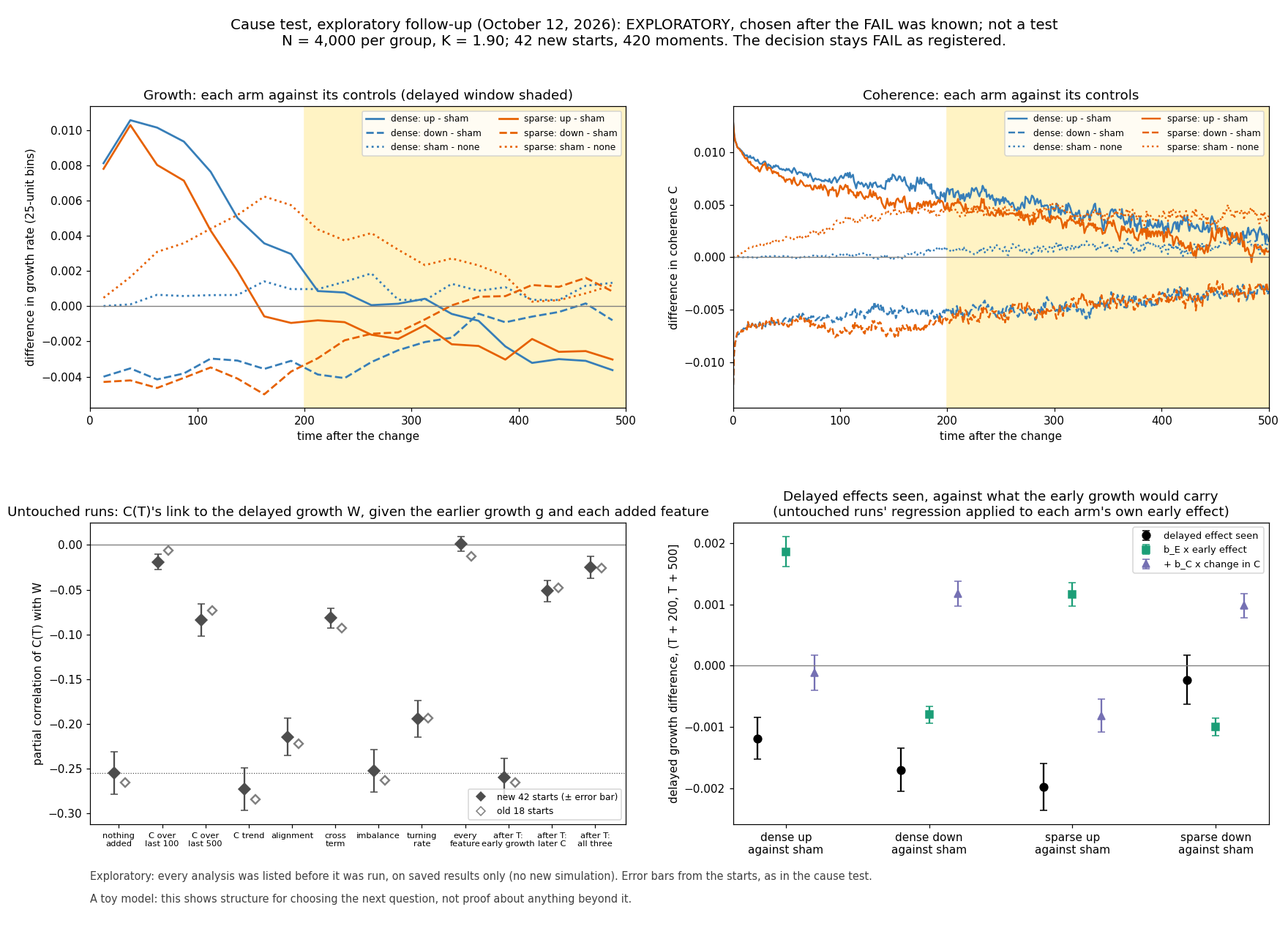
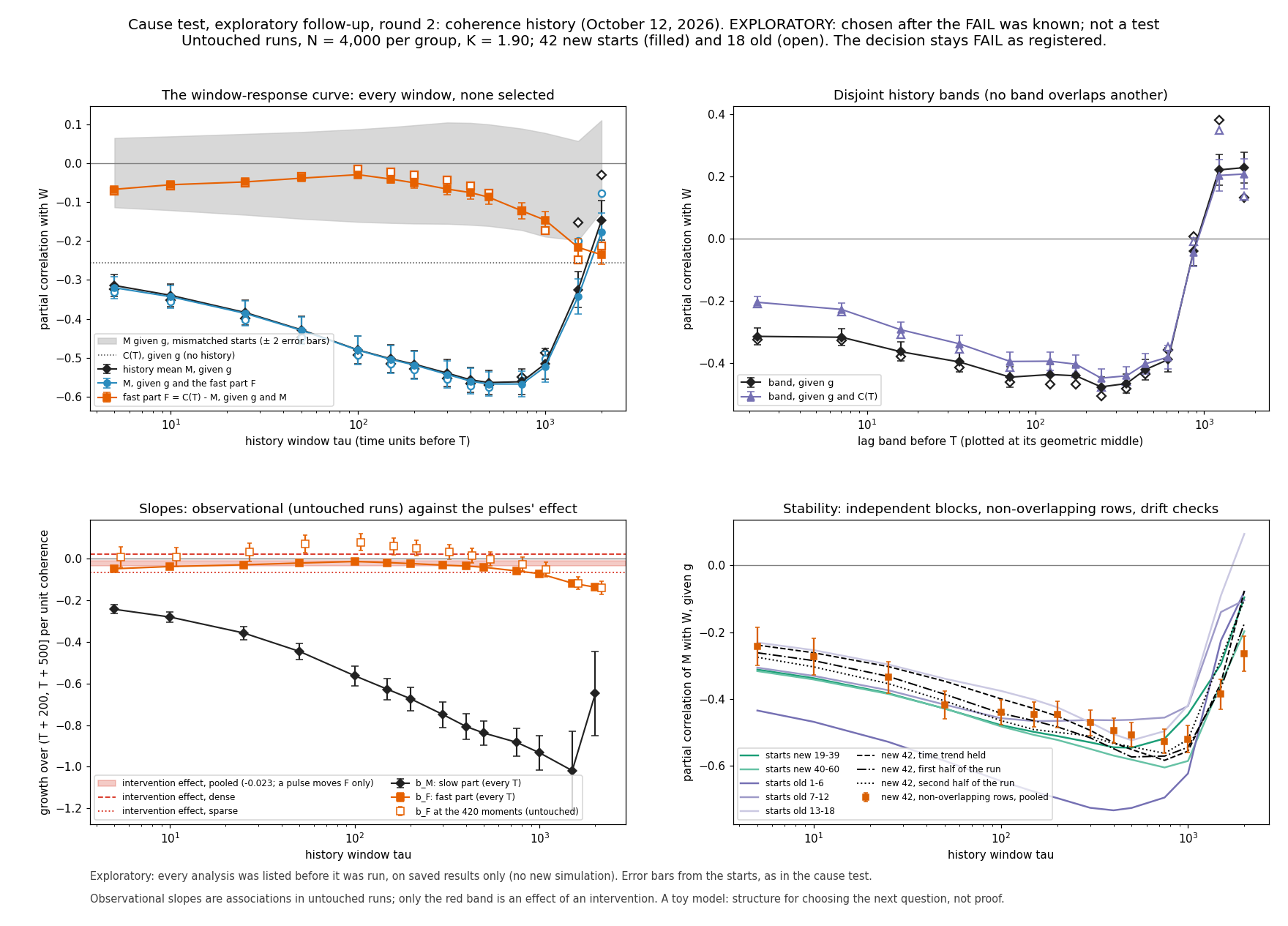
Part 6. The medium test: change the medium, not the state (October 14)
cancer-research/medium-test/ · 22 files · 453,122 bytes
- calibration_results.json · JSON record · 17,982 bytes · SHA-256 7a1c24f636a159d450c45b04d5285fe0ba129e51c123fc6ecc695bbb893ed7b9
- calibration_results.txt · Text report · 3,249 bytes · SHA-256 f0f9d1987ac35f1615e372dbfc65c1eafc6589157313954782429a0cc58f140f
- calibration_runlog.json · JSON record · 21,480 bytes · SHA-256 bf86887e88359dabfee277050dda39f303c586d1a4aba902a7d5971a0c13c913
- check1_timing.json · JSON record · 9,371 bytes · SHA-256 5904fc30aa91bae4b47bf74be5a2bafbc588179483f934f13a7e2528ece7c74b
- check1_timing.py · Python script · 15,615 bytes · SHA-256 25058732e40926e395c3cc1e9e6c4899c199769a0e26a7ba5104dd88471c5ca0
- check1_timing.txt · Text report · 5,793 bytes · SHA-256 d1f8ec4765b0b3fafeba1021dd0c8124626e87470b63303bfdd568410904a150
- check2_moments.json · JSON record · 3,656 bytes · SHA-256 7a9822aee5b34b886582cf021b99de65b04eca0b966866ae27e2c8a1b21fdce7
- check2_moments.py · Python script · 17,225 bytes · SHA-256 9a4e49f4a61e0186ddec3b90805268531bae644eccb58e97292bc008b04b388b
- check2_moments.txt · Text report · 4,156 bytes · SHA-256 86f4636801d98f1712cf7784573c72586d204ea052550c644455177cc65a0237
- check3_fluidity.json · JSON record · 12,728 bytes · SHA-256 d68270fecdf562dd71f3802b6133ff46218269350d3550ffa992507da38cd7fc
- check3_fluidity.py · Python script · 30,448 bytes · SHA-256 0d919eb7f95d9ac66be63e9038b64c476d6aec8275b1baab9d16ad2cf32f1601
- check3_fluidity.txt · Text report · 7,295 bytes · SHA-256 cb06669be09762714278c5973bab58b1f4531df3c69c3b7d4ed6254cc5966083
- checks.txt · Text report · 2,354 bytes · SHA-256 86aba85584385de6ffa4f0d210ea2e610af4898a6291cf60f328de0f0e0baf0c
- medium_freeze.json · JSON record · 21,671 bytes · SHA-256 84bbcf36552a224c2a61f99f8188fcc913fcc3039f642497e0c1cb03feb5fa20
- medium_test.py · Python script · 75,190 bytes · SHA-256 6b75b7801692298dff0000f1e5fbebdae18285a8b1fedce8805f616e286b793e
- pilot_preflight.txt · Text report · 1,662 bytes · SHA-256 c7aff2005e3e4435372d1f32b53867bf8250ffaad27a605c189a1273f0410258
- pilot_results.json · JSON record · 29,974 bytes · SHA-256 815143812c559fa744237909b0e2209e9ffb066e5ea7887376ce7f051a48af31
- pilot_results.txt · Text report · 7,459 bytes · SHA-256 8cc107ee45ff8ca9e8ff0c0b554272922344c35a46917f140fc06375043d242f
- pilot_review.md · Markdown note · 20,376 bytes · SHA-256 16445a8a5ff8c9c57de76089d0cd13efbd3d124b02be6362bf2e108f7fcdb401
- pilot_runlog.json · JSON record · 102,938 bytes · SHA-256 db52067d64efc47ea06b57ad7ba3c7b2f515deb6b5e3f5455a5ea3b7a61877b0
- plan-draft-1.md · Markdown note · 13,056 bytes · SHA-256 ef77ff91c95250640e818739c6faeafca7ae1722cdfeb9e716bd04a434ffd4a3
- plan.md · Markdown note · 29,444 bytes · SHA-256 b2592cfea01be207022145da51d78b48c9f30dc1ff5dc53c0ae86026abe7f427
Part 7. The Fluidity Replication (October 14): both hypotheses PASS
cancer-research/medium-test/fluidity-replication/ · 11 files · 502,299 bytes
- checks.json · JSON record · 7,236 bytes · SHA-256 895b65f92596ab9cf6baf32b4a6077dd1330e9ddd0a7f8c72c2729b98b4b7672
- checks.txt · Text report · 3,491 bytes · SHA-256 21689443e9e0ddea567ac4d3cb9ac5db2ef2cfbf15f6599331bf42463037ee2d
- plan-draft-1.md · Markdown note · 27,332 bytes · SHA-256 21a716c43adb17a89461c07bc2155c7f71e3c5651b7c950078e87c4b120bc8d1
- plan.md · Markdown note · 38,896 bytes · SHA-256 50aaebfbb4492f455744be7eb7ce2cced685198fc38b0ed4746eb534749d2d23
- replication.py · Python script · 88,508 bytes · SHA-256 499f5648a6aeed7282fc71918b16d543b92c6e1d29c6d7f5d5e9c0473f70dee3
- replication_go.json · JSON record · 1,293 bytes · SHA-256 f7b15a4ef714048bf94e216a710d70540f71592c24be9a70e5f9b20dca1233c0
- replication_lock.json · JSON record · 12,552 bytes · SHA-256 b976bc189e3e23bfbf17a8c62c8c4f046f0a36af75ee8f135ab94c7bd36cbf77
- replication_results.json · JSON record · 69,706 bytes · SHA-256 23499aef4da8d63fddcd7547eef7dd0e209ba54f7678448acbd43b5dc7d4e528
- replication_results.txt · Text report · 11,217 bytes · SHA-256 c2010f4bf3a344e16647360fe6a14e28fdfcec292e9847ddd27fbf8a9551c4ea
- replication_review.md · Markdown note · 7,676 bytes · SHA-256 9f121d403ee29353b86faab83d69aacd0ae6d19a4cf447720b59230ff3ddbbf2
- replication_runlog.json · JSON record · 234,392 bytes · SHA-256 46da6efdbb4e55e4ffa7db139187aa310411bcf190cb508f75f8cf61ba008f8c
Part 12. The scattering side: narrowing the spread against raising the pull (late October 14 to October 15)
cancer-research/scattering-side/ · 33 files · 1,176,373 bytes
- amendment-2026-10-15.md · Markdown note · 13,779 bytes · SHA-256 d1edbec186079043706fa6ee63b756de4e7c1e52f011b06d491fd379335f1c75
- checks.json · JSON record · 33,585 bytes · SHA-256 c1d47b86cbc77a9807b1cee725c2da92cadee0f19dccd7c8253c67fe765e0e0f
- checks.txt · Text report · 9,087 bytes · SHA-256 805d6950f527068ece7649546a39c7ff75bf6ba8c207693f46ff48fe0b3edf2f
- lock.json · JSON record · 9,109 bytes · SHA-256 3c7f70973247a327067a1817766b0dae3e0d72154f1de7785df7213ff271b23d
- pilot_checks.json · JSON record · 51,087 bytes · SHA-256 c386a98f0926836cd9b06602c6802be62e3f034aa421ca16d0ac4bf2ba05220e
- pilot_checks.txt · Text report · 14,171 bytes · SHA-256 cbca34c2f76d043c76f9d59683dc16389d99b994004b9d486a1c958f4502c142
- pilot_go.json · JSON record · 2,524 bytes · SHA-256 d55c9c0a825ac00b02b357656e408e79aa862d296f39dd42a3f0e646708e51d5
- pilot_lock.json · JSON record · 17,247 bytes · SHA-256 a434b2af2f4e64e02aef069ef945570b64e2278ae8ab318abd65fc8d625ae9f2
- pilot_results.json · JSON record · 23,236 bytes · SHA-256 31b1dd50a177e986b1e41f1780a20228dc0d76d8ce783e3428162df7ab6ac382
- pilot_results.txt · Text report · 8,152 bytes · SHA-256 30e1c817135af3dfe11fea17a8de972b7e7dc03b0c181c85960524edffcb4c6c
- pilot_runlog.json · JSON record · 95,635 bytes · SHA-256 e1cded6d732b0b4d5dc22703c9b3f548f38947963d38339aff5e70923fd9faae
- plan-draft-1.md · Markdown note · 13,964 bytes · SHA-256 2a5e133ec67c17a9e7503c2ca12e6f9e7351805afc31f8cc8e04764df852938f
- plan-final.md · Markdown note · 34,800 bytes · SHA-256 0e3f8f114ed44eade7e211317217f23e27c1075008e561c2b07ea11645823121
- plan.md · Markdown note · 21,167 bytes · SHA-256 a0ec465c6fa4332bc74fecdb424bd5e2d237f4dbdfa52212eff353cdfc16331f
- replication-plan-draft-1.md · Markdown note · 25,441 bytes · SHA-256 9b196e3075903b50be8c88f2ee1d1ef793eb09a2959250d61cf30da16289a2c9
- replication-plan-final.md · Markdown note · 30,999 bytes · SHA-256 fedc7c0f1852215751dadb430f4b8efe45de5ae1cd0c7623326ee1e987b6ce5d
- replication_after.json · JSON record · 2,639 bytes · SHA-256 e6b8fa589adbb9211ea9d4a023768259a5f14cdf42469a693c89580251a47c1e
- replication_after.txt · Text report · 1,875 bytes · SHA-256 6bd94768269812c6fb1a4c5abf70dabdf7a5d3a5240ac99871a76cd1652a25e9
- replication_checks.json · JSON record · 57,333 bytes · SHA-256 e11a782844283f33e9ffda64931893010b45829880f3cda403db6976a6ed0b7c
- replication_checks.txt · Text report · 19,125 bytes · SHA-256 68e6760d70f11904fcc015e4f0c380122f305b08cc143f6fb6d8ad0df950651e
- replication_go.json · JSON record · 3,934 bytes · SHA-256 5b8de44bf27cdc7c21b3a88020494b8ad8eca90f551bc189bea782f014e44363
- replication_lock.json · JSON record · 22,745 bytes · SHA-256 cb258ac222057ee53876e246b34f9d5d5900c2be1de52127db8f2f5b6bdbac72
- replication_results.json · JSON record · 30,330 bytes · SHA-256 ee977a6e2f592971c260203c6b615a9085f58c1f63aacf055e8504feaaa7e0d6
- replication_results.txt · Text report · 13,094 bytes · SHA-256 04fbeb58219e181f19fb11c89a572b505c3ba0492eb3d0110d629e30bd009fbc
- replication_runlog.json · JSON record · 256,136 bytes · SHA-256 f0c46499cc8860373d2adc9666e9bc73cfb5a437fc856c562cc46ca9bb0af11f
- scattering_pilot.py · Python script · 65,849 bytes · SHA-256 1d4acb826160fdd48e06d9ff8a6eb23f596650e2c75bdc89cf5e19ab38f5e54c
- scattering_replication.py · Python script · 77,388 bytes · SHA-256 4626b0545f1041888adaa8a1f32ca0eccf0a8104f0958106ddc68bc7dc11e41a
- scattering_side.py · Python script · 65,247 bytes · SHA-256 2a20b872d594a53b50f7b124e700c58e0e4efe12377324ac17105818f9e94634
- theory_numbers.py · Python script · 7,315 bytes · SHA-256 b7b2064dcaa4e12d9a9b36c4ad6db38d604c2c066d5c0d94fac17682f4b4417a
- theory_numbers.txt · Text report · 4,845 bytes · SHA-256 c49dec44456beba1ca7ebe4e6e17a8885dc5eadc310366a1cc3197d0623ce85b
- window_check.json · JSON record · 124,241 bytes · SHA-256 888124cd81c63a9071ee1df947ba0c2d201a26d4e9feed1644ce771a9f9dfbca
- window_check.txt · Text report · 7,176 bytes · SHA-256 e8505cdbba43e97f8f6ca13f050185078c6955f00ffd26f580ce1cf63acaa02d
- window_check_runlog.json · JSON record · 13,118 bytes · SHA-256 7cc4cea8ea59046b9efff9fe6e5da2f9fee2442a741ba4520334484e8d80f0d0
Rebuild guide
2 files · 35,857 bytes · each with its SHA-256 fingerprint
Published with this edition; not one of the 138 records. A guide, written on October 16, 2026, to rebuilding from public files the three raw-run archives that the records don't include, with its helper script. It states which arrays its tests reproduced exactly, which differed and why, and which full rebuilds were not run.
- rebuilding-the-raw-run-archives-v1.md · Markdown guide · 15,592 bytes · SHA-256 d3c8edd8203c9f40458cca4667b6418d0de834bb38f24b9eaf0271a6f6cec121
- rebuild_archives.py · Python script · 20,265 bytes · SHA-256 cd61f319a03e3dd9048791e38230accff962e7c623c8a1a6a0afe604f68b1e61